
Telecommunications Company Near Me: A Business Guide
You searched telecommunications company near me because something is already hurting operations. Maybe your contract is expiring. Maybe the office move is blocked by circuit lead times. Maybe your warehouse team keeps losing calls and blaming the carrier when the underlying issue is old cabling in the building.
Most businesses start this process the wrong way. They compare advertised speeds, ask for a quote, and assume the project ends when the new service goes live. In practice, a telecom change is an infrastructure project with procurement, facilities, IT, and cleanup work tied together.
Beyond the Search Bar Finding the Right Telecom Partner
A frustrated facilities or operations manager usually lands on the same search results. Big promises. Generic coverage maps. Residential-style pricing pages. Not much that helps you evaluate a provider for a multi-suite office, a managed property, or a warehouse with cameras, access control, and VoIP riding on the same network.
That gap is real. Existing content on telecom providers overwhelmingly focuses on residential speeds and poorly addresses business needs like space reclamation projects, and 65% of U.S. businesses delay office relocations due to telecom infrastructure overhauls according to Totelcom’s discussion of telecom planning gaps.
What most searches miss
If you're managing a business site, the right question isn't just, “Who services this address?”
It’s closer to this:
- Can this provider support our actual operations: phones, cloud apps, guest WiFi, cameras, scanners, and remote access?
- Will their install team coordinate with building constraints: risers, conduits, demarc location, after-hours access, and landlord approvals?
- What happens to the old equipment: desk phones, patch panels, routers, WAPs, camera gear, and obsolete cabling?
That last question gets ignored all the time. It shouldn't.
A telecom upgrade that leaves a closet full of dead hardware isn't finished. It's just incomplete project management.
Businesses that handle this well tend to treat provider selection, cutover, and decommissioning as one job. That mindset matters even before you request quotes, especially if your team is also planning a relocation, a suite refresh, or a larger cleanout. If you want a sense of how commercial cleanout projects are typically handled in Atlanta, Fulton Junk Removal’s company background gives useful context on the operational side.
Define Your Technical and Operational Needs First
Before you speak with a sales rep, write your own requirements. If you don't, the provider will write them for you, and those requirements will usually favor the most expensive package they can sell.
A good telecom buying process starts with a plain-language inventory of the business. Count the people, devices, locations, and workflows that rely on connectivity. Separate what is mission-critical from what is merely convenient.

Start with business use, not bandwidth marketing
Ask four practical questions:
What breaks if the connection drops?
Phones, POS systems, shipping stations, tenant systems, cameras, and cloud file access don't all carry the same risk.Which applications are sensitive to delay or instability?
VoIP, video meetings, cloud desktops, and remote support tools care about consistency more than headline download speed.What will change in the next few years?
New headcount, more cameras, additional suites, an ERP rollout, or a warehouse expansion can make a cheap contract expensive fast.Who owns the internal network work?
The carrier might deliver service to the building, but your team still has to deal with closets, switches, patching, and endpoint readiness.
If voice is part of the project, it helps to review a separate resource on managing customer communications so your telecom decision lines up with call handling, routing, and service expectations.
Audit the inside plant
A new fiber handoff won't fix bad copper in the walls. For structured cabling, standards like TIA/EIA-568-B matter, and Category 6A supports 10 Gbps. Poor installation details also matter. An improper bend radius can cause up to 25% signal attenuation, which is enough to make a premium service feel unreliable inside the building, as outlined in this structured cabling reference from Lee Company.
Use a pre-provider checklist like this:
- Cabling condition: Identify whether runs are Cat5e, Cat6, or Cat6A, and note damaged jackets, messy terminations, or unlabeled patch panels.
- Closet readiness: Check power, cooling, rack space, grounding, and whether your demarc area is accessible.
- Device load: List phones, WAPs, cameras, printers, scanners, access control panels, and workstations.
- Power over Ethernet needs: Cameras and newer wireless gear may need more power than older switches can provide.
- Growth assumptions: Leave room for future drops and spare switch ports.
For Atlanta-area businesses planning a broader office, retail, or warehouse transition, it also helps to look at commercial cleanout and removal services early so the telecom work doesn’t get separated from the physical turnover.
Practical rule: If a provider asks about speed before asking about your applications, failover needs, and building wiring, you're still in a sales conversation, not a design conversation.
How to Research Local Provider Coverage and Reputation
Provider research gets better when you stop treating the carrier website as the truth. Coverage tools are useful for a first pass, but commercial serviceability often depends on building access, existing fiber routes, landlord restrictions, and whether the provider has already lit that property.
Start local. The businesses next to you usually know more than the provider’s landing page.

What to ask neighboring businesses
Call or visit businesses in your building, office park, or industrial area. Ask specific questions, not “Do you like them?”
A better list:
- Install experience: Was construction simple, or did permits, access, or landlord approvals drag it out?
- Outage behavior: When service failed, did support own the problem quickly or bounce the ticket around?
- Billing clarity: Were fees and add-ons explained up front?
- Account management: Is there a named business rep who answers, or does every issue start from scratch?
- Real fit: Are they using the service for work similar to yours, or is their operation much simpler?
Look for patterns, not perfect reviews
Consumer review sites can be noisy. For business telecom, you care less about one angry post and more about repeated themes. One provider may install cleanly but handle support poorly. Another may be slower to schedule but stable once live.
Use a simple comparison table as you collect feedback.
| Decision area | What good looks like | Warning sign |
|---|---|---|
| Availability | Provider confirms exact address and suite details | Vague “service should be available” language |
| Installation | Clear site walk, demarc review, and timeline | Quote arrives without anyone reviewing the building |
| Support | Defined escalation path | Generic call center only |
| Contract | Clear term, fees, and responsibilities | Verbal promises that don’t appear in writing |
A local search should also include practical logistics. If your business footprint covers multiple facilities or nearby turnover projects, checking Atlanta-area service coverage for related vendors can help align telecom work with property operations.
Ask one question every provider rep hates and every good rep can answer: “Who handles the problem when the circuit is live, but performance inside the building is still bad?”
That answer tells you whether they understand the difference between carrier delivery and end-to-end business usability.
Comparing Service Level Agreements and Support Models
Monthly recurring cost gets too much attention. Key value usually sits in the Service Level Agreement, the escalation path, and who picks up the phone when something breaks.
That matters most for sites where revenue, safety, or tenant operations depend on stable connectivity. A cheap plan with vague support can become the most expensive option you buy.
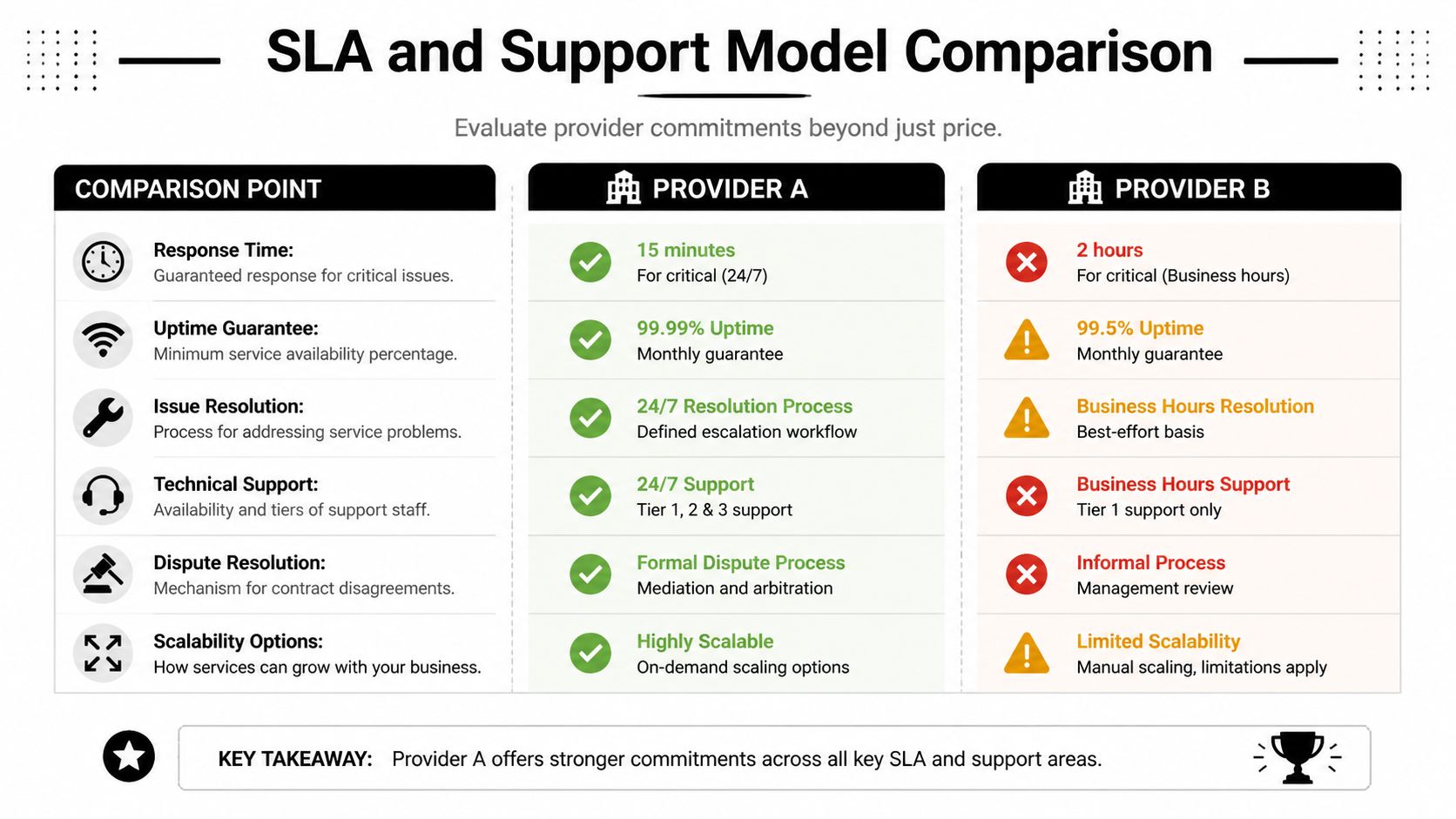
What to read line by line
Ask for the full SLA document, not a summary slide. Then check these items:
- Uptime commitment: Is the service best-effort broadband or a contractually defined business service?
- Response times: What qualifies as critical, and how fast must they respond?
- Restoration target: Response is not the same as resolution.
- Credit structure: If they miss the SLA, what happens automatically and what requires a dispute?
- Maintenance windows: When can they touch the network without triggering a breach?
- Escalation model: Account manager, NOC access, field dispatch, and after-hours support all matter.
When dedicated service is worth it
For critical operations, MEF-certified Point-to-Point Ethernet can offer 99.999% availability with less than 50ms protection switching, according to this Point-to-Point Ethernet overview from Lightyear. That kind of service isn't necessary for every office, but it can make sense for facilities running time-sensitive voice, inter-site traffic, production systems, or tenant-critical infrastructure.
Here’s the trade-off in plain terms:
| Option | Works well for | Main compromise |
|---|---|---|
| Business broadband | General office use, lower sensitivity workloads | Less predictable performance and weaker guarantees |
| Dedicated Ethernet or P2P | Multi-site traffic, critical voice, uptime-sensitive operations | Higher cost and more planning |
A lot of teams buy the wrong class of service because they compare the invoice instead of the business consequence of downtime.
Better support isn't a luxury line item. It's part of the service you’re buying.
Questions that expose weak offers
Use negotiation questions that force specifics:
“Who owns the install from site survey through turn-up?”
If responsibility is blurry, expect delays.“What’s excluded from your SLA?”
Exclusions often matter more than guarantees.“Can you provide the escalation path in writing?”
If they can't, the path probably depends on who answers that day.“What changes after the introductory term?”
Providers may compete hard on year one and recover margin later.
If you regularly manage facilities, turnovers, or operational upgrades, reading a few commercial cleanout articles and field notes can help you pressure-test telecom quotes against the broader project reality. The carrier contract is only one moving piece.
Planning Your Equipment Decommission and Cleanout
After the cutover, the old telecom pile shows up fast. Legacy routers, unmanaged switches, racks, patch cords, desk phones, WiFi gear, access points, cameras, UPS units, and mystery boxes from three IT managers ago all end up in one room.
That material is easy to ignore because the new circuit is live and everyone wants to move on. But ignoring it creates security, housekeeping, sustainability, and compliance problems.
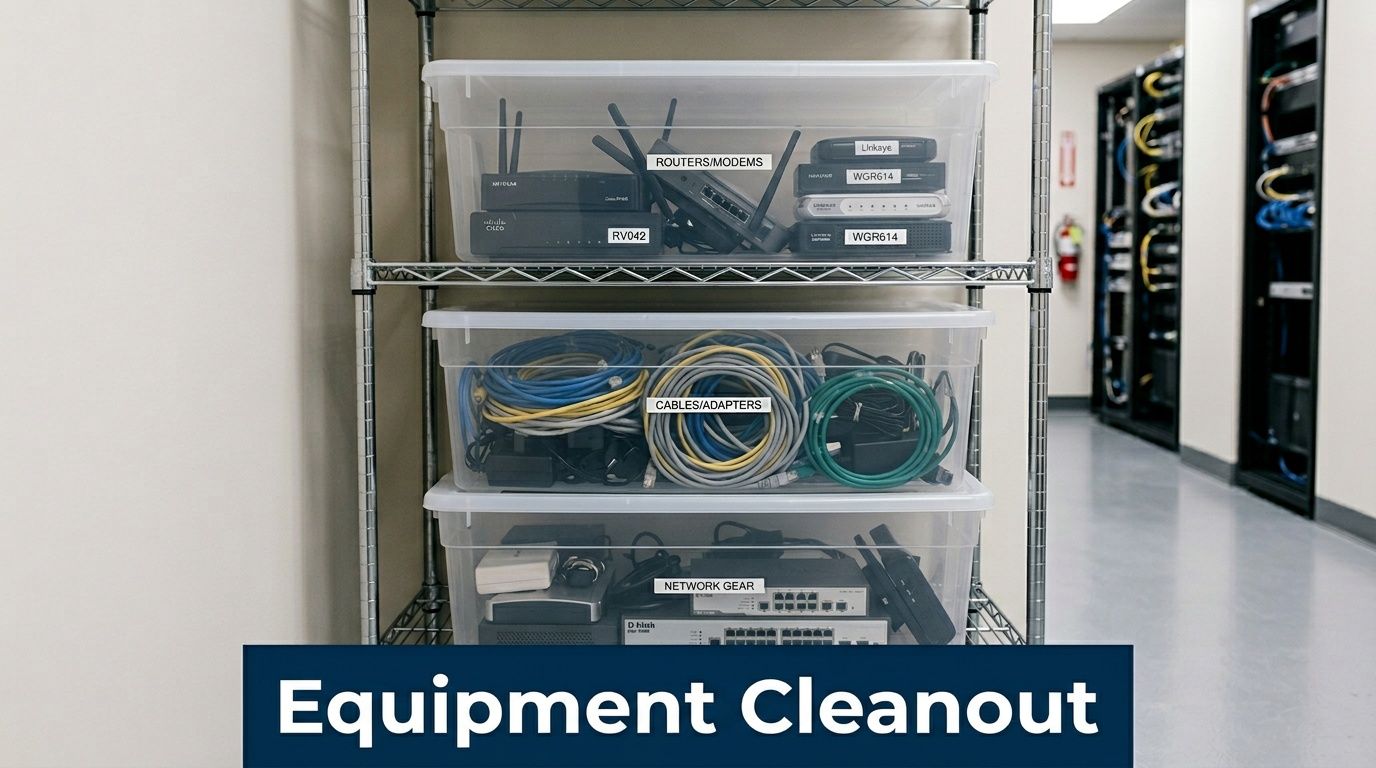
Why the cleanup deserves its own plan
An often-ignored aspect of telecom upgrades is the e-waste left behind. A Gartner trend report notes that 40% of small and medium-sized businesses prioritize low-downtime cleanouts over faster internet speeds, yet few resources help them combine telecom changes with responsible removal and recycling, as summarized in this telecom cleanup discussion at CenturyLink.
That tracks with what operators see in the field. Businesses don't want a perfect new service if the migration leaves a telecom closet unusable for weeks.
What should happen before removal day
Treat decommissioning like a controlled handoff, not an afterthought.
- Separate active from retired gear: Label what stays, what gets returned to the provider, and what is approved for disposal.
- Confirm data handling: Storage-capable devices, firewalls, and some multifunction equipment need review before release.
- Document ownership: Some equipment belongs to the carrier, some to the landlord, some to your business.
- Bundle the work: If you're also clearing offices, storage rooms, or warehouse space, combine those scopes under one schedule.
- Ask for recycling documentation: Sustainability and EHS teams often need records, not just a pickup confirmation.
The fastest telecom migration is often the one that pairs cutover, equipment pull, and cleanout in the same operational window.
A responsible cleanout partner can remove the burden from your internal team. That matters for offices, warehouses, and property managers who need the space back quickly and want electronics handled through proper recycling channels instead of mixed disposal.
Your Provider Vetting Checklist and Phone Script
Once you've narrowed the field, use the same questions with every carrier. Consistency matters. It keeps the slickest sales rep from controlling the conversation.
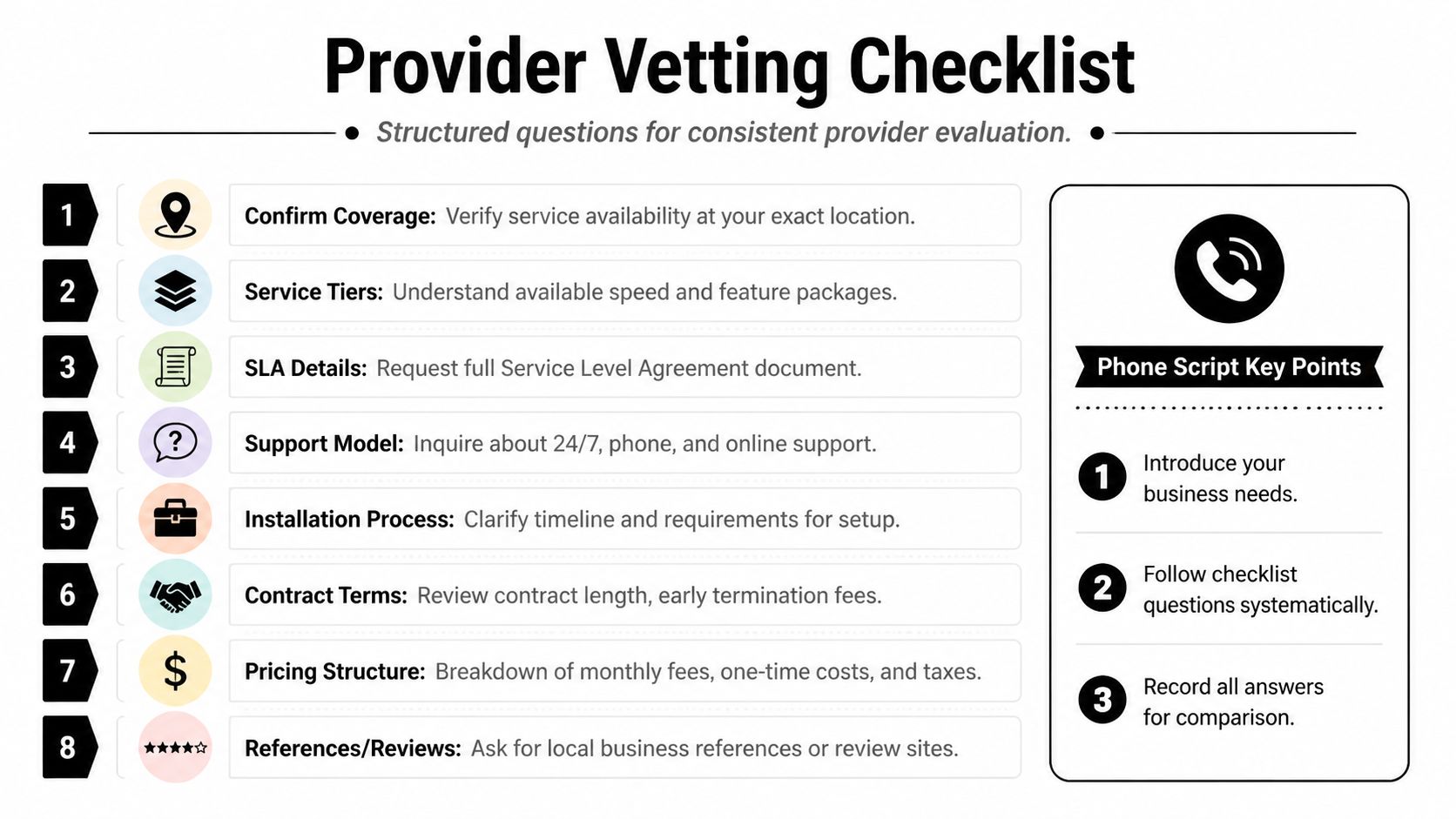
Provider checklist
- Exact address check: Confirm serviceability by suite, floor, or warehouse bay.
- Install scope review: Ask whether a site walk is required before final pricing.
- SLA request: Get the complete document, not a summary.
- Support path: Ask who answers after hours and how escalation works.
- Internal wiring assumptions: Confirm what they deliver and what your team must handle.
- Contract review: Check term length, renewal language, and hardware return obligations.
- Cutover planning: Ask how they reduce disruption during migration.
- Decommission expectations: Confirm what old provider gear must be returned and by when.
If you're also reviewing cloud calling options, this guide to choosing business VoIP is a useful companion because it helps separate phone-system decisions from pure connectivity decisions.
Simple phone script
Use this on first calls:
“We’re evaluating a business telecom provider for our location. We need you to confirm exact coverage, installation requirements, support model, SLA terms, and what responsibilities remain on our side inside the building. We’re comparing providers side by side, so please send those details in writing.”
Then ask one final question:
“What usually surprises customers during installation or turnover at a site like ours?”
Good reps answer directly. Weak ones go vague.
When you're ready to line up the physical side of the project, including old telecom gear, office cleanout items, and recyclable electronics, you can contact Fulton Junk Removal to coordinate a commercial pickup plan built around your schedule.
If your telecom upgrade also means old phones, switches, cabling, racks, or general office clutter need to go, Fulton Junk Removal can help you finish the job cleanly. For Atlanta-area offices, warehouses, and property teams, Fulton handles haul-away while Beyond Surplus supports responsible recycling of electronics, metals, and reusable materials. That makes it easier to clear space fast, keep useful material out of the landfill, and simplify documentation for compliance and sustainability reporting.
