
Telecommunications Services Dallas: A Business Guide
Your team is adding cloud apps, your phones now ride on internet service, and one bad circuit can freeze sales, support, and operations at the same time. That’s usually when Dallas business owners start searching for telecommunications services Dallas and realize the market is crowded with options that sound similar but behave very differently.
The good news is that Dallas gives you an unusually strong starting point. The local market isn’t just large. It’s deep, competitive, and built for businesses that depend on reliable connectivity every day.
Navigating Telecommunications Services in Dallas
If you run a business in Dallas, connectivity isn’t a background utility anymore. It affects how fast your staff can work, how clearly calls come through, how stable your cloud software feels, and how much downtime hurts when something breaks.
That matters even more here because Dallas has the kind of telecom ecosystem many cities would like to have. In 2017, 8% of the Dallas-Fort Worth metro area's workforce was employed in the IT and telecommunications industry cluster, and the region hosts over 864 privately owned telecom companies, according to One America Works on Dallas telecom sector growth. When a market has that much telecom concentration, businesses usually get more provider options, more network paths, and better odds of finding a service that fits the way they operate.

Why this decision reaches beyond IT
A lot of owners treat internet and voice service like a simple price comparison. That’s where costly mistakes happen. The cheapest line on a quote might be fine for a tiny office with light usage, but it can become a bottleneck once you add video meetings, offsite backups, security cameras, cloud ERP, or a second location.
Think of telecom like the road system around your business. If your company depends on one narrow side street, deliveries, visitors, and staff all get stuck together. If you choose the right mix of circuits, failover, and voice tools, traffic keeps moving even when one route has a problem.
Practical rule: Buy telecom based on operational risk, not just monthly cost.
What Dallas businesses usually need to sort out
Most confusion starts with a few practical questions:
- Do you need internet, private networking, business phones, or all three?
- Do you have one site or several across DFW?
- Can your team tolerate outages, call quality issues, or slow cloud access?
- Is fast install more important than maximum performance?
Those trade-offs shape the right answer. A law office, warehouse, clinic, retailer, and multifamily property may all sit in Dallas, but they won’t buy the same service mix.
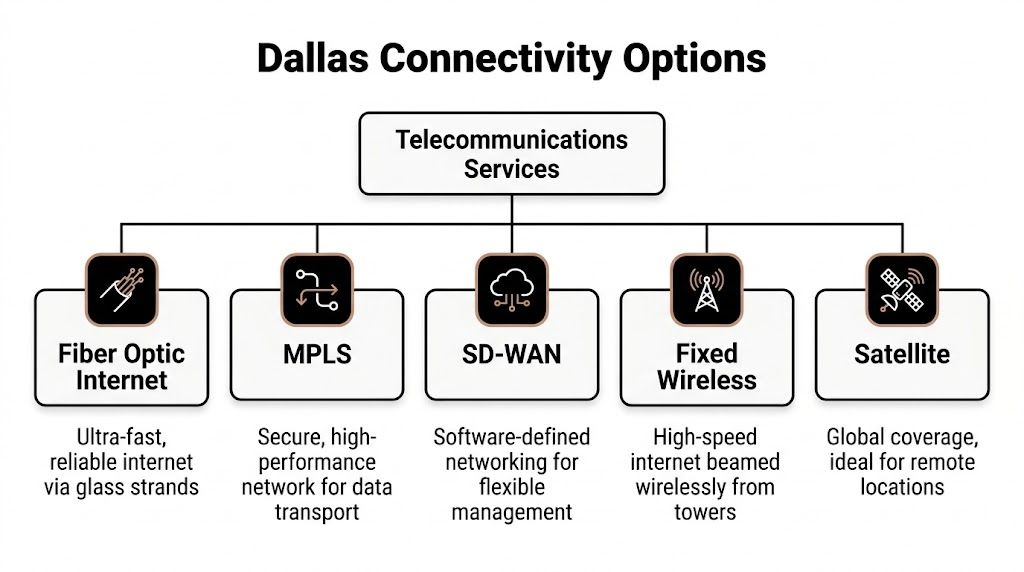
Decoding Your Dallas Connectivity Options
The names can sound technical, but the core services are easier to understand if you treat them like transportation options. Some are built for speed, some for control, and some for flexibility when wired service isn’t ideal.
Fiber optic internet
Fiber is the high-capacity freeway of business connectivity. It carries data over strands of glass using light, which is why providers use it for high-performance service.
For a Dallas business, fiber is often the best fit when you rely on cloud software, heavy file transfers, video calls, hosted phones, or many users working at once. It usually delivers the most stable experience for modern offices because it handles simultaneous traffic well.
Where owners get confused is this point: not all fiber offerings are the same. Some are shared broadband services, while others are dedicated circuits built for business performance and contractual support. On paper they may both say “fiber,” but the support model and consistency can feel very different.
MPLS
MPLS is like a private express lane for your business traffic. Instead of sending everything across the open public internet, it gives your company a more controlled path between sites.
That’s useful when you have multiple offices and want predictable performance for sensitive applications such as voice, payment systems, or internal business software. It’s also common in organizations that value strict traffic separation and established network design standards.
MPLS isn’t always the cheapest or most flexible option. But when a company says, “I care less about novelty and more about stable, controlled connectivity between locations,” MPLS is still part of the conversation.
If your applications are sensitive to delay and inconsistency, a private path can be more valuable than raw advertised speed.
SD-WAN
SD-WAN is the smart traffic controller. It can use multiple connections, then steer traffic based on what each application needs.
For example, your video calls might use the cleanest path, general web traffic might use a lower-cost line, and a backup circuit can take over if the primary service fails. That’s why many multi-site businesses prefer SD-WAN. It helps them mix performance with cost control instead of buying the most expensive circuit at every location.
People often mix up SD-WAN and internet access. They’re not the same thing. Internet service is the road. SD-WAN is the system deciding which road each type of traffic should use.
Fixed wireless
Fixed wireless sends connectivity from a nearby tower or radio point to your building. It’s not mobile phone service. It’s a business internet option that avoids trenching or waiting for new cabling when wired availability is limited or installation would take too long.
This can work well for temporary sites, warehouses, construction offices, and businesses that need service up quickly. It’s also useful as a backup path because it doesn’t depend on the same physical cable route as your wired primary connection.
The trade-off is environmental and line-of-sight sensitivity. In the right location it can be a strong business tool. In the wrong location it may be better as secondary service than primary.
Satellite
Satellite is the broadest-coverage option and the least location-dependent in terms of terrestrial infrastructure. If your operation has remote coverage needs outside typical wired footprints, satellite can fill an important gap.
In mainstream Dallas commercial properties, though, satellite usually isn’t the first choice when fiber, cable, or fixed wireless are available. Latency-sensitive workloads such as live voice and interactive cloud applications often push businesses toward terrestrial options first.
Voice still matters
Many companies now treat phone service as software rather than a separate “phone line” purchase. VoIP, or voice over internet protocol, turns your business calling into an internet-based application with features like call routing, auto attendants, softphones, and remote-user flexibility.
If you’re comparing local phone platforms, this guide to compare DFW business VoIP services is useful because it frames the choice around business use rather than consumer calling habits.
A simple way to sort the choices
- Choose fiber when performance and consistency matter most.
- Choose MPLS when private, controlled site-to-site traffic is the priority.
- Choose SD-WAN when you want flexibility across multiple links or locations.
- Choose fixed wireless when speed to install or path diversity matters.
- Choose satellite when location limits your terrestrial options.
Choosing the Right Service for Your Business Model
The first mistake I see is buying business connectivity like it’s home internet. Residential service is designed for general use. Business service is built around uptime, support responsiveness, traffic consistency, and compatibility with operational systems.
A home user mostly wants streaming, browsing, and basic calls to work. A business may need stable point-of-sale traffic, cloud app responsiveness, phone quality, VPN access, guest Wi-Fi separation, security systems, and support that answers before operations stall.
Business-grade vs residential-grade
Three differences matter most:
- Service commitment: Business services usually come with stronger support structure and clearer escalation paths.
- Network features: Businesses may need static IPs, better router options, or managed equipment.
- Performance expectations: Offices care about upload as much as download because cloud work sends plenty of traffic upstream.
A business line should match the cost of downtime, not the cost of home entertainment.
Dallas Telecom Services Comparison
| Service | Best For | Typical Speeds | Key Advantage |
|---|---|---|---|
| Fiber optic internet | Offices, medical practices, firms using cloud platforms, call-heavy teams | Varies by provider and plan | High reliability and strong performance for modern business workloads |
| MPLS | Financial firms, healthcare groups, multi-site operations needing controlled traffic | Varies by provider and design | Private, predictable data transport between locations |
| SD-WAN | Retail groups, distributed offices, growing companies with mixed circuits | Depends on underlying connections | Centralized traffic control and flexible use of multiple links |
| Fixed wireless | Warehouses, temporary sites, backup connectivity, fast-turn deployments | Varies by signal path and provider | Faster deployment and path diversity from wired circuits |
| VoIP | Businesses that want modern phone features and remote-user flexibility | Depends on internet quality and call volume design | Scalable calling without legacy phone system limits |
Matching service to real business situations
A single-location professional office in Uptown or Downtown often does best with fiber plus hosted VoIP. The office needs stable video meetings, dependable calls, and responsive cloud apps. Simplicity matters as much as speed.
A multi-location retailer across DFW may lean toward SD-WAN with broadband or fiber at each store. Why? Because someone at headquarters can manage traffic policies centrally instead of troubleshooting every site as a separate island.
A financial or compliance-heavy firm may still prefer MPLS or dedicated fiber for key traffic. If client data, transactional systems, or internal application performance are tightly controlled, the more private design can justify the cost.
A warehouse or light industrial operation may prioritize install speed and coverage over perfect elegance. Fixed wireless can be a practical answer, especially as a temporary primary circuit or a backup to wired internet.
Questions that narrow the shortlist fast
Ask these before requesting quotes:
- How many people and devices share the connection daily?
- Which apps fail first when the network struggles?
- Do you need a second connection for failover?
- Are all your sites similar, or does each location need a different design?
- Will phones run over the same connection?
If you answer those truthfully, the “best” telecom service usually narrows to one or two realistic options very quickly.
Leveraging Dallas's World-Class Telecom Infrastructure
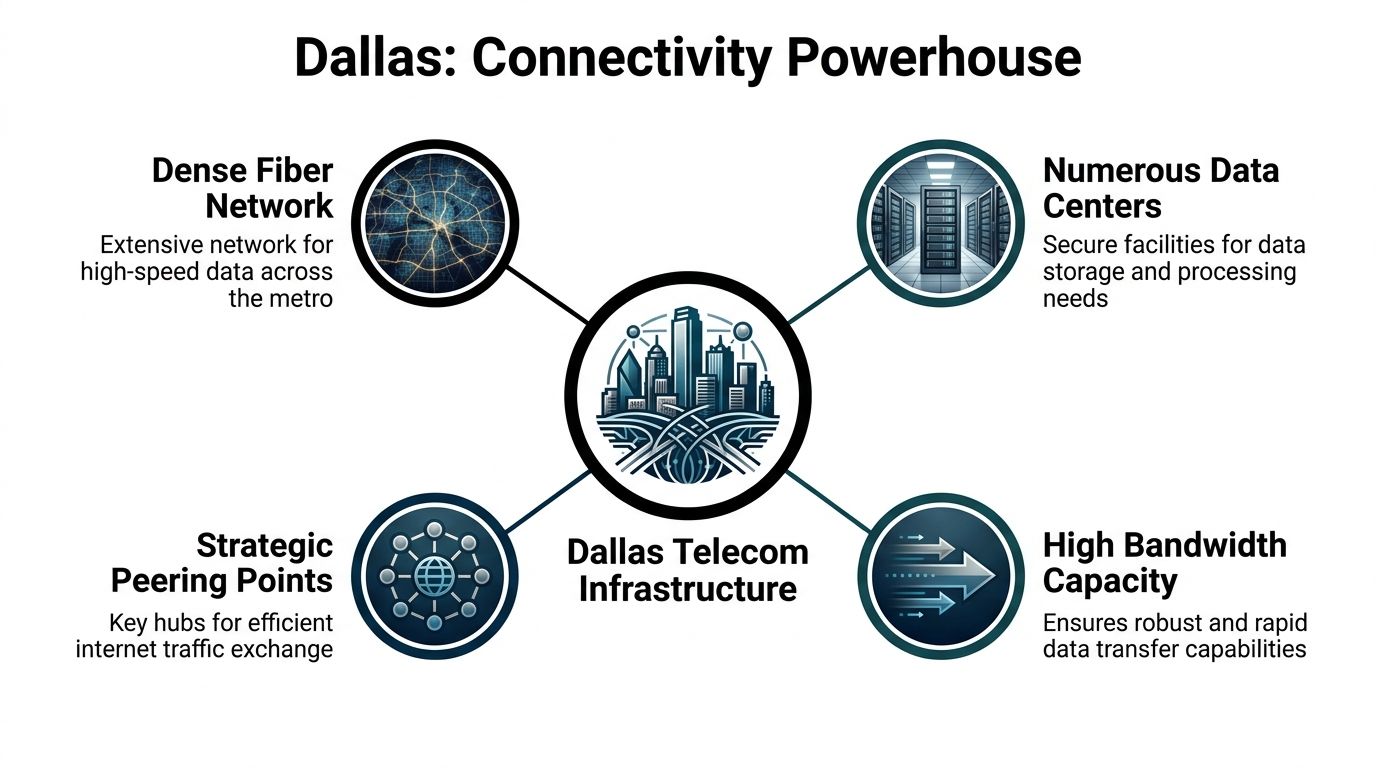
Dallas gives businesses an advantage that isn’t always obvious on a provider brochure. The city’s network environment is built around interconnection. That changes what you can buy, how resilient it can be, and how much bargaining power you may have during provider negotiations.
Why carrier density matters
Dallas is one of the most interconnected internet exchanges in the U.S., and facilities like the Infomart function as major data carrier hotels, according to DataBank's overview of Dallas connectivity and data center advantages. For a business owner, “carrier hotel” sounds abstract, but the practical meaning is simple: many networks meet in the same market, and that creates choice.
When multiple carriers operate in the same ecosystem, you’re less likely to be trapped with a single path or a single pricing model. That carrier diversity supports redundancy, competitive pricing, and high availability for mission-critical applications, as noted in the same DataBank article.
What that means on the ground
Here’s how this shows up in real buying decisions:
- More provider choice: If your building is well served, you may be able to compare several serious options instead of taking a single incumbent quote.
- Better failover design: Diverse carriers can reduce the risk that one cable issue takes down everything.
- Stronger negotiation position: Providers compete harder in dense, connected markets.
- Cleaner path for growth: If your company adds cloud workloads, voice seats, or new sites, the local market can usually support that expansion without a full redesign.
For owners of apartments, mixed-use properties, and managed communities, local telecom depth also affects resident and tenant experience. If that’s your world, this resource on property-wide Wi-Fi for Dallas MDU helps translate telecom infrastructure into practical building-wide service planning.
Local advantage: In Dallas, your building address can be as important as your budget. Two offices a few miles apart can have very different carrier access.
How to use the Dallas advantage during procurement
Don’t ask only, “What’s your monthly price?” Ask where the provider’s network is already strong. Ask whether your building is on-net, near-net, or dependent on construction. Ask whether the backup option follows a different route. Ask what happens if a local fiber cut affects your block.
Those questions matter more in a connected market because you often have alternatives. The Dallas business that understands local infrastructure tends to buy smarter than the one comparing internet packages as if they were interchangeable.
Understanding Costs and Service Guarantees
Telecom quotes often confuse buyers because providers use terms that sound financial, technical, and contractual all at once. You don’t need to be a network engineer to read them well, but you do need to know what each charge and promise means.

The two charges most quotes include
Most commercial telecom proposals break pricing into two buckets:
- MRC: Monthly recurring charges. This is the ongoing service fee.
- NRC: Non-recurring charges. This usually covers setup, installation, construction, or activation.
A low monthly price can hide a large upfront build cost. The reverse can also happen. A quote with a higher monthly rate may include installation concessions, managed equipment, or stronger support terms that make it the better deal over the contract period.
How to read an SLA without getting lost
The service level agreement, or SLA, is the part of the contract that tells you what the provider is willing to stand behind. Owners often skip this section and focus only on speed. That’s risky.
Look for these items:
Uptime commitment
This tells you how available the service is expected to be. Higher commitments matter most for businesses where downtime stops revenue or customer service.Latency
This is delay across the network. Lower latency usually helps voice, video, and interactive cloud apps feel more responsive.Jitter
Jitter measures variation in delay. Even if average speed looks fine, unstable timing can hurt call quality and video meetings.Packet loss
Lost data packets can create choppy voice, frozen screens, and failed sessions.Mean time to repair
This is the provider’s target for restoring service after a qualifying outage.
Don’t ask only, “How fast is it?” Ask, “What happens when it breaks, and how quickly do you fix it?”
What good looks like in plain language
A strong SLA is specific. It defines the measurement window, the response process, and what credits apply if the provider misses the target. A weak SLA uses broad language, leaves room for exceptions, or makes the credit process difficult to claim.
Also check who supports the service after installation. Some providers sell aggressively, then hand everything off to a generic support queue. Others give business customers local account support or a clear escalation path. When your phones and internet share the same link, support quality becomes part of the product.
Your Next Steps to Better Dallas Connectivity
Most businesses don’t need more telecom jargon. They need a clean buying process that reduces surprises. If you’re evaluating telecommunications services Dallas, use a shortlist method instead of collecting random quotes.
A practical checklist
- Map your real usage: List your cloud apps, phone setup, key devices, number of users, and any mission-critical systems.
- Rank what matters most: Decide whether your top priority is uptime, fast install, lower cost, private networking, or multi-site control.
- Check building serviceability: Confirm what carriers already serve your address and whether the building is on-net.
- Request side-by-side quotes: Ask each provider to separate monthly charges, one-time charges, contract term, equipment, and support scope.
- Inspect the SLA: Review uptime language, repair commitments, and escalation procedures before signing.
- Plan for failure: Ask what backup option makes sense if the primary circuit goes down.
- Test support early: The way a provider answers pre-sales questions often tells you how they’ll behave after the contract is signed.
The Dallas market rewards buyers who ask precise questions. If a provider can’t explain routing, redundancy, install conditions, and support ownership in plain language, keep looking.
Frequently Asked Questions About Dallas Telecom
How do I find out if my building is fiber-ready?
Ask providers for a serviceability check using your exact suite address, not just the building name. In Dallas, one floor or suite may be easier to serve than another. Also ask whether the location is already on-net or if construction is required.
How long does business internet installation usually take?
It depends on the service type, the building, and whether new construction is needed. Fixed wireless is often faster to deploy than a newly built fiber circuit. If your move-in date is tight, ask for both a standard install estimate and a backup option.
Should I bundle VoIP with internet service?
Sometimes yes, sometimes no. Bundling can simplify billing and support. Buying separately can give you more flexibility if you want one specialist for connectivity and another for phones. The better choice depends on whether you value single-vendor accountability or vendor independence.
Is a backup connection really necessary?
If your company loses money, calls, appointments, or transactions during outages, yes. Many Dallas businesses use a secondary path because one cut or one provider issue can affect an entire office.
What should I bring to a provider meeting?
Bring your current bill, your address, a rough user count, your phone system details, and a list of the apps your staff depends on most. That turns the conversation from generic selling into actual network design.
If you're clearing out an office, warehouse, retail space, or property before an IT refresh or telecom upgrade, Fulton Junk Removal is worth a look. They handle commercial cleanouts with an eco-conscious approach, and through Beyond Surplus they can help route electronics, metals, and other recyclable materials away from the landfill. For businesses that need junk removal plus responsible recycling, that can make move-outs, upgrades, and sustainability reporting much easier.
