
Telecom Services in Atlanta: A Commercial Guide
A lot of Atlanta companies don’t realize they have a telecom problem until operations start slipping. The warehouse can’t sync inventory fast enough. A field team loses access to dispatch tools. A property manager can’t get camera feeds back reliably from a secondary site. Finance sees one monthly circuit bill. Operations feels the outage.
That’s why telecom services in Atlanta shouldn’t be treated like a commodity purchase. For a commercial business, connectivity affects scheduling, tenant experience, cloud access, security controls, remote support, building systems, and disaster recovery. In many cases, it also affects compliance documentation and sustainability reporting.
Atlanta gives businesses a strong starting position. It’s one of the best-connected markets in the country, but that doesn’t mean every address gets the same result. The right service depends on building access, provider footprint, application needs, contract terms, and whether you’re buying internet, transport, voice, private infrastructure, or a mix of all of them.
The Strategic Importance of Telecom for Atlanta Businesses
A building goes live on Monday. By Wednesday, badge readers lag, VoIP calls clip, and the warehouse team starts using personal hotspots to keep orders moving. In Atlanta, that usually is not a citywide bandwidth problem. It is a business planning problem. The companies that get telecom right treat it as part of site selection, operating risk, and capital planning, not as a last-minute utility order.
Atlanta gives commercial buyers real advantages. The city has long been recognized as a major communications hub, and CBRE’s data center market reporting notes Atlanta’s scale and importance in national digital infrastructure. For an office, industrial facility, medical site, or mixed-use property, that often translates into more carrier options, better odds of route diversity, and a clearer path to add capacity without rebuilding the network design from scratch.
What matters is how that local advantage supports business goals.
A facilities team may be running access control, cameras, HVAC monitoring, and tenant systems across one or more properties. IT may need predictable performance to cloud platforms, contact center tools, and interoffice traffic. Operations may need dependable service across a broad service footprint that includes downtown sites, industrial corridors, and Atlanta-area commercial coverage. Those are operating dependencies with cost, risk, and compliance consequences.
Why this is a board-level issue
Telecom decisions affect more than uptime. They shape:
- Business continuity when a fiber cut or carrier outage interrupts revenue-producing work
- Security and compliance when logs, cameras, access systems, and remote administration depend on stable connectivity
- Real estate decisions when one building can support diverse carrier entry and another cannot
- Sustainability and building performance when smart systems, energy monitoring, and centralized controls rely on reliable transport
- Growth planning when new sites, temporary space, or acquisitions need service that can be added quickly and governed consistently
Practical rule: If a circuit failure can stop shipments, interrupt tenant services, delay reporting, or weaken security controls, telecom belongs in the same planning discussion as lease terms, electrical capacity, and physical access.
The expensive mistake is rarely the higher-grade circuit. It is choosing a low-cost service that cannot support the operational, contractual, or compliance demands of the site.
Atlanta's Connected Ecosystem A Telecom Overview
A Buckhead office can look fully served on paper and still end up with limited carrier options once the provider checks risers, conduit, and building entry rights. I see this often in Atlanta. The metro market gives commercial buyers more choices than many Southeast cities, but those choices are not distributed evenly by building type, corridor, or submarket.
Atlanta’s advantage is concentration. Carrier hotels, major fiber routes, enterprise office towers, industrial corridors, and data center facilities give businesses real options for internet, transport, voice, and failover design. For an IT or facilities manager, that matters because competition can improve pricing, shorten restoration paths, and create better redundancy if the circuits are diverse at the street and building level.
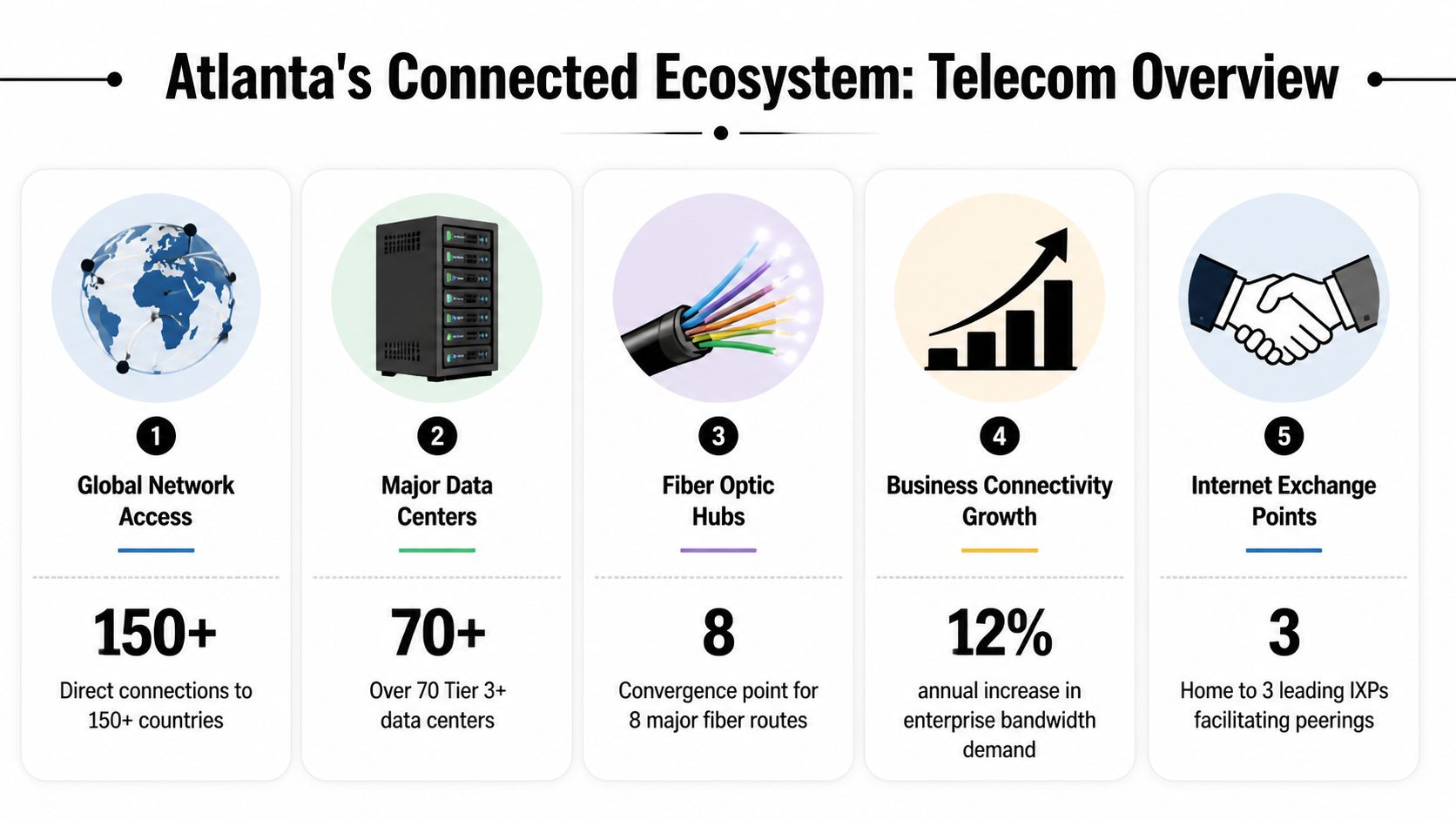
What that means on the ground
Downtown and Midtown usually offer the deepest carrier density. Some perimeter office clusters and logistics areas also perform well, especially where enterprise demand has justified more fiber buildout. The trade-off shows up when a company expands into older industrial buildings, adaptive reuse space, smaller suburban offices, or temporary project sites. The metro market may be strong overall, while one address still has only one practical wired option, long construction intervals, or expensive access work.
That distinction matters more than provider brand recognition. Two carriers in the same building do not always mean two independent routes. They may share the same lateral, conduit path, or central office dependency. A buyer who needs continuity for dispatch, cameras, tenant systems, payment traffic, or warehouse operations should ask for route diversity details, not just a second quote.
A broad service area across Atlanta-area communities matters for the same reason. Many companies are not operating from one flagship office. They may have branch sites, managed properties, storage yards, field offices, and short-term project locations that need a standard telecom design instead of one-off decisions.
How businesses should read the ecosystem
Atlanta is a favorable market, but the practical value depends on the business model and the site.
| Business need | Best way to interpret Atlanta’s advantage |
|---|---|
| Multi-site operations | More provider presence can improve buying power and make it easier to standardize service across offices, warehouses, and field locations |
| Cloud and SaaS dependence | Strong regional connectivity can reduce latency variability and make dedicated access easier to source in well-served buildings |
| Customer-facing voice | More carrier choice can support better failover design, SIP diversity, and cleaner escalation paths during outages |
| Industrial and warehouse operations | Market strength helps, but building serviceability, construction cost, and demarc location still decide the real outcome |
| Compliance-driven environments | Better access to enterprise-grade transport and backup options can support logging, monitoring, security controls, and documented resilience plans |
The services businesses actually buy
In Atlanta, commercial demand usually centers on a small set of service types tied to business outcomes.
- Shared business internet for general office use, lighter cloud activity, and secondary connectivity
- Dedicated internet access for predictable performance, service guarantees, and cleaner support accountability
- Private transport between sites, data centers, or cloud on-ramps where consistency matters more than raw bandwidth
- VoIP and SIP services for calling, contact centers, and continuity planning
- Wireless backup or primary fixed wireless for resilience, temporary space, or hard-to-serve sites
- Colocation and related infrastructure services for firms that need tighter control over applications, interconnection, or disaster recovery design
The market gives buyers room to build a telecom strategy that fits operations, not just a quote sheet.
The better question is not whether Atlanta has strong connectivity. It does. The better question is whether a specific building, carrier mix, and contract structure support the uptime, expansion plans, sustainability goals, and compliance obligations your operation carries.
Decoding Key Commercial Telecom Offerings
Most commercial telecom buying mistakes happen because teams compare unlike services as if they’re interchangeable. They’re not. Shared fiber internet, dedicated internet, EPL, VoIP, wireless backup, and colocation all solve different business problems.
Atlanta’s data center growth is part of why this matters. The city is projected to reach 1.82 GW in 2026 and grow at a 26.92% CAGR to 2031, while total inventory reached 1,459.2 MW by the end of 2025, making Atlanta the second-largest U.S. data center market, according to Atlanta data center market research. That local depth supports stronger options for cloud access, interconnection, edge workloads, and off-site infrastructure strategy.
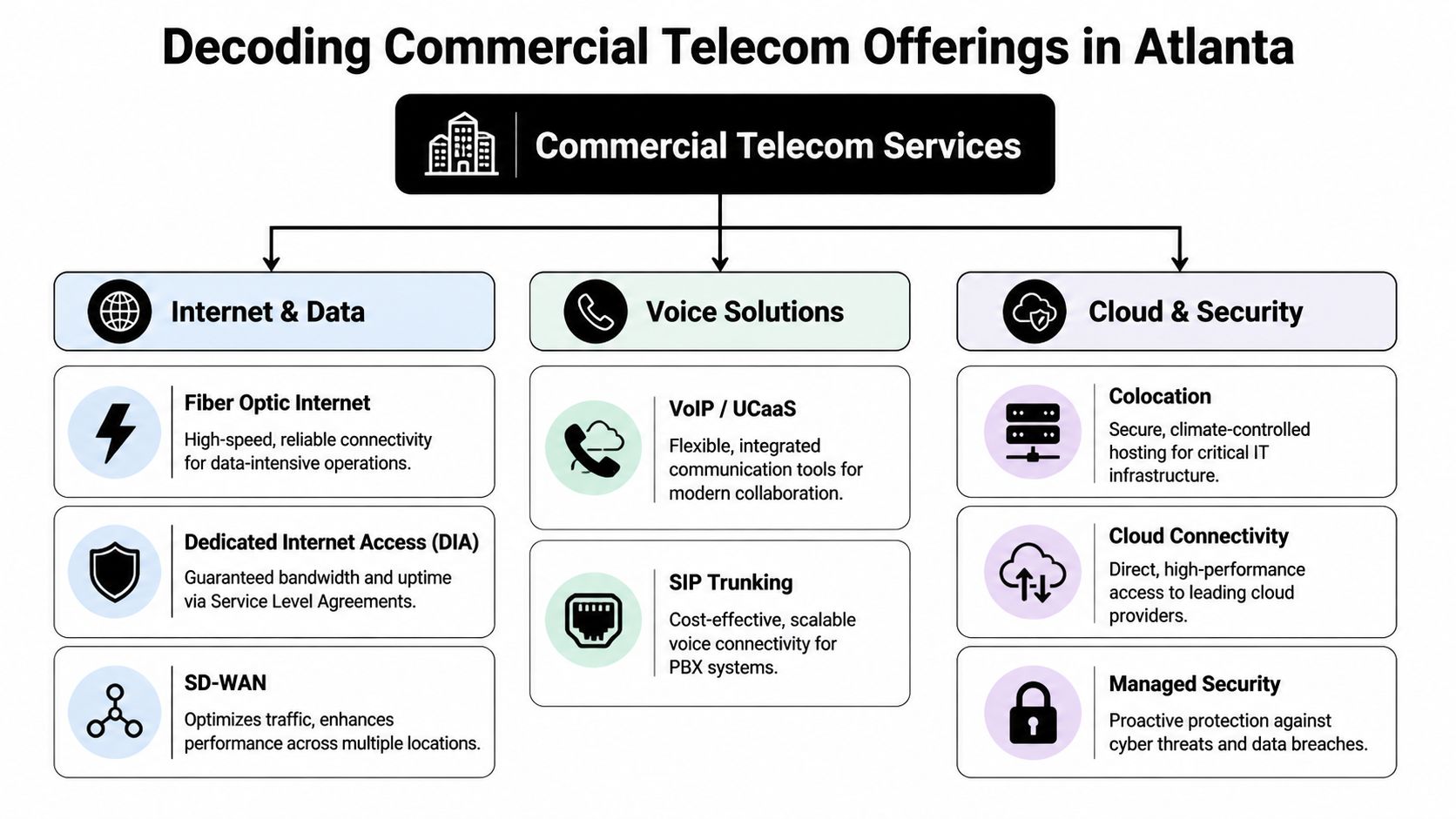
Internet and transport choices
Shared business internet is usually the entry point. It’s fine for small offices, general browsing, cloud apps, and as a backup path. It’s not ideal when large file transfers, camera traffic, or site-to-site application performance have to remain predictable during busy periods.
Dedicated Internet Access, often called DIA, is different. You’re paying for a committed service with stronger operational accountability. That’s what I’d look at first for a headquarters, an office with heavy cloud use, a call-heavy environment, or any site where an outage triggers immediate business disruption.
Ethernet Private Line, or EPL, solves another problem entirely. Atlanta EPL services use Layer 2, point-to-point connections with guaranteed bandwidth and low-latency characteristics, as outlined in this Ethernet Private Line guide for Atlanta. For a business moving data between two locations, EPL behaves more like a private lane than internet access. It’s useful when the traffic itself matters more than broad web connectivity.
Voice and collaboration
A surprising number of buyers still treat voice as a side decision. That leads to poor call quality, awkward failover, or a system that doesn’t match how staff work.
VoIP and UCaaS make sense when you want:
- Mobility because staff split time between office, home, and field
- Central administration for adds, moves, and changes
- Integration with help desk, CRM, or collaboration tools
- Location flexibility when a business may expand or consolidate space
SIP trunking can be the better fit if you already own a capable PBX environment and want to modernize connectivity without fully replacing your voice platform.
Wireless and edge use cases
Wireless services are excellent for temporary offices, construction trailers, field operations, and backup connectivity. They’re less convincing as a primary service for sites that require deterministic performance. If dispatch, surveillance uploads, or a warehouse management platform must stay consistent, wireless should usually complement wireline, not replace it.
Colocation and private infrastructure
The Atlanta market’s depth gives businesses more than internet circuits. It creates room for colocation, cross-connect-driven cloud access, and private infrastructure decisions that would be harder to justify in smaller cities.
Use colocation when you need to keep physical control over key systems but don’t want to operate everything from your own office or warehouse. That’s often the right move for businesses dealing with:
- Disaster recovery requirements
- Security separation
- Legacy systems that can’t move cleanly to public cloud
- Operational needs for regional infrastructure close to Atlanta users
If your IT room has become a mix of production systems, spare parts, and wishful thinking, colocation is usually worth evaluating before the next expansion.
A practical comparison
| Service | Good fit | Poor fit |
|---|---|---|
| Shared business internet | Small office, backup link, light SaaS use | Critical production workloads |
| DIA | HQ, support center, cloud-heavy operations | Very small sites with low operational risk |
| EPL | Site-to-site data movement, controlled application traffic | General-purpose internet replacement |
| VoIP or UCaaS | Distributed staff, modern collaboration | Teams that need isolated legacy voice only |
| Wireless or 5G | Temporary sites, mobile teams, failover | Core fixed operations with strict performance needs |
| Colocation | Compliance, resilience, hybrid IT | Organizations with no server or private infrastructure needs |
The right answer is often a blend. A warehouse may need DIA plus wireless failover. A multi-site firm may need shared internet at branch offices and private transport only between critical sites. A facilities-heavy organization may discover that building systems, not desktop users, are what justify a higher-grade connection.
The Critical Differences In Business and Home Services
A residential mindset causes bad telecom decisions in commercial environments. The line item may look lower, but the risk profile is completely different. Home service is built for convenience. Business service is built for accountability.

What the extra cost actually buys
Residential service is like driving on a public road. It works most of the time, but you share capacity, support queues, and restoration priorities with everybody else. Business service is closer to a managed route with contractual expectations around performance, support, and escalation.
That difference shows up in a few places fast:
- Service Level Agreements that define uptime and response expectations
- Business support channels with faster escalation paths
- Static addressing and network options needed for secure remote access and certain hosted systems
- Installation standards that are more suitable for structured commercial environments
- Security and architecture flexibility when the network supports devices, not just laptops
For a single user or a home office, residential service may be enough. For a property office, warehouse, or regional branch, it often isn’t.
The hidden trap in Atlanta-area coverage
Cheap service also assumes the advertised plan is available where you need it. That’s not always true outside the strongest fiber corridors. Businesses in nearby commercial zones, outer neighborhoods, or mixed-use areas such as Sandy Springs commercial service areas need to verify serviceability at the exact suite or parcel level, not just by ZIP code.
The larger issue is operational exposure. If your site depends on one consumer-grade circuit and the provider treats it like a residential repair ticket, your staff may lose a day while the monthly savings disappear in labor cost and missed work.
Where business service wins
Buy business-class telecom when the cost of downtime is higher than the cost difference on the monthly invoice.
That applies even more when a site carries:
- Shared printers, phones, and guest networks
- Cameras, access control, or building automation
- Cloud applications with active transactions
- Remote users connecting back into the office
- Customer-facing teams that can’t wait on consumer support
Procurement teams sometimes push back because both plans look like “internet.” Operations teams usually stop making that comparison after the first serious outage.
How to Evaluate Atlanta Telecom Providers and Contracts
Provider evaluation in Atlanta has to start with a blunt question. Can this carrier serve my exact address with the exact service I need, on the timeline I need, without ugly surprises in construction or contract terms? A provider map on a website won’t answer that.
Businesses outside prime corridors face a real coverage problem. This Atlanta dedicated internet overview notes that major carriers dominate the market, but coverage is fragmented in underserved urban and rural communities around the city. If your building sits outside a primary fiber path, you have to verify availability at the service-address level.

Start with physical reality, not marketing
I tell clients to evaluate providers in this order:
Address validation
Ask for a formal serviceability check for the exact suite, floor, dock area, or building entrance. Large campuses and multi-tenant properties often have uneven access.On-net versus near-net status
A building that looks “served” may still require construction, conduit work, or landlord approvals.Path diversity
If you’re buying primary and backup service, ask whether both routes share the same building entry, riser, or local plant.Installation dependencies
Clarify who handles permits, demarc extension, inside wiring, and any third-party access fees.
That same discipline matters in strong suburban business nodes such as Alpharetta-area service locations, where premium office parks can still vary widely by building.
Read the contract like an operations document
A telecom agreement isn’t just legal boilerplate. It defines how pain gets allocated when something goes wrong.
Review these items carefully:
Term and renewal language
Auto-renewals are common, and they’re expensive if you miss notice windows.Early termination liability
This matters if you may relocate, consolidate, or close a branch.Construction contingencies
A low monthly rate can hide significant one-time build costs.Service credits
Credits matter less than restoration speed, but weak credit language usually signals weak SLA value.Support and escalation terms
Ask how after-hours incidents reach an engineer, not just a ticket queue.
For teams sorting through access options, I like concise explainers such as Leased Line vs Broadband because they frame the core trade-off clearly. Shared access may be cheaper. Dedicated access usually gives you better predictability and stronger accountability.
Questions that separate strong providers from polished sales teams
Ask for written answers to these:
- What service is available at our exact address today, not after a future build?
- What parts of the install depend on the landlord, utility coordination, or third-party contractors?
- Where is the demarcation point, and who pays to extend service from there?
- How do you support multi-site clients across mixed building types?
- What changes if we need to add voice, private transport, or backup access later?
A good provider answers with engineering detail. A weak provider answers with brochure language.
The best buying decision usually comes from a mix of network fit, building practicality, and contract discipline. The worst one usually comes from chasing the lowest monthly quote before anybody has inspected the site.
Managing Installation and Building Infrastructure Access
A carrier can approve service at your Atlanta address and still miss your move-in date by weeks. I see that happen when the order is placed before anyone confirms riser access, landlord signoff, suite pathway, or where the handoff will land. For facilities and IT teams, installation is an operations project with telecom dependencies, not an administrative step after procurement.
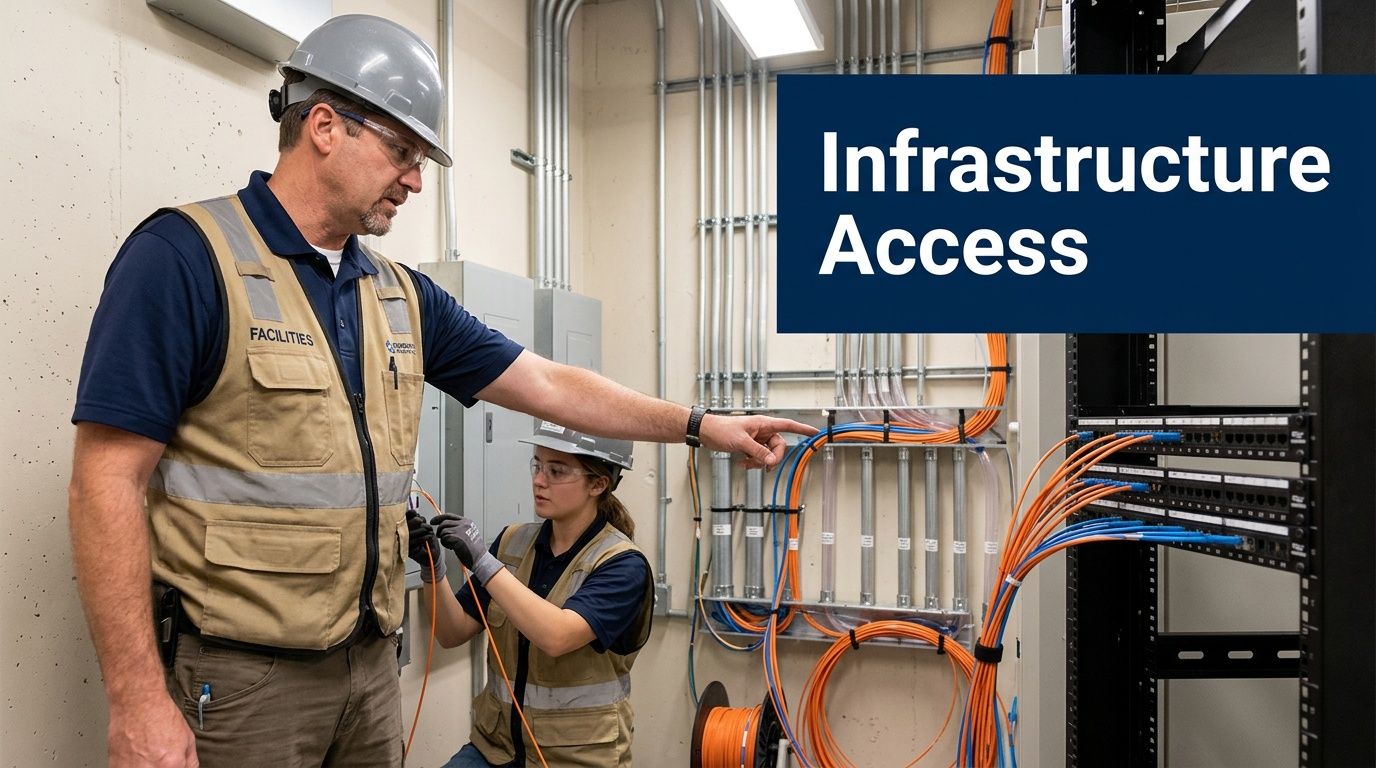
The main risk is simple. Carrier availability on a map does not equal usable service inside the building.
In Atlanta, that gap shows up in older office towers, mixed-use properties, warehouses, medical suites, and converted industrial spaces. The outside network may be close. The inside path may be blocked, undocumented, full, or under landlord control. If your business depends on cloud applications, cameras, access control, voice, or tenant systems, that delay turns into overtime, temporary circuits, and occupancy problems.
What facilities teams should confirm before the order is submitted
The cleanest installs start with a building readout that answers a few practical questions:
- Who controls right of entry and landlord approval?
- Where are the MPOE, risers, telecom closets, and approved pathways?
- Is there open conduit or innerduct from the entry point to your suite or equipment room?
- Will work require after-hours access, escorting, shutdown windows, or certificates of insurance?
- Do technicians or subcontractors need site-specific security clearance or badging?
Properties across South Fulton commercial locations often need extra scrutiny because yard space, detached structures, and retrofitted buildings rarely have the standardized pathway design you get in newer Class A office inventory.
A practical installation workflow
A workable process is not complicated, but it does require ownership on the customer side.
| Stage | What to confirm |
|---|---|
| Site survey | Building entry point, telecom room condition, available pathways, riser capacity |
| Design review | Demarc location, handoff type, rack space, power, grounding, inside wiring scope |
| Building coordination | Landlord approval, access schedule, insurance documents, escort requirements |
| Construction | Conduit work, fiber pull, labeling, patching, suite extension, cleanup standards |
| Turn-up | Light testing, handoff validation, failover check, monitoring setup, support contacts |
That workflow matters for more than speed to install. It determines whether the infrastructure can support a second carrier later, whether backup connectivity can follow a separate path, and whether your next suite expansion will require another construction cycle.
Building access decisions affect long-term cost and compliance
Demarc placement is one of the most overlooked issues in commercial telecom. If the carrier hands off service in a basement room but your network stack sits on another floor or in another building segment, the extension cost often lands on the tenant. That can include cabling, conduit, patch panels, electrician work, and coordination with building engineering. None of that shows up cleanly in a monthly service quote.
This also matters for compliance. Healthcare, financial, logistics, and multi-tenant operators often need documented cable paths, labeled circuits, controlled room access, and clean separation between provider equipment and customer equipment. A rushed install creates audit problems later.
Where advanced infrastructure planning fits
Some Atlanta organizations should treat inside and outside plant planning as part of a broader network design decision. If you expect to connect multiple facilities, support low-latency traffic between sites, or maintain tighter control over routing and security, ask early whether the building and campus pathways can support future private transport or owner-controlled fiber arrangements. The answer may change how you build the first install.
Teams that want a field-level view of conduit, pathing, labor, and coordination can review material on telecom infrastructure deployment. It is useful because it frames installation as physical infrastructure management, not just carrier ordering.
Treat the install like a site readiness project with budget, ownership, and a critical path.
A poorly managed install does more than delay turn-up. It can stall occupancy, create safety and access conflicts, force temporary workarounds onto production systems, and limit what the site can support later. A well-managed install gives the business reusable infrastructure for primary access, backup circuits, voice, cameras, building systems, and future growth.
Your Strategic Telecom Procurement Checklist
A telecom purchase usually goes off track before pricing even starts. The IT lead asks for bandwidth. Procurement asks for a quote. Facilities gets pulled in later when the provider cannot reach the suite, the landlord wants new paperwork, or the backup circuit rides the same path as the primary. In Atlanta, that sequence is expensive because the market gives commercial buyers more choices than standard business internet, and the wrong fit can leave gaps in resilience, audit support, or long-term site strategy.
Use this checklist in provider meetings and RFP reviews. It helps separate a circuit that is merely available from one that supports the business.
Questions about service fit
Which business function breaks first if this service slows down or fails?
Tie the answer to phones, dispatch, cloud platforms, cameras, POS, or traffic between sites.Is this service intended for primary access, backup connectivity, or private transport between locations?
The answer should drive design, routing, and support expectations.Can the service grow with added sites, heavier cloud use, more devices, or new operational systems?
A low monthly rate loses value if the site has to be redesigned a year later.
Questions about operations and risk
- What is the outage escalation path for our exact address and service type?
- How will failover work in practice across primary and secondary connections?
- Who answers after hours, on weekends, and during a building or utility event?
Quotes look polished. Outage handling is where provider quality shows up.
Questions about building and implementation
- Where is the demarc, and who covers the cost to extend service into our suite, IDF, or server room?
- What landlord approvals, riser access rules, or site access constraints could delay turn-up?
- What part of the delivery depends on construction, outside contractors, or building-owned infrastructure?
These questions matter in Atlanta office towers, mixed-use properties, and industrial sites where provider availability on paper does not always match the work required to get service live.
Questions about compliance and long-term business requirements
- Do you offer options beyond standard internet, such as private transport, colocation access, or dark fiber, if our operating model requires more control?
- What documentation can you provide for disaster recovery reviews, security governance, or customer audit requests?
- How does this service support resilience planning, reporting obligations, or broader efficiency goals across our facilities?
The better procurement question is not “What’s your price?” It’s “What business requirement does this service satisfy, and what is the cost if it fails?”
Questions about commercial terms
- What triggers renewal, and how much notice is required to cancel without penalty?
- What happens if we relocate, consolidate space, or exit the building before the term ends?
- Are construction charges, access fees, or other one-time costs excluded from the quoted monthly rate?
Smart buyers in Atlanta press on contract mechanics as hard as they press on bandwidth. That is usually where the avoidable cost sits.
Conclusion Making the Right Connection for Your Business
Telecom services in Atlanta give commercial buyers real advantages, but only if they buy with operational discipline. The city’s connectivity depth, competitive provider market, and advanced infrastructure options create opportunity. They also create complexity.
The right decision depends on more than speed. It depends on building realities, route diversity, service class, contract language, installation planning, and whether your business needs standard internet or something more strategic. Facilities, IT, procurement, and operations all need a seat at the table.
When you treat telecom as business infrastructure instead of a utility bill, you make better decisions. You reduce downtime, support growth, and avoid the expensive mismatch between what a provider sells and what your operation needs.
If you're managing an office cleanout, warehouse transition, tenant turnover, or e-waste-heavy project while upgrading operations, Fulton Junk Removal can help simplify the physical side of the work. As part of Beyond Surplus, the team pairs haul-away with responsible recycling, including electronics and reusable materials, which makes it easier for Atlanta businesses, property managers, and facilities teams to clear space, reduce landfill waste, and support internal compliance or sustainability reporting.
