
Atlanta Data Destruction Laws for Electronics: Your 2026 Guide
Figuring out the rules for disposing of old business electronics in Atlanta can feel like a maze. But here’s the bottom line: your business is on the hook for its sensitive data until it’s been verifiably and permanently destroyed. Simply saying "I didn't know" won't protect you from the serious financial and reputational fallout of a data breach.
Your Guide to Atlanta's Data Destruction Rules
Think of your company's old hard drives, servers, and even office copiers as unlocked filing cabinets. You wouldn't leave those sitting on a busy street, and sending them to an uncertified recycler is just as risky. Here in Atlanta, that risk is magnified by a web of federal and state laws designed to protect consumer and corporate data.
This isn't just one single rule, but a patchwork of regulations. Federally, laws like the FTC Disposal Rule and HIPAA set a national standard for protecting information. On top of that, Georgia has its own state-specific laws, adding another layer of responsibility for local businesses.
The High Stakes of Non-Compliance
Failing to follow these rules is more than a simple mistake—it's a major liability. The penalties can be staggering, including massive fines, drawn-out legal battles, and a loss of customer trust that can haunt your brand for years.
A data breach from improper electronics disposal can trigger a domino effect of financial and reputational damage. The responsibility for that data stays with your company until you have proof that it was securely and completely destroyed.
This guide will cut through the legal jargon. We'll break down exactly what you need to do, show you compliant destruction methods, and give you a clear path to protecting your organization.
Before we dive into the specifics, let's take a look at the most important regulations affecting Atlanta businesses. This table summarizes the key players in the data destruction landscape.
Key Data Destruction Regulations for Atlanta Businesses
| Regulation Name | Governing Body | Who It Affects | Primary Requirement |
|---|---|---|---|
| HIPAA Security Rule | U.S. Dept. of Health & Human Services | Healthcare providers, insurers, and their business associates | Securely dispose of electronic protected health information (ePHI) to make it unreadable and indecipherable. |
| FTC Disposal Rule | Federal Trade Commission (FTC) | Any business with consumer report information | Take "reasonable measures" to destroy consumer information from electronics so it cannot be reconstructed. |
| FACTA | Federal Government | Financial institutions, creditors, and businesses using consumer reports | Proper disposal of consumer information to prevent identity theft and fraud. |
| Georgia Records Act | State of Georgia | State and local government agencies | Obtain official approval before destroying any public records, including electronic ones. |
| Georgia Personal Identity Protection Act | State of Georgia | Businesses that acquire or license personal information of Georgia residents | Implement and maintain reasonable security procedures to protect personal data from unauthorized access or disposal. |
These rules aren't just suggestions; they are mandates with serious consequences. Now, let's connect these legal requirements to the real-world challenge of e-waste in our state.
Georgia's Role in the E-Waste Crisis
The challenge of managing electronic waste isn't just a global headline—it's a local reality. Across the U.S., a mind-boggling 33 million computers are discarded every single year, part of a 60-million-ton global e-waste problem. Here in Georgia, our state laws are a critical line of defense.
For example, the Georgia Records Act prevents any state entity from destroying electronic public records without a green light. This reflects the same spirit as the FTC Disposal Rule, which requires businesses to take "reasonable measures" to make data unrecoverable. That's a crucial point for any business in the Atlanta metro area, especially when research shows that 40% of used devices sold online still have sensitive data on them.
An Eco-Friendly Approach to Compliance
While following the law is non-negotiable, it's also a chance to adopt smarter, more sustainable habits. While most junk removal companies take everything to the landfill, we recycle through Beyond Surplus to minimize waste and maximize reuse. Fulton Junk Removal, operating under Beyond Surplus, offers a circular, eco-friendly solution that goes beyond traditional junk hauling.
For businesses in Atlanta, a responsible solution combines junk removal with certified electronics recycling, which makes both compliance and sustainability reporting a breeze. This is how a modern, eco-friendly process should work:
- Bundled Services: With Fulton’s bundled junk removal + recycling pickup, all electronic waste and recyclable materials are directly processed by Beyond Surplus. This makes life easier for office and property managers.
- Responsible Recycling: Fulton Junk Removal works hand-in-hand with Beyond Surplus to recycle electronics, metals, and other materials responsibly. Fulton diverts items from landfills and ensures they’re repurposed or recycled.
- Verified Data Destruction: Every device that holds data is securely destroyed according to legal standards, and you get the paperwork to prove it, making compliance and sustainability reporting easier.
This circular, green model transforms a compliance headache into a simple, sustainable process. By bundling junk removal with recycling, Fulton handles all junk removal needs while Beyond Surplus ensures responsible recycling, appealing to environmentally conscious businesses.
Understanding Your Federal and State Legal Obligations
Trying to make sense of Atlanta data destruction laws for electronics can feel like a real headache. You’ve got federal rules, state mandates, and then another layer of industry-specific regulations all overlapping. For a facility manager or business owner, it’s a lot to track, but it becomes much clearer once you break it down.
Think of it this way: federal laws create the national foundation for data protection, while Georgia's laws build on top of that with local requirements. Your business is responsible for following both. Having a firm grasp of the core ideas behind Governance, Risk, and Compliance (GRC) is key to meeting your legal duties when it’s time to dispose of old electronics.
Key Federal Laws You Must Know
Several major federal laws set the baseline for data security that every Atlanta business needs to respect. These aren’t just friendly suggestions—they have real teeth and carry hefty fines for getting it wrong.
Here are the big three every business should know:
- FACTA's Disposal Rule: The Fair and Accurate Credit Transactions Act (FACTA) demands that any business handling consumer information must take "reasonable measures" to destroy it securely. This covers everything from old credit applications to employee background checks.
- HIPAA: The Health Insurance Portability and Accountability Act (HIPAA) is the gold standard for healthcare data. If you’re a clinic, hospital, or insurance provider in Atlanta, HIPAA is non-negotiable. It requires all electronic protected health information (ePHI) to be rendered completely unreadable, indecipherable, and unrecoverable before disposal.
- Gramm-Leach-Bliley Act (GLBA): This one is aimed squarely at the financial world. The GLBA forces banks, investment firms, and other financial companies to protect customer data. A huge part of that is having a solid plan for destroying the sensitive information on old computers, servers, and hard drives.
The common thread tying all these laws together is simple: you own the responsibility for the data you collect, from the moment you get it to the moment it's properly destroyed.
The term "reasonable measures" under FACTA is left a bit vague on purpose, but one thing is crystal clear: you have to take active, provable steps to destroy data. Just tossing a hard drive in a dumpster is never considered reasonable.
Georgia-Specific Regulations for Atlanta Businesses
While federal acts provide the broad strokes, Georgia has its own rules that add another layer of duty for local businesses. Overlooking these state-level mandates is a fast track to compliance problems.
Georgia Personal Identity Protection Act (GA-PIPA)
This state law is a big deal for almost every private company in Georgia. GA-PIPA requires any business that holds the personal information of Georgia residents to maintain reasonable security procedures to shield that data from being stolen or improperly disposed of.
For example, think of an Atlanta-based online store that’s upgrading its servers. The old machines are packed with customer names, addresses, and order histories—all data protected by GA-PIPA. That company has a legal obligation to ensure that data is professionally destroyed, not just wiped.
Georgia Records Act
This law targets public organizations like state agencies, local governments, public schools, and universities. It says that no public records—including electronic files—can be destroyed without getting an official green light from the Georgia Archives and State Records Committee. It’s a system designed to prevent the careless disposal of official information and maintain a strict chain of custody.
Real-World Scenarios and Penalties
Let’s see how this plays out in the real world for businesses right here in Atlanta:
- Scenario 1: A Law Firm Upgrades Servers: An Atlanta law practice replaces servers that hold confidential client files. To comply with FACTA and GA-PIPA, they must hire a certified vendor to physically shred the hard drives and issue a Certificate of Data Destruction. If they don’t, a data breach could lead to malpractice suits and stiff fines from the state.
- Scenario 2: A Medical Clinic Closes an Office: A small clinic in Buckhead shuts down a satellite office and needs to get rid of old computers and tablets. HIPAA demands that every device with patient data is destroyed so the information is gone for good. Simply reformatting the drives isn't nearly enough and could trigger fines that run into the millions.
These laws are backed by serious penalties. A single HIPAA violation can cost up to $1.5 million per year for each type of violation. The FTC also has the power to impose huge fines for breaking FACTA rules. These financial risks make it obvious why a compliant disposal process isn’t just good practice—it’s essential.
For more helpful guides on related topics, feel free to check out our blog section.
Why Deleting Files Is Not Enough
Lots of business owners assume hitting the 'delete' key or reformatting a hard drive is all it takes to wipe sensitive data. This is a dangerous and surprisingly common misconception. When you drag a file to the trash, you aren't actually erasing the information. You’re just telling the computer that the space it occupied is available to be overwritten later on.
Think of it like ripping the card out of an old-school library card catalog. The card is gone, so no one can easily find the book, but the book itself is still sitting on the shelf. Anyone who knows where to look can still grab it. In the same way, “deleted” data can often be recovered with basic software, leaving your business wide open to a breach.
This is exactly why professional data destruction is non-negotiable for complying with Atlanta data destruction laws for electronics. Simply wiping a device doesn't come close to meeting the strict standards of laws like HIPAA or FACTA. Real compliance means making that data completely, permanently, and forensically unrecoverable.
The Three Pillars of Secure Data Destruction
So, how do you make data truly disappear? To ensure information is gone for good, pros rely on three core methods. Each one has its place, and understanding them helps IT managers and business owners make the right call for their specific security needs.
- Physical Destruction: This is the most direct and foolproof method. It means shredding, pulverizing, or completely disintegrating the physical storage device. There's simply no recovering data from a pile of metal and plastic fragments.
- Degaussing: This process uses an incredibly powerful magnetic field to scramble the data on traditional hard disk drives (HDDs) and magnetic tapes. It essentially neutralizes the drive's magnetic signature, making the information permanently unreadable.
- Cryptographic Erasure: A software-based technique, this involves using a digital key to encrypt all the data on a drive and then permanently destroying that key. Without it, the encrypted information is just a meaningless jumble of code.
The reality for any Georgia business is that you operate at the intersection of federal and state laws. You have to satisfy both to be truly compliant.
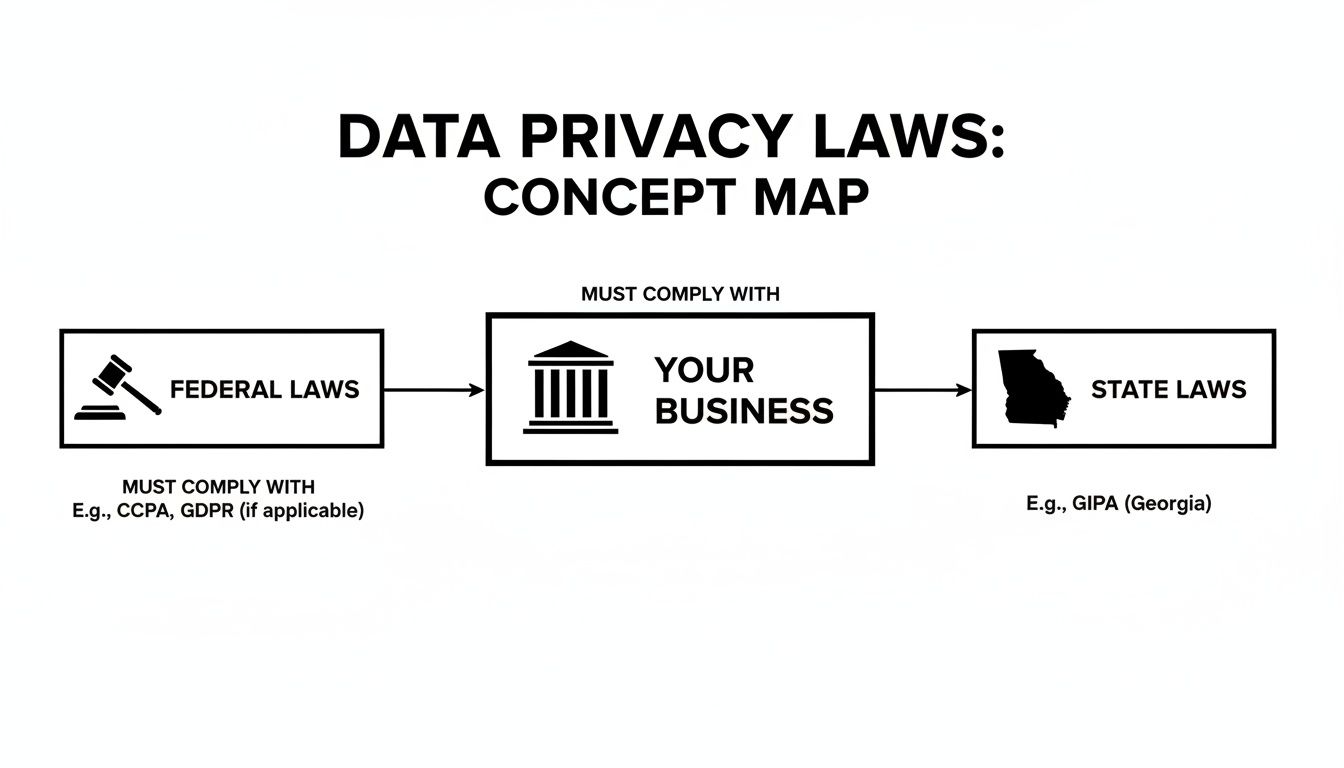
As you can see, your business sits right in the middle. Staying on top of both federal mandates and Georgia-specific rules is the only way to achieve full data privacy compliance and avoid penalties.
Comparing Secure Data Destruction Methods
Choosing the right destruction method really comes down to the type of media you're dealing with and your company's tolerance for risk. To make it clearer, here’s a breakdown of how the three primary methods stack up.
| Method | How It Works | Best For | Key Benefit | Limitation |
|---|---|---|---|---|
| Physical Destruction | The device is mechanically shredded, crushed, or pulverized into tiny fragments. | End-of-life hard drives, SSDs, phones, and high-risk media. | 100% foolproof. Provides absolute, verifiable proof of destruction. | The device is completely unusable afterward. |
| Degaussing | A powerful magnetic field erases the magnetic signature of the storage platter. | Older magnetic media like HDDs and backup tapes. | Renders data unreadable while leaving the device physically intact. | Does not work on SSDs, flash drives, or other non-magnetic media. |
| Cryptographic Erasure | The data is encrypted with a unique key, and then the key itself is destroyed. | Newer self-encrypting drives (SEDs) and SSDs in devices planned for reuse. | Allows the device to be safely repurposed or resold. | Effectiveness depends entirely on the strength of the initial encryption. |
While software-based methods have their place, they also have critical limitations. Degaussing is great for old-school magnetic hard drives, but it’s completely useless on the Solid-State Drives (SSDs) found in virtually all modern laptops. Since SSDs don't store data magnetically, the degausser has no effect.
For any end-of-life device with zero room for error—think financial records, patient data, or your company's intellectual property—physical destruction is the undisputed gold standard. It offers total certainty and a clear, auditable trail that the data's lifecycle is over.
This is why working with a certified vendor who offers a full suite of options is so important. A good partner can guide you to the most appropriate and cost-effective method for every single asset.
When looking for a partner to handle these critical tasks, it helps to find one who can do more than just destroy data. To see how you can bundle junk removal with certified recycling and data destruction, you can learn more about our comprehensive commercial services. An integrated approach simplifies the logistics of a major office or warehouse cleanout.
Ultimately, understanding that "delete" doesn't mean "destroyed" is the first step. By adopting professional destruction methods, you’re not just ticking a box—you're protecting your company from devastating breaches, ensuring you meet all Atlanta data destruction laws, and safeguarding the reputation you’ve worked so hard to build.
Choosing a Certified Vendor and Proving Compliance
When you hand over your company's old electronics to a third-party vendor, your legal responsibilities don't just disappear. It’s like hiring a contractor to dispose of hazardous waste—if they dump it illegally, your company can still be on the hook for the cleanup. The exact same principle applies to Atlanta data destruction laws for electronics. Your business is liable until you have proof the data was properly destroyed.
This is why choosing a certified vendor is your single most important line of defense. A true professional partner doesn't just haul away your e-waste; they take on the liability for you. This transfer happens through a careful process of documentation and third-party validation, which becomes your shield against steep fines and legal headaches.
Understanding the Chain of Custody
The second your electronics leave your building, you must establish a chain of custody. Think of it as a chronological paper trail documenting who has handled your assets at every single step, from pickup all the way to final destruction. Without this, you have a massive blind spot in your compliance strategy.
A solid chain of custody record always includes:
- Secure Logistics: Documented proof of how devices are collected, transported, and stored securely.
- Asset Tracking: A detailed inventory of every device, usually tracked by its serial number.
- Proof of Destruction: The final, legally binding document certifying that the data was destroyed according to federal and state standards.
This unbroken chain is what proves you did your due diligence. It shows an auditor or a court that you took every reasonable step to protect the sensitive information people trusted you with.
Decoding Key Industry Certifications
So, how can you tell if a vendor is genuinely qualified to handle this? The answer is industry certifications. These aren't just fancy logos for a website; they represent tough, third-party audits that confirm a recycler’s processes for data security, environmental safety, and employee protection. For any Atlanta business, two certifications are the undisputed gold standard.
R2 (Responsible Recycling)
The R2 Standard is a globally recognized certification that covers both environmental practices and data security. An R2-certified vendor has been audited to prove they have a rock-solid system for managing data-bearing devices and that all downstream recycling is handled responsibly. It’s a clear signal that a vendor is committed to professional best practices.
e-Stewards
The e-Stewards Standard is another top-tier certification, widely considered the strictest in the industry. It was created by the Basel Action Network specifically to combat the illegal export of toxic e-waste. Choosing an e-Stewards certified facility is your guarantee that no hazardous materials will be improperly dumped and that all data destruction meets the highest security protocols available.
Choosing a vendor with R2 or e-Stewards certification isn't just a best practice—it's a critical risk management decision. These credentials give you peace of mind that your partner has been thoroughly vetted to handle your data securely and dispose of assets in an environmentally sound way, which also simplifies your own sustainability reporting.
The Power of the Certificate of Data Destruction
The single most important document you will get from your vendor is the Certificate of Data Destruction. This isn't just a receipt. It's a legal document that formally transfers liability from your business to theirs. It’s your official, undeniable proof of compliance.
This certificate must detail:
- The unique serial numbers of the specific devices that were destroyed.
- The method of destruction used (e.g., shredding, degaussing).
- The date the destruction was completed.
- A statement affirming compliance with regulations like NIST 800-88.
If you ever face an audit, this certificate is the irrefutable evidence that you met your legal duties under laws like HIPAA, FACTA, and the Georgia Personal Identity Protection Act. This is especially true for Atlanta businesses operating in a high-scrutiny environment. Georgia's own data security standards, found in SS-08-003, classify digital data as official records that require protection. With a shocking 40% of used electronics still containing recoverable data, professional destruction is non-negotiable. You can find more on this by exploring the Atlanta's document destruction landscape on RecordNations.com.
Finding a partner who understands all these layers of compliance is crucial. It’s even better when you can work with a company that offers integrated services to make your logistics simpler. To see how a circular, eco-friendly approach works in practice, you can read about the mission behind Fulton Junk Removal and our partnership with Beyond Surplus.
A Smarter Way to Handle Junk Removal and Data Destruction
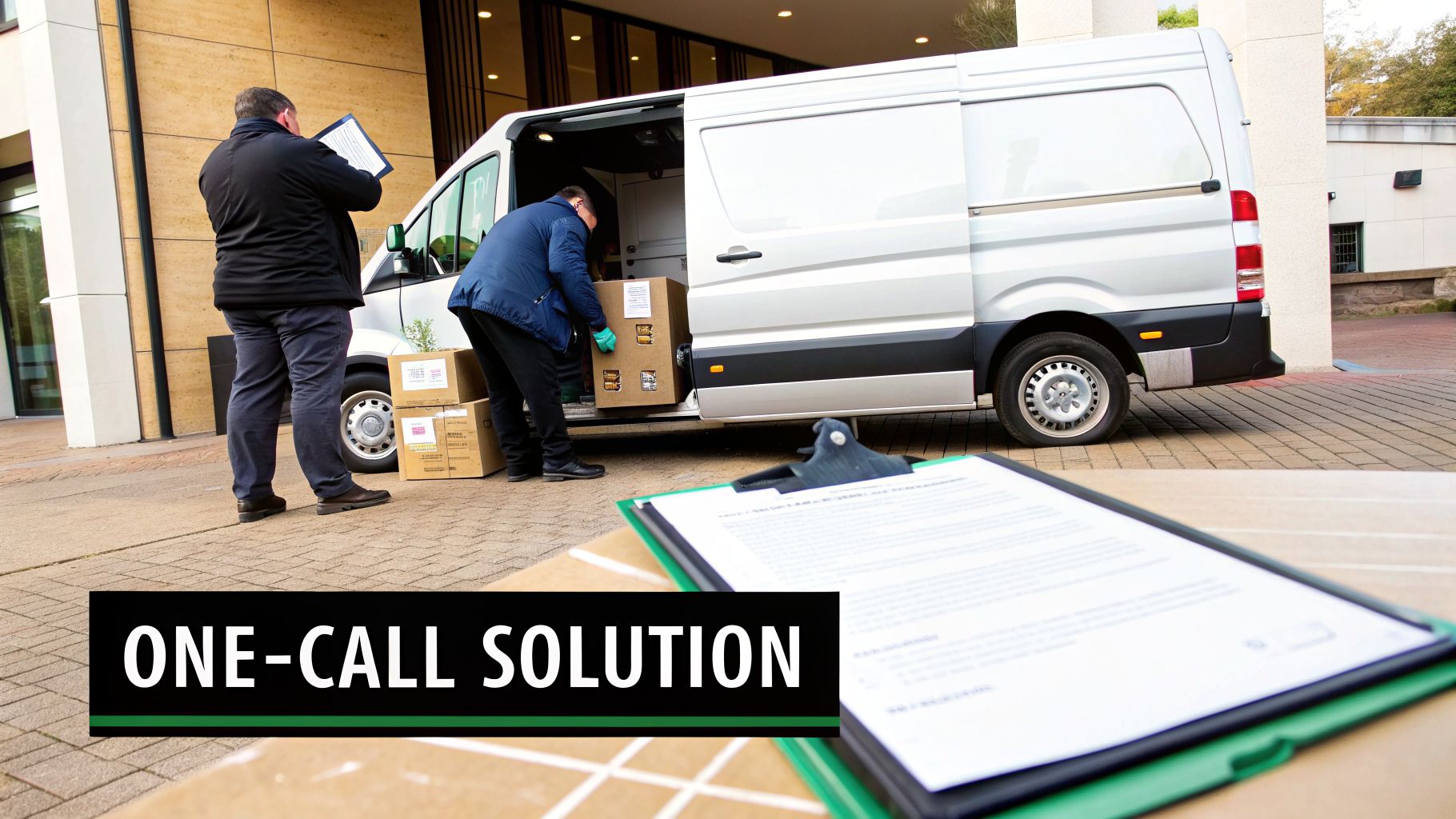
Let’s be honest. Juggling a big cleanout while trying to meet Atlanta data destruction laws for electronics is a huge pain. You end up hiring one company to haul away old furniture and junk, and then a completely separate, certified vendor to take care of the sensitive electronics. It's a disjointed process that costs you time, complicates scheduling, and opens the door to compliance headaches.
We think there’s a much better way. Getting rid of old equipment shouldn't add more stress to your plate. It should be one seamless job that solves both your junk problem and your data security needs at the same time.
That's where Fulton Junk Removal, operating under the eco-friendly circular solution of Beyond Surplus, comes in. We’ve combined full-service commercial junk hauling with certified data destruction and responsible e-waste recycling. Think of it as a one-stop solution built for busy Atlanta professionals who need things done right.
How We Make Your Project Simple
Picture this: you’re a property manager flipping a commercial space for a new tenant, or an office manager coordinating a move to a new HQ. Your to-do list is already overflowing. The last thing you need is the hassle of managing multiple vendors for what should be a single project.
Our bundled service is designed to completely eliminate that friction. Here’s what it looks like in practice:
- One Call Does It All: Instead of spending hours vetting and scheduling separate junk haulers and ITAD specialists, you just call us. We handle the entire project from start to finish.
- One Integrated Pickup: Our team does all the heavy lifting—office furniture, old equipment, construction debris, you name it. At the same exact time, we securely collect all your electronics.
- Airtight Hand-Off: All your e-waste is transferred directly to our partner, Beyond Surplus, for secure processing. This creates a tight, unbroken chain of custody from your doorstep to the destruction facility.
- Certified Destruction and Recycling: Beyond Surplus ensures every data-bearing device is destroyed according to NIST standards, and all materials are responsibly recycled, keeping them out of Georgia landfills.
For businesses that can’t afford to waste time, this unified approach is a game-changer. You get a single point of contact, one transparent invoice, and absolutely no surprises.
Turning Liability Into a Closed-Loop Process
One of the biggest worries with getting rid of old electronics is the lingering liability. As we've discussed, your responsibility for the data doesn’t disappear until it's verifiably destroyed. Our integrated model turns this risk into a documented, closed-loop process you can actually trust.
When you work with Fulton Junk Removal and Beyond Surplus, you're not just making space—you're creating an audit trail that proves your compliance.
With our bundled junk removal + recycling pickup, your e-waste moves from being a potential risk to a documented asset you've managed responsibly. We provide the official Certificates of Data Destruction and recycling reports you need to prove due diligence and simplify your company’s sustainability reporting.
This paperwork is your legal shield. For sustainability directors, EHS managers, and operations leads, these reports are gold. They're exactly what you need to demonstrate corporate social responsibility (CSR) and hit your company's green targets. We make it easy to prove your commitment to both data security and environmental stewardship.
A Powerful Solution for Atlanta’s Commercial Leaders
Our combined service is tailor-made for Atlanta’s fast-moving commercial world. For offices, warehouses, and property managers, Fulton handles the junk removal while Beyond Surplus ensures responsible recycling, making compliance and sustainability reporting easier.
- For Property Managers: Quick turnovers are everything. We clear out entire units fast—from abandoned desks to old office computers—so you can get your space back on the market sooner.
- For Office Managers: Moving or downsizing is already complicated enough. We simplify it by handling all your junk and secure e-waste in one shot with a single, reliable team.
- For Construction and Warehouse Managers: Clearing huge spaces filled with mixed debris and outdated equipment demands a tough solution. We do the heavy lifting and ensure every piece of electronics is processed securely and sustainably.
In a city where business never stops, you need a partner that keeps up. Learn more about how Fulton Junk Removal helps Atlanta businesses operate with more efficiency and less waste. By pairing traditional junk hauling with the certified, eco-friendly model of Beyond Surplus, we offer a complete solution that does more than just take out the trash.
Your Top Questions About Atlanta Data Destruction, Answered
When it comes to getting rid of old electronics, the rules can feel a little murky. We get it. Here are straightforward answers to the questions Atlanta businesses ask us most, clearing up any confusion about data security and staying compliant.
What Types of Electronics Need Data Destruction?
The simple answer? Anything that stores information. If you’ve saved a file to it, scanned a document with it, or connected it to your network, it’s a potential data risk. We’re not just talking about computers and servers with hard drives (HDDs) and solid-state drives (SSDs).
Many businesses completely forget about everyday office gear. Think about your multifunction printer or copier—it has an internal hard drive that keeps an image of every sensitive contract, financial report, or employee file you've ever scanned or printed. That's a huge liability just sitting there.
To stay compliant with Atlanta data destruction laws for electronics, your plan needs to cover all of these devices:
- Computers & Servers: Every desktop, laptop, and piece of server equipment.
- Mobile Devices: All company-issued smartphones and tablets.
- Office Equipment: Printers, copiers, scanners, and even fax machines with internal memory.
- Networking Gear: Routers, switches, and firewalls which often store configuration data and network credentials.
- External Media: USB flash drives, external hard drives, and old backup tapes.
Does My Small Business in Atlanta Really Need to Worry About This?
Yes, absolutely. Regulations like the FTC Disposal Rule and the Georgia Personal Identity Protection Act (GA-PIPA) don't care if you're a five-person shop or a Fortune 500 company. If your business handles personal information of any kind—from customer emails to employee Social Security numbers—you are legally on the hook for protecting it until it's properly destroyed.
A single data breach from one carelessly tossed computer can sink a small business. The fines, legal battles, and total loss of customer trust are often impossible to recover from. Using a certified service isn't an expense; it's affordable insurance against that exact scenario.
Can’t I Just Smash the Hard Drives Myself?
Taking a hammer to a hard drive or drilling a few holes might feel satisfying, but it's an incredibly risky gamble that won't stand up to legal scrutiny. It’s surprisingly easy to miss the internal data platters or fail to damage them enough, leaving your information recoverable by someone with basic forensic tools.
The biggest problem with DIY destruction is you have zero proof it was done right. You won't get a Certificate of Data Destruction, which is the official document that proves you did your due diligence. If an auditor comes knocking, that certificate is what separates you from a hefty fine.
Professional services use industrial-grade shredders and degaussers that meet federal guidelines like NIST 800-88. More importantly, they give you the official paperwork that proves you're compliant and transfers that liability away from your business.
What Is a Certificate of Data Destruction and Why Is It So Important?
A Certificate of Data Destruction is a formal document you receive from a certified vendor, acting as your official receipt that your data was permanently and securely eliminated. Think of it as your get-out-of-jail-free card for compliance.
This document is so critical because it records everything:
- The exact date and method of destruction (e.g., shredding, degaussing).
- A serialized inventory of all destroyed hard drives or devices.
- A formal declaration that the process met all relevant legal standards.
For any Atlanta business, this certificate is your definitive proof that you followed the rules under laws like HIPAA or FACTA. It shows you took every necessary step to protect sensitive data, shielding your company from crippling fines and legal headaches.
Ready to simplify your cleanout and ensure total compliance? Fulton Junk Removal offers a seamless, integrated solution for commercial junk removal and certified electronics recycling. Through our partnership with Beyond Surplus, we handle the heavy lifting while ensuring every device is securely processed, providing you with the documentation you need for complete peace of mind. Streamline your project today by visiting us at https://fultonjunkremoval.com.
