
IT Asset Disposal for Atlanta Financial Firms: A Compliance Guide
For Atlanta's competitive financial firms, IT Asset Disposal (ITAD) isn't just about clearing out old equipment—it's a critical business function that safeguards your firm's reputation and bottom line. Getting it wrong can expose you to seven-figure data breach fines and brand damage that’s impossible to repair. A proper ITAD strategy has to blend airtight security, strict regulatory compliance, and real environmental stewardship into a single, documented process.
Why ITAD Is a Critical Strategy for Atlanta's Financial Sector
In Atlanta’s bustling financial hub, managing the lifecycle of your technology is a high-stakes game. When servers, company laptops, and hard drives reach their end-of-life, they don't just become clutter. They become potential time bombs loaded with sensitive client data, proprietary trading algorithms, and internal financial records. Simply unplugging a device doesn't make the risk go away.
The financial sector’s constant need for new tech creates a non-stop flow of retired assets. This reality has driven massive growth in the ITAD market, which was valued at USD 29.23 billion in 2025 and is projected to explode to USD 99.82 billion by 2035. The Banking, Financial Services, and Insurance (BFSI) sector is one of the biggest users of these services, which makes sense given the sheer volume of sensitive data on retired devices. In fact, the data destruction segment alone made up 28.9% of the entire market in 2025, showing just how urgent the need to prevent breaches has become.
The Core Pillars of Financial ITAD
A successful ITAD program for any financial firm—from a hedge fund in Buckhead to a bank downtown—is built on three core pillars. For the office managers, property managers, and IT directors tasked with this, understanding these pillars is the key to protecting the firm.
Airtight Security: The absolute top priority is preventing data breaches. This means using certified data destruction methods that make all information completely unrecoverable before an asset is ever recycled or resold.
Regulatory Compliance: Financial firms are buried under a mountain of regulations like GLBA, SOX, and FACTA. A compliant ITAD process gives you an audit-proof paper trail that documents every step of the secure disposal process.
Environmental Stewardship: Responsible disposal is no longer a "nice-to-have." Firms are now expected to prove their commitment to sustainability by diverting e-waste from landfills and reporting on it.
This flowchart shows how a modern ITAD strategy knits together security, compliance, and sustainability into one seamless process.
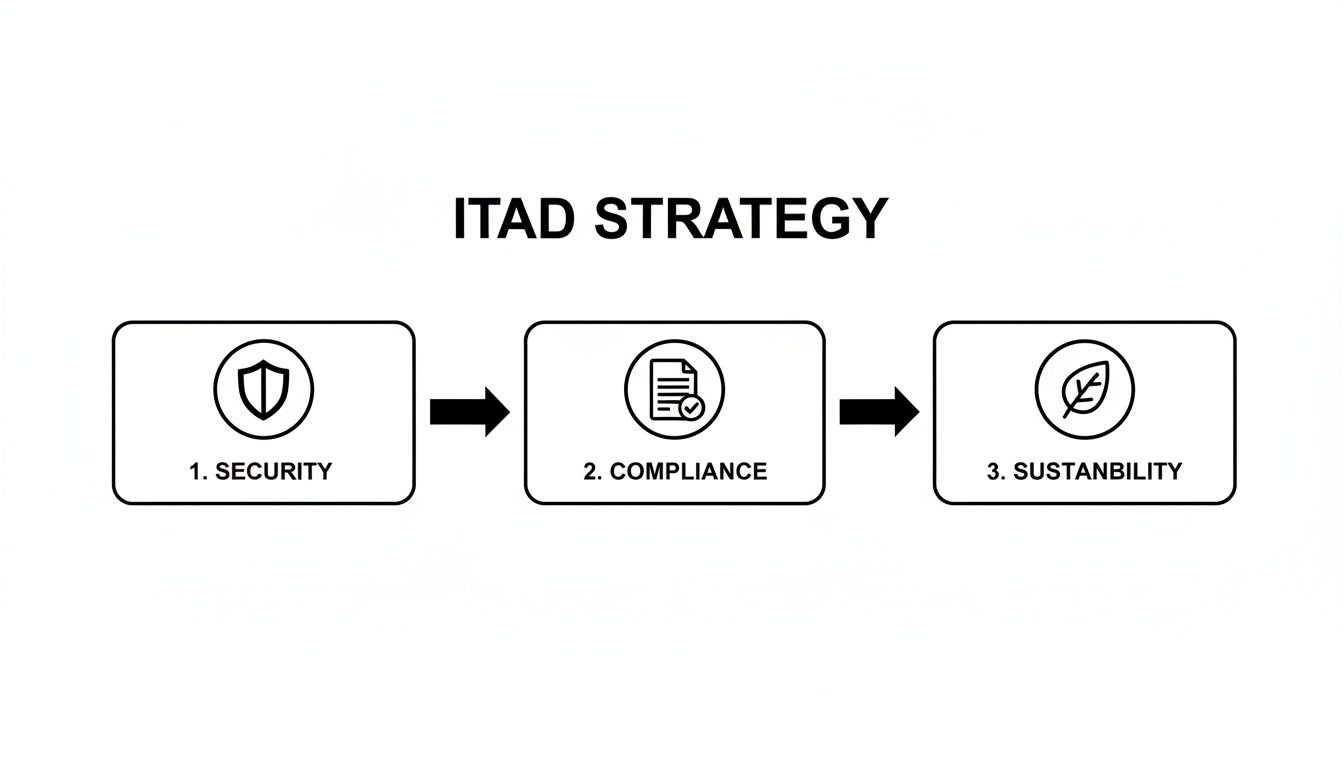
As you can see, these aren't separate jobs but interconnected parts of a single strategy for handling asset retirement correctly.
For Atlanta financial firms, the question isn’t just what to do with old IT assets, but how to do it in a way that is secure, documented, and defensible. An undocumented disposal process is a compliance failure waiting to happen.
Focussed on commercial services, Fulton Junk Removal operates under its parent company, Beyond Surplus, a circular, eco-friendly solution that goes beyond traditional junk hauling. We handle the physical junk removal for your office, warehouse, or property, while Beyond Surplus ensures every single electronic device is recycled responsibly and securely. This bundled service makes compliance and sustainability reporting far easier for your team. You can learn more about our specialized commercial services in Atlanta.
Understanding the specific compliance rules for financial institutions is crucial. As detailed in expert guides like SOC 2 for Fintech Companies, a rock-solid ITAD strategy is a foundational element of your entire security posture.
Before any hardware ever leaves your Atlanta office, your first line of defense isn't a locked truck—it's a meticulously built inventory. For financial firms, proper IT asset disposal starts with a detailed spreadsheet or asset management system. This isn't just paperwork; it's the foundation for your chain of custody and your key to surviving a regulatory audit.
Think about it. You're gearing up for an office-wide tech refresh, and soon you'll have piles of laptops, desktops, and networking gear. Without a precise inventory, you're flying blind. A good list turns that potential chaos into a controlled, documented process, ensuring every single data-bearing device is tracked from the moment it's unplugged until you get a final certificate of destruction.
What to Capture for Each Asset
A simple device count won't cut it, especially in the finance world. Compliance is everything. Your inventory needs to be granular enough to satisfy auditors for regulations like GLBA and SOX. Each entry should serve as a unique fingerprint for that piece of hardware.
For every single item being retired, your inventory must capture:
- Asset Type: Is it a server, laptop, firewall, company phone, or loose hard drive?
- Manufacturer and Model: For example, "Dell Latitude 7420" or "Cisco Catalyst 9300."
- Serial Number: This is the most important unique identifier. Don't skip it.
- Internal Asset Tag: Your company’s own tracking number.
- Last Known User/Department: Crucial for tracing data ownership and risk.
- Data Sensitivity Level: Classify the data on the device (e.g., Public, Internal, Confidential, Client PII).
With this level of detail, if an auditor ever asks about the disposal of a specific trader’s old laptop, you can pull its entire lifecycle record in seconds. No sweat.
Software vs. Spreadsheets
For smaller firms or a one-off project, a securely managed and encrypted spreadsheet might be all you need. It gets the job done. But as your firm grows, dedicated IT Asset Management (ITAM) software becomes a game-changer. These platforms automate tracking, slash human error, and can often integrate with network discovery tools to populate most of your inventory for you.
Whichever tool you choose, consistency is what matters most. The goal is to create a single source of truth for all end-of-life hardware. This document becomes the master list your ITAD vendor will reconcile against, verifying every asset they receive.
An incomplete inventory is more than just a logistical headache; it's a security and compliance failure. Every unaccounted-for device represents a potential data breach and a giant red flag for auditors.
A Practical Scenario: Decommissioning a Data Center
Let's walk through a common project: decommissioning a small, on-premise data center. The inventory process here gets even more intense. You aren't just dealing with a few laptops; you have servers, storage arrays (SANs), switches, and firewalls, all packed with highly sensitive financial data.
Your inventory needs to list not just the server chassis serial number, but the serial number of every individual hard drive and SSD inside it. For a single server with 24 drives, that means you have 25 separate line items on your inventory sheet. This is what a true, defensible chain of custody looks like.
At Fulton Junk Removal, we know that a large-scale cleanout often involves more than just electronics. That’s why we offer a bundled junk removal + recycling pickup solution. We can handle the removal of old furniture, fixtures, and general office junk, and all electronic waste and recyclable materials are directly processed by Beyond Surplus. This integrated approach simplifies the whole process for offices, warehouses, and property managers. To see how we can help with all your cleanout needs, check out our commercial removal services.
Choosing the Right Data Destruction Method for Financial Data
Once your assets are inventoried, you’ve reached the most critical moment in the IT disposal process: deciding how to destroy the sensitive data they hold. For an Atlanta financial firm, this is where the risk of a catastrophic data breach is won or lost. A single improperly wiped hard drive can instantly unravel years of client trust and shatter your compliance record.
The right choice comes down to a clear-eyed look at your data's sensitivity, your duties under frameworks like GLBA and SOX, and whether the physical asset has any resale value. Essentially, your options boil down to two main paths: physical destruction and data sanitization.
Physical Destruction: The Gold Standard for High-Risk Data
For assets that held the crown jewels of your firm—think proprietary trading algorithms, non-public client investment data, or internal M&A documents—physical destruction is the only acceptable answer. It’s the most definitive method, ensuring data is completely irretrievable because the media it was stored on is literally gone.
The two most common and effective methods we use are:
- Shredding: Exactly what it sounds like. We feed hard drives, SSDs, smartphones, and backup tapes into industrial-grade shredders that grind them into tiny, unsortable fragments. This is the ultimate guarantee of data obliteration.
- Degaussing: This technique uses an incredibly powerful magnetic field to instantly and permanently erase the magnetic data stored on hard drives and tapes. While it's perfect for magnetic media, keep in mind it doesn’t work on Solid-State Drives (SSDs).
From a compliance standpoint, physical destruction is the most defensible option in an audit. It simply leaves no room for doubt.
When you’re dealing with devices that held your firm's most guarded secrets, physical destruction provides absolute certainty. The Certificate of Destruction you receive isn't just a piece of paper; it’s documented proof that the data and the device are gone forever.
Data Sanitization: Wiping for Asset Reuse and Remarketing
What about those assets that are newer and still hold significant value? Think about the laptops from last year's tech refresh or servers being replaced before their time. Physically destroying them can feel like throwing money directly into the shredder. This is where data sanitization, or wiping, is the smart move.
This process involves specialized software that overwrites every single sector of a storage device with random data, often in multiple passes. When done correctly, this method renders the original data unrecoverable by any known forensic tool.
The key here is using a method that meets the NIST 800-88 "Purge" or "Clear" standards. A simple format or dragging files to the trash is a rookie mistake—that data is easily recovered. A multi-pass, certified wipe is the only way to ensure the information is gone for good.
The chart below shows how data security concerns are a massive driver for the ITAD market.
Chart from Grand View Research
The chart makes it clear: intense regulatory pressure and the sky-high cost of a breach are pushing firms toward more bulletproof data destruction practices. This makes the choice between wiping and shredding more critical than ever.
Sanitization's main benefit is preserving the hardware. This allows your firm to recoup value through remarketing or to donate the equipment to support local community initiatives. However, this path requires meticulous verification and documentation to prove it was done right. You can dive deeper into data protection strategies in other articles on the Fulton Junk Removal blog.
Data Destruction Methods Comparison for Financial Firms
Deciding between wiping and shredding requires a careful risk assessment. The pressure is immense; the global data destruction market is projected to hit a 28.9% share by 2025, driven by the astronomical costs of breaches, which could average $10.5 trillion worldwide. In the U.S., financial firms are major contributors to this trend, as data-heavy laptops accounted for 43% of the ITAD market in 2024.
To help guide your decision-making for your firm's IT asset disposal in Atlanta, we've put together this simple comparison.
| Method | Best For | Security Level | Compliance Alignment (NIST 800-88) | Asset Reuse Possible? |
|---|---|---|---|---|
| Physical Shredding | Highest-risk data, end-of-life assets, proprietary algorithms, client PII | Highest (Irreversible) | "Destroy" Standard | No |
| Degaussing | Magnetic media (HDDs, tapes) with sensitive data | High (Irreversible for magnetic) | "Purge" Standard | No |
| Data Wiping | Newer, valuable assets planned for remarketing or donation | High (If certified) | "Clear" or "Purge" Standard | Yes |
Ultimately, a strong ITAD policy often uses a hybrid approach. For example, laptops used by your C-suite and trading desks might be shredded on-site, while standard employee laptops from a recent refresh are wiped and resold. The most important thing is to make a conscious, documented choice for every single asset based on the data it contained.
How to Select a Compliant and Certified ITAD Vendor in Atlanta
Once you’ve inventoried your assets and settled on data destruction methods, the final step is finding the right partner to get the job done. For any financial firm in Atlanta, your ITAD vendor is far more than a junk hauler—they’re a direct extension of your security and compliance team.
Picking the wrong partner can unravel all your careful planning and expose your firm to staggering risk. Their credentials, processes, and paperwork must be strong enough to withstand the intense scrutiny of a regulatory audit. This isn't just about checking a box; it's about building your legal shield.
The Vendor Vetting Checklist
When you’re evaluating potential ITAD partners, don’t hold back. Ask the tough questions. A truly professional vendor will welcome the diligence and provide clear, direct answers. Their transparency is often the first and best indicator of their reliability.
Before you sign on the dotted line, make sure any vendor can give you solid answers on these non-negotiables:
- Certifications: Are they R2 (Responsible Recycling) or e-Stewards certified? These are the undisputed gold standards, guaranteeing they follow strict protocols for both environmental safety and data security.
- Chain of Custody: How do they track and document assets from the moment they leave your facility to their final destruction? Ask to see sample reports. They should be detailed, asset-specific, and leave no room for error.
- Certificates of Data Destruction: Do they issue a legally defensible Certificate of Data Destruction (CoDD) after every single project? This document needs to list each asset by serial number and confirm the exact date and method of destruction.
- Employee Security: Are the employees who will be handling your sensitive assets background-checked and properly trained? Secure handling during transport is just as critical as the final destruction process.
Performing comprehensive third-party due diligence isn't just a suggestion; it’s a mandatory step to verify a vendor’s claims and protect your firm from downstream liability.
A Local Partner with an Integrated Solution
For businesses and property managers across the Atlanta area, choosing a local provider creates real advantages in logistics, scheduling, and responsiveness. This is where the integrated model of Fulton Junk Removal and our parent company, Beyond Surplus, offers a clear edge.
Fulton Junk Removal handles the physical removal of everything you need gone—from old office furniture and cubicles to general clutter. Meanwhile, Beyond Surplus ensures every single electronic asset is processed according to the highest industry standards for security and sustainability.
An ITAD vendor isn't just a service provider; they are your compliance partner. Their documentation is your documentation. If their records are weak, your audit defense will be too.
This bundled service makes everything simpler. Instead of coordinating a junk hauler and a separate certified e-waste recycler, you get one seamless pickup. All electronics collected by our Fulton Junk Removal crews are processed directly by Beyond Surplus, guaranteeing a responsible, documented, and compliant outcome. This integrated approach also makes sustainability reporting much easier for your team.
You can learn more about this unique partnership by reading about the Fulton Junk Removal and Beyond Surplus partnership.
Understanding Market Trends
The ITAD market is growing fast, especially as financial firms accelerate hardware refreshes and navigate tightening e-waste regulations. The server disposition segment alone is on track to capture 31.2% of the market share in 2025. The overall U.S. market is forecasted to grow at a CAGR of 11.4% between 2025 and 2030.
To combat rising cybersecurity threats, more firms are shipping assets directly to ITAD specialists. That trend grew by 5% between 2023 and 2025 alone, with a heavy reliance on automation to create audit-proof tracking.
A qualified vendor in Atlanta will not only understand these dynamics but have the secure logistics and real-time tracking infrastructure to match. By choosing a certified and compliant partner, you’re not just getting rid of old equipment—you’re investing in audit-proof documentation and genuine peace of mind.
Turning Plans Into Action: The Disposal and Recycling Phase
Once you’ve done the hard work of inventorying your assets and picking the right vendor, it's time for the final, most critical step: getting those assets out of your building securely and responsibly. This is where the rubber meets the road. For Atlanta’s financial firms, it’s not just about removal; it’s about flawless execution, secure transport, and proving your commitment to sustainability.
The second your equipment leaves the premises is your moment of highest risk. That documented chain of custody is the only thing connecting your inventory list to the final certificate of destruction. It’s the audit-proof evidence that regulators will ask for, and any gap is a liability you can't afford.
Secure Logistics and On-Site Execution
A professional ITAD pickup isn't a rushed, chaotic affair. It’s a quiet, methodical process designed to cause zero disruption to your daily operations. Your vendor’s team should show up ready to work like a security detail, not just a moving crew.
Here’s what that looks like on the ground:
- They’ll reconcile every single asset against your inventory list, scanning serial numbers on-site to confirm nothing is missed.
- Assets are then packed into locked, sealed containers for transport. This isn't negotiable—it prevents any unauthorized access while the truck is on the road.
- A clear chain of custody is maintained from your office door to their secure facility, often using GPS-tracked vehicles and documented handoffs.
This isn't about speed; it's about precision. The goal is to transfer custody with zero ambiguity, creating a perfect paper trail.
A secure pickup should feel like a non-event. The vendor's team comes in, verifies everything, secures it, and leaves. It’s a smooth, documented handoff that proves every device was handled correctly from start to finish.
A Circular Model That Actually Works
This is also where your sustainability goals become a reality. Most junk removal companies have one destination in mind: the landfill. It’s an outdated model that’s bad for the environment and a complete waste of resources. This is exactly why Fulton Junk Removal’s approach, powered by our parent company Beyond Surplus, is different.
We don’t think in straight lines. We operate on a circular, eco-friendly model focused on diverting materials for reuse and recycling. When you hire Fulton Junk Removal, you’re not just clearing out old equipment—you’re kicking off a responsible recovery process.
Office, warehouse, and property managers love this bundled service because it simplifies everything. Fulton handles junk removal, and Beyond Surplus ensures responsible recycling, making compliance and sustainability reporting easier. All e-waste is processed directly by Beyond Surplus, slashing landfill waste and maximizing material recovery.
Proving Your Environmental Commitment
Getting toxic e-waste out of Georgia's landfills is a huge win, but you also need to prove it. This strengthens your firm's Corporate Social Responsibility (CSR) efforts and gives you concrete data for annual reports and stakeholder updates. The key is the diversion report.
This is a simple but powerful document from your recycling partner that quantifies your impact. It shows:
- The total weight of all materials collected.
- A breakdown of materials by type (electronics, metals, plastics, etc.).
- Confirmation of how much material was diverted from landfills for recycling or reuse.
Suddenly, your ITAD project isn't just a line item expense; it's a documented victory for your company’s green initiatives. It provides tangible proof that your firm is walking the walk on corporate citizenship. This integrated approach—combining junk removal with certified e-recycling—makes compliance and sustainability reporting effortless.
If you're ready to see how a secure and truly sustainable disposal project works in practice, you can easily get in touch with our team to schedule a pickup.
Common Questions About IT Asset Disposal in the Financial Industry
If you’re an IT, operations, or property manager at an Atlanta financial firm, you know that disposing of old IT equipment is a high-stakes job. It's a mix of intense security needs, strict compliance rules, and environmental responsibilities.
We get a lot of questions from firms navigating this process. Here are the straight-up, practical answers to the concerns we hear most often.
How Can We Be Sure Our Data Is Truly Destroyed?
This is always the top concern, and rightly so. The answer comes down to one word: proof. It's not enough for a vendor to say they destroyed your data—they have to prove it with documentation. For any financial institution, a Certificate of Data Destruction (CoDD) isn't just nice to have; it's mandatory.
A legitimate CoDD is a legal document, not just a receipt. It should list every single device by its unique serial number, detail the exact destruction method (like a NIST 800-88 compliant wipe or physical shredding), and confirm the date of destruction. For the most sensitive data, nothing beats on-site physical destruction, where you can literally watch your hard drives turn into confetti.
What Is the Difference Between a Junk Hauler and a Certified ITAD Vendor?
There’s a world of difference. A typical junk hauler’s job is to get stuff off your property, and while most junk removal companies take everything to the landfill, Fulton Junk Removal recycles through Beyond Surplus to minimize waste and maximize reuse. A certified IT Asset Disposition (ITAD) vendor is a security partner whose entire process is built around compliance and data protection.
This is where Fulton Junk Removal's integrated model comes in. We operate as a full-service commercial junk removal company, but with a crucial distinction: we work hand-in-hand with Beyond Surplus, a certified electronics recycler.
This partnership gives you the best of both worlds:
- Fulton Junk Removal clears out all the non-technical junk—furniture, debris, and clutter.
- Beyond Surplus takes every piece of electronics and processes it securely and sustainably.
This means property and office managers get a single, streamlined solution for a complete cleanout, with one point of contact and one set of paperwork. This appeals to environmentally conscious businesses.
What Do We Do with Non-IT Junk During an Office Cleanout?
An office decommissioning is never just about computers. There are always desks, chairs, filing cabinets, and cubicle walls that a specialized ITAD-only company won't touch. Trying to coordinate a separate junk hauler and an e-waste vendor is a logistical nightmare.
Our bundled service solves this exact problem. Fulton can offer a bundled junk removal + recycling pickup, where all electronic waste and recyclable materials are directly processed by Beyond Surplus. We show up and haul away all the general office junk while our team also collects the retired IT assets. We turn a complicated, two-vendor headache into one simple, efficient operation.
How Can We Prove Our Disposal Process Was Sustainable?
Proving your commitment to sustainability for corporate social responsibility (CSR) and ESG reports requires more than just good intentions. You need hard data. A credible partner will provide you with a diversion report or a carbon reduction receipt after the project is done.
These reports give you tangible metrics, including:
- The total weight of materials successfully diverted from the landfill.
- A detailed breakdown of recycled commodities (metals, plastics, etc.).
- The estimated carbon emissions avoided by choosing recycling over the landfill.
This is the data you need for your annual sustainability reports and stakeholder updates. Because Fulton Junk Removal works directly with Beyond Surplus, we ensure you get the documentation to make your firm's green initiatives measurable and defensible.
A vendor who can’t provide documentation of their landfill-free policy and diversion metrics is not a true sustainability partner. They’re just another hauler. Vague promises of "green disposal" are a red flag; demand verifiable data.
Ultimately, a strong IT Asset Disposal for Atlanta Financial Firms strategy depends on a partner who gets the intersection of security, compliance, and sustainability. Your vendor's process becomes your process, and their paperwork becomes your proof in an audit. Choosing a partner who offers an integrated, documented, and transparent service is the key to managing this critical business function.
Ready to simplify your office cleanout and ensure responsible IT asset disposal? Fulton Junk Removal offers bundled junk removal and certified electronics recycling to make compliance and sustainability reporting easier for Atlanta's offices, warehouses, and property managers. Visit us at https://fultonjunkremoval.com to get a free estimate today.
