
Recycle Electronics Atlanta | Secure Business Disposal 2026
Old laptops in a locked closet. Retired desktops under a warehouse rack. A stack of monitors waiting for “when we have time.” That’s how electronics disposal usually starts in Atlanta businesses. It doesn’t look urgent until a move, an office refresh, a lease turnover, or an audit puts those devices back on the agenda.
For commercial teams, the problem isn’t just getting rid of equipment. It’s deciding how to remove it without creating a data exposure issue, a documentation gap, or another truckload headed straight to a landfill. Generic junk hauling can clear space fast, but that isn’t the same as responsible electronics recycling. When businesses search for ways to recycle electronics Atlanta, they usually need more than a drop-off list. They need a process that holds up operationally and on paper.
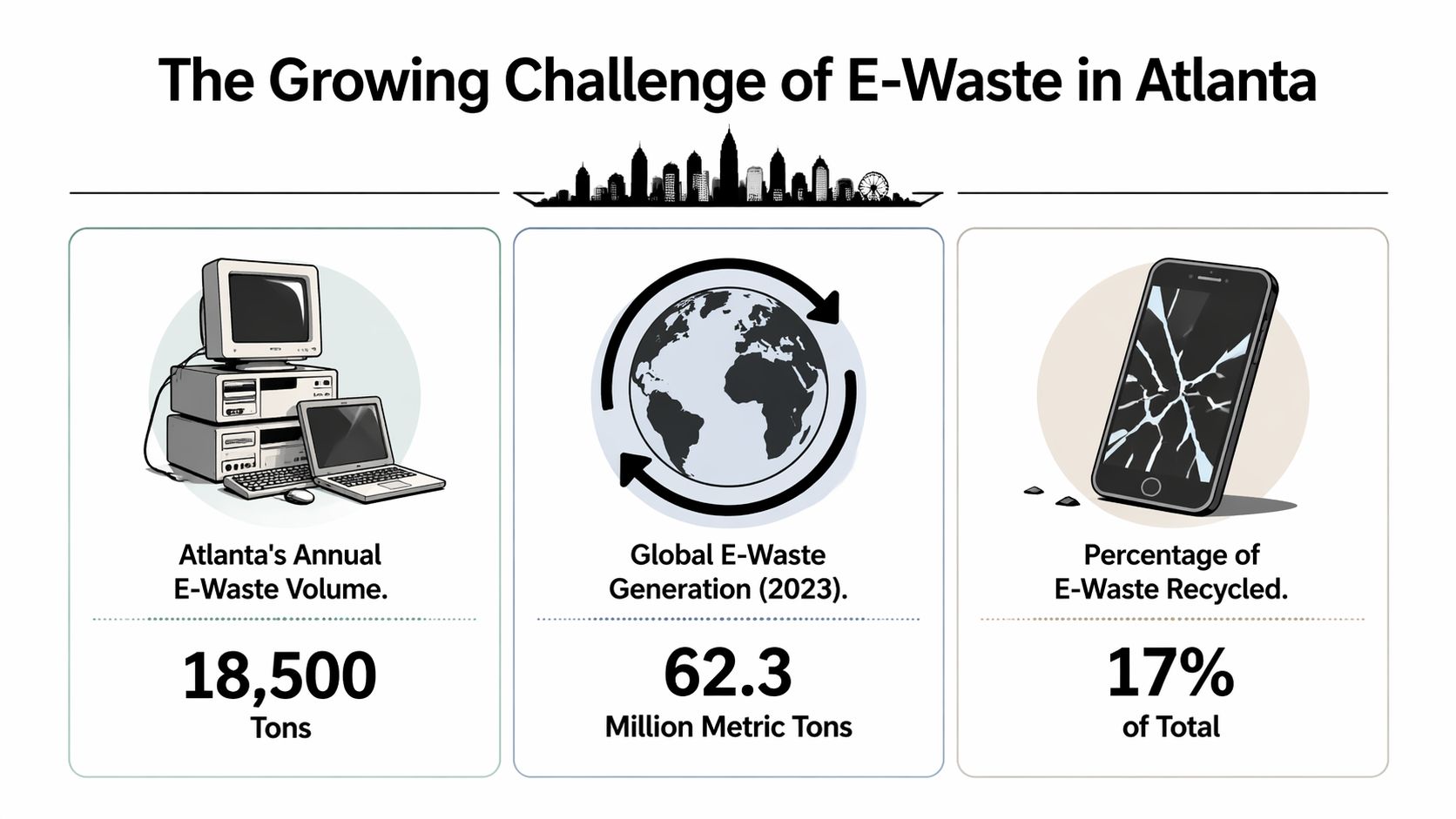
The Growing Challenge of E-Waste in Atlanta
Most office managers know the pattern. The company upgrades laptops, swaps out networking gear, replaces front-desk workstations, and pushes the old equipment into storage “for later.” Later turns into years. Eventually, the pile includes hard drives, monitors, printers, docking stations, and miscellaneous cables no one wants to claim.
That backlog is more than clutter. It’s deferred risk. Devices sitting in back rooms still carry business data concerns, and once they’re handled casually, they can disappear into mixed loads that no one tracks.
The scale of the problem is hard to ignore. In 2022, the world generated 62 million tonnes of electronic waste, and that figure is projected to rise to 82 million tonnes by 2030, while only 22.3% was properly collected and recycled, according to Atlanta Computer Recycling’s summary of global e-waste trends. For Atlanta businesses, that global gap shows up locally as overloaded storage rooms, inconsistent disposal habits, and too many “free” options that don’t address compliance.
What businesses get wrong
The biggest mistake is treating electronics like ordinary junk. They aren’t. A broken chair and a retired server don’t belong in the same decision tree.
A few common failures show up again and again:
- Storage becomes disposal by delay. Teams hold old devices because they don’t know who owns the decision.
- Hauling happens before inventory. Equipment leaves the site, but no one records model, serial, or user assignment.
- Convenience wins over chain of custody. The load gets removed, but the business can’t prove what happened next.
- Landfill assumptions go unchallenged. Many haulers are built to clear volume, not separate reusable and recyclable material streams.
Practical rule: If a vendor can remove electronics but can’t explain the downstream handling, your risk hasn’t been removed. It’s been transferred out of sight.
A circular model works differently. Instead of treating all outgoing material as waste, it separates what can be refurbished, what requires secure data destruction, and what should be dismantled for material recovery. That matters for sustainability reporting, but it also matters for practical operations. Facilities teams can reclaim space without creating a paperwork problem for IT or procurement later.
Businesses looking for ongoing disposal guidance can also review additional operational examples on the Fulton Junk Removal blog.
Why this matters in Atlanta
Atlanta has plenty of activity around recycling, donation, cleanouts, and office turnover. The issue isn’t whether options exist. The issue is whether those options match the needs of a business that has devices, deadlines, and accountability requirements.
The trade-off is simple. The fastest removal route is often the least documented. The most responsible route requires planning, but it gives the business control over data handling, material diversion, and final records. For commercial cleanouts, that’s usually the difference between “it’s gone” and “it was handled correctly.”
Secure Your Data and Prepare Devices for Disposal
Before any device leaves your building, handle the data side first. That sounds obvious, but it’s where many disposal projects fail. A rushed cleanout can remove equipment quickly and still leave the company exposed if no one documented what was collected, who released it, and how the drives were sanitized.

Start with an asset inventory
The first control point is a clean inventory. That means capturing asset tags, serial numbers, device type, department, and physical location before pickup. For IT teams, this is basic chain of custody. For property managers and operations leads, it’s the only way to reconcile what left the site.
Use a simple release list if you have to. A spreadsheet is better than memory. What doesn’t work is staging everything in a loading area and trying to identify it after the truck is packed.
A practical pre-disposal checklist should include:
- Identify the devices. Record laptops, desktops, servers, monitors, printers, mobile devices, and loose drives.
- Confirm internal ownership. Note whether the equipment belongs to IT, a tenant, a department, or a former employee pool.
- Flag storage media separately. Loose hard drives, SSDs, backup tapes, and removable media need their own handling.
- Designate an authorized releaser. One person should sign off on what leaves the site.
Choose the right data sanitization method
Not every device needs the same treatment. What matters is choosing a method that fits the media type and the business risk.
According to Reworx Recycling’s ITAD process overview, data sanitization includes DoD 5220.22-M certified wiping, degaussing, or physical shredding. The same source notes that hard drive shredding to less than 2mm particles achieves 100% data irrecoverability, and that sorting can divert 40% to 60% of corporate e-waste to refurbishment. That combination matters because secure handling and circular recovery aren’t opposites. Done correctly, they support each other.
Here’s how the methods differ in practice:
- Software wiping works when devices are functional and the media supports overwriting.
- Degaussing is used for magnetic media where demagnetization is appropriate.
- Physical shredding is the most final option for drives that contain sensitive data or can’t be reliably wiped.
If there’s any uncertainty about whether a drive is readable, damaged, or needed for business continuity, pause disposal and involve technical review first.
For organizations that discover they still need data from a failed drive before destruction, professional data recovery services can be a useful resource to assess whether recovery is possible before the asset enters the destruction stream.
Prepare devices for safe handling
Data isn’t the only issue. Physical preparation affects transport safety and downstream processing.
Use these field-tested habits:
- Remove or isolate damaged batteries. Swollen or compromised batteries need separate handling.
- Keep accessories with systems when useful. Power supplies, docks, and keyboards help with reuse evaluation.
- Don’t mix electronics with general debris. Construction waste, food waste, and office trash contaminate loads fast.
- Label pallets or gaylords by category. Monitors, computers, printers, and loose storage media shouldn’t travel as one unmarked batch.
What works and what doesn’t
What works is a documented handoff. IT signs off. Facilities stages the equipment. The recycler or pickup crew receives a known list.
What doesn’t work is the common shortcut: “Those are old anyway, just take them.” That phrase has caused a lot of preventable headaches.
A device doesn’t stop being a record-bearing asset because it’s outdated. If your business wants to recycle electronics in Atlanta without creating avoidable risk, the prep phase is where the project is won or lost.
Evaluating Atlanta's Electronics Recycling Methods
Businesses in Atlanta usually end up choosing between three routes. They can self-haul to a drop-off site, wait for a community event, or schedule a pickup service. Each option can work, but they do not solve the same problem.
For a homeowner with a single keyboard and an old laptop, a drop-off may be fine. For an office suite with retired workstations and compliance obligations, it often isn’t.
The limits of free options
“Free recycling” sounds clean on paper. In practice, it often comes with restrictions that affect commercial users the most. Bulky items can trigger fees. Certain devices may be rejected. Event schedules may not line up with move-out or project timelines.
As noted by Keep North Fulton Beautiful’s electronics guidance, many Atlanta-area drop-off programs now charge fees for TVs and computer monitors, reject some items such as console TVs, and bulky item recycling fees rose 20% in 2025. That doesn’t make these programs bad. It means businesses should read the acceptance rules before they start stacking CRTs and monitors by the loading dock.
Free works best when your material matches the event’s accepted list, your timing is flexible, and you don’t need formal documentation.
What businesses should compare
Convenience is only one factor. For commercial disposal, the primary decision criteria are chain of custody, reporting, accepted materials, and disruption to staff time.
Here’s the side-by-side view.
| Method | Best For | Data Security | Compliance Reporting | Convenience | Typical Cost |
|---|---|---|---|---|---|
| Community drop-off event | Small residential loads, simple consumer devices | Limited, varies by event | Rarely suitable for business audit needs | Low for businesses, because staff must sort, load, and transport | Sometimes free, but specialty items may carry fees |
| Permanent drop-off center | Small organizations with a few devices and internal transport capacity | Better than curbside, but documentation may be limited | Varies by provider | Moderate, depends on site hours and item restrictions | Mixed, often affected by item type |
| General junk hauler | Fast clearing of mixed office contents | Often unclear unless electronics handling is specifically documented | Often limited for electronics-specific needs | High for clearing space | Bundled hauling cost, but downstream handling may be opaque |
| Integrated pickup with recycling backend | Offices, warehouses, property turnovers, multi-category loads | Strongest option when chain of custody and destruction records are included | Best fit for internal controls and sustainability records | High, because pickup and sorting are coordinated | Project-based, but operationally efficient |
For businesses comparing bundled removal and recycling options, the commercial service lineup from Fulton Junk Removal shows the kind of mixed-load projects that often benefit from one coordinated pickup rather than separate vendors.
Where generic hauling falls short
Typical junk hauling is optimized for speed. That’s useful when the only goal is clearing square footage. It becomes a weak fit when your outgoing load includes hard drives, employee laptops, point-of-sale equipment, medical electronics, or inventory systems.
The problem isn’t that every hauler disposes irresponsibly. The problem is that many aren’t structured around electronics-specific controls. They may not separate reusable assets from scrap. They may not issue the paperwork your EHS team needs. They may not be able to tell you whether a batch was refurbished, dismantled, or discarded.
A business should ask a short list of questions before approving any removal method:
- Will you provide a chain-of-custody record for collected electronics?
- How is data-bearing media handled once it leaves the site?
- Can you document destruction and diversion?
- Are there fees or exclusions for monitors, TVs, batteries, or specialty equipment?
The right method depends on the risk
If your load is small, low-risk, and non-urgent, a drop-off route may be enough. If your project includes office furniture, old electronics, loose storage media, and a deadline, fragmented disposal usually creates more work than it saves.
That’s the practical reality behind most recycle electronics Atlanta decisions. The method that looks cheapest at the start can become the most expensive in staff time, project delay, and missing documentation.
Why Certified Recycling is Non-Negotiable for Businesses
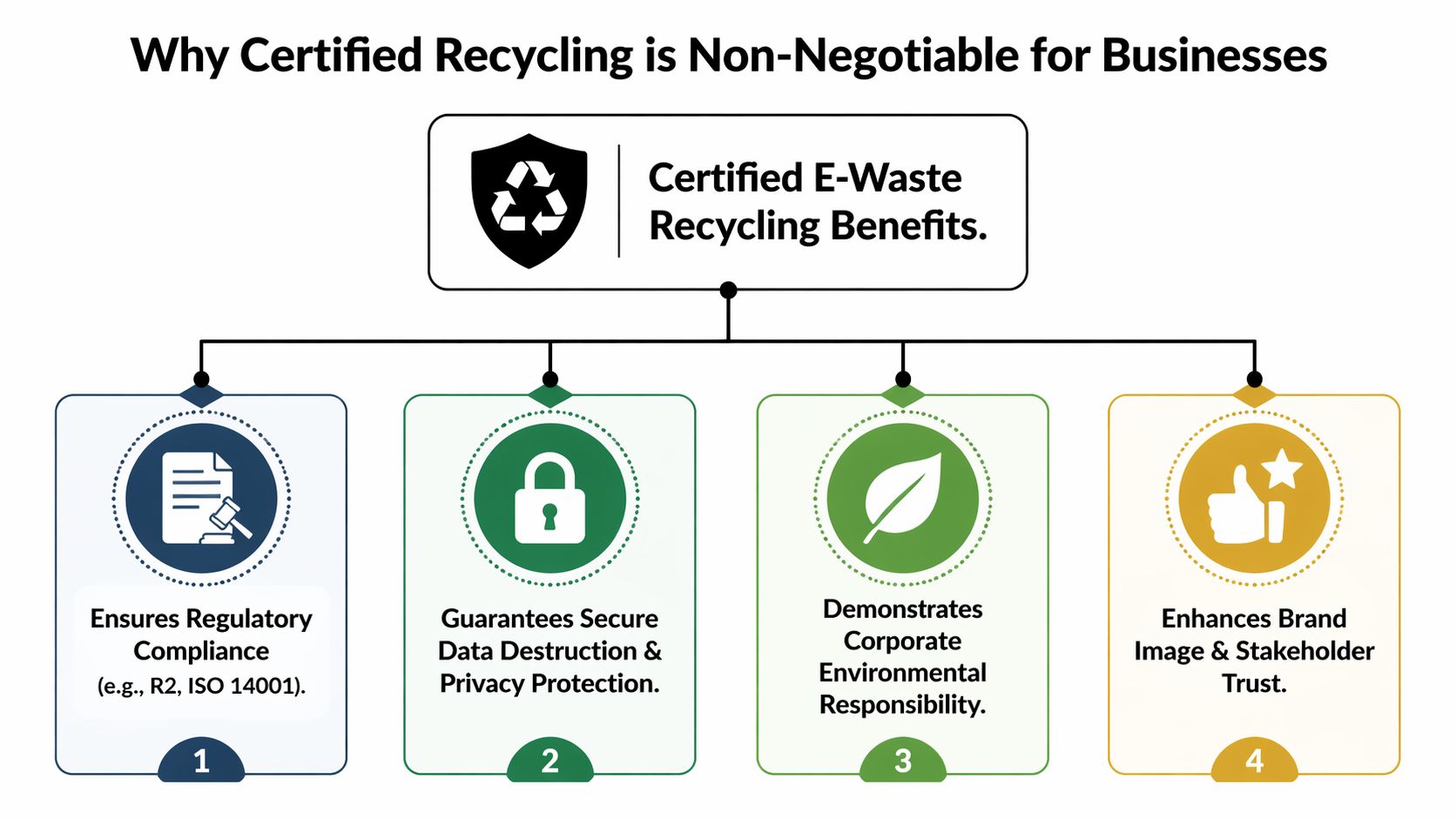
Businesses don’t need certification language because it sounds impressive. They need it because electronics disposal sits at the intersection of privacy, environmental handling, and internal accountability. If a vendor can haul devices away but can’t back up the process with recognized controls and records, the business is left trusting a blind spot.
That’s why certification matters. It gives procurement, IT, and compliance teams a framework for asking the right questions before material leaves the premises.
Why the paperwork matters as much as the pickup
A clean truck and a fast crew don’t prove compliant disposal. Documentation does. Businesses need to know how data-bearing equipment was sanitized, whether custody was maintained, and what records will exist if legal, finance, or security teams ask later.
According to Atlanta Computer Recycling’s discussion of secure electronics recycling, data security is the top barrier for 60% of businesses considering e-waste recycling, and many Atlanta resources still don’t explain how to verify provider compliance for audits or how to comply with Georgia’s data breach law under O.C.G.A. § 10-1-911. That gap is exactly why generic disposal advice falls short for commercial users.
A business shouldn’t have to guess whether a recycler’s claims are enough. It should ask for records.
What to verify before approving a recycler
The strongest vendors can explain their process plainly and provide supporting documents without hesitation.
Look for these checkpoints:
- Chain of custody. You need a record of what was picked up and when responsibility transferred.
- Data destruction documentation. A Certificate of Destruction closes the loop for drives and data-bearing devices.
- Process transparency. The vendor should explain wiping, shredding, degaussing, sorting, and downstream handling in clear terms.
- Audit readiness. If your organization faces internal reviews, the disposal file should stand on its own.
Certified recycling turns disposal from a vague operational task into an auditable business process.
Compliance isn’t limited to one regulation
Many companies focus only on privacy or only on sustainability. In reality, disposal decisions touch both. If your organization handles payment data, health data, customer records, HR files, or internal financial systems, disposal practices should align with the broader control environment your company already maintains. Teams reviewing adjacent security obligations may also find PCI compliance guidance for SMBs helpful when thinking about how disposal fits into a larger data-protection program.
Certification also strengthens ESG reporting because it helps substantiate diversion and responsible handling claims. That matters when sustainability managers are asked to support annual reporting with more than a general statement.
Why integrated service helps commercial teams
An office cleanout often involves more than electronics. There may be furniture, pallets, obsolete marketing displays, shelving, cable bundles, and old fixtures in the same project. Splitting those streams across multiple vendors can work, but it increases scheduling and documentation complexity.
For mixed commercial loads, Fulton Junk Removal works with Beyond Surplus to combine haul-away logistics with certified recycling workflows and the documentation businesses often need after the pickup. Company background and service approach are outlined on the about page for Fulton Junk Removal.
That integrated model matters because the business gets one coordinated removal event while still preserving the controls expected for electronics. For many property managers and operations leads, that’s the practical middle ground between convenience and auditability.
Your Integrated Junk and E-Waste Removal with Fulton
For commercial projects, the best process is the one people can follow under deadline. Office closures, warehouse reconfigurations, and tenant turnovers rarely happen on a leisurely timeline. The disposal workflow needs to be simple enough for facilities, IT, and operations to coordinate without creating duplicate work.
How the bundled process works
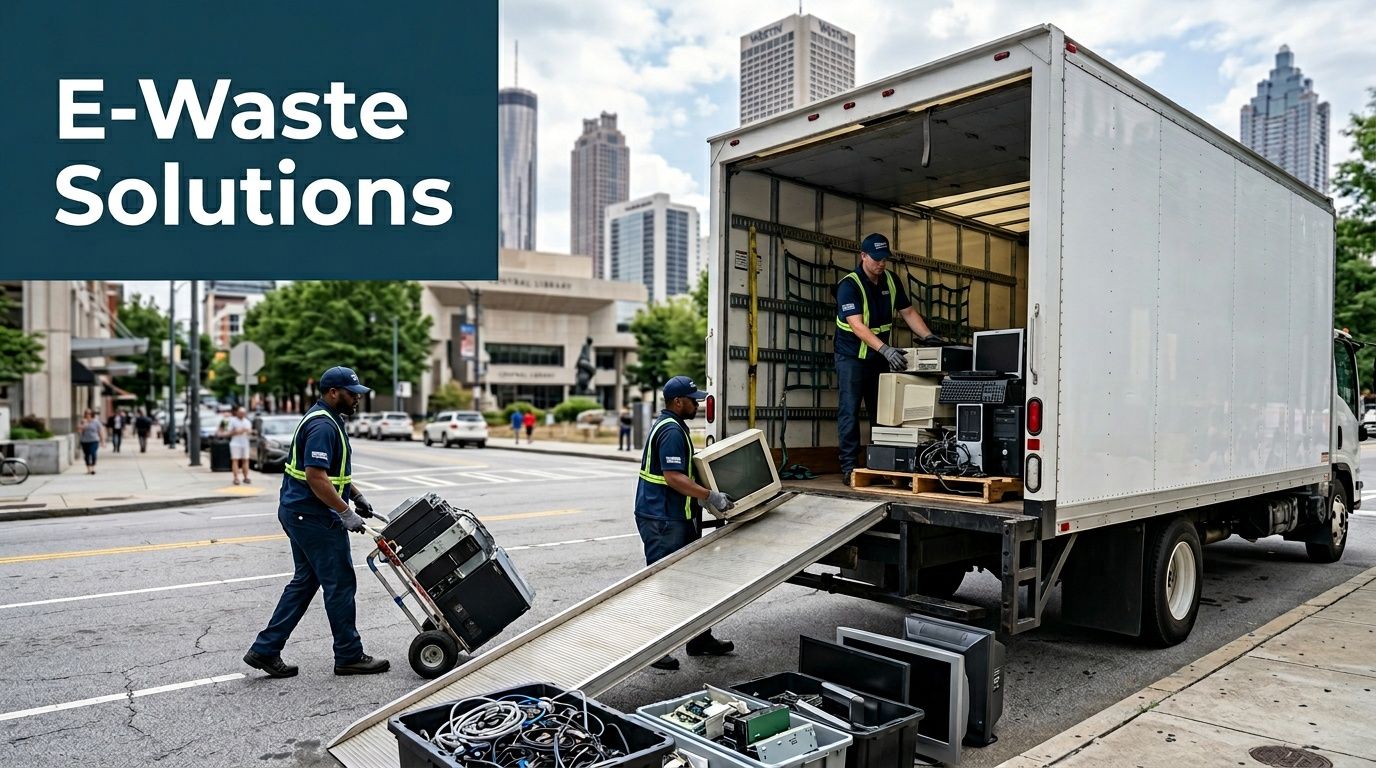
The practical advantage of an integrated model is that general junk and electronics can move in one project while still going through separate downstream paths.
A typical commercial workflow looks like this:
Initial scoping
The business identifies what’s leaving the site. That may include office furniture, boxed electronics, loose drives, printers, servers, or warehouse miscellany. The point is to define the material categories early so the pickup plan matches the risk profile.On-site pickup and separation
Crews remove the material and keep electronics distinct from ordinary junk and recyclable metal streams. At this stage, mixed-load jobs either stay organized or go sideways.Backend electronics processing
Data-bearing devices move into secure handling and approved recycling workflows. Reusable equipment can be assessed for refurbishment, while end-of-life units move into dismantling and material recovery.Final documentation
The business receives the records needed to close out the project internally, including destruction documentation where applicable and diversion reporting for sustainability or facilities files.
Why this model works better for mixed cleanouts
The main operational gain is fewer handoffs. Property teams don’t have to book a junk hauler for furniture, a separate recycler for computers, and another specialty provider for residual electronics. Fewer vendors means fewer appointment windows, fewer points of failure, and fewer chances for devices to be staged incorrectly.
That backend matters too. According to eWaste ATL’s overview of electronics recycling outcomes, Atlanta-area providers using advanced sorting and refurbishment achieve 75% to 90% diversion from landfills, recover 98% of precious metals from dismantled components, and note that Certificates of Destruction are key for GDPR/SOX compliance. Those are exactly the kinds of outcomes businesses should look for after the truck leaves.
The pickup is only half the service. The real value is in what happens after collection and what proof comes back to the client.
Best fit projects
This kind of service tends to work well for:
- Office decommissions where desks, chairs, monitors, and old endpoints all leave at once
- Warehouse cleanouts that include outdated scanners, terminals, network gear, and scrap metal
- Property turnovers where management needs a single vendor path for abandoned electronics and general contents
- Multi-site refreshes where standard paperwork matters as much as physical removal
Commercial customers planning pickups in the city can review Atlanta service coverage to confirm local availability and scheduling context.
Making Smart, Sustainable Disposal the Easy Choice
The hard part isn’t recognizing the problem. Most businesses already know when electronics have piled up too long. The hard part is choosing a disposal method that clears space without creating uncertainty around data, reporting, or landfill impact.
Atlanta businesses are operating in a market where e-waste volumes keep rising and responsible handling still isn’t automatic. As noted by Beyond Surplus on Atlanta’s disposal challenges, only 17.4% of e-waste is properly recycled, and choosing a certified service helps businesses support sustainability mandates while contributing positively to the local economy and environment. That’s the practical business case in one sentence. Responsible recycling protects more than the planet. It protects process integrity.
What the smart choice looks like
A strong disposal decision usually has four traits:
- It removes the material on schedule so operations can move forward
- It protects data-bearing equipment with documented handling
- It separates electronics from general waste streams instead of treating everything as trash
- It produces records your team can keep for audits, internal reviews, or ESG reporting
Generic hauling solves the first item. Commercial electronics recycling should solve all four.
The standard businesses should expect
If you manage facilities, IT assets, or property turnovers, you shouldn’t have to choose between convenience and compliance. A coordinated removal model gives you both. General junk can be cleared. Electronics can be handled through proper recycling channels. The business can keep the paperwork that proves the job was done correctly.
That’s the standard worth setting for any company trying to recycle electronics in Atlanta without wasting staff time or accepting unnecessary risk. If your storage room is full, your lease deadline is close, or your next hardware refresh is already underway, it’s a good time to move the project out of “later” and into a documented plan.
For scheduling and project questions, contact the Fulton Junk Removal team.
If your office, warehouse, or property needs a single removal project that accounts for both general junk and responsible electronics handling, Fulton Junk Removal can help you scope the job, coordinate pickup, and keep the disposal process documented from collection through final reporting.
