
Sustainable Telecom Recycling Dallas: Secure E-Waste & Data
A Dallas office cleanout usually starts with a space problem and ends as a risk problem.
The storage room has old desk phones in banker boxes, a stack of routers from the last internet changeover, access points in a cabinet, cracked monitor stands, cable bundles, and a rolling cart nobody wants to claim. Facilities wants the room back. IT wants nothing to leave the building without documentation. Property management wants the job done before the next tenant walkthrough.
That's where sustainable telecom recycling Dallas stops being a feel-good phrase and becomes an operations decision. Telecom gear isn't just clutter. Some of it still has resale or reuse value. Some of it contains configuration data, call settings, or network information. Some of it belongs in a certified recycling stream. Some of it is just junk, but it still has to move out without creating a mess for your team.
A standard junk pickup often solves only the visible part of the problem. The room gets emptied, but nobody can clearly explain which items were reused, which were recycled, what happened to data-bearing devices, or what records exist if procurement, compliance, or legal asks later.
Businesses with multiple sites run into this even faster. One office closeout turns into a regional project. One telecom refresh turns into furniture removal, wire closet cleanup, palletized electronics, and mixed debris from several departments. That's why companies often look for providers that can manage both cleanout logistics and responsible downstream handling across Fulton service areas.
The Hidden Challenge in Your Dallas Office Cleanout
Why telecom gear creates a different kind of cleanout
A file cabinet is easy. A broken chair is easy. Legacy telecom equipment isn't.
The hard part is that office and property teams usually inherit a mixed pile of assets with different handling rules. A VoIP phone might look disposable to one person and sensitive to another. An old firewall may be physically small but operationally important because it once held network settings. A box of broadband gear may include items that should be refurbished, traded in, or securely recycled instead of tossed into a generic haul-away stream.
Practical rule: If a device ever connected to your network or your carrier environment, treat it as an asset first and trash second.
Dallas businesses also deal with timing pressure. Leases end. Renovation crews need access. New tenants want broom-clean space. During that rush, teams make bad disposal decisions because the easiest path looks good enough.
It usually isn't.
What works and what usually fails
What works is a staged process. Separate data-bearing telecom hardware from obvious trash. Identify assets that may still belong in a return, trade-in, or refurbishment path. Then coordinate the physical removal so the cleanout doesn't drag on for weeks.
What fails is combining everything into one undifferentiated junk pile and asking questions later. Once routers, phones, switches, and cabling disappear into a mixed load, documentation gets weak fast. So does accountability.
A useful way to think about this is simple:
| Cleanout item | Better handling path |
|---|---|
| Routers, switches, firewalls, VoIP phones | Secure asset handling with documented downstream processing |
| Broadband modems and customer premise gear | Evaluate return, trade-in, refurbishment, or certified recycling |
| Scrap cable, metal shelving, broken fixtures | Material recovery or junk removal stream |
| General office debris | Standard haul-away |
The businesses that handle this well don't treat telecom disposal as a side task. They treat it as part of site closeout, security, and sustainability at the same time.
What Sustainable Telecom Recycling Actually Means
A Dallas office cleanout usually produces two very different waste streams at the same time. One is obvious junk. The other is telecom equipment that still has reuse value, return obligations, recoverable material, or security requirements. Sustainable telecom recycling starts by separating those paths before a loader starts clearing rooms.
Sustainable telecom recycling keeps equipment in service where that still makes business sense, then sends the remainder through documented refurbishment, parts recovery, and certified material processing. In practice, that means asking a harder question than “Who can pick this up?” The right question is “What is the best end-of-life path for each category of gear, and who can document it?”
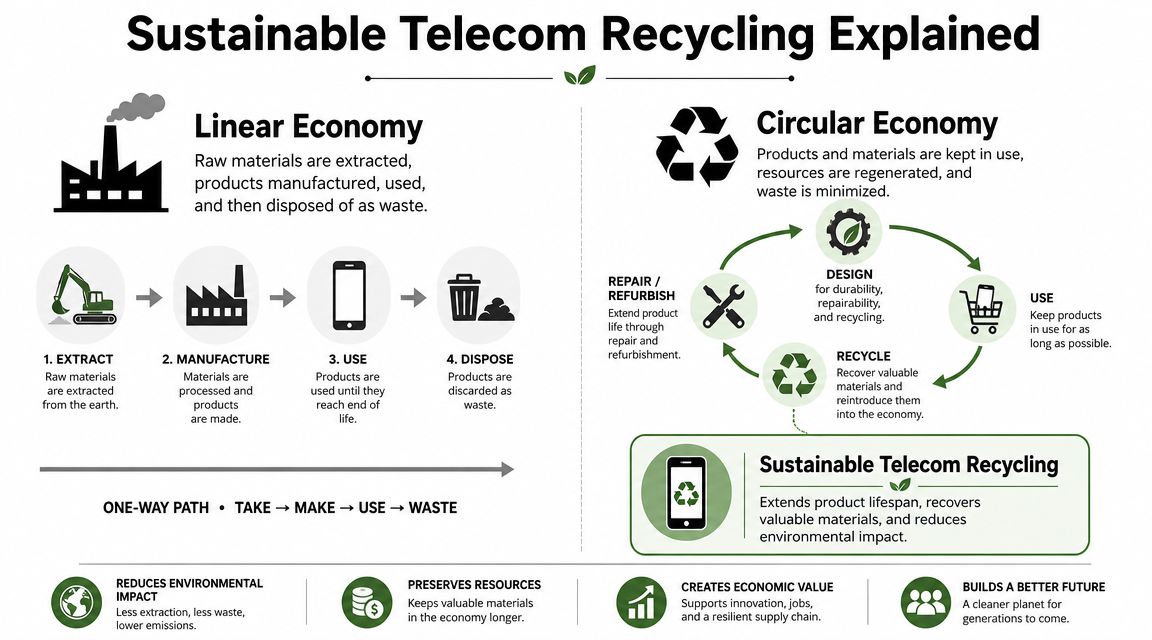
The circular model in practical terms
Telecom hardware often holds more value than facilities teams expect. VoIP phones, switches, routers, access points, broadband devices, rack components, and even some cabling assemblies may fit a return program, a resale channel, a repair workflow, or a commodity recovery stream.
That is why competent recyclers sort first and process second.
A strong ITAD and recycling program does not send everything straight to shredding. Destruction has its place, especially for damaged or data-bearing equipment that cannot be reused safely. But if every item gets the same outcome, the company usually loses recoverable value, creates avoidable replacement demand, and weakens the sustainability result.
AT&T's circularity reporting gives a useful telecom example at scale. The company reports recovering nearly 14 million customer devices in 2025 and estimates that refurbishment and recycling avoided about 907,000 metric tons of CO2e compared with manufacturing new devices, according to AT&T circularity reporting.
What this means in a Dallas cleanout
For a Dallas business, sustainability is not just about keeping equipment out of landfill. It is about matching each item to the right disposition path while the rest of the site is being cleared. That is the operational challenge many vendors miss. The office may need furniture removed, storage rooms emptied, packaging hauled off, and telecom gear handled under tighter controls, all on the same schedule.
That mix changes the job.
If the recycler only wants palletized electronics, facilities still has to find another vendor for the non-electronic debris. If the junk hauler takes everything in one mixed load, the telecom side loses traceability fast. The better model combines property cleanout logistics with certified electronics handling so the site gets cleared without treating telecom assets like ordinary scrap.
For teams building internal buy-in, this overview of the Benefits of phone recycling is a useful starting point for explaining why small devices should stay out of the general waste stream.
What sustainable handling looks like onsite
Onsite, the work should be simple and disciplined:
- Returnable gear: Carrier-owned, leased, or manufacturer take-back eligible devices
- Reusable equipment: Working units with resale, redeployment, or refurbishment potential
- Data-bearing hardware: Devices that need controlled handling and documented disposition
- Commodity recovery: Cable, metal, boards, and non-repairable components with material value
- General junk: Packaging, broken furniture, fixtures, and non-electronic debris headed to standard haul-away or recycling channels
Teams looking for practical examples of mixed cleanout planning often review articles on the Fulton Junk Removal blog because telecom recycling rarely happens in isolation. It usually sits inside a larger office, warehouse, retail, or property turnover project.
Sustainable telecom recycling works when each item leaves the site through a deliberate, documented path. That is how businesses reduce waste, protect asset value, and finish a cleanout without creating a second problem later.
Navigating Dallas E-Waste Rules and Business Compliance
Improper disposal becomes a compliance problem long before it becomes a sustainability problem.
Most local e-waste content aimed at Dallas focuses on convenience. Accepted item lists. Drop-off options. Household recycling guidance. That's useful for residents, but it doesn't answer the questions commercial teams face when they're clearing out telecom gear from an office, warehouse, school, or managed property.

The business issue isn't convenience
A Dallas company doesn't just need a place that accepts electronics. It needs a process that supports internal controls. That includes asset tracking, secure handling of devices that may hold data, and documentation that can stand up to internal review.
A key gap in Dallas-focused content is that it rarely answers the most important operational question for IT and facilities teams: what happens to the data-bearing parts of telecom gear. Local guides often focus on convenience and accepted item lists rather than secure IT asset disposition, chain-of-custody, and certified data destruction, as discussed in RTS's guide to recycling e-waste in Dallas.
That distinction matters. Residential-style drop-off guidance may be perfectly fine for a broken keyboard at home. It's not enough for a business decommissioning phones, routers, broadband devices, or rack hardware from a tenant suite or corporate office.
What compliance looks like on the ground
For commercial teams, compliance usually comes down to four questions:
Who touched the equipment?
There should be a documented handoff from your staff to the pickup team.What was removed?
The asset list doesn't have to be complicated, but it needs to be real.How was sensitive equipment processed?
Secure wipe, destruction, refurbishment, resale, or certified recycling should be clear.What paperwork is available afterward?
You need records for internal controls, sustainability reporting, and future questions.
A lot of buyers now evaluate recyclers through the same lens they use for managed IT partners. If you want a good primer on how businesses frame policy, data risk, and documentation together, tekRESCUE's data privacy solutions offers a useful compliance-focused perspective.
If a vendor can remove the equipment but can't explain the records you'll receive after pickup, the compliance side isn't under control.
Data Security and the Unbroken Chain of Custody
A Dallas office cleanout often starts with furniture, packaging, and abandoned storage. Then someone opens the telecom closet and finds routers, switches, desk phones, access points, and an old firewall still mounted in the rack. That is where cleanout work turns into an ITAD job.
Telecom gear is easy to misclassify because it does not always look like a traditional computer asset. It still may hold saved credentials, configuration files, call logs, network maps, or admin settings. If those devices get tossed into a general debris load, the business loses control of both the equipment and the record of what happened to it.
Chain of custody fixes that problem by documenting each handoff from release to final disposition. In practice, that means your team can answer four basic questions later. What left the site, who released it, who received it, and how each data-bearing item was processed.
What chain of custody should include
A usable custody record starts before pickup.
Mark which devices are approved for removal, who on your side authorized the release, and where the equipment was staged. Flag anything that may need wiping, physical destruction, refurbishment review, or carrier return. Once the truck is loaded, the documentation should continue through transport, intake, testing or sanitization, and final recycling or resale.
A workable chain-of-custody file usually includes:
- Pickup details: Date, site address, and releasing contact
- Asset record: Serial numbers, model counts, or clearly separated categories
- Transport record: Who moved the load and where it went
- Processing outcome: Sanitized, destroyed, refurbished, resold, or recycled
- Final paperwork: Certificate of destruction, recycling report, or asset disposition summary
Why a simple hauling receipt falls short
A hauling receipt confirms removal from the property. It does not show whether data-bearing devices were segregated, tracked, or sanitized.
That gap creates real risk for office managers, facilities teams, and IT staff. If an internal audit, legal hold, or security review comes later, a generic load ticket cannot show what happened to a specific firewall or switch. The equipment is gone, but the questions remain.
The better standard is documented disposition tied to recognized data destruction practices. Teams often use NIST 800-88 as the benchmark for media sanitization because it gives IT and compliance staff a common reference point. In the field, the decision is rarely one-size-fits-all. A newer phone system controller may be a reuse candidate after proper data handling, while an obsolete firewall with no resale path may need physical destruction.
Where cleanouts go wrong
The failure point is usually mixing handling paths.
Crews clearing a suite or property are under pressure to empty the space fast. If junk, metal, and telecom hardware all get loaded together, sensitive devices stop being traceable. That also kills recovery value. Equipment that could have been tested, redeployed, or sent through a resale channel often ends up treated like scrap.
This is why integrated project planning matters. Facilities teams need bulk junk removed. IT needs the telecom and network gear separated, documented, and sent through the right downstream process. Some companies split those tasks between two vendors. Others use a coordinated service model through telecom and junk removal service options so the office debris can leave the site without losing control of the devices that require secure handling.
What to confirm before release
Before pickup day, get direct answers to these questions:
| Question | Why it matters |
|---|---|
| Will telecom and IT assets be separated from general junk at the site? | Reduces mixed-load errors and loss of traceability |
| Who signs for custody at pickup and intake? | Establishes accountability at each handoff |
| How are data-bearing devices evaluated for wipe, destruction, or reuse? | Determines whether security and asset value are both being addressed |
| What records will be issued after processing? | Supports audits, internal controls, and reporting |
| Can the vendor explain the downstream path for each material type? | Shows whether the process is controlled or just hauled away |
I advise clients to treat retired telecom gear like controlled property until the paperwork is complete. That standard may feel strict during a fast office cleanout. It feels a lot more reasonable when someone asks where a decommissioned firewall went six months later.
A Practical Process for Office and Property Managers
Most office and property managers don't need a theory lesson. They need a repeatable process that works when a lease ends, a network refresh finishes, or a building engineer says the telecom closet has to be cleared by Friday.
The cleanest projects follow a four-phase rhythm. Inventory the material. Separate it by handling path. Coordinate removal so nothing sensitive gets mixed into general debris. Then close the loop with documentation.
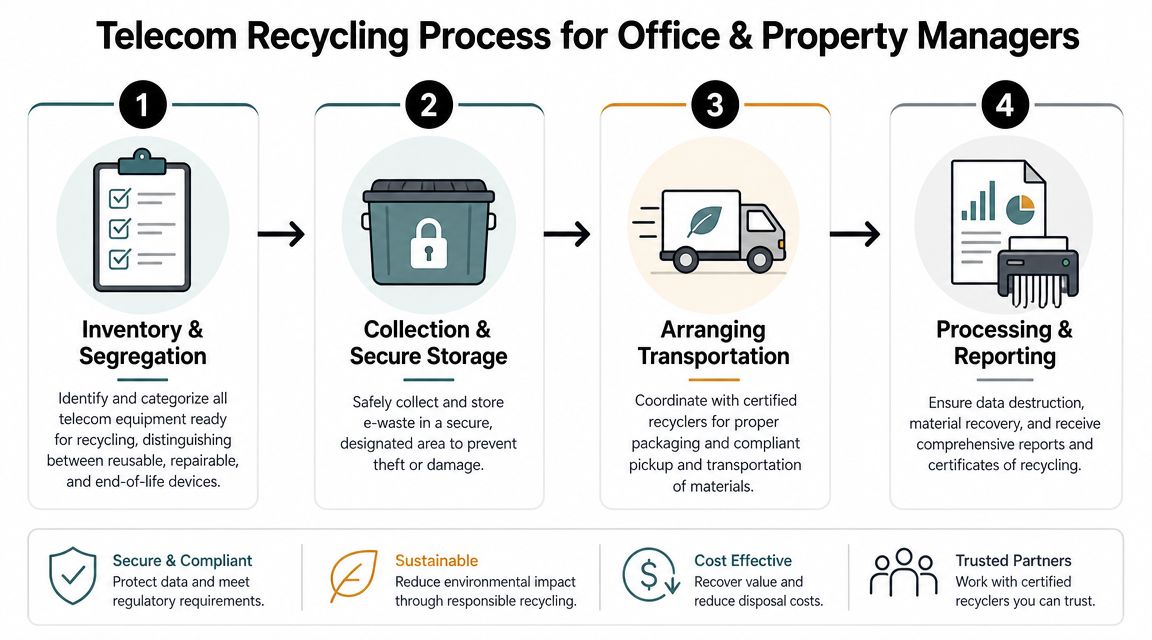
Phase one inventory and segregation
Start with a walk-through, not a pickup request.
Open every cabinet, IDF room, under-desk shelf, and storage closet. Count categories first. Detailed serial capture can come later if needed, but the first win is knowing what you're dealing with.
Separate the load into practical groups:
- Telecom hardware with possible data risk: Routers, switches, firewalls, VoIP phones, gateways.
- Return or trade-in candidates: Broadband gear, carrier equipment, newer devices.
- Commodity electronics and cable: Access points, broken handsets, copper bundles, power supplies.
- General junk: Furniture fragments, packaging, obsolete fixtures, non-electronics debris.
Don't let facilities bag everything together just to clean the room faster. Mixed loading is where good intentions usually fail.
Phase two secure collection and staging
Create one staging area and control access to it.
That can be a locked room, caged area, or supervised loading zone. What matters is that sensitive devices don't drift through the building in random carts over three days while multiple vendors and contractors are onsite.
A short internal handoff sheet helps more than people expect. It doesn't have to be elaborate. Site name, room location, approving manager, pickup date, and notes on sensitive equipment are enough to avoid confusion later.
The fastest way to lose control of a cleanout is to let three departments move assets independently.
Phase three pickup and transportation
Integrated service provides a real operational advantage. Many cleanouts include junk, scrap metal, furniture, and telecom equipment at the same time. If those streams aren't coordinated, your team spends more time supervising vendors than clearing the site.
A bundled approach can work well when one provider handles the physical cleanout and routes electronics into a secure recycling workflow. If you're coordinating a mixed office closeout, it's often easier to start the conversation through Fulton's contact page so the junk removal and electronics handling can be scoped together instead of as separate last-minute jobs.
During pickup, verify three things before the truck leaves:
- Sensitive telecom equipment was kept separate from general debris.
- The count or item categories match your release notes.
- Your team knows what paperwork will be issued after processing.
Phase four reporting and closeout
A project isn't complete when the room is empty. It's complete when the records are filed.
For telecom recycling, closeout documents may include an inventory summary, chain-of-custody record, certificate of destruction for applicable devices, and a recycling or diversion report. Facilities wants proof the material is gone. IT wants proof the sensitive portion was handled correctly. Sustainability or procurement may want reporting they can keep for internal reviews.
Here's a simple closeout checklist:
| Document | Keep it because |
|---|---|
| Pickup acknowledgment | Confirms transfer from your site |
| Asset or category list | Shows what left the building |
| Certificate of destruction | Supports data handling records |
| Recycling or diversion report | Supports sustainability and vendor accountability |
When teams skip this phase, they usually regret it months later, not the same day.
How to Vet and Choose a Certified Recycler in Dallas
Choosing a recycler gets easier when you stop asking who can pick up fastest and start asking who can defend the process afterward.
Many vendors can move equipment. Fewer can explain downstream handling, data controls, employee procedures, and final reporting in a way that gives IT, facilities, and procurement confidence. That's the difference between a hauler and a true disposition partner.
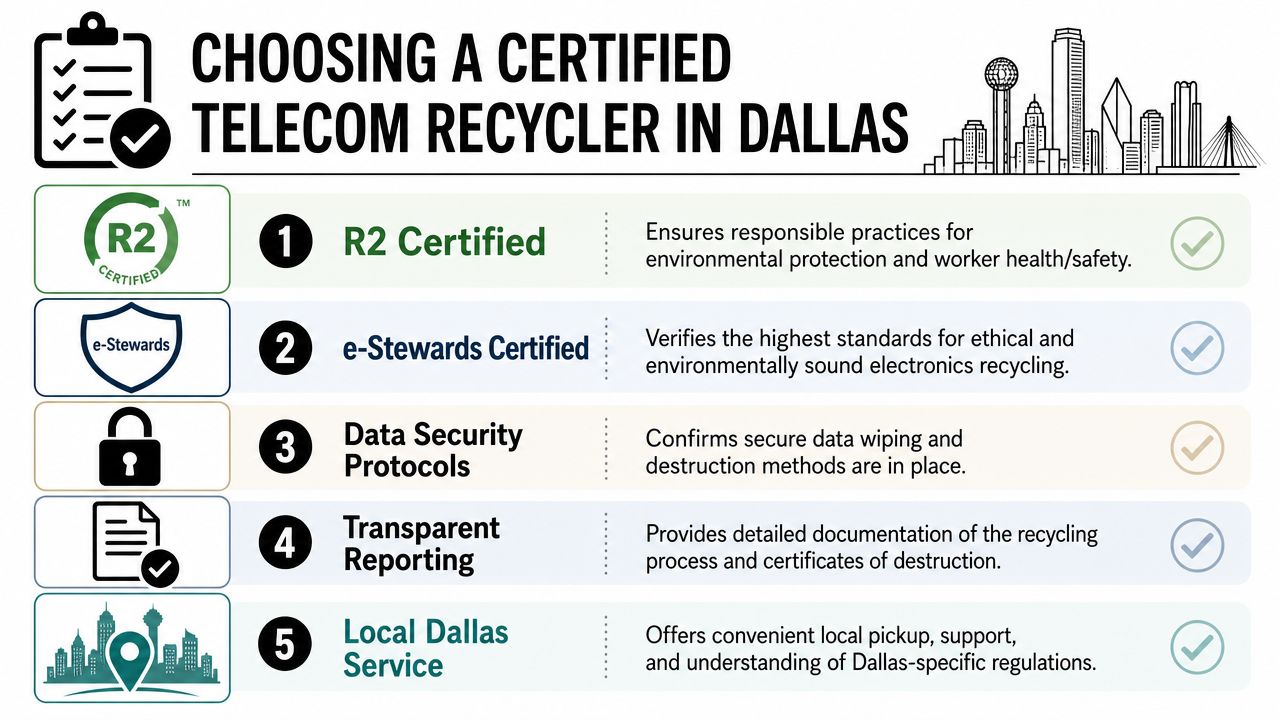
What certifications mean in practice
R2 certification matters because it speaks to responsible recycling practices, environmental controls, and worker health and safety. For a buyer, the practical benefit is process discipline.
e-Stewards is another recognized certification path. It's often associated with strict standards around responsible electronics recycling and downstream accountability. If a vendor claims this certification, ask how it affects actual site handling, not just what logo appears on a proposal.
For data destruction, many businesses also look for specialized destruction controls and documented media handling. In some projects, the recycler and the destruction provider are the same company. In others, they aren't. What matters is clarity.
A side-by-side way to compare vendors
Use this framework during vendor review:
| Vetting point | Strong answer | Weak answer |
|---|---|---|
| Data-bearing telecom handling | Clear separation, sanitization or destruction path, documentation | “We recycle everything responsibly” |
| Chain of custody | Documented from pickup through final processing | Basic invoice only |
| Downstream transparency | Can explain where material goes after intake | Vague or evasive |
| Reporting | Offers destruction and recycling records | No clear closeout package |
| Local service execution | Understands business pickups and site coordination | Treats project like a simple drop-off |
Questions worth asking on the first call
Ask direct questions. Good vendors won't mind.
How do you identify data-bearing telecom devices?
If they can't answer quickly, they probably treat all electronics the same.What documentation do you issue after processing?
You want specifics, not “whatever you need.”Do you separate reuse, trade-in, and recycling paths?
This shows whether the company understands circular handling.How do you manage mixed loads from office cleanouts?
That matters if phones, routers, furniture, and scrap are leaving together.Can you explain your downstream process in plain language?
If the answer gets fuzzy, so will the accountability.
Red flags that show up early
Watch for these problems:
- Too much focus on accepted items: Useful for public drop-off, weak for business disposition.
- No distinction between junk and sensitive electronics: A sign of operational shortcuts.
- No mention of chain of custody: Means the burden may fall back on you later.
- Reluctance to discuss reporting: Usually a clue that reporting is thin.
- Pickup-first sales style: Fast scheduling is nice, but it shouldn't outrun process quality.
If you want to understand how a provider positions its cleanout and recycling workflow, company background pages like about Fulton Junk Removal can be helpful because they show whether the business treats responsible recycling as part of operations or as an afterthought.
The right recycler should make your internal approval easier, not force you to explain away unanswered questions.
The Future of Your Business Is Circular
The companies that handle end-of-life telecom equipment well usually handle other operational transitions well too.
They don't wait until the storage room is overflowing. They build disposition into refresh cycles, office moves, and property turnover plans. That improves security, supports cleaner reporting, and keeps reusable material in circulation instead of sending everything to landfill.
A circular approach also reads better to the people who matter around the project. Procurement sees process. IT sees custody and destruction controls. Facilities sees fewer delays during closeout. Sustainability teams see documentation they can use.
That's the larger point behind sustainable telecom recycling Dallas. It isn't just about where old phones and routers go. It's about whether your business can retire equipment with the same discipline it uses to deploy it.
Businesses that choose partners with documented, certified, and operationally practical workflows usually end up with fewer surprises. They also end up with a cleaner answer when someone asks what happened to the equipment after it left the building.
Frequently Asked Questions
| Question | Answer |
|---|---|
| What counts as telecom equipment in a business cleanout? | It usually includes routers, switches, firewalls, VoIP phones, modems, gateways, access points, cabling, power supplies, and related rack gear. If the device supported voice, broadband, or network connectivity, treat it as telecom equipment until your recycler or ITAD partner classifies it more precisely. |
| Why isn't a normal junk hauler enough? | A normal junk hauler may be fine for broken furniture, packaging, and general debris. It usually isn't enough for data-bearing devices or assets that should go through reuse, trade-in, or certified recycling channels. The issue isn't hauling. It's documentation, custody, and downstream handling. |
| Do old routers and VoIP phones really have data risk? | They can. Telecom devices may retain configurations, credentials, logs, or call settings. The right approach is to assume risk until the device has been evaluated, sanitized, or destroyed through a documented process. |
| Should everything be shredded or destroyed? | No. Destruction is sometimes the right choice, but not always. Some devices are better suited for refurbishment, resale, parts harvesting, or manufacturer return. Sustainable telecom recycling works best when each asset is assigned the right path rather than forced into one outcome. |
| What paperwork should a business ask for? | At minimum, ask for pickup confirmation and final disposition records. Depending on the project, that may include an asset list, chain-of-custody documentation, a certificate of destruction for sensitive devices, and recycling or diversion reporting. |
| Is drop-off recycling enough for a company office? | Usually not for larger or mixed commercial projects. Drop-off options may help with small quantities, but office cleanouts often involve loading docks, property rules, staging, and mixed material streams. Commercial teams usually need scheduled pickup, coordinated labor, and documented processing. |
| What's the benefit of bundling junk removal with telecom recycling? | It simplifies the job. Offices and property managers often need furniture, debris, fixtures, and telecom equipment removed at the same time. Bundling reduces site coordination headaches while still letting the telecom portion move through a secure, documented recycling path. |
| How should property managers prepare before pickup day? | Separate sensitive telecom gear from general junk, assign one staging area, identify an approving contact, and ask the vendor what records will be issued after processing. That small amount of preparation prevents most handoff problems. |
If your team needs one workflow for office cleanout debris, telecom equipment, and documented recycling, Fulton Junk Removal can coordinate the removal side and route electronics through a responsible processing path that supports secure handling and reporting.
