
Secure Telecom Equipment Recycling Chicago
A Chicago office finishes a phone system cutover and everybody moves on to the next problem. The new VoIP handsets are live. The switches are mounted. Users stop complaining. Then someone opens the storage room and finds the old PBX shelf, a stack of handsets, patch panels, cabling, and a few mystery boxes from the last network refresh.
That's where telecom equipment recycling Chicago stops being a cleanup task and becomes an ITAD decision. If the load includes phones, routers, switches, firewalls, or anything with stored settings, you're dealing with compliance, data handling, material recovery, and building logistics at the same time. A lot of Chicago teams still treat that pile like ordinary junk. That's the mistake.
Your Chicago Office Upgrade Is Done Now What?
The most common version of this job looks the same. An office manager has a move deadline. The IT lead has already spent the budget on the upgrade. Facilities wants the telecom closet cleared before painters, movers, or landlords walk through. Nobody wants to babysit two or three vendors to get it done.
That pile also sits inside a much bigger waste stream. The world generated 53.6 million metric tons of e-waste in 2019, but only 17.4% was formally recycled, and projections reach 74 million metric tons by 2030, according to First America's e-waste statistics overview. Old handsets and switches in a Chicago office aren't a niche problem. They're part of a large, under-recycled stream that businesses need to handle correctly.
A lot of office cleanouts happen alongside broader transitions. If you're sorting out furniture, fixtures, and surplus contents at the same time, it helps to look at how other local disposition projects get organized. Teams planning mixed-property transitions sometimes borrow staging ideas from resources on estate sales Chicago, especially when they need to separate reusable items from waste before pickup.
What usually goes wrong
The weak path is familiar:
- Storage drift: equipment sits for months because nobody owns the final disposition.
- Dumpster thinking: someone assumes old telecom gear can go out with general debris.
- Split vendors: one hauler removes the room, another recycler handles electronics, and chain-of-custody gets blurry.
What works better is a bundled commercial approach where the non-electronic junk gets removed in the same project as the telecom load, but the electronics still move through the right downstream channel. That's the practical value of working with a provider that handles haul-away and routes electronics into a separate recycling workflow, such as Fulton Junk Removal.
Old telecom hardware becomes harder to identify, harder to track, and harder to dispose of correctly the longer it sits untouched.
What belongs in scope
Most Chicago business pickups include a mix of these items:
- Voice equipment: legacy PBX components, desk phones, conference phones, gateways
- Network hardware: switches, routers, firewalls, access points
- Physical infrastructure: racks, shelves, patch panels, structured cabling
- Support gear: UPS units, power supplies, batteries, adapters
If you treat all of that as one undifferentiated junk pile, you lose control fast.
Navigating Chicago Telecom Recycling Laws
Chicago businesses don't get to improvise with e-waste. Illinois law makes it illegal for businesses and residents to dispose of electronic waste in regular trash, and Chicago's commercial recycling requirements raise the compliance bar for business operations, as summarized in this Chicago recycling law overview.

That matters because telecom retirement often gets folded into a larger office project, and that's when bad assumptions creep in. Someone sees old phones and cabling next to broken furniture and assumes one truck can take everything to the same place. It can't, at least not if the electronics are going to be handled legally and documented properly.
What the rules mean in practice
For facility and IT managers, the compliance baseline is simple:
- Don't put covered electronics in regular trash.
- Use approved recycling channels for end-of-life electronic equipment.
- Keep business recycling inside a documented operational process.
The law doesn't care that your project was rushed. It doesn't care that the equipment looks obsolete. If your business generated the equipment, your business owns the disposition risk.
Where companies get tripped up
The issue usually isn't knowing that recycling is a good idea. The issue is underestimating what counts as regulated electronic waste in a telecom room. A closet cleanout can include devices with boards, power components, batteries, and stored settings. It can also include reusable materials and recoverable metals. That puts the load outside ordinary trash hauling.
A good internal rule is to separate your project into two streams before pickup:
| Material group | Typical examples | Correct handling |
|---|---|---|
| General junk | broken shelving, non-electronic debris, packaging | standard commercial junk removal |
| Telecom and e-waste | phones, switches, routers, UPS units, cabling with electronic components | approved recycling or ITAD workflow |
Practical rule: If it plugged into your network, phone system, or rack power, don't let it leave the site without a defined electronics disposition path.
A useful comparison from outside the US
Facility teams with multinational processes sometimes compare local disposal policies across offices to tighten internal standards. For furniture-related examples, this practical guide for UK workplace managers shows the same operational lesson. Disposal gets easier when the business separates reusable assets, recyclable materials, and general waste before the vendor arrives.
Chicago telecom recycling works the same way. Compliance starts before pickup day.
The Secure Recycling Process From Pickup to Destruction
A secure telecom disposition job should feel controlled from the first manifest to the final certificate. If the vendor shows up with a truck and no asset discipline, you're not looking at ITAD. You're looking at haul-away.
True telecom decommissioning is more involved. A local telecom decommissioning source describes the process as secure removal, sorting of e-waste from other materials like cabling, and certified data handling, not simple scrap hauling, in this decommissioning workflow reference.
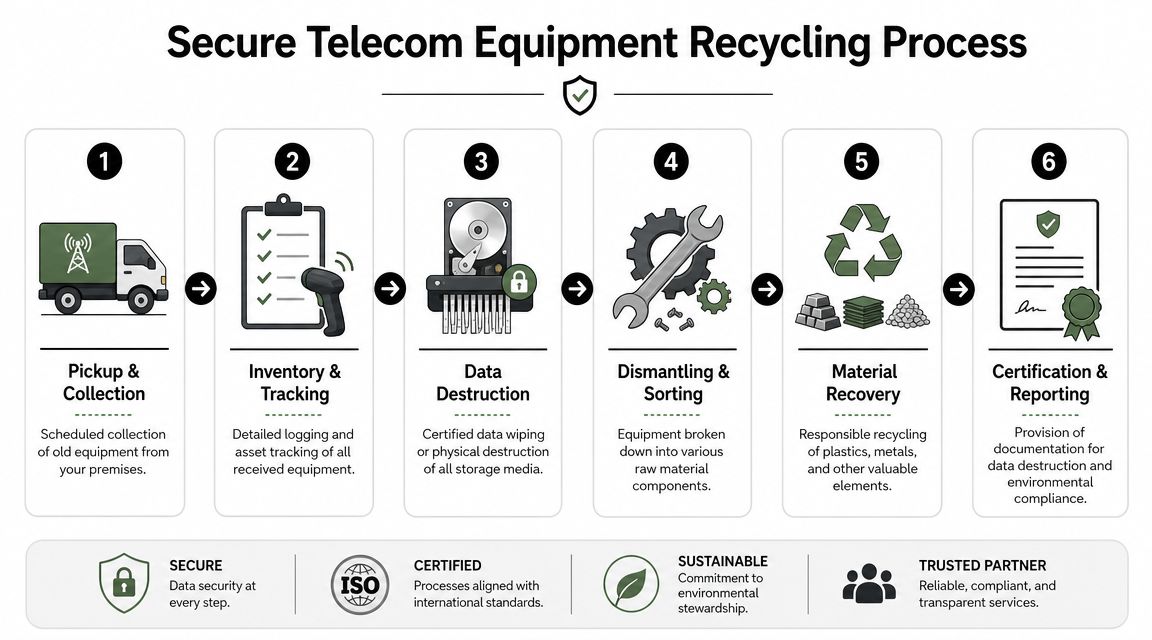
What a strong process looks like
In a clean project, the sequence matters.
Pickup and verification
The team identifies what is being removed, what stays, and what needs special handling. Racks, loose devices, cable bundles, and data-bearing hardware shouldn't be mixed casually during loading.Inventory and tracking
Phones, routers, firewalls, switches, and related gear should be logged in a way that lets your team reconcile what left the site.Secure transport
Once assets leave the building, custody needs to stay visible. Poor visibility makes weaker providers hard to trust, as their paperwork often stops at “picked up electronics.”
Data-bearing telecom gear needs separate treatment
A surprising number of devices in a telecom environment store useful information. Not always user files, but still information you don't want floating around in secondary channels. Configuration data, call settings, network identifiers, and internal labels all matter.
That's why you should ask the vendor to separate the load into at least these categories:
- Data-bearing assets: routers, firewalls, managed switches, appliances, some phones
- Reuse candidates: newer complete hardware that may still have market or redeployment value
- Recycle-only electronics: obsolete, damaged, incomplete, or low-value hardware
- Commodity materials: cabling, chassis metals, and other sorted fractions
A factory reset isn't the same thing as documented sanitization.
Why mixed loads fail
The fastest way to weaken the job is to let movers, electricians, and haulers all touch the same material without a common control point. By the time the recycler gets involved, the original rack layout is lost, labels are missing, and valuable or sensitive devices are buried inside a general debris load.
A better approach is to stage telecom assets first, then remove adjacent junk second. Teams reviewing project prep often use commercial cleanout checklists like the ones discussed on the Fulton Junk Removal blog because the same discipline applies across offices, warehouses, and renovation turnovers. Sort first. Load second. Document everything that matters before the truck doors close.
What you should receive after processing
Your file should usually include these outputs:
| Deliverable | Why it matters |
|---|---|
| Pickup record | confirms what left the building |
| Asset or load tracking details | supports reconciliation |
| Data destruction documentation | closes the security side of the job |
| Disposition summary | shows what was reused, destroyed, or recycled |
If a vendor can't explain those deliverables clearly, they're not ready for business telecom loads.
Why Certified Recyclers Are Non-Negotiable
Certification matters because downstream risk doesn't disappear when the truck leaves your dock. It just becomes harder to see.
For Chicago-area electronics processing, a certified recycling center highlights a processing capacity of 40,000,000 lbs per annum along with secure product destruction in this Chicago recycling center reference. Scale alone isn't the reason to use a certified partner, but it does show that business electronics recycling in Chicago runs through established industrial channels, not improvised back-lot scrap handling.
What certifications change in the real world
For an IT or facilities team, certifications aren't about logos on a website. They're shorthand for whether the recycler has documented controls, audited processes, and a serious chain-of-custody model.
When I vet a vendor, I'm looking for proof that they can answer practical questions like these:
- Can they document intake and destruction?
- Do they have a defined process for data-bearing devices?
- Can they explain where material goes after sorting?
- Do they separate reuse from destruction instead of shredding everything up front?
What uncertified operators tend to get wrong
The problem with uncertified scrap handling is rarely the pickup itself. It's everything after pickup.
A weak operator often does one or more of the following:
| Weak practice | Business risk |
|---|---|
| treats all electronics as scrap | destroys resale value and wipes out reuse options |
| provides only generic weight tickets | leaves audit gaps |
| gives vague answers on destruction | creates data exposure |
| can't explain downstream handling | shifts environmental and reputational risk back to you |
If the vendor can't describe the downstream path in plain English, you should assume the documentation will be weak too.
What to insist on
For Chicago telecom recycling, certification should be paired with evidence. Ask to see current credentials, sample reporting, and a sample destruction certificate. Then ask how they handle phones, switches, and managed network gear specifically.
That last question matters because a lot of vendors can recycle consumer electronics. Fewer can manage business telecom assets with the discipline that procurement, facilities, compliance, and IT need.
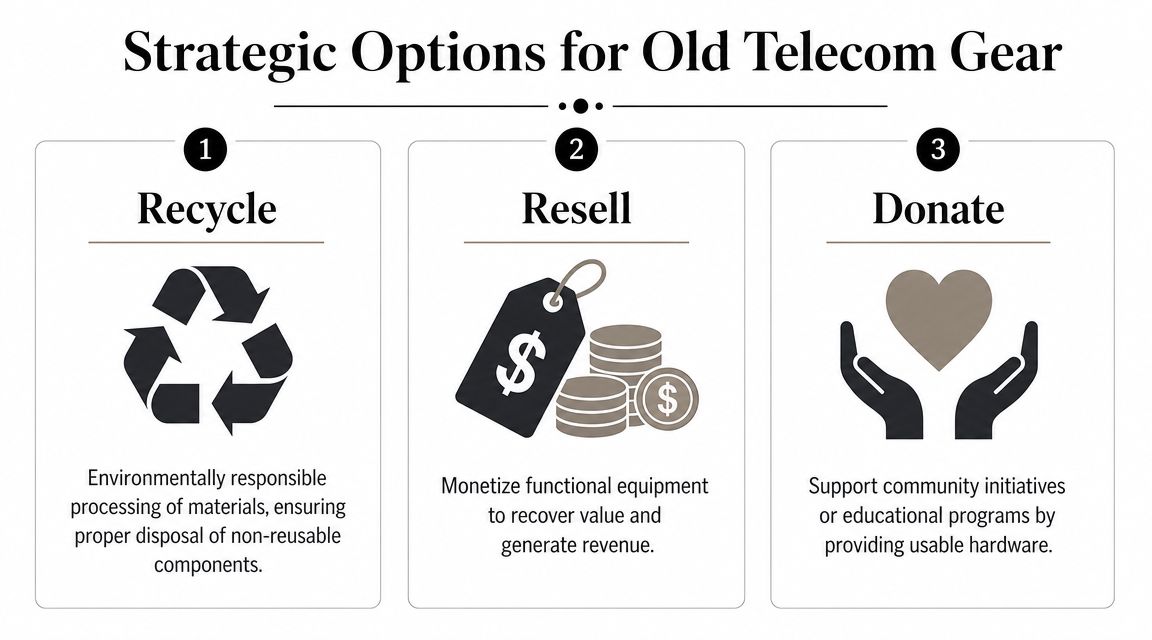
Recycle, Resell, or Donate Your Old Telecom Gear
Not every retired telecom asset should go straight into the shred stream. That's where a real ITAD approach separates itself from ordinary recycling.
A key distinction often missed is that ITAD includes inventorying, data sanitization, and resale to preserve value, while simple scrap processing skips straight to destruction or material recovery, as noted in this discussion of reuse, donation, and recycling pathways.
Start with condition and data sensitivity
The right disposition path usually comes down to three questions.
First, does the device still work or appear complete.
Second, does it contain stored settings, credentials, or other sensitive information.
Third, is there any realistic second-life use for it.
Those questions produce very different outcomes.
| Path | Best fit | Wrong fit |
|---|---|---|
| Recycle | obsolete, damaged, incomplete, low-value gear | newer usable equipment with resale or redeployment potential |
| Resell | newer functional gear with market demand | hardware with uncertain condition or unresolved data issues |
| Donate | usable gear with community or nonprofit fit | unsupported equipment that would just shift disposal burden |
When recycling is the right answer
Recycling is correct when the hardware is too old, too damaged, too incomplete, or too risky to place back into service. Think broken handsets, legacy boards, unsupported chassis, or gear that has no practical value after sanitization and testing.
In those cases, the goal is controlled material recovery, not squeezing out a few more dollars.
When resale deserves a closer look
Resale only works when the process protects value. If a vendor tosses potentially reusable switches and phones into a gaylord with scrap cabling and broken power supplies, the resale option is gone before the load reaches intake.
That's why I tell teams to hold back obviously cleaner assets during staging. Put newer complete equipment on its own pallet or shelf. Label it. Keep accessories with the unit when possible.
Don't destroy resale value by mixing good gear with scrap on pickup day.
When donation makes sense
Donation is worth considering when the gear is usable, data issues can be resolved, and the equipment still has a practical second life. That's often a better answer than shredding serviceable hardware because your company no longer needs it.
The mistake is treating donation as an afterthought. Donation still requires the same front-end discipline as resale. Inventory, sanitization, and condition review come first. Good intentions don't replace process.
Planning Logistics and Understanding Costs
Most telecom recycling jobs go sideways on logistics, not theory. The hard parts are access, timing, labor, packaging, and deciding who's responsible for what before pickup day.
Chicago projects add their own complications. A suburban warehouse cleanout is different from a downtown office where every cart ride depends on elevator reservations, loading dock rules, and building management windows. The telecom closet may be on one floor, the staging room on another, and the dock on the other side of the building.
A Chicago-focused business recycling source points out key questions buyers ask during large-volume telecom upgrades: pickup costs, minimum quantities, palletization, and certified destruction deliverables, in this telecom recycling logistics guide. Those are the right questions.
What usually drives project cost
Without quoting numbers, because pricing varies by vendor and job scope, these are the factors that typically matter most:
- Site access: freight elevator, loading dock access, stairs, after-hours rules
- Labor condition: still racked, loose stacked, boxed, palletized, or spread across rooms
- Material mix: telecom electronics, scrap metal, general junk, batteries, cabling
- Documentation needs: simple removal versus asset tracking and destruction records
- Service model: one integrated pickup or separate vendors with separate visits
Bundled service usually reduces friction
When a company hires one vendor for junk and another for electronics, the handoff points multiply. One team blames the other for delays. Building access gets booked twice. Nobody wants the mixed piles. You also end up managing two scopes, two invoices, and two sets of scheduling calls.
The more practical model for offices, warehouses, and property managers is to bundle the cleanout and the electronics stream in one coordinated job, then route the telecom portion through proper downstream recycling. If you're planning a site-specific removal, the easiest starting point is usually a direct scope review through the Fulton Junk Removal contact page, then confirming which portions of the load require electronics processing versus ordinary haul-away.
How to prepare your site before the truck arrives
Use a short internal prep list:
- Assign one owner for inventory, access, and final signoff.
- Separate telecom gear from furniture, trash, and construction debris.
- Identify sensitive devices that need tracked destruction handling.
- Photograph the staged load if multiple internal teams are involved.
- Confirm building rules for dock access, COI requirements, carts, and elevator timing.
Questions worth asking before you approve pickup
| Question | Why you need the answer |
|---|---|
| Do you provide pickup only, or pickup plus on-site labor? | affects staffing and schedule |
| Do you require equipment to be palletized or boxed first? | changes prep work |
| Can you handle mixed loads with junk and electronics in one project? | reduces vendor sprawl |
| What reporting comes after the job? | supports compliance and internal closeout |
Good logistics feel boring. That's the goal.
Checklist for Vetting a Chicago Recycling Vendor
Most vendors sound competent in a short sales call. The differences show up when you ask for specifics.
If you're evaluating telecom equipment recycling Chicago providers, don't ask broad questions like “Do you recycle responsibly?” Ask operational questions that force clear answers. You want to know how they control pickup, what proof they provide, and what happens to the material after intake.
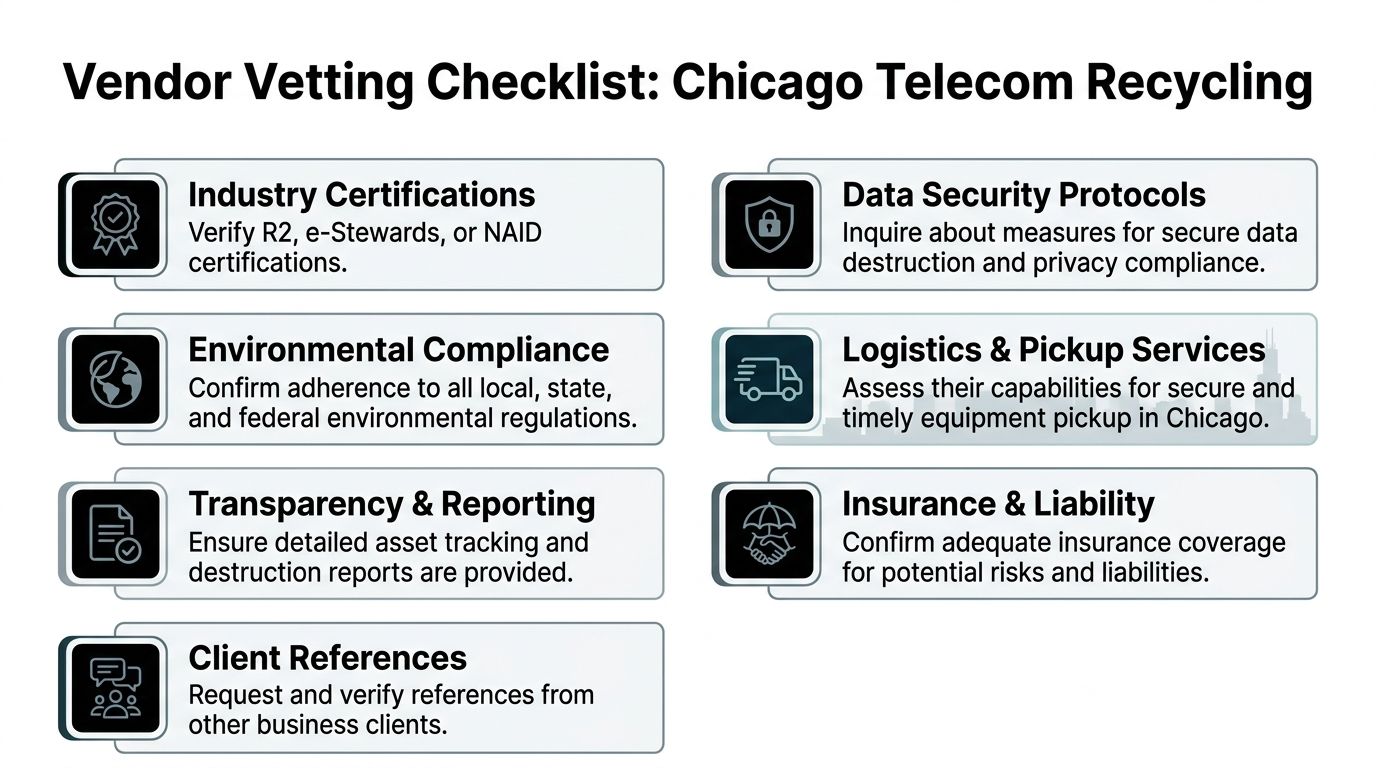
Vendor Vetting Questions
| Category | Question to Ask | Why It Matters |
|---|---|---|
| Certifications | Are your recycling and destruction operations certified, and can you provide current documentation? | verifies audited controls rather than verbal claims |
| Data security | How do you handle data-bearing telecom devices such as routers, switches, firewalls, and phones? | shows whether they understand telecom-specific risk |
| Pickup process | What documentation is created at pickup? | helps preserve chain-of-custody |
| Asset tracking | Do you record serials, asset tags, or load-level manifests? | supports reconciliation later |
| Destruction records | Can you provide a certificate of destruction when needed? | closes out the security file |
| Reuse decisioning | How do you decide whether equipment is reused, donated, resold, or recycled? | prevents premature shredding |
| Downstream handling | Where do non-reusable assets go after intake? | reduces blind spots after the first handoff |
| Logistics | Do you offer on-site packing, palletization, and building-friendly pickup coordination? | matters for offices, warehouses, and high-rises |
| Insurance | What insurance coverage applies during pickup and transport? | helps with internal risk review |
| Reporting | What final reports do clients receive after processing? | supports audit, sustainability, and closeout needs |
Answers that should make you cautious
Some red flags show up fast:
- Generic language: “We wipe everything” without explaining telecom devices
- No paperwork samples: they can't show a manifest or destruction certificate
- No downstream clarity: they only talk about pickup
- All-scrap mindset: they don't distinguish between resale, donation, and recycling
- Weak business fit: they operate like a public drop-off service, not a commercial partner
The best vendors answer operational questions quickly because they already run the process that way.
One more check before you sign
Before you release any load, look at who you're hiring and whether their service model matches your project type. A company that focuses on commercial cleanouts and coordinated removal work should be able to explain that operating model clearly, which is why buyers often review the background on Fulton Junk Removal before deciding whether a bundled junk removal and electronics pathway fits their site.
The right vendor shouldn't need dramatic marketing. Their paperwork and answers should do the work.
The Smart Choice for Chicago Telecom Recycling
Chicago telecom recycling is not just about getting old hardware out of a closet. It's a control issue. Your business has to handle electronics legally, protect any stored data, preserve value where it still exists, and move the project without creating a scheduling mess for facilities, IT, and property teams.
That's why the integrated model works so well for office cleanouts, warehouse upgrades, relocations, and post-renovation telecom removals. One coordinated provider can remove the general junk, isolate the electronic stream, and send the telecom load into responsible processing instead of treating everything like landfill-bound debris. For companies comparing service models, the practical benchmark is whether the provider can support both site cleanout needs and proper electronics handling through a single workflow, as outlined in Fulton Junk Removal's services.
If you're planning telecom equipment recycling Chicago, keep the decision simple. Separate the electronics before pickup. Demand documentation. Use a provider that can manage the cleanout and the compliance side together.
If your office, warehouse, or property in Chicago needs a telecom cleanout, Fulton Junk Removal can help you coordinate removal and responsible downstream recycling through Beyond Surplus. Request an estimate, define the scope, and get the equipment out without losing control of compliance, reporting, or reuse options.
