
Secure IT Equipment Recycling Telecom Houston
A lot of Houston businesses have the same problem sitting behind a locked door right now. There's a storage room with old switches, retired servers, UPS units, racks, cabling, and a few mystery boxes nobody wants to touch because nobody is completely sure what still holds data, what still has resale value, and what creates a compliance problem if it leaves the building the wrong way.
That's why IT equipment recycling telecom Houston isn't really a hauling task. It's a disposition project. The companies that handle it well treat pickup, asset tracking, data destruction, reuse, recycling, and final reporting as one connected process. The companies that handle it poorly focus on getting the room cleared out and worry about the paperwork later.
The Challenge of Retiring Telecom and IT Assets in Houston
Houston teams rarely retire one clean equipment category at a time. A network refresh usually leaves behind a mixed load. Core switches sit next to access points. Rack servers sit next to batteries, patch panels, laptops, phones, and random boxes of small peripherals from prior projects. That mix is where mistakes start.
The first mistake is treating everything as junk. Some assets still have reuse potential. Some need certified sanitization before they move an inch. Some can go through normal electronics recycling channels. Some need extra handling because they contain hazardous components or data-bearing media.
The second mistake is waiting too long. Idle storage sounds harmless, but it usually creates three problems at once: less recoverable value, weaker chain of custody, and more internal confusion about ownership and approval. By the time facilities, IT, procurement, and security all weigh in, the project has often become harder than it needed to be.
Why this isn't just a local cleanup issue
The bigger context matters. A United Nations-backed assessment cited in industry reporting found that small IT and telecommunication equipment totaled about 4.6 million tonnes globally, but only 22% had documented collection, meaning most of that stream was not formally tracked for recovery, repair, or recycling according to this telecom recycling industry summary.
That number explains why business buyers now ask harder questions before they sign off on disposal. They don't just want a truck and a receipt. They want to know who picked the assets up, how serials were logged, whether drives were wiped or destroyed, and where the material went after processing.
Practical rule: If you can't reconstruct what happened to each high-risk asset after pickup, you don't have a recycling process. You have a liability gap.
Houston also has an established commercial and public recovery environment, which means companies don't need to improvise. They need a disciplined workflow and a partner that can carry it through. For organizations that want hauling and responsible downstream processing under one roof, Fulton Junk Removal represents the kind of integrated service model buyers increasingly look for.
What responsible retirement actually means
A workable program has to answer a few plain questions:
- What are we moving out: A real inventory, not “about three pallets.”
- What holds data: Servers, storage, network gear with embedded storage, laptops, and removable media need separate handling.
- What can be reused: Functional assets shouldn't be mixed into scrap without review.
- What proof do we need afterward: Audit trail, destruction records, and recycling documentation need to be defined before pickup day.
That's the difference between clearing space and closing a project properly.
Preparing Your Telecom Assets for Secure Recycling
Internal preparation determines whether the recycler can work fast, whether your security team signs off, and whether any value can be recovered before equipment becomes obsolete. The cleanest pickup starts long before the truck arrives.
The most reliable workflow for telecom and IT disposition follows a staged pipeline: serialized inventory intake, functional triage, certified data sanitization, parts harvesting or refurbishment, and downstream material recovery. Industry guidance also notes that older assets can lose value quickly in storage, with one analysis citing typical value loss of 2–4% per month after year 4 of asset life in this asset recovery guide.
That's why preparation isn't clerical work. It directly affects security, timing, and budget.
Here's the basic prep flow teams generally need on the front end:
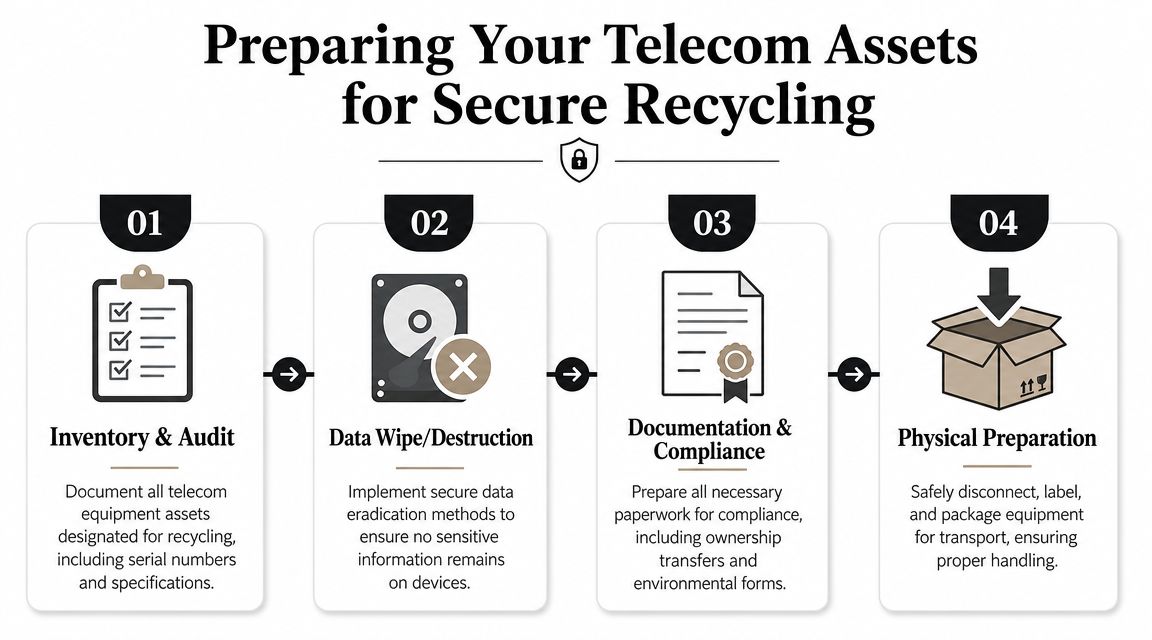
Build the inventory before anyone touches the racks
Start with a serialized asset list. If your CMDB is current, use it as a baseline. If it isn't, walk the room and create a fresh intake list from the device labels.
Include the details that matter during handoff:
- Serial number: This is the anchor for chain of custody.
- Asset type: Router, switch, server, storage shelf, UPS, laptop, phone system component, rack accessory.
- Manufacturer and model: Helps determine reuse, parts harvesting, and handling requirements.
- Location: Building, floor, room, rack, or closet.
- Status: Working, failed, unknown, missing drive, damaged, incomplete.
If you skip this step, every other control weakens. Data destruction becomes harder to verify. Finance can't match retired assets to records. Facilities ends up counting pallets instead of equipment.
Separate data-bearing assets from everything else
Don't stage all electronics in one pile. That's one of the most common operational failures on decommissioning jobs.
A better approach is to create three physical groups:
Data-bearing equipment
Servers, storage arrays, laptops, desktops, firewall appliances, and any network device with internal or removable storage go here.Non-data telecom gear
Racks, rails, cable trays, patch panels, antennas, transceivers, power distribution components, and cabling can usually be staged separately.Hazard or special handling items
Batteries, UPS systems, and damaged electronics should never be mixed casually into general loadout material.
This separation speeds up pickup day because the recycler doesn't have to sort high-risk items in the parking lot or on the truck.
Put a responsible employee in charge of the quarantine area. When everyone can add items to the pile, nobody owns accuracy.
Triage for reuse before scrap decisions are made
Not every retired asset is dead. Some hardware has service life left, especially when it was removed because of a standard refresh cycle rather than actual failure.
A simple internal triage can classify assets into:
- Clearly reusable
- Needs testing
- End of life
- Incomplete or damaged for parts
You don't need to run a full refurbishment bench in-house. You do need to avoid sending potentially reusable hardware straight into scrap just because the room needs to be cleared.
That matters most for enterprise switches, newer servers, and related accessories that still have secondary-market usefulness. It also matters for ESG reviews because reuse usually tells a stronger disposition story than bulk shredding.
Lock down data handling before the pickup window
This step has to be decided internally before the vendor arrives. Your options typically fall into two buckets:
- Certified sanitization for assets intended for reuse
- Physical destruction for media that can't leave any doubt
What you choose depends on policy, device type, and residual value. What doesn't work is making that decision ad hoc while loaders are waiting.
Prepare a written instruction set for the vendor and for your internal stakeholders. It should identify what must be wiped, what must be shredded, who approves exceptions, and what documentation must come back after processing.
Prepare the room for safe and fast removal
Physical prep saves more time than is commonly anticipated. Label pallets or staging zones by category. Remove loose accessories from rack shelves. Secure drives or media in locked containers if your process requires that. Make sure someone can grant dock access, freight elevator access, and after-hours entry if needed.
A short pre-pickup checklist helps:
| Internal prep item | What good looks like |
|---|---|
| Inventory file | Updated, serialized, reviewed by IT |
| Data-bearing segregation | Separate from racks, scrap, and loose metal |
| Access planning | Loading dock, elevator, badges, contact names confirmed |
| Approval chain | IT, facilities, security, procurement aligned |
| Packing decisions | Pallets, gaylords, bins, on-site breakdown plan defined |
Teams often think the recycler will fix disorder on arrival. Sometimes they can. But when the site is prepared, you get a cleaner audit trail, faster removal, and fewer disputes about what was picked up.
How to Vet and Select an IT Recycling Vendor in Houston
Most vendor comparisons go wrong because the buyer asks only two questions: “How fast can you pick up?” and “What will it cost?” Both matter. Neither tells you whether the vendor can protect your data, document the process, and keep recoverable material out of the landfill stream.
A serious telecom recycling program should be built around zero-landfill processing and secure data destruction. One independent program example reported nearly 3.9 million pounds of computer equipment processed in a year with a 99.9% reuse-or-recycling rate, which is a useful benchmark for what mature diversion systems look like in practice, as described in this Houston telecom recycling overview.
That benchmark doesn't mean every vendor performs the same way. It means buyers should expect a clear downstream strategy, not vague promises.
What an integrated service model solves
The biggest practical advantage comes from using a provider that can manage physical removal plus electronics disposition as one coordinated job. That reduces handoffs. It also reduces the number of companies touching sensitive equipment.
For offices, warehouses, and property managers, that model is often easier to control because one team can handle cleanout logistics while a specialized electronics recycling arm handles sorting, data-bearing media, and final reporting. That's the logic behind bundled hauling and recycling programs such as Fulton Junk Removal's service approach, where physical removal and responsible downstream processing are aligned instead of split between unrelated vendors.
A fragmented setup can still work. It just creates more opportunities for inventory drift, scheduling gaps, and chain-of-custody questions.
Ask for process details, not marketing language
A vendor doesn't need polished sales language to be good. They do need clear answers.
Ask questions that force operational specificity:
- How do you log serialized assets at intake
- How do you separate reuse candidates from scrap
- What data destruction options do you offer
- What records do you provide after processing
- Who are your downstream processors
- Can you support mixed commercial cleanouts with telecom equipment included
If the answers stay broad, keep looking. Good vendors can explain their workflow plainly.
If a recycler talks a lot about sustainability but can't explain custody and documentation, they're selling the easy half of the service.
Vendor evaluation checklist for IT and telecom recycling
| Evaluation Criterion | What to Ask or Verify | Why It Matters |
|---|---|---|
| Data destruction process | Ask whether the vendor offers certified wiping, physical destruction, or both, and how the method is assigned by asset type | Data risk sits inside the equipment, not in the marketing brochure |
| Serialized tracking | Verify whether serial numbers are captured from pickup through final processing | You need equipment-level accountability, especially for audits |
| Reuse-first triage | Ask how working gear is evaluated before scrap decisions are made | Reuse supports both recovery value and landfill avoidance |
| Downstream transparency | Ask where non-repairable material goes after initial handling | Your compliance risk doesn't stop at pickup |
| Zero-landfill policy | Verify whether the vendor can explain diversion practices in writing | Buyers increasingly need more than a simple disposal receipt |
| Mixed-load capability | Confirm they can handle servers, network gear, racks, batteries, and general cleanout material in one project | Most real-world jobs are mixed, not neat single-stream pickups |
| Site logistics | Ask whether they can manage packing, palletizing, dock coordination, and building access constraints | The best processing plan still fails if the loadout is chaotic |
| Insurance and operating controls | Verify coverage, worker procedures, and secure transport practices | A damage or loss event during removal becomes your problem too |
| Reporting package | Ask exactly what paperwork arrives after the job closes | Final documentation is what internal stakeholders care about later |
What works and what doesn't
Some buyer habits consistently lead to better outcomes.
What works
- Defining the inventory standard before requesting quotes
- Requiring a written explanation of sanitization and destruction methods
- Asking for sample reporting packages before award
- Using one coordinated project lead on your side
What doesn't
- Choosing only on haul-away price
- Letting the vendor decide on-site which assets matter
- Mixing general junk, scrap metal, and data-bearing electronics without labels
- Assuming “recycled” means “documented”
The right vendor should make the project simpler. If their process creates more ambiguity than clarity, they're not the right fit.
Understanding Data Destruction and Chain of Custody
Data destruction is where many recycling projects either become defensible or become risky. Telecom and IT hardware often looks harmless once it's powered down, but retired equipment can still store credentials, configurations, logs, user data, backup fragments, and sensitive business records.
That's why chain of custody matters from the moment equipment is identified for removal.
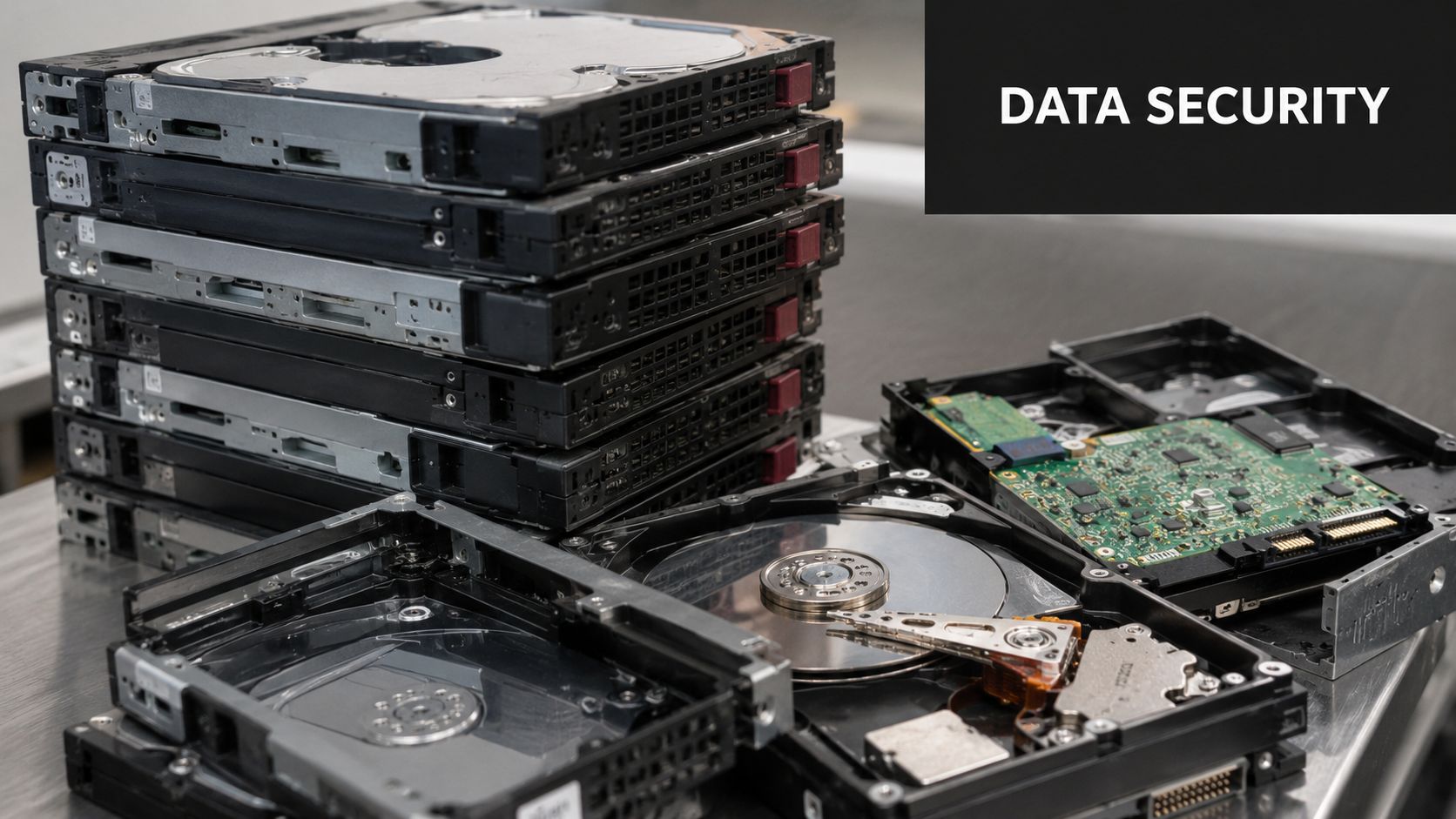
Wiping and destruction serve different goals
In practice, companies usually rely on one of two paths.
Software sanitization makes sense when a device is still suitable for reuse and your policy allows the media to remain intact after certified erasure. This path supports refurbishment and remarketing, but only if the process is documented and tied back to the asset record.
Physical destruction makes sense when policy requires irreversible destruction, when the media is damaged, or when the device category is too sensitive to release for reuse. Drives, SSDs, and removable media often fall into this category depending on the environment.
Neither method should happen informally. The issue isn't just whether data was removed. The issue is whether you can prove how it was handled.
Chain of custody starts before the truck leaves
The strongest programs don't start custody at the recycler's dock. They start on your premises.
A practical custody sequence usually includes:
- Controlled staging: Identified area for retired assets, limited access
- Asset matching: Items staged against the inventory list
- Pickup confirmation: Driver, date, asset count, and transfer acknowledgment recorded
- Secure transport: Locked containers or otherwise controlled movement for sensitive assets
- Processing reconciliation: Vendor confirms what was received against what was tendered
That sequence is why integrated service models are useful. Fewer handoffs usually mean fewer blind spots.
For organizations trying to combine cleanout support with responsible electronics handling, service options that bundle removal and recycling are often easier to govern than piecing together separate haulers, ITAD vendors, and scrap outlets.
What your certificate should actually prove
A certificate of data destruction only matters if it ties back to the specific assets. A vague statement that “materials were destroyed” won't help much during an internal review.
Look for documentation that identifies:
| Documentation element | Why it matters |
|---|---|
| Company and processing date | Establishes who performed the work and when |
| Asset identifiers or serial references | Connects destruction to actual equipment |
| Destruction or sanitization method | Shows what was done, not just that something happened |
| Quantity or itemization | Helps reconcile pickup inventory to processed material |
| Authorized signoff | Confirms the work was formally completed |
Your legal and compliance teams don't need a pretty certificate. They need a traceable one.
The other important point is timing. Don't wait until after pickup to ask what the certificate will include. Ask before award, and make sure the expected format is part of the scope.
Managing Logistics Costs and Compliance Documentation
The physical recycling is only half the job. The other half is proving what happened in a form your finance team, security team, facilities group, and sustainability stakeholders can use.
That's become more important because the documentation question has moved from “Can we get a receipt?” to “Can we show an auditable trail?” The issue is easy to understand in context. Global e-waste reached 62 million tonnes in 2022, yet only 22.3% was formally collected and recycled, and for facilities managers and IT directors the practical concern is often what documentation they receive after decommissioning switches, routers, servers, and storage, as noted by the Houston-Galveston Area Council used electronics resource.
That's why final paperwork isn't administrative cleanup. It's the closeout.
A useful way to think about execution is to borrow from broader logistics practice. If your team wants a plain-language refresher on how outside logistics partners coordinate transport, handling, and accountability, these essential 3PL insights are helpful context for planning a secure asset pickup workflow.
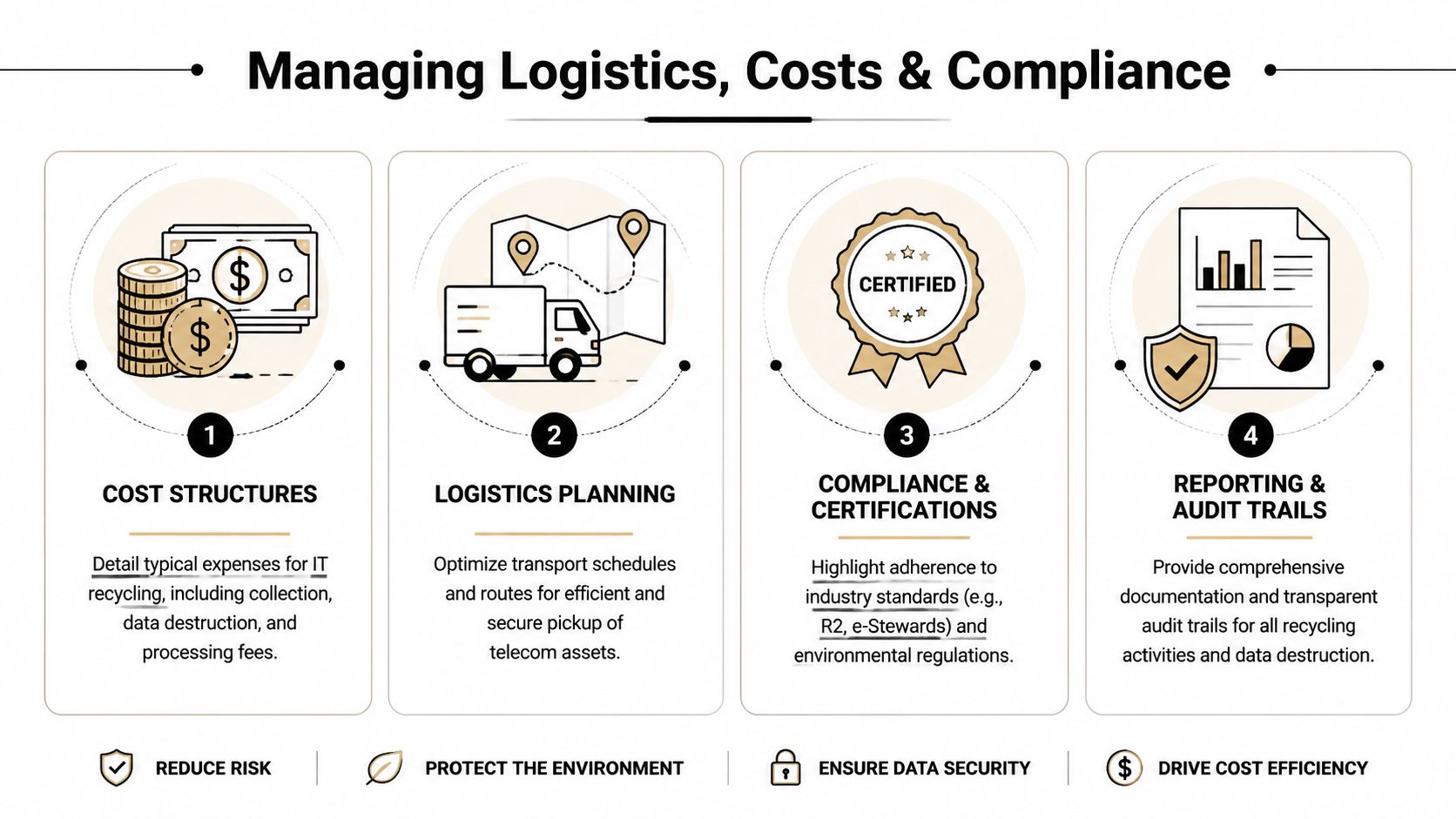
What affects project cost
Houston telecom recycling projects are usually priced based on the complexity of the load, not just the fact that electronics are involved.
Common cost drivers include:
- Site access conditions: Freight elevator use, loading dock limits, security escorts, after-hours scheduling
- Labor intensity: Rack breakdown, palletizing, onsite sorting, and removal from multiple floors
- Data services: Certified wiping, media destruction, and documentation requirements
- Material mix: Batteries, UPS units, loose cabling, scrap metal, and general junk mixed with IT assets
- Reporting burden: Serialized audit trails and detailed final reports take real work
Residual value can offset costs in some projects, but don't assume it will. The right way to evaluate economics is to look at the whole disposition package: removal effort, data handling, reuse potential, and reporting needs.
The paperwork you should expect at closeout
A strong project leaves behind a file, not just an empty room.
At minimum, most commercial teams should expect these records:
Pickup or transfer record
This establishes what left the site, when, and under whose control.Data destruction documentation
This covers sanitized or physically destroyed media and should align with the asset list.Recycling or diversion report
This shows what was reused, recycled, or otherwise processed through approved channels.Supporting chain-of-custody records
Depending on the vendor, this may include intake reconciliation, serialized logs, or downstream handling summaries.
These documents are what procurement stores, what security asks for later, and what sustainability teams need when leadership wants more than a disposal invoice.
Field note: A recycler's reporting package is part of the product. If the vendor treats documentation like an extra, expect headaches after the truck is gone.
Logistics planning should match the building, not just the equipment
A well-run pickup plan accounts for the property itself. Office towers, industrial campuses, hospitals, and multi-tenant buildings all create different handling constraints.
Before scheduling, confirm:
- Who controls dock access
- Whether pallets or bins are needed
- If the elevator reservation is required
- Whether after-hours removal is necessary
- Who signs the release at pickup
For companies managing multiple sites or suburban facilities around the metro, a local coverage footprint matters too. Reviewing service-area availability for coordinated pickups can help determine whether one partner can support all the locations involved in a rollout or closure.
When logistics and documentation are planned together, the project usually runs smoothly. When they're treated as separate issues, the paperwork often falls apart after the assets are already gone.
Frequently Asked Questions About Houston Telecom Recycling
Houston buyers usually don't need more theory by the time they're ready to schedule a project. They need direct answers.
Can a small office use the same process as a large data center
Yes, but the scale changes the level of control. A small office with a few servers, laptops, and switches still needs inventory, data handling decisions, and final documentation. A large data center decommissioning adds more staging, more reconciliation, more labor coordination, and usually stricter signoff procedures.
The mistake small offices make is assuming their volume is too low to justify a formal process. It isn't. If the equipment holds business data, the process still matters.
Should we use city collection events for business telecom equipment
Public infrastructure exists, and that's useful context. The City of Houston has listed free electronics recycling collection events for years and explicitly accepts categories such as computers, servers, and network equipment, with records showing organized public collection dating back at least to 2017 on the City of Houston electronics collection page.
For business users, though, public collection and commercial disposition solve different problems. City events help with access to responsible recycling. Commercial projects usually require onsite pickup, building coordination, data destruction workflows, and audit-ready paperwork. That's why most companies with telecom equipment don't treat public drop-off as a substitute for managed IT asset disposition.
What equipment usually belongs in a telecom recycling project
Most commercial jobs include a mixed stream such as:
- Core IT equipment: Servers, desktops, laptops, storage units, workstations
- Telecom and network gear: Routers, switches, firewalls, access points, phones, patch panels
- Infrastructure components: Racks, rails, cable management hardware, antennas, transceivers
- Power-related items: UPS systems, batteries, power distribution equipment
- Loose material: Cabling, adapters, docks, peripherals, and metal accessories
If you're also planning an office relocation, decommissioning the old environment before move day makes the new site easier to control. This Boston office IT move guide is a useful example of how move planning and IT handling need to be coordinated even when the geography is different.
Can companies recover value from retired equipment
Sometimes, yes. Working or refurbishable equipment may have remarketing or reuse value. That usually depends on age, condition, completeness, and whether secure sanitization allows the hardware to be resold or redeployed.
The key is to decide that early. Once hardware sits in storage too long, loses components, or gets mixed into scrap, recovery becomes much less likely.
What are the most common mistakes businesses make
A few show up repeatedly.
Focusing only on pickup price
Cheap hauling can become expensive if it produces weak records, poor segregation, or unclear downstream handling.
Skipping the asset list
Without serialized inventory, disputes are hard to resolve and destruction records are less useful.
Letting departments work in isolation
IT, facilities, security, and procurement all touch the same project. If they don't align, delays and mistakes follow.
Treating documentation as optional
This is the big one. Responsible recycling isn't complete until the paperwork closes the loop.
What should we ask before signing with a recycler
Keep it simple and direct:
| Question | What you want to hear |
|---|---|
| How will you track our assets | A clear explanation of inventory and reconciliation |
| How do you handle data-bearing devices | Defined sanitization or destruction procedures |
| What happens to reusable equipment | A reuse-first triage process |
| What documents do we receive | Pickup record, destruction proof, recycling reporting |
| Can you handle mixed cleanout material too | Yes, with separate handling where needed |
When should we start planning
Earlier than often assumed. Start planning as soon as a refresh, closure, move, or renovation is approved. That gives you time to identify high-risk devices, line up internal approvals, and avoid the last-minute rush that causes bad handoffs.
If you need to coordinate a commercial cleanout, equipment pickup, and responsible recycling workflow, the easiest next step is usually to start the conversation early through Fulton Junk Removal's contact page.
If your office, warehouse, or facility is sitting on retired telecom and IT equipment, Fulton Junk Removal can help coordinate the haul-away side with a recycling-first approach through Beyond Surplus, so your team can clear space while keeping data handling, diversion, and documentation aligned with a responsible disposition process.
