
City of Atlanta Waste Guide: Junk, Bulk & Recycling
A full garage before a move. A leasing office trying to turn a unit fast. An office manager staring at old desks, broken chairs, and a pile of monitors no one wants to touch. In the city of atlanta, junk is rarely just junk. It usually comes with rules, deadlines, labor, and disposal questions that waste more time than the cleanup itself.
That confusion is getting more common as Atlanta grows. The city’s population has grown by approximately 25% since 2000, reaching an estimated 520,070 in 2024, which increases pressure on waste systems, property services, and cleanup logistics across the area, according to the Georgia Encyclopedia’s Atlanta overview. More people, more businesses, and more turnover means one practical reality. More items do not fit neatly into a curbside bin.
Your Guide to Navigating Atlanta's Waste & Junk Rules
A typical cleanup in the city of atlanta starts with a simple question and quickly turns into five more. Can this go in the cart. Will the city take it. What about a mattress. What about a broken TV. What if the property has old paint, mildew, or pest debris mixed into the load.

Those questions matter because city service, private hauling, recycling, and specialty disposal do not operate the same way. A homeowner doing a declutter has different options than a property manager handling a turnover. A warehouse cleanout creates a different compliance problem than a curbside trash pickup.
Why Atlanta cleanouts feel harder than they used to
Atlanta is not a small-service environment anymore. A growing city creates more move-ins, move-outs, renovations, office reconfigurations, estate cleanouts, and retail resets. The Atlanta service area page reflects what anyone working in the market already sees on the ground. Jobs are rarely isolated to one bag, one cart, or one room.
A city rulebook also does not solve the physical problem. Even when residents know the basic ordinance, they still have to sort loads, protect reusable items, separate electronics, and avoid placing prohibited material in the wrong stream.
What usually works and what usually fails
The most efficient cleanups follow a sequence:
- Sort first: Separate trash, recyclables, electronics, metal, and reusable goods before anything goes to the curb.
- Identify restricted items early: Mattresses, appliances, renovation debris, and electronics cause the most delays.
- Match the disposal method to the load: Curbside works for routine household waste. It does not work well for mixed bulk loads or commercial cleanouts.
What fails is the common shortcut. People set out oversized items, mix recyclables with trash, or assume any hauler can manage electronics and reporting the same way.
Tip: In Atlanta, the fastest cleanout is usually the one planned around item type, not around room type. A “garage load” may contain metal, e-waste, cardboard, donation items, and landfill material that each need different handling.
Understanding Atlanta's Basic Waste & Recycling Ordinances
The first distinction in the city of atlanta is simple. Residential and commercial properties do not play by the same day-to-day rules.
Residential users generally work within city-managed collection systems for ordinary household waste and standard recycling. Commercial properties, by contrast, usually need private service arrangements that fit the building, tenant mix, and waste stream. That difference explains why a homeowner can think in terms of carts and pickup days while a building manager has to think in terms of contracts, loading areas, contamination risk, and tenant compliance.
What belongs in regular household service
For routine residential disposal, the safe approach is to keep standard bins limited to ordinary household trash and accepted recyclables. Paper, cardboard, certain containers, and other common household recyclables generally belong in the recycling stream only when they are clean and not mixed with non-accepted material.
The problem is not the basics. The problem is the edge cases. Electronics, bulky furniture, construction material, and special cleanup debris do not belong in ordinary curbside containers.
A good practical rule is this:
- Household trash: Everyday bagged waste from normal living.
- Recycling: Clean paper, cardboard, and accepted containers.
- Not for standard bins: Televisions, computers, large furniture, fixtures, and renovation debris.
If a load contains heavy, oversized, sharp, or regulated material, assume it needs a different path.
Why contamination creates avoidable headaches
Most disposal delays come from mixing categories. A single cart filled with cardboard, loose trash, broken shelving, and a printer looks efficient for five minutes and becomes inefficient for everyone after that.
Use a simple screening check before setout:
| Waste type | Best handling approach |
|---|---|
| Everyday household waste | Regular trash service |
| Clean cardboard and paper | Recycling stream |
| Old computers and monitors | Separate for specialty recycling |
| Furniture and large household items | Bulky or private removal |
| Drywall, lumber, tile, cabinets | Construction debris handling |
The city of atlanta also creates a practical division between what residents can place out for municipal service and what businesses must arrange privately. Offices, retail spaces, apartment communities, and industrial sites usually need systems that do more than remove material. They need scheduling, labor, and documentation.
For readers who want more operational guidance on cleanup workflows, the Fulton Junk Removal blog covers recurring issues like sorting, property prep, and responsible material handling.
Key takeaway: The right question is not “Can this be thrown away?” The right question is “Which waste stream is this item supposed to enter?”
Commercial properties need a stricter standard
For commercial sites, the standard is higher because the risk is higher. A mixed office cleanout can include paper records, scrap metal, old cubicles, electronics, packaging, and breakroom waste in the same project. A warehouse can add pallets, shelving, damaged inventory, and obsolete equipment.
That is why experienced facility teams build around three priorities:
- Access and labor planning
- Separation of recyclable material
- Documented disposal for sensitive or high-volume items
If those three are missing, the cleanup usually costs more time than expected.
How to Handle Bulky Items and Special Waste
Bulky waste is where many city of atlanta cleanup plans start to break down. A sofa, mattress, appliance, or roomful of turnover debris is not just “more trash.” It often triggers a different disposal process, different timing, and different liability.

The official path can work for a limited, straightforward setout. It works poorly when the load is mixed, the property must be turned quickly, or the material includes anything beyond ordinary bulk household items.
Where city bulky pickup runs into limits
The city process is designed for controlled, narrow scenarios. It is not built for a full eviction cleanout, a retail backroom purge, a warehouse reset, or a building-wide furniture removal.
That matters because real properties rarely produce neat categories. One turnover can include:
- Furniture: Sofas, bed frames, dressers, and damaged tables
- Bagged trash: Food waste, paper goods, and general discards
- Special material: Televisions, small appliances, cords, and broken fixtures
- Property residue: Damp boxes, pest-damaged contents, and materials from deferred maintenance
A narrow municipal pickup model often forces staff to split one job into multiple disposal paths. That slows turnover and increases labor.
Older housing stock adds health and handling issues
This is especially true in distressed or aging properties. Atlanta’s affordable housing initiatives and aging building stock mean property managers often face cleanouts involving environmental health hazards like lead, mold, and pests. Healthy Homes Atlanta provides grants for remediation but lacks integrated guidelines for the subsequent junk hauling, creating a critical service gap, according to the City of Atlanta’s Healthy Homes Atlanta program page.
That gap shows up in the field during estate clearouts, eviction work, and post-remediation cleanup. Once remediation crews finish, someone still has to remove contaminated household contents, damaged furnishings, non-salvageable debris, and bulky leftovers without turning the site into a secondary hazard.
Tip: If a property has visible mold, pest debris, old flaking paint, or contaminated soft goods, plan the hauling step after hazard control, not before. Removal crews should not be asked to “sort it out on site” in a health-risk environment.
Practical handling rules for special waste
Use this decision framework:
- Mattresses and upholstered items: Check whether they are clean, dry, and acceptable for bulk handling. If not, isolate them.
- Appliances: Remove food, loose glass, and detachable shelves before pickup planning.
- Electronics: Never treat them like ordinary bulk trash.
- Renovation debris: Keep it separate from household junk from the start.
The worst approach is curb-dumping a mixed pile and hoping it qualifies. The best approach is identifying special waste before anything leaves the unit.
For managers trying to reduce vacancy time, the value is not only disposal. It is reducing touchpoints. One organized removal is usually better than repeated trips, partial setouts, and rejected loads.
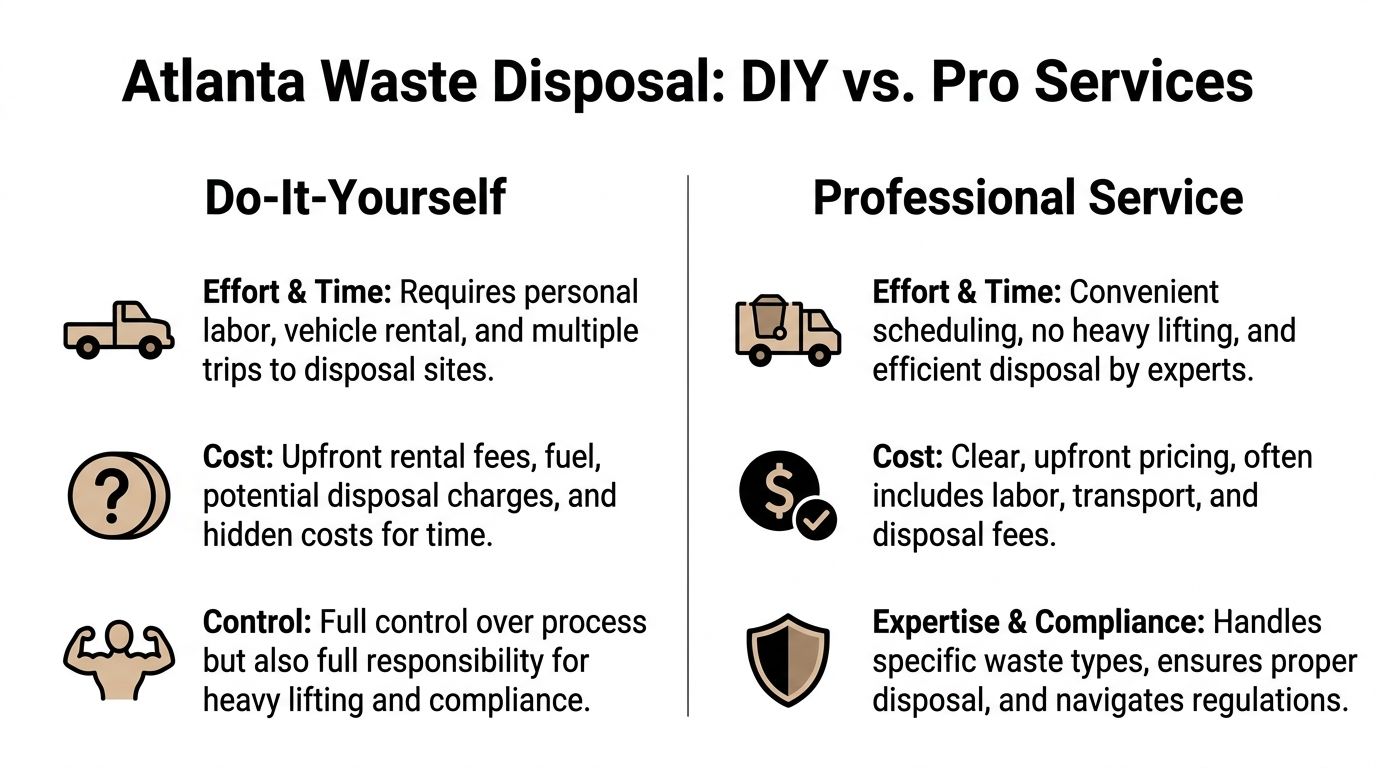
Comparing Your Disposal Options DIY vs Professional Services
Residents in the city of atlanta typically have three realistic options. Handle it yourself. Rely on limited public pickup where it fits. Hire a removal team.
The right choice depends less on price alone than on time, labor, and how mixed the load is.
DIY makes sense in narrow cases
If you have a small, clean, pre-sorted load and access to a truck, DIY can work. It is best for a few boxes, a short list of donation items, or a controlled one-room purge.
DIY starts to fail when any of these are true:
- The load is heavy
- The material types are mixed
- You need the space cleared fast
- You are dealing with electronics or bulky items
- The property has stairs, loading constraints, or tenant deadlines
The hidden cost is not just disposal. It is missed work time, vehicle rental, fuel, loading risk, and the need to make judgment calls at the disposal site.
City pickup works only for specific situations
Municipal service is useful for routine household waste and certain limited bulky scenarios. It is not designed to run a commercial cleanout, empty a storage room, or support an office decommission.
That distinction matters for apartments, offices, and warehouses. A city-style mindset often leads managers to underestimate labor and overestimate what a standard collection stream can absorb.
Professional service wins on labor and control
For anything beyond a light, sorted load, professional removal is usually more efficient. The service overview reflects the broader point. The useful part of professional help is not merely hauling. It is combining labor, scheduling, transport, sorting, and proper downstream handling.
A simple comparison makes the trade-off clear:
| Option | Best for | Main drawback |
|---|---|---|
| DIY | Small, clean, sorted loads | Highest personal labor |
| City pickup | Routine residential setout | Narrow scope |
| Professional removal | Mixed, bulky, commercial, or urgent loads | Requires scheduling service |
Key takeaway: DIY is a disposal method. Professional removal is an operations solution.
If you are clearing a business, rental property, or multi-room residential load, efficiency usually comes from reducing handling steps. One crew, one truck plan, one scheduling window.
Smart Waste Solutions for Atlanta Businesses and Properties
Commercial cleanup in the city of atlanta is not a curbside problem. It is an operations problem. Office managers need fast clear-outs with minimal disruption. Property managers need unit turnovers that do not stall on bulky debris. IT directors need old devices removed without creating a compliance mess. Warehouse teams need floor space back.
A general hauler can remove items. A better commercial solution removes items and preserves order in the process. That means scheduling around dock access, tenant activity, building rules, data sensitivity, reusable materials, and sustainability reporting.
The e-waste issue is getting bigger
Atlanta’s commercial market is producing more obsolete electronics, not fewer. As Atlanta's data centers, which will absorb 80% of Georgia Power's projected industrial electricity growth by 2035, expand, the turnover of IT assets will accelerate. This creates a massive stream of e-waste that requires specialized, compliant recycling solutions beyond what standard haulers provide, according to Mordor Intelligence’s Atlanta data center market analysis.
That projection matters beyond the data center sector itself. Every support office, server room, colocation user, and vendor ecosystem around that growth produces equipment refresh cycles. Monitors, networking gear, cables, workstations, and peripheral hardware need a recycling channel, not a landfill-first shortcut.
What business clients should demand from a removal partner
For commercial sites, four capabilities separate a useful vendor from a truck with labor:
- Load segregation: Electronics, metals, furniture, cardboard, and landfill material should not all go into the same stream.
- Clear chain of handling: Managers need to know where material is going.
- Site efficiency: Crews should work around business operations, not against them.
- Documentation: Sustainability and facilities teams increasingly need diversion reporting for internal records.
The about Fulton Junk Removal page is relevant here because it points to the integrated model many businesses require. Hauling alone is incomplete if the load includes electronics, recyclable commodities, or reusable equipment.
Real trade-offs in office, warehouse, and property work
In practice, different sites need different tactics.
An office cleanout usually requires quiet, fast removal and protection of shared areas. A warehouse purge often needs palletized staging, aisle control, and quick differentiation between scrap and usable goods. A multifamily turnover calls for speed, but also caution when debris includes bio-residue, pests, or water-damaged contents.
What does not work is treating all three as generic junk jobs.
Tip: For commercial properties, ask one question before scheduling removal. “Do we need proof of what was recycled, repurposed, or discarded?” If the answer is yes, you need an integrated process, not a basic haul-away.
The strongest waste strategy for businesses is simple. Remove material once. Sort it correctly. Capture what can be recycled. Keep records.
The Eco-Friendly Advantage of Responsible Junk Removal
A lot of junk hauling still follows the old model. Load the truck fast. Dump the mixed contents. Move on to the next stop.
That model is easy for the hauler and expensive for everyone else. It wastes reusable material, sends recyclable commodities to landfill, and makes sustainability claims hard to prove.
What a circular approach looks like in practice
A circular model treats a cleanup as a sorting and recovery job first, not just a disposal event. Electronics go to specialized recycling channels. Metals get separated. Cardboard and similar recyclables stay out of mixed trash. Reusable items have a better chance of being repurposed.
That is where an integrated company structure changes the result. Fulton Junk Removal operates with Beyond Surplus, which allows junk removal and material recovery to work together instead of as separate afterthoughts. For offices, warehouses, and property managers, that bundled approach is more useful than hiring one vendor to haul and another later to untangle electronics and recyclable material.
Why this matters in Atlanta neighborhoods
The environmental case is not abstract in Atlanta. In Atlanta, urban heat islands are most severe in underserved areas with high concentrations of heat-trapping junk and debris. Data from UrbanHeatATL shows these same areas suffer from higher rates of chronic health conditions, highlighting how rapid, eco-friendly cleanups can support both environmental and public health, according to The Atlanta Voice coverage of Atlanta urban heat islands.
That matters on the ground in alleys, vacant lots, industrial edges, overloaded garages, and neglected multifamily areas. Heat-trapping clutter does not just look bad. It can worsen already difficult site conditions.
What responsible removal gets right
A responsible cleanout should do more than empty space. It should improve the property’s condition after the truck leaves.
That usually means:
- Removing heat-holding bulk material from paved or low-shade areas
- Separating metals and electronics from general trash
- Reducing landfill dependence where reuse or recycling is possible
- Creating a cleaner turnover environment for the next resident, tenant, or employee
The practical advantage is just as important as the environmental one. Once sorting is integrated into the service, clients spend less time coordinating separate disposal paths.
Key takeaway: Eco-friendly junk removal is not a branding line. It is a better operating method for material recovery, reporting, and neighborhood impact.
The city of atlanta has enough growth, turnover, and redevelopment pressure already. Landfill-first hauling adds friction. Recovery-first hauling removes it.
Your Action Plan for a Clutter-Free Property
A cleanout moves faster when each group follows a short checklist instead of improvising on pickup day.
Checklist for homeowners
- Walk the property once. Separate normal trash from furniture, electronics, and anything reusable.
- Pull restricted items aside. Keep televisions, computers, and similar devices out of ordinary disposal piles.
- Decide what needs labor, not just transport. If the job includes stairs, heavy items, or multiple rooms, get help early.
- Request a quote for full-service removal. Use the contact page to schedule an estimate and avoid repeat handling.
- Stage access before pickup day. Clear a path from the item location to the exit.
Checklist for property managers
Start with the turnover deadline, not the junk pile. That changes the plan.
Create three categories. Standard trash, recoverable material, and specialty items. Then identify whether the unit has moisture damage, pest residue, or contents that should be handled after remediation.
Finish with one operational question. Can one crew remove everything in one visit without mixing streams that should stay separate. If not, the job needs a more structured removal plan.
Checklist for business owners
- Audit by department: Storage rooms, break areas, IT closets, and back-of-house spaces usually contain different waste types.
- Protect recyclable value: Do not let scrap metal, cardboard, and e-waste get buried under general trash.
- Ask for documentation: If your team tracks sustainability or internal compliance, make diversion reporting part of the scope.
- Schedule around operations: Removal should fit business hours, dock availability, and staff access.
For all three groups, the same rule applies. The best cleanup is the one that reduces touches. Sort once. Remove once. Process material through the correct channel the first time.
Frequently Asked Questions About Atlanta Waste Disposal
Can I put renovation debris out with regular trash
No. Renovation and construction debris should be handled separately from ordinary household waste. Drywall, lumber, tile, cabinets, and fixture debris create a different disposal problem than routine trash or standard recycling.
Are mattresses and appliances treated like normal bulk junk
Not always. Mattresses and appliances often require separate planning because condition, size, and material type affect how they should be handled. If an item is damaged, wet, or mixed with contaminated contents, treat it as a specialty removal issue.
How do businesses get recycling documentation for sustainability goals
Ask for diversion reporting before the job starts, not after pickup. If a company wants internal ESG records, waste summaries, or proof that electronics and recyclables were separated, that should be built into the scope from the beginning.
What if a property has mold, pests, or other environmental health concerns
Do not treat it like a routine junk job. Handle hazard control first, then schedule hauling that matches the post-remediation condition of the site. Mixed loads from distressed units usually need more planning than ordinary move-out debris.
Do services extend beyond the city itself
Yes. The practical market is much larger than the city of atlanta alone. The Atlanta metropolitan area has over 6.3 million residents across 29 counties and is the sixth-largest metropolitan area in the United States, according to Wikipedia’s Atlanta metro overview. For removal providers, that means service demand extends well beyond the city proper into surrounding communities, business corridors, and suburban properties.
What is the biggest mistake people make with Atlanta waste disposal
They treat a mixed load like one category. Once furniture, electronics, cardboard, scrap metal, and general trash are piled together, every next step gets slower and less efficient.
If you need a practical cleanup partner in the city of atlanta, Fulton Junk Removal handles residential, commercial, office, warehouse, and property cleanouts with a stronger recycling-first process. Through Beyond Surplus, the team combines haul-away service with responsible recycling for electronics, metals, and other recoverable materials, helping businesses and property managers simplify disposal, support sustainability reporting, and keep more material out of the landfill.
