
Telecom Asset Recovery Services Near Me: An Atlanta Guide
A network upgrade usually ends with a bad storage problem. The new switches are live, the old PBX is disconnected, and a rack of retired gear is now sitting in a closet, warehouse corner, or unused office. Nobody wants to throw it in the trash, but nobody wants to own the risk either.
That's the moment businesses search for telecom asset recovery services near me. What they need isn't a pickup. They need a controlled process that protects data, documents custody, separates resale value from scrap, and gives the business a clean audit trail when the equipment is gone.
The Hidden Liability in Your Storage Closet
An Atlanta office move or network refresh tends to create the same pile. Old routers. Switches. Handsets. Firewalls. Patch panels. Maybe a few servers mixed in because nobody wanted to decide what to do with them during the cutover. The equipment sits longer than planned because the business is busy and the gear is “already offline.”
That idle pile creates three problems at once. First, it takes up space that operations or facilities teams need back. Second, some of that equipment may still hold configurations, credentials, or stored data. Third, every week it sits, the chance of recovering useful value usually gets worse.
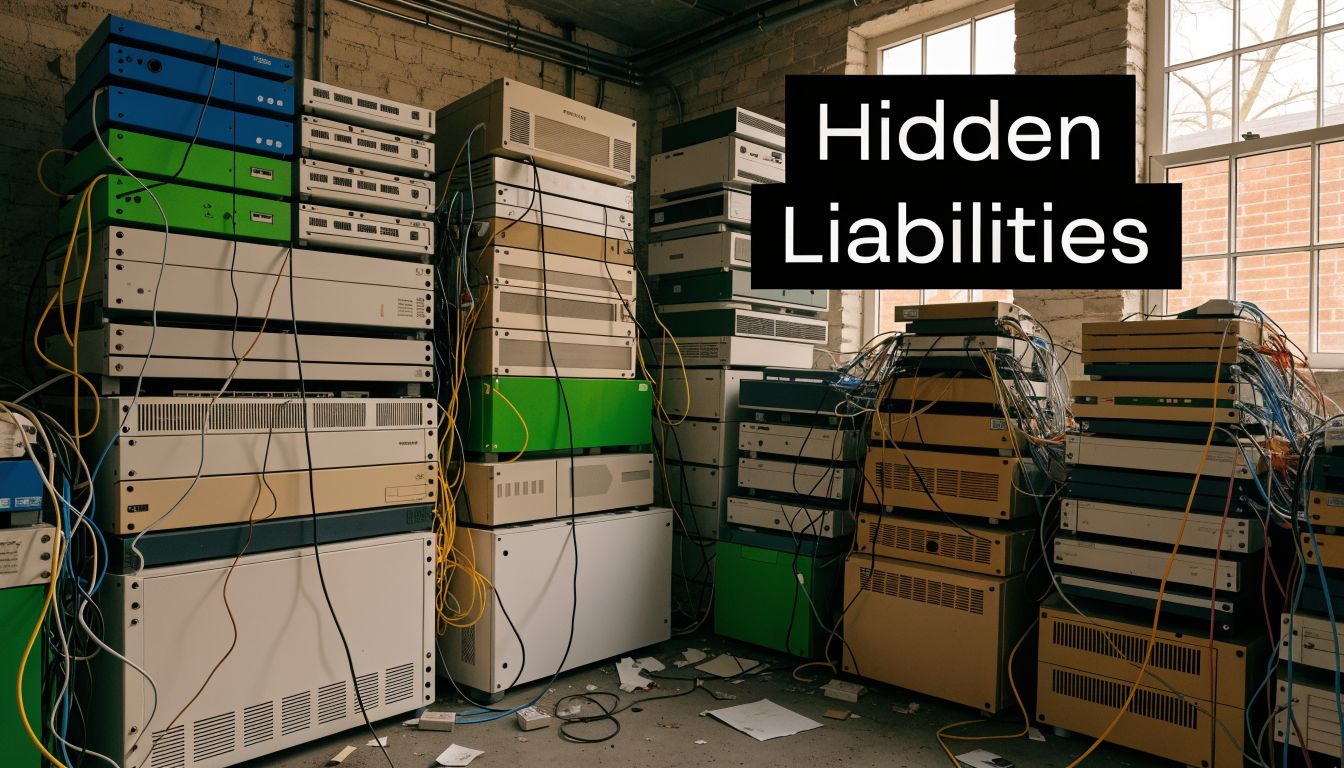
A lot of businesses treat this like overflow storage. That's a mistake. If you already manage offsite inventory or equipment staging through structured warehousing, the same mindset applies here. Retired telecom gear needs location control, handling rules, and a defined exit path.
Why this isn't a small side task
The broader market shows how established this work has become. The global asset recovery services market was valued at USD 8.7 billion in 2025 and is projected to reach USD 16.2 billion by 2034, with IT and telecommunications identified as a major end-user group in Dataintelo's market report. That matters because it confirms telecom recovery isn't an improvised cleanup category. It's an operating function tied to refresh cycles, compliance, and resale.
Old telecom equipment becomes more expensive the longer nobody owns the decision.
A proper recovery program turns a clutter problem into a managed disposition project. Equipment that still has market value gets identified. Data-bearing devices get sanitized or destroyed under documented controls. Non-working units get recycled through the right channels instead of disappearing into a mixed junk stream.
That's the difference between clearing space and closing risk.
What Telecom Asset Recovery Truly Means
Many IT leaders hear “asset recovery” and think haul-away. That's too narrow.
Telecom asset recovery is a reverse supply chain for retired network and communications equipment. The job isn't just to remove hardware from your site. The job is to control what happens after removal, with enough detail that IT, operations, procurement, and compliance can all sign off on the result.
The word asset matters
If you treat every retired device as trash, you lose two things. You lose potential resale value on usable hardware, and you lose the chance to recover parts or components from units that aren't worth remarketing intact.
In this context, an asset can be:
- A marketable unit that can be tested, graded, and resold
- A refurbishable device that needs repair or reconfiguration before remarketing
- A parts donor with reusable modules, cards, or components
- A regulated electronics item that needs documented recycling because resale no longer makes sense
That's why telecom recovery sits closer to operations and finance than to basic junk hauling.
The word recovery matters too
Recovery is the discipline. It covers de-installation, packaging, transport, audit, sanitization, testing, sortation, resale, and final recycling. If any one of those steps is weak, value drops and exposure rises.
A junk truck can remove a stack of phones and switches in an afternoon. A recovery provider has to answer harder questions:
- What left the site
- Who handled it
- Which serial numbers were received
- Which items were wiped
- Which items were destroyed
- Which items were sold
- Which items were recycled
Operational lens: If your vendor can't reconcile inventory to final disposition, you're not buying asset recovery. You're buying uncertainty.
That distinction matters for Atlanta businesses dealing with office closures, warehouse cleanouts, branch consolidations, and data room upgrades. The physical removal may look simple from the hallway. The actual heavy lifting starts once the equipment leaves the room.
Professional teams treat the retired gear like controlled inventory on the way out, not junk on the way to a landfill.
The Four Pillars of Smart Asset Recovery
A solid telecom recovery program earns its place because it solves four separate business problems. Miss any one of them and the project starts to leak value.

Financial return
This is the part most companies notice first, but it only works when the process is fast and organized. According to Beyond Surplus telecom equipment asset recovery guidance, organizations using professional services for data-wiped telecom assets can retain 40% to 60% of resale value, compared with 10% to 20% for firms without a strategic recovery program. The same guidance says delays can destroy 40% to 60% of potential value.
That changes the economics of decommissioning. A retired switch in a labeled, tested, traceable batch is very different from a scratched switch tossed in a gaylord with power cords and scrap metal.
Security protection
Telecom gear often carries more risk than teams expect. Routers, switches, firewalls, PBXs, storage appliances, and edge devices can retain configurations, credentials, or other sensitive artifacts. If that gear leaves your site without a documented sanitization path, your disposal project becomes a security project.
What works is straightforward:
- Identify data-bearing assets early
- Separate them from general removal loads
- Use documented wiping or destruction
- Match the sanitization result back to inventory records
What fails is the casual approach where devices are boxed first and questioned later.
Compliance control
Environmental and data-handling obligations don't disappear because equipment is old. Once a business hands over telecom hardware, it still needs evidence that disposal was handled correctly. That means documented destruction where required, documented recycling where resale isn't possible, and enough reporting to survive an internal review.
A provider that only says “we recycle everything responsibly” isn't giving you a control. They're giving you a slogan.
Sustainability impact
Good recovery programs extend equipment life where appropriate and keep non-viable electronics out of the wrong disposal stream. That helps with internal sustainability reporting because the business can show that reusable assets were remarketed and non-working assets were processed through responsible recycling channels.
Recovery works best when finance, IT, and sustainability all get what they need from the same project.
The companies that do this well don't describe retired telecom gear as junk. They treat it as inventory that needs a secure and defensible exit.
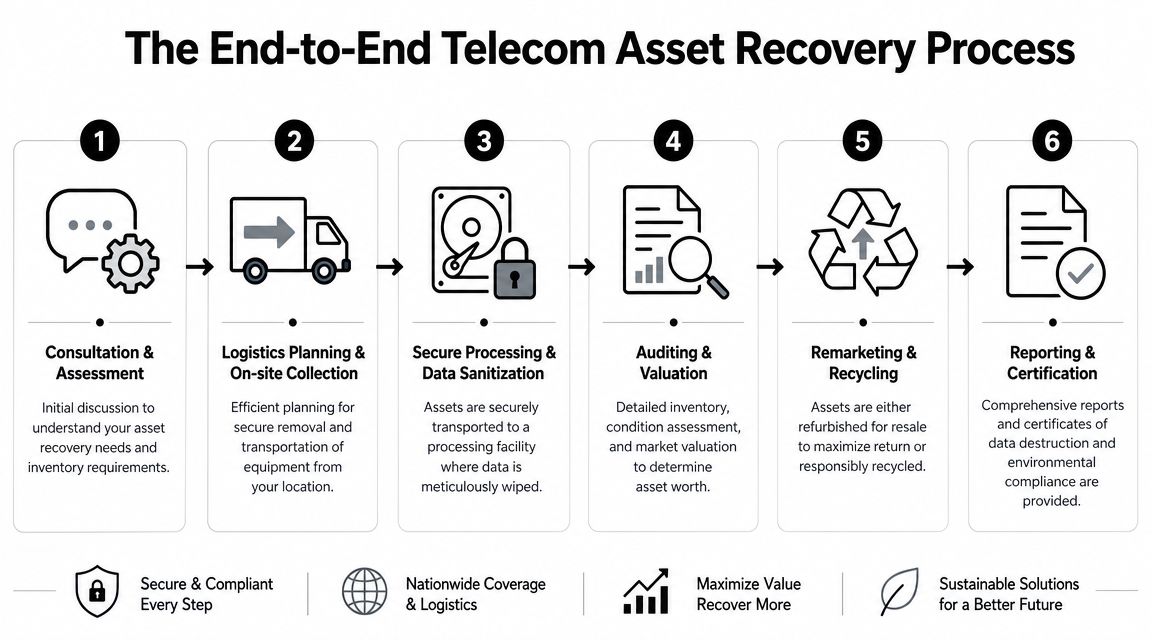
The End-to-End Recovery and Disposition Process
The safest telecom recovery jobs follow a controlled sequence. Not because the process needs to look formal, but because value and accountability break down when teams skip steps. The highest-value programs are treated as reverse logistics workflows with de-installation, secure transport, cataloging, testing, and certified recycling, as described by SCC Telecom asset recovery services.
For companies that need broader cleanout help around offices, warehouses, or mixed commercial spaces, some firms also combine general removal with electronics handling. One example is commercial cleanout and removal services, where the physical cleanout scope can be coordinated alongside more specialized downstream processing.
What happens on site
The job usually starts with de-installation or controlled pickup. Gear is removed from racks, closets, MDFs, storage shelves, or staging areas. Teams should pack it to prevent damage and preserve traceability. Mixing loose hardware, cables, optics, and drives into one container is one of the fastest ways to lose resale value and inventory accuracy.
On-site discipline should include:
- Asset segregation for data-bearing devices, marketable units, and recycle-only material
- Labeling and manifesting so the receiving facility knows what it has before testing starts
- Release controls that identify who handed off the equipment and when
What happens in transit and intake
Transport matters more than buyers think. Secure transport isn't just about theft prevention. It's also about chain-of-custody continuity. A professional provider should be able to show when assets left your site, when they arrived, and how intake was reconciled.
If a truck leaves with a vague load description, the reporting problem has already started.
Once the assets arrive, intake teams catalog equipment by serial number or other identifying detail where available. That record becomes the backbone for everything that follows.
What happens during processing
Processing should move in a controlled order:
- Sanitization or destruction for data-bearing components
- Testing and grading for functional equipment
- Refurbishment or parts harvesting where appropriate
- Resale routing for marketable assets
- Recycling disposition for units with no viable reuse path
Real asset recovery separates itself from a haul-away vendor at this stage. The provider isn't just removing hardware. The provider is deciding, item by item, whether the right path is resale, refurbishment, component recovery, or certified recycling.
What the closeout should include
A proper closeout package should give your team enough documentation to answer three basic questions. What left the site, how it was handled, and where it ended up.
That usually means:
- Inventory-level reporting
- Data destruction records where applicable
- Disposition summaries for resale and recycling
- Final reconciliation against the original pickup or manifest
When that reporting is complete, the project is closed. Until then, it's just equipment in motion.
Key Certifications and Documentation to Demand
When buyers compare telecom asset recovery services near me, they often focus on pickup speed. The stronger filter is paperwork. A provider that can't produce evidence before the job starts usually won't produce clean evidence after the job ends.
The baseline requirement is documented data handling. Reputable providers specify NIST 800-88-compliant sanitization and provide a certificate of destruction, as noted by Zurich Tech Solutions asset recovery guidance. That same guidance makes the key point clearly: if sanitization isn't verified with documented wiping and reconciliation against asset reports, the organization inherits data leakage risk.
The documents that matter
Ask to see samples, not just promises. You want to know what the provider issues, how detailed it is, and whether it would satisfy your internal audit or legal team.
Look for these items:
- Asset manifest that identifies what was collected and from which location
- Certificate of data destruction tied back to inventory or serial-number reporting
- Certificate of recycling or equivalent disposition record for non-remarketable items
- Exception process showing how mismatched or unlisted items are handled
If a vendor says the paperwork comes later and can't show a sample now, keep looking.
The certifications worth discussing
The brief matters as much as the badge. Buyers often ask about standards such as R2 or e-Stewards because those certifications signal process discipline and responsible downstream handling. The point isn't to collect acronyms. The point is to verify that the provider operates inside documented controls and can explain those controls in plain language.
A legitimate provider should also be able to describe who does what inside the operation. If you want context on how a local commercial cleanout company presents its operating model and service scope, reviewing a firm's company background and service approach can help frame the right due-diligence questions.
Paperwork is not administrative overhead. It is the proof that your retired equipment didn't disappear into an untraceable stream.
For telecom equipment, “we wiped it” is not enough. “Here is the method, here is the certificate, and here is the reconciliation to the inventory” is the standard.
How to Vet Providers in the Atlanta Area
The phrase telecom asset recovery services near me sounds local and simple. However, the actual buying decision isn't simple. The hardest part is determining whether a nearby vendor can prove chain-of-custody, data destruction, and environmental handling instead of just claiming them.
That's a common gap in local service descriptions, and TXO's ITAD overview for legacy telecom and IT systems points directly at it. Certified providers bundle de-installation, data destruction, resale, and responsible recycling, and they should be able to prove each part.
A useful comparison is the warehouse world. Anyone evaluating fulfillment partners knows that location alone doesn't make a provider qualified. The same discipline used in articles about choosing a 3PL warehouse Los Angeles applies here too. Ask for operational proof, not polished copy.
Atlanta businesses can start with this local Atlanta service area reference for geographic fit, then move immediately into process questions.
Atlanta Telecom Asset Recovery Vendor Checklist
| Area of Inquiry | Key Question to Ask | What to Look For (The "Green Flag" Answer) |
|---|---|---|
| Chain of custody | How do you document custody from pickup through final disposition? | A clear handoff process, site-level manifests, intake reconciliation, and named custody points |
| Data sanitization | What method do you use for routers, switches, firewalls, servers, and storage devices? | Specific wiping or destruction procedures, not general assurances |
| Proof of destruction | Can you show a sample certificate of destruction? | A certificate tied to identifiable assets or inventory records |
| Inventory control | Do you provide serial-number or inventory-level reporting? | Detailed reporting that maps collected assets to disposition outcomes |
| Resale process | How do you separate reusable equipment from scrap? | Testing, grading, and sortation before recycling decisions are made |
| Recycling compliance | Where do non-working assets go? | A defined downstream recycling path with documentation |
| Exceptions | What happens if counts or asset descriptions don't match? | A documented discrepancy process instead of an informal adjustment |
| Project scope | Can you handle de-installation, pickup, and final reporting? | End-to-end capability rather than a pickup-only offer |
| Financial clarity | How are fees and recovery value explained? | A written explanation of charges, offsets, and settlement logic |
| Reporting closeout | What documents do we receive at the end? | Inventory summary, destruction records where needed, and final disposition reporting |
Red flags that should slow the decision
Some answers should put a vendor on pause fast:
- Vague security language such as “everything is erased” without method details
- No sample documents for manifests, certificates, or reconciliation reports
- No downstream explanation for where recycling happens
- Pickup-first selling where the discussion centers on trucks and labor but not controls
A local provider should make verification easier, not harder. Near matters. Proof matters more.
Understanding Project Pricing and Timelines
Telecom recovery pricing isn't arbitrary. It follows scope, handling complexity, and the amount of value that can realistically be recovered from the equipment. That's why two projects with similar equipment counts can price very differently.
What changes the cost
A few factors do most of the work:
- Asset mix affects labor and downstream handling. Phones, switches, servers, batteries, and rack gear don't move through the same process.
- Data requirements matter. On-site destruction, off-site sanitization, and certificate-heavy projects involve different workflows.
- Site conditions change labor needs. Live environments, access restrictions, stair carries, and de-installation needs all add operational complexity.
- Potential resale value can offset part of the project, but only after testing, grading, and market review.
A broader cleanout across north metro locations may also involve staging and scheduling considerations similar to other local service projects, such as commercial removal support in Sandy Springs.
What changes the timeline
Larger jobs usually take longer because the actual timeline includes more than collection. Equipment has to be received, audited, sanitized, tested, sorted, and reported out.
A realistic timeline usually depends on:
- How complete your starting inventory is
- Whether gear is already staged or still installed
- How much documentation your organization requires
- How much of the load needs testing before disposition
The fastest quote isn't always the fastest closeout. If reporting matters, measure the project by when final documentation is delivered, not when the truck departs.
Your Next Step for a Secure and Sustainable Cleanout
The right telecom recovery partner does more than remove old hardware. They reduce exposure, preserve value where possible, and leave your business with documentation that stands up after the equipment is gone. That's why this decision belongs with operations, IT, compliance, and facilities. Not just whoever happens to be available to book a pickup.
For Atlanta businesses, the practical goal is simple. Choose a provider that can handle the physical cleanout and the downstream accountability. In many commercial projects, that means pairing general junk removal with a recovery process that routes electronics, metals, and telecom equipment into reuse, resale, or compliant recycling instead of treating everything as landfill-bound debris.

If you're planning an office move, network refresh, warehouse cleanout, or branch shutdown, start by getting the asset list organized and the questions above into your vendor review. Then ask for sample reporting before anyone touches the equipment.
The fastest way to regain control is to move from “we need this gone” to “we need this documented.” If you're ready to start that process, request a project review through Fulton Junk Removal's contact page.
If your Atlanta team needs a coordinated cleanout that includes retired telecom equipment, general commercial junk, and responsible downstream recycling, Fulton Junk Removal can be part of that conversation. The practical advantage is having one local point of contact for removal logistics, with electronics and recyclable materials processed through Beyond Surplus so your business has a clearer path for security, compliance, and waste diversion.
