
Telecom Equipment Recycling Atlanta: Eco-Friendly Disposal
Old phone systems, stacked switches, unlabeled routers, wall-mounted gear from the last tenant, and a few mystery boxes from a hurried upgrade. That's the condition many Atlanta offices, warehouses, and multi-site facilities face when a telecom room finally gets attention. What looks like clutter is usually something else entirely. It's a mix of data risk, compliance exposure, recoverable material, and avoidable operational drag.
That's why telecom equipment recycling Atlanta shouldn't be treated like a bulk trash problem. It's an IT asset disposition problem with a facilities component. The companies that handle it well don't just clear space. They document assets, protect data, separate reuse from scrap, and leave behind records that hold up under internal review.
Why Telecom Recycling Is a Critical Task for Atlanta Businesses
A telecom closet rarely becomes a problem all at once. It happens over years. A PBX gets replaced by VoIP. Branch switches come back from a site closure. Access points, rack hardware, handsets, patch panels, and legacy cabling all pile up because nobody wants to be the person who throws out the wrong thing.
That hesitation is justified. The United States generates over 3.5 million tons of e-waste annually, and it's the fastest-growing part of municipal solid waste, according to Atlanta e-waste recycling guidance from Reworx Recycling. Telecom hardware adds another layer of risk because it often contains both confidential data and recoverable metals. In practice, that means phones, VoIP systems, network gear, and related devices shouldn't go into ordinary trash streams or undifferentiated cleanouts.
Why telecom gear is different from ordinary office junk
A broken chair is a hauling issue. A decommissioned firewall or IP phone system is different.
Telecom and networking equipment often carries configuration data, call records, credentials, internal addressing information, or storage media that someone forgot was there. Even when a device seems low value, its data profile may still be high risk. That's why chain of custody matters more than speed alone.
A practical disposal plan usually needs to answer four questions before anything leaves the site:
- What exactly do you have: You need a verified inventory, not an estimate.
- What data may still exist: Phones, gateways, firewalls, and network appliances all need a sanitization path.
- What can be reused or resold: Some assets have value beyond scrap.
- What documentation will you receive: Audit trails matter to IT, facilities, procurement, and finance.
Casual disposal creates two problems at once. You lose control of the data, and you lose visibility into what happened to the assets.
Disposal is the wrong mindset
The smarter frame is strategic disposition. That means treating the project as part cleanout, part security process, and part sustainability program. Atlanta facility managers usually feel this most during office relocations, telecom upgrades, and property turnovers, where general junk and sensitive electronics show up in the same room on the same timeline.
That's also where a combined hauling and electronics workflow becomes useful. A local option like Fulton Junk Removal's Atlanta junk removal blog reflects the operational side of these projects. Teams often need one coordinated process for clearing non-electronic material while routing telecom gear into documented recycling or refurbishment instead of landfill disposal.
The Pre-Recycling Game Plan Asset Inventory and Valuation
The quality of the pickup day depends on the quality of the inventory you build before pickup day. Most downstream problems start upstream. Missing serials, mixed pallets, unlabeled gear, and “we'll sort it later” decisions weaken your records and make value recovery harder.
Before anyone touches a rack, start with a room-by-room inventory. Include telecom closets, IDFs, MDFs, branch offices, storage cages, and any overflow area where retired equipment tends to collect. The goal isn't to make a pretty spreadsheet. The goal is to create a control document that operations, IT, and finance can all rely on.

What to capture before removal
For each item, record the asset in a way that someone else could verify later without asking follow-up questions.
Inventory checklist
Model: Identifies what the device is and helps determine handling requirements.
Serial number: Supports chain of custody and final reconciliation.
Condition: Separates likely resale candidates from obvious scrap.
Location: Shows where the asset came from, especially useful for distributed offices and telecom closets.
Add asset tags if your company uses them. If the unit is rack-mounted, note the rack and position when practical. If the device is incomplete, write that down. Missing power supplies, damaged ports, cracked handsets, or removed modules all affect the next decision.
Where valuation usually goes right and wrong
Initial valuation doesn't require a full market appraisal. It requires sorting by likely disposition path. Some items may be suitable for resale or refurbishment. Others may only have parts value. Some should go directly to documented recycling because of age, damage, or data sensitivity.
Use a three-bucket working model:
- Likely reusable: Cleaner, newer, complete devices with business demand.
- Likely parts recovery: Incomplete or aging gear with salvageable components.
- Likely recycle only: Obsolete, damaged, or low-demand items.
This first-pass valuation helps your internal team make better decisions before a vendor touches the load. It also prevents a common mistake: treating the entire lot like scrap when only part of it belongs there.
What experienced teams do before the truck arrives
The strongest projects separate audit work from physical removal. They don't try to do both at the same time in a hallway full of pallets and disconnected cables.
A simple prep routine works well:
- Walk every storage point and confirm you've found the hidden gear.
- Photograph racks and stacks before removal if layout matters.
- Create one master inventory file instead of separate department lists.
- Flag anything with possible storage media so sanitization decisions happen deliberately.
- Stage high-value and high-risk items separately from clear recycle-only material.
If you skip this step, you'll still get the room emptied. You just won't know exactly what left, what was worth saving, or whether your paperwork matches the physical load.
Securing Your Data and Ensuring Chain of Custody
For most IT managers, data exposure is the issue that keeps the project from moving. That instinct is correct. Telecom disposal fails when people assume a disconnected device is a harmless device.
A robust workflow for retired telecom assets requires complete asset identification before removal, device-specific sanitization, segregation for resale or recycling, and final disposition reporting, as described in Beyond Surplus telecom asset recovery guidance. That structure matters because it creates an auditable trail from the telecom closet to final disposition.

Not every device should be handled the same way
A VoIP handset, a call manager appliance, and a firewall don't present the same risk profile. Some assets can follow a software sanitization path. Others are better suited to physical destruction because of policy requirements, device condition, or media type.
Here is the practical distinction commonly used:
- Software wiping: Appropriate when the device and storage media support it and the organization allows reuse or resale after sanitization.
- Degaussing: Used in narrower cases where magnetic media and internal policy support that method.
- Physical destruction: Often chosen for failed drives, unsupported media, or environments with strict destruction requirements.
If your security policy is strict, review it before pickup day. Don't let the loading dock become the place where your team debates wiping versus shredding.
A related point gets missed often. Device disposal is only one layer of protection. The other layer is how your organization protects data before retirement. If your team wants a concise refresher on broader handling controls, data encryption best practices for SMEs offers a useful overview of the policies that should already be in place before hardware leaves service.
What chain of custody looks like in the real world
Chain of custody isn't marketing language. It's a documented sequence of possession and control. If a vendor can't explain that sequence plainly, the process is weak.
At minimum, a defensible workflow includes:
- Tagged assets at origin: The pickup team should know what they are collecting and how it maps to your inventory.
- Controlled handoff: Someone from your side should release the material formally, not casually.
- Sealed or secured transport: Equipment shouldn't move through an informal hauling stream with mixed unknown loads.
- Receiving reconciliation: The processor should confirm what arrived against what was documented.
- Disposition records: You need final reporting that closes the loop.
The mistake I see most often is not bad intent. It's improvisation. Teams skip serial capture in one closet, combine unlike assets on one pallet, and assume the paperwork can be fixed later.
Questions to settle before pickup
Security problems usually come from unresolved assumptions. Get these answers in writing before any truck is scheduled:
| Control point | What to confirm |
|---|---|
| Sanitization method | Which assets will be wiped, which will be destroyed, and who decides |
| Accepted media types | Whether the vendor handles the specific storage types in your equipment |
| Manifest process | How items are listed, counted, and transferred |
| Exceptions handling | What happens when an item is missing a label, drive, or power component |
| Final records | What certificate, report, or reconciliation file you'll receive |
What works and what doesn't
What works is boring on purpose. Inventory first. Policy review second. Pickup only after the scope is clear. What doesn't work is relying on memory, letting facilities and IT keep separate lists, or treating low-value devices like they don't need the same controls as core network hardware.
When the chain of custody is tight, data security and sustainability stop competing with each other. You can protect information and still preserve reuse value where policy allows.
Logistics and Scheduling Your Atlanta Telecom Pickup
Pickup day goes smoothly when the site is staged for labor, not just for inspection. A lot of Atlanta telecom removal projects involve mixed material. The closet has old phones and switches, but the adjacent room has shelving, packaging, broken furniture, and renovation debris. If those streams aren't separated, the project slows down and documentation gets messy.
An integrated hauling and recycling workflow offers practical value for complex projects. Some teams require one provider for general junk removal and a separate entity for certified electronics processing. Others prefer a single coordinated path where the hauling team clears the site while telecom and IT assets are directed into the proper downstream stream. In Atlanta, that can mean utilizing a local service model like Atlanta pickup coverage from Fulton Junk Removal for the physical cleanout while electronics move through Beyond Surplus for documented recycling and recovery.
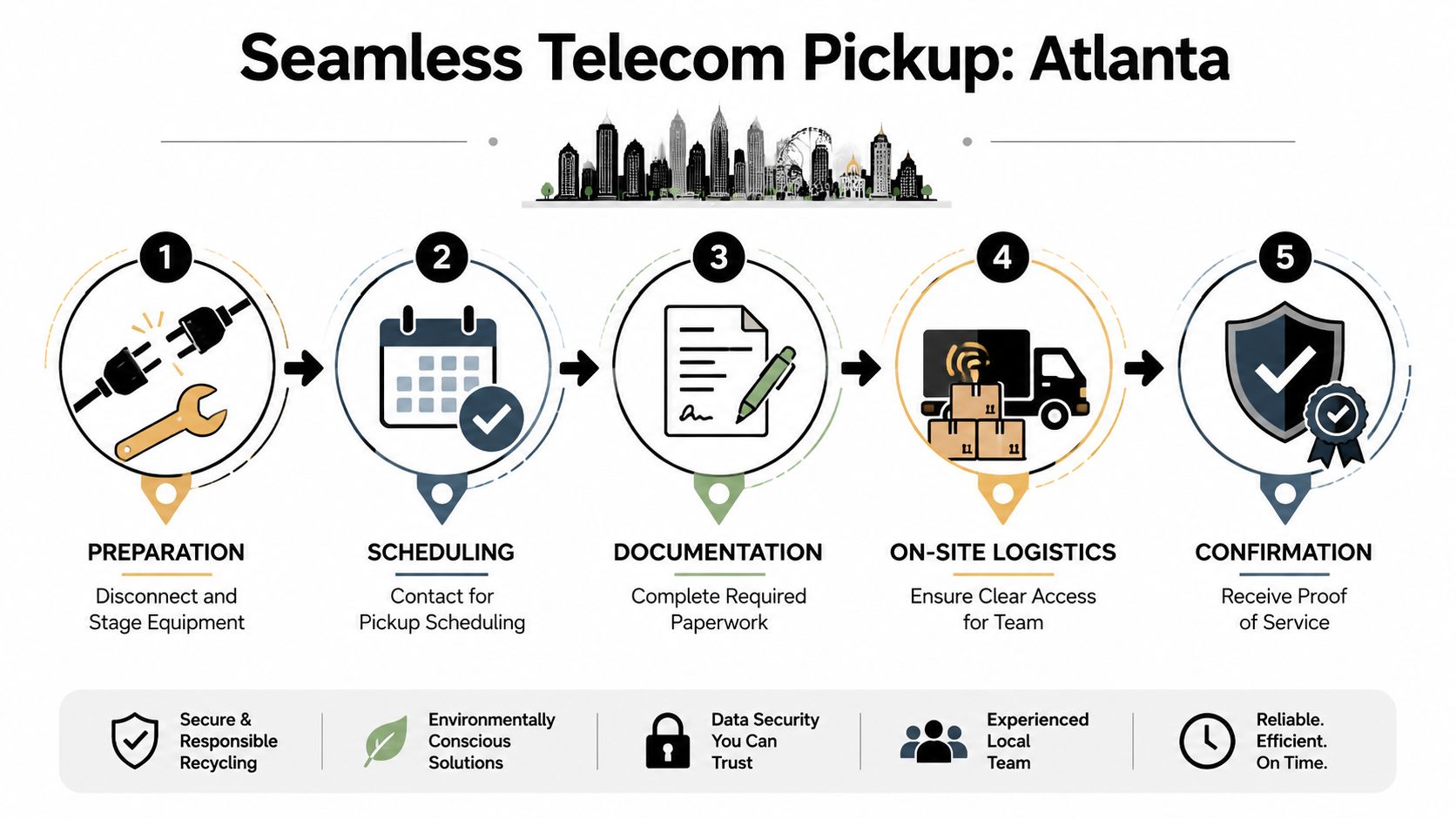
How the day typically unfolds
A well-run pickup doesn't start with loading. It starts with confirmation. The crew arrives with a defined scope, site access instructions, and an understanding of which material is telecom equipment, which material is ordinary bulk junk, and which items need extra handling because of data concerns.
Then the physical work begins in a predictable sequence:
- Access gets cleared first so crews aren't carrying gear through blocked corridors or crowded tenant areas.
- Telecom assets are staged separately from furniture, fixtures, cardboard, and non-electronic debris.
- Questionable items are paused for client review rather than guessed at on the spot.
- The load is documented so there's a record of what left and how it was categorized.
- The site gets closed out with proof of service and next-step reporting.
How to prepare your building team
Property managers and office managers can make the day easier with a few practical moves:
- Disconnect in advance: Remove assets from live service before the crew arrives.
- Consolidate by type: Keep handsets, rack gear, cabling, and non-electronic junk in distinct groups if possible.
- Reserve access routes: Freight elevators, loading docks, and parking permissions should be arranged ahead of time.
- Assign one decision-maker: The project moves faster when one client contact approves scope questions.
If your project includes both retired telecom gear and ordinary office junk, don't force one crew to invent a sorting process in the hallway. Decide the material streams before arrival.
Why mixed-load projects need coordination
Single-stream projects are easy. Real buildings rarely give you those. More often, a suite turnover or infrastructure refresh creates a mixed load that includes electronics, scrap metal, shelving, and general bulk waste all at once.
That's where a one-call approach solves a practical problem. The hauling team handles the physical cleanout, and the electronics side handles the controlled recycling path. Done correctly, that reduces tenant disruption, shortens the time a room stays out of service, and keeps sensitive assets from being treated like ordinary debris.
Navigating Atlanta's Regulations and Compliance
Compliance around telecom disposal is less about one dramatic rule and more about whether your process stands up to scrutiny. If your company handles customer data, internal communications data, or regulated business information, your disposal records matter. So do the certifications and controls used by the downstream processor.
Atlanta's profile makes this more relevant than it might be in a smaller market. Atlanta is the 6th largest data center market in the U.S., according to Atlanta network equipment recycling analysis. That drives frequent enterprise retirements of switches, routers, firewalls, servers, and related telecom infrastructure. In plain terms, this city produces a steady stream of equipment that can't be handled with casual disposal habits.

What certifications and documentation actually do
Teams often ask about R2 or e-Stewards as if the label itself is the result. It isn't. The result is what those systems force a vendor to maintain: documented processes, controlled downstream handling, and repeatable records.
For a client, the practical benefits are straightforward:
- Risk reduction: You have a more defensible basis for how assets were managed.
- Consistency: Multi-site pickups are less dependent on ad hoc decisions.
- Reporting support: Your internal stakeholders can use the paperwork for audits, compliance files, and sustainability reviews.
The right paperwork usually includes some combination of asset manifests, data destruction records, certificates of recycling, and diversion-oriented reporting. Different organizations care about different pieces of that packet. IT may focus on sanitization evidence. Facilities may want service confirmation and site closure. Sustainability teams may care more about reuse and landfill avoidance.
Why Atlanta organizations should care
Atlanta has plenty of office, warehouse, healthcare, logistics, and data-heavy business environments where telecom equipment accumulates quickly. That means procurement, facilities, and IT often share responsibility for a disposal event, even if nobody owns the full process end to end.
A certified downstream path helps when those groups need one common record set. It also helps when landlords, clients, or internal audit teams ask what happened after the truck left.
Here's the practical standard I recommend. If the vendor can remove equipment but can't explain downstream handling, that's incomplete. If the vendor can recycle electronics but can't support building logistics, that's also incomplete for many commercial projects. Companies with broad real estate footprints often need both capabilities, whether they're servicing one Atlanta property or multiple locations listed in a wider Georgia and metro service area overview.
A certificate isn't valuable because it exists. It's valuable because it ties your inventory, your sanitization decision, and your final disposition into one record chain.
Understanding Costs and Maximizing Value
The cheapest pickup price is rarely the lowest-risk option. With telecom disposal, cost has to be viewed through three lenses at the same time: labor, data handling, and downstream value recovery.
A professional scope usually includes some mix of on-site labor, transportation, inventory reconciliation, data destruction, and recycling or refurbishment processing. That means the quote reflects more than hauling. It reflects control. If a provider is dramatically cheaper, ask what has been removed from the workflow.
Comparing the real options
Here's the practical comparison most managers end up making:
| Option | Upfront price feel | What you may be missing |
|---|---|---|
| General junk hauling only | Lower | Weak documentation, no electronics-specific controls, unclear downstream handling |
| Electronics recycler only | Moderate | Good processing, but limited help with mixed junk, access challenges, and full cleanouts |
| Coordinated hauling plus certified recycling | Higher visibility on scope | Better alignment between building logistics, chain of custody, and reporting |
The point isn't that every project needs the most elaborate scope. The point is that you should pay for the controls your risk profile requires.
Where value recovery changes the math
Some telecom assets still have resale or parts value. That doesn't mean every retired switch or handset is worth monetizing. It means the lot should be evaluated instead of written off automatically.
The right question isn't “What's your pickup fee?” It's “How do you separate reusable assets from material that should go straight to recycling?” That's especially important when procurement or finance wants to offset disposition costs through recoverable equipment value.
Transport can also affect the total picture, especially for multi-site or bulky loads. If you need a simple framework for thinking through shipment pricing variables, this guide on how to compare freight rates is useful for understanding how route, load type, and service level can shape logistics costs.
Organizations that handle these projects repeatedly often prefer providers that can cover cleanouts, electronics, and supporting logistics under one operational umbrella. For mixed commercial projects, that usually starts with a service scope similar to what's outlined in Fulton Junk Removal service offerings, then narrows into the chain-of-custody and recovery requirements for the telecom portion.
Your Vendor Vetting Checklist for Telecom Recycling
Most recycling proposals sound responsible. The differences show up when you ask detailed questions about security, documentation, and downstream decisions. That's where weak vendors start speaking vaguely.
The circular-economy question matters more than many buyers realize. Globally, 22.3% of the 62 million tonnes of e-waste generated in 2022 was formally recycled, according to Beyond Surplus telecom equipment recycling guidance. That's why it's worth pressing vendors on what happens after pickup. Not everything should be shredded immediately, and not everything should be pushed into resale either.
Ask the vendor to explain the decision tree. When are assets resold, when are parts harvested, and when is material shredded? If they can't answer clearly, you still don't know what service you're buying.
Vendor Questions for Telecom Recycling RFP
| Category | Question to Ask | Why It Matters |
|---|---|---|
| Certifications | What certifications apply to your electronics processing partners and facilities? | Shows whether the vendor operates within a documented compliance framework |
| Data handling | How do you decide between wiping, destruction, and other sanitization methods? | Confirms whether the process is device-specific rather than generic |
| Chain of custody | What documentation is created at pickup, in transit, and at receiving? | Protects against gaps between removal and processing |
| Inventory control | Do you reconcile assets against a client inventory or create your own manifest? | Helps prevent missing-item disputes |
| Downstream disposition | What percentage of the load is considered for reuse, parts harvesting, or recycling? | Reveals whether value recovery is built into the workflow |
| Exceptions | What happens if an item arrives damaged, unlabeled, or missing a component? | Tests operational discipline under imperfect conditions |
| Reporting | What final records do clients receive? | Determines whether audit, finance, and ESG teams will have usable documentation |
| Insurance and liability | What coverage applies during pickup and transport? | Clarifies responsibility during physical handling |
| Building logistics | Can you support office, warehouse, and property cleanouts that include non-electronic material? | Important for mixed-load projects |
| Project management | Who is the point of contact when scope changes on site? | Reduces confusion during active removal |
Smarter questions separate serious vendors from convenient ones
A good RFP process shouldn't stop at “Do you recycle electronics?” That question is too easy. Better questions force the vendor to describe process, accountability, and outcomes.
Use prompts like these:
- Walk me through pickup day: Who documents what, and when?
- Show me a sample final report: Redact client details, but show the format.
- Explain your reuse threshold: What pushes an item toward resale versus dismantling?
- Describe your handoff controls: Who signs, seals, receives, and reconciles?
If you're evaluating local providers and want baseline company context before the detailed questions start, Fulton Junk Removal company background gives a sense of how one Atlanta operator positions hauling, recycling, and service coverage.
Answering Your Top Telecom Recycling Questions
Can one pickup handle office junk and telecom equipment together
Yes, if the provider has a defined process for separating material streams. That matters for offices, warehouses, and property turnovers where retired phones, rack gear, furniture, and general debris all show up in the same project. The key is that telecom assets shouldn't fall into the ordinary junk stream just because they're physically nearby.
What if some of the equipment still has resale value
That should be evaluated before the load is treated as scrap. Reuse, refurbishment, parts harvesting, and recycling are different outcomes. A good vendor can explain how they decide among them and what records support that decision.
Do we need to wipe devices ourselves before pickup
Not always. Many organizations prefer to keep devices intact and route them through a documented sanitization workflow. What matters is that the method matches your security policy and that the chain of custody starts before the equipment leaves the premises.
What kinds of telecom assets usually belong in this process
Common examples include VoIP phones, PBX components, switches, routers, firewalls, wireless gear, cabling accessories, and rack-mounted telecom hardware. The exact handling path depends on condition, age, and data sensitivity.
What paperwork should we expect after the job
At minimum, you should expect records that show what was collected and how it was handled. Depending on the scope, that can include manifests, data destruction documentation, recycling records, and supporting reporting for internal compliance or sustainability teams.
If your Atlanta property, office, or facility needs a practical way to clear telecom equipment along with other unwanted material, Fulton Junk Removal is one local option to evaluate. The company handles commercial cleanouts and works within the Beyond Surplus ecosystem for responsible electronics recycling, which can simplify pickup coordination, site logistics, and documentation for mixed-load projects.
