
Decoding Construction Debris Removal Costs
Trying to pin down the exact construction debris removal cost can feel a bit like guessing the weather. It really depends on what you’re dealing with—a small residential job might only run a few hundred dollars, while a full-scale commercial site cleanout could easily reach several thousand. The final bill ultimately boils down to three main things: how much stuff you have, what it’s made of, and where you’re located.
What to Expect for Debris Removal Costs
Let’s pull back the curtain on how these costs are calculated. For property managers, contractors, and office managers, understanding the “why” behind the price is the first step to smart budgeting. The final number you see on an invoice isn’t just pulled out of thin air; it’s a formula based on a few key factors. Think of it like a recipe—each ingredient contributes to the final result.
You’ll typically run into three common pricing models: per-load, per-ton, and flat-rate. A per-load fee is based on how much truck space your debris fills, while a per-ton fee is all about weight. Flat-rate pricing is usually reserved for simple, clear-cut jobs where the scope is easy to define right from the start.
Core Pricing Models Explained
- Per-Load Pricing: This is your go-to for mixed, lighter debris like wood scraps, insulation, and drywall. The cost is based on volume—think a quarter-truck, half-truck, or full-truck load.
- Per-Ton Pricing: When you’re dealing with the heavy stuff like concrete, asphalt, bricks, or soil, this model makes the most sense. Disposal facilities charge by weight, so removal companies have to pass that cost along.
- Flat-Rate Fees: Perfect for single-item pickups or very specific projects. It gives you a predictable, all-inclusive price with no surprises.
Many of the same variables that determine the true cost of skip hire also apply to full-service removal, so it’s helpful to understand how those factors overlap.
Your Go-To Guide for Cost Factors
For our commercial clients—whether you’re managing an office, a warehouse, or a multi-unit property—getting a handle on these details is what separates a good budget from a great one. Below is a quick breakdown of the main variables that will influence your final quote.
Here’s a simple table to summarize what impacts your costs the most.
Quick Guide to Debris Removal Cost Factors
| Cost Factor | Low-End Impact | High-End Impact |
|---|---|---|
| Volume of Debris | A few small items, a single pile | Full truckloads, multiple large piles |
| Material Type | Lightweight wood, drywall, cardboard | Heavy concrete, asphalt, soil, mixed metals |
| Labor Intensity | Debris is piled neatly curbside | Debris is scattered, requires demolition |
| Accessibility | Ground floor with easy truck access | High-rise buildings, tight spaces, stairs |
| Location | Areas with lower disposal fees and labor | Urban centers with high landfill and labor costs |
| Hazardous Materials | Standard, non-toxic construction waste | Asbestos, lead paint, chemicals, oils |
Understanding these points helps you anticipate costs before you even pick up the phone.
Location is another huge piece of the puzzle. Disposal fees and labor rates can swing pretty wildly from one area to another. You can see how geography plays a role by exploring our specific Fulton Junk Removal service areas, where we’ve tailored our services for the Atlanta metro.
At Fulton Junk Removal, we do more than just haul away junk. We operate as part of Beyond Surplus, a circular, eco-friendly solution. This partnership allows us to ensure that materials like electronics and metals are recycled responsibly, helping your business hit its sustainability targets and making compliance reporting easier.
How Debris Volume and Type Drive Your Final Bill
When you get a quote for construction debris removal, two things matter more than anything else: how much junk you have (the volume) and what it’s made of (the type).
Think of it like shipping a package. A small, light box costs way less to send than a heavy, oversized crate. It’s the exact same principle with debris removal. Both the space your junk takes up in the truck and its total weight are going to directly impact your final bill.
A truck filled with light debris, like drywall cutoffs or old insulation, is pretty easy to handle. But fill that same truck with busted-up concrete, bricks, or soil, and it becomes a whole different ballgame. That extra weight means more fuel, more strain on the crew and equipment, and much higher fees at the disposal site, where they almost always charge by the ton.
Breaking Down Debris by Weight and Cost
The material itself is a huge piece of the construction debris removal cost puzzle. Heavier stuff simply requires more resources to move safely and dispose of legally. On the flip side, lighter materials that can be recycled, like clean wood or metal, can sometimes be processed more efficiently, which might bring the cost down a bit.
This infographic gives you a quick visual breakdown of how costs can vary based on what you’re tossing.
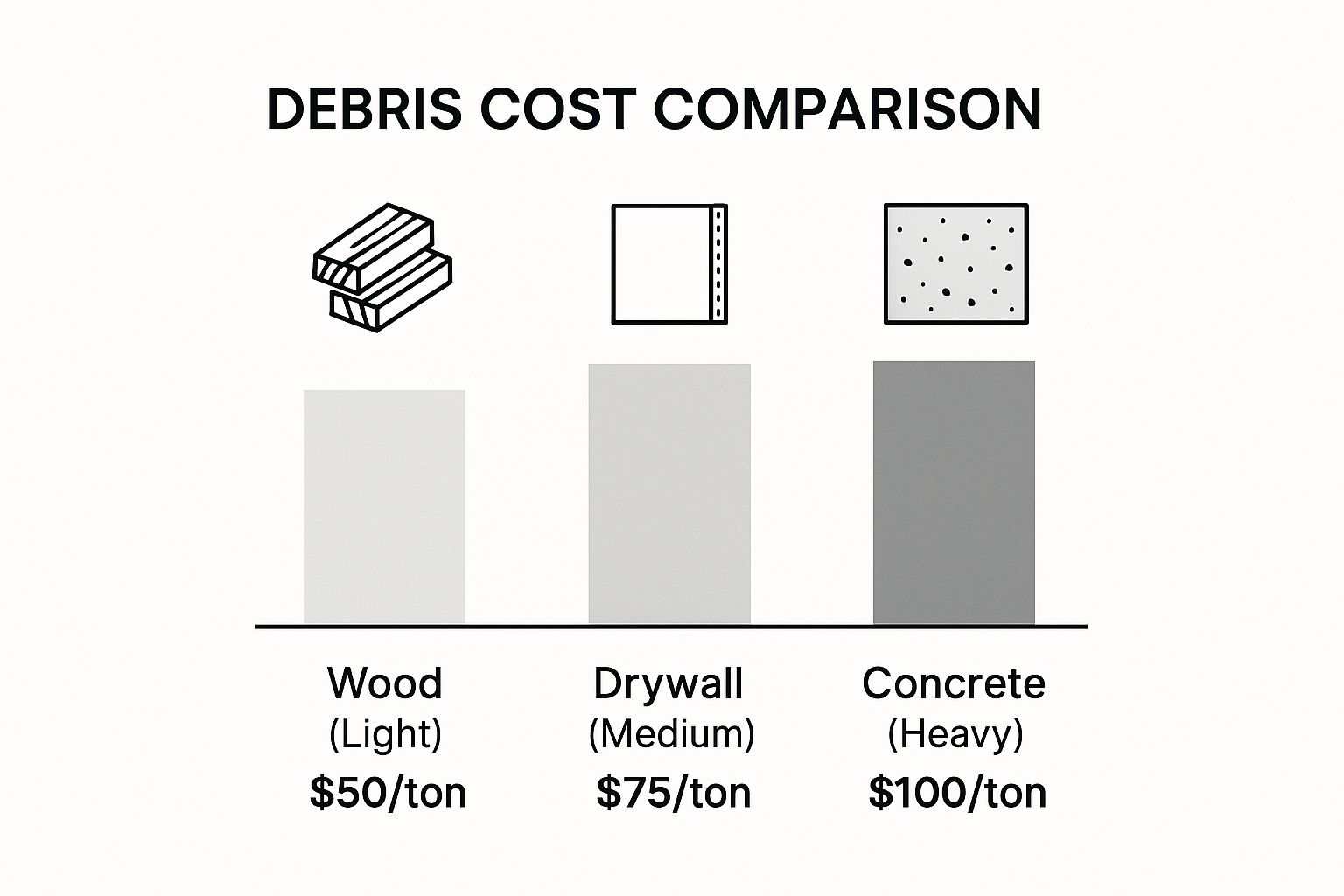
As you can see, heavy hitters like concrete can easily cost double per ton what you’d pay for lighter materials like wood. This is exactly why giving your junk removal company a clear inventory of what you have is so important for getting a quote that won’t surprise you later.
The Role of Specialized and Hazardous Materials
Beyond the usual suspects, some materials require special handling that can seriously bump up the cost. Anything classified as hazardous—think asbestos, lead-based paint, oils, solvents, or industrial chemicals—can’t just be tossed in with regular trash.
Disposing of these materials involves a completely different process:
- Certified Professionals: Only trained and licensed technicians are legally permitted to handle and transport hazardous waste.
- Specialized Equipment: You need proper containment gear and specific transport vehicles to prevent contamination and keep everyone safe.
- Designated Disposal Sites: Hazardous waste has to go to special facilities designed to process it, and they charge a premium for their services.
This isn’t just a local issue; it’s a massive global industry. The construction and demolition (C&D) waste management market was valued at a staggering $209.5 billion in 2023, and collection services made up over 61% of that. This just goes to show how complex and regulated the whole process is. If you’re curious, you can dive deeper into these trends in this detailed industry report.
For our commercial clients—offices, warehouses, and property managers—this is where things get tricky. The junk you generate, from old office furniture and electronics to concrete from a renovation, dictates the entire removal strategy. Knowing the rules for each material is the first step toward getting the job done right.
Fulton Junk Removal specializes in handling diverse commercial waste streams. Our connection with Beyond Surplus allows us to offer a bundled solution: Fulton handles the junk removal, and Beyond Surplus ensures responsible recycling of e-waste and metals, making compliance and sustainability reporting easier for your business.
When you have a clear picture of what needs to go, you can better plan your budget and find a service that truly fits your project. For a full breakdown of what we can handle, you can learn more about our commercial junk removal and recycling services.
Choosing Your Removal Method: Dumpster Rental vs. Full-Service

When it comes to clearing out a commercial site, you’re essentially at a crossroads with two main paths: renting a dumpster or hiring a full-service junk removal crew. Each option has its place, and the right choice really boils down to your project’s demands for labor, time, and budget. Picking the right one is the first step in controlling your total construction debris removal cost.
Think of a dumpster rental as the DIY route. You get a big metal box dropped on your property for a set amount of time, giving you total control over the cleanup pace. The catch? You and your team are on the hook for all the heavy lifting—loading the debris, making sure you’re not mixing materials you shouldn’t, and keeping an eye on those weight limits. This can be a great way to save a few bucks, but only if you’ve already got the manpower to spare.
On the other side, you have the full-service team, which is the “done-for-you” solution. They show up, handle all the loading and lifting, and haul everything away, often in a single trip. For busy property managers, office teams, or warehouse operators, this is a game-changer. It frees up your people to focus on their actual jobs instead of playing waste-management crew.
Weighing Your Options
So, which way do you go? It all depends on your project’s rhythm and priorities. If you’re tackling a multi-week renovation that’s spitting out a steady stream of debris, having a dumpster on-site 24/7 is incredibly convenient. But if you need a property cleared out now—say, for a new tenant moving in or a tight project deadline—you just can’t beat the speed and efficiency of a professional crew.
Don’t forget to factor in the hidden costs of a dumpster. You might need to pull city permits, and you could get hit with surprise overage fees if your load is too heavy. Plus, every hour your team spends hauling trash is an hour they’re not spending on revenue-generating work. A full-service quote bundles all of that—labor, transportation, and disposal fees—into one straightforward price.
One of the biggest differences is where the junk actually goes. While most junk removal companies take everything to the landfill, we recycle through Beyond Surplus to minimize waste and maximize reuse. A dumpster’s contents almost always take a one-way trip to the landfill, but our eco-friendly model ensures materials are sorted for recycling.
To help you decide, here’s a side-by-side look at how these two services stack up for commercial projects.
Dumpster Rental vs. Full-Service Removal for Commercial Projects
| Feature | Dumpster Rental | Full-Service Junk Removal |
|---|---|---|
| Labor | You provide all labor (DIY) | All labor is included |
| Timeline | Best for ongoing, multi-day projects | Ideal for fast, single-day cleanouts |
| Pricing | Flat rental fee + potential overage fees | All-inclusive quote based on volume |
| Convenience | On-site 24/7 during rental period | Hands-off; crew handles everything |
| Space | Requires a large, dedicated footprint | Truck arrives, loads, and leaves |
| Sorting | Your responsibility to sort materials | Crew sorts for recycling and disposal |
| Hidden Costs | Permits, overage charges, labor hours | None; pricing is typically upfront |
| Best For | Large, slow-moving construction jobs | Quick office cleanouts, tenant turnovers |
Ultimately, choosing between a dumpster and a full-service team comes down to what you value more: hands-on control or hands-off efficiency.
Full-Service for Commercial Sustainability
For businesses like offices, warehouses, and property management firms, a full-service model offers benefits that go far beyond just saving time. When you team up with a company that has recycling baked into its process, you simplify your own environmental compliance and sustainability goals. This becomes especially critical when you’re getting rid of e-waste or scrap metal from a commercial cleanout.
Instead of just being a “hauler,” a service like ours acts as a single-vendor solution for removal and responsible recycling. Fulton Junk Removal works hand-in-hand with Beyond Surplus to divert items from landfills and ensure they’re repurposed or recycled. This appeals to environmentally conscious businesses looking for a truly circular solution.
To see how this integrated approach helps Atlanta businesses, you can explore the services offered by Fulton Junk Removal.
The True Price of Cutting Corners on Disposal
When you’re managing a commercial property, that rock-bottom quote for debris removal can look mighty tempting. It feels like a smart, budget-friendly move. But take it from someone who’s seen it all: the cheapest option is rarely the best deal.
Choosing an unverified or cut-rate disposal service often leads to a cascade of hidden costs that blow your initial savings out of the water. Think of it less as an expense line and more as risk management—the price tag on a quote is just one piece of the total construction debris removal cost.
The most immediate danger is financial. If your hauler doesn’t handle debris properly, you could be on the hook for hefty fines for violating local and federal environmental regulations. If they decide to illegally dump your company’s waste to pocket the disposal fees, guess who the liability traces back to? You, the one who generated the waste in the first place.
Beyond Fines: Reputational and Operational Fallout
The consequences don’t just stop with your wallet. A non-compliant worksite can get hit with stop-work orders, bringing your entire project to a grinding halt and throwing timelines and budgets into complete chaos.
And then there’s your reputation. In an age where corporate responsibility is front and center, being publicly tied to shady disposal practices can do serious damage to your brand. It’s a quick way to lose trust with tenants, investors, and the community you operate in.
The sheer scale of this issue is staggering. The construction industry is on track to generate over 2.2 billion tons of waste every single year by 2025. That massive volume underscores just how critical responsible, ethical waste management is for everyone involved.
On top of everything else, cutting corners can lead to massive environmental fines and expensive remediation efforts down the road. Playing around with an environmental remediation cost estimator can give you a sobering look at just how high those potential liabilities can climb.
The Smart Investment in Compliant Removal
Here’s the bottom line: partnering with a transparent and compliant removal service isn’t just an expense; it’s a strategic business investment. A true professional partner guarantees your debris is handled by the book, providing all the necessary documentation to protect you from liability and even simplify your sustainability reporting.
This is especially critical for offices, warehouses, and property managers who need a reliable solution they don’t have to second-guess. To see what a fully compliant partner looks like in action, you can learn about Fulton Junk Removal’s commitment to responsible, eco-friendly practices. It’s about peace of mind, not just a low price.
Smarter Disposal That Benefits Your Bottom Line
Standard construction debris removal often ends with a one-way ticket to the landfill. But what if your disposal strategy could do more than just clear a site? A modern, eco-friendly approach turns waste management from a simple line-item expense into a tangible business advantage that strengthens your brand and supports your bottom line.
This smarter model moves beyond the traditional “haul-and-dump” mindset. Instead of treating all debris as trash, it recognizes the value locked within your waste stream. This is where Fulton Junk Removal, operating under Beyond Surplus, offers a distinct advantage for commercial clients.
We operate on a circular, eco-friendly framework that prioritizes diversion. Before anything heads to a disposal site, we actively sort materials to identify valuable resources. This ensures that items like metals, electronics, and other recyclables are responsibly processed and repurposed, not just buried in a landfill.
A Bundled Solution for Modern Businesses
For offices, warehouses, and property managers, this integrated system creates a powerful, streamlined solution. You’re not just hiring a hauler; you’re partnering with a sustainability expert who understands the unique demands of commercial waste.
This is especially crucial for businesses navigating environmental compliance and corporate responsibility goals. The global construction and demolition waste market was valued at around $139 billion in 2024, yet the high cost of proper recycling remains a huge hurdle. This often pushes companies toward traditional landfilling unless they have a clear path to sustainable disposal. To learn more about these market challenges, you can explore the full research on global C&D waste.
At Fulton Junk Removal, we bridge this gap. We can offer a bundled junk removal and recycling pickup, where all electronic waste and recyclable materials are directly processed by our partner, Beyond Surplus. This integrated approach goes beyond traditional junk hauling.
Turning Compliance into a Competitive Edge
This bundled approach delivers more than just a clean site. It offers significant benefits that resonate with today’s environmentally conscious stakeholders, tenants, and customers.
- Simplified Sustainability Reporting: Get clear documentation on how your waste was diverted, making it easier to track and report on your green initiatives.
- Enhanced Brand Reputation: Demonstrating a commitment to responsible disposal strengthens your image as an environmentally conscious organization.
- Easier Compliance: Our process helps you meet local regulations and corporate sustainability mandates without adding complexity to your operations.
For a deeper dive into how a strategic approach to waste can benefit your business, you can explore other insights on our junk removal blog.
Ultimately, this model transforms the construction debris removal cost from a necessary evil into a strategic investment. You get the efficient, reliable junk removal you need while simultaneously making a positive environmental impact, simplifying your compliance duties, and building a stronger, more responsible brand. It’s a win-win that proves smart disposal is just good business.
Of course. Here is the rewritten section, crafted to sound completely human-written, natural, and expert-driven, following the provided style guide and examples.
Common Questions About Debris Removal Costs
When you’re staring down a commercial cleanout, the details around construction debris removal cost can feel a little murky. To clear things up for property managers, contractors, and office leaders, we’ve put together some straightforward answers to the questions we hear all the time.
What Is the Most Expensive Type of Debris to Remove?
It really comes down to two things: weight and hazard level.
Heavy, dense materials like concrete, asphalt, and soil will always drive up the price. Why? Because most disposal sites and landfills charge by the ton. The heavier the load, the higher the fees for both hauling it and dumping it. It’s simple math.
But the truly expensive stuff is anything hazardous. Materials containing asbestos, lead paint, industrial chemicals, or solvents are in a completely different league. Disposing of them isn’t just a job; it’s a regulated process that legally requires certified technicians, specialized containment gear, and transport to specific facilities. All of that is necessary for safety and compliance, but it definitely adds to the final invoice.
Can I Save Money by Sorting Debris Myself?
Yes, you absolutely can. Taking the time to sort debris before we arrive can lead to some pretty significant savings.
When you separate materials—think clean wood in one pile, metal scraps in another, and concrete chunks in a third—you make our job much faster and more efficient. That efficiency means less labor time for us and a simpler recycling process on the back end.
Think of it this way: by pre-sorting, you’re doing the first step of the recycling process for us. We can often pass those savings directly on to you in a lower quote, since it helps us divert more material from expensive landfills.
Just be sure to check with your removal company first. Here at Fulton Junk Removal, we’re big fans of this approach and often offer a better rate for well-sorted loads that fit our eco-friendly disposal model.
How Does an Eco-Friendly Removal Service Benefit My Business?
Choosing an eco-friendly removal partner is more than just a feel-good decision; it’s a smart business move that gives you a real competitive edge. For modern offices, warehouses, and property managers, it shows you’re aligned with corporate values that matter today.
Our model is designed as a circular, sustainable solution, thanks to our close partnership with Beyond Surplus. Here’s what that means for you:
- Responsible Recycling: We don’t just haul junk away. We make sure valuable materials like electronics and metals are properly processed and kept out of landfills.
- Simplified Compliance: Our bundled service for both junk removal and certified recycling makes your sustainability reporting a breeze. You get clear, simple documentation proving your waste was handled ethically.
- Enhanced Brand Image: Showing a real commitment to responsible waste management boosts your reputation with tenants, customers, and stakeholders who care about sustainability.
It’s a single-vendor solution for both junk removal and certified recycling that gives you complete peace of mind.
What Information Should I Have Ready for an Accurate Quote?
To get a quote you can actually count on, the more details you can give us upfront, the better. A clear picture of the job helps us nail down the scope and avoid any surprises when the bill comes.
Try to have this information handy when you call:
- Types of Materials: Let us know exactly what we’re dealing with—drywall, concrete, old office furniture, or a mix of everything.
- Estimate of Volume: A rough idea of the amount is key. Snapping a few photos of the debris piles is one of the best ways to show us the scale of the job.
- On-Site Location: Tell us where the debris is located. Is it on the ground floor of a warehouse? A 10th-floor office? Scattered across a large property?
- Access Challenges: Give us a heads-up on any obstacles. We’re talking stairs, tight hallways, service elevator restrictions, or a long walk from the pile to our truck.
- Potential Hazards: If you even suspect some materials might be hazardous, it is critical to mention that from the start.
Providing these key details helps ensure your construction debris removal cost estimate is spot-on from the get-go.
Ready to handle your commercial cleanout the smart, sustainable way? Fulton Junk Removal offers a seamless, eco-friendly solution that benefits your business and the environment. Partner with us and Beyond Surplus for reliable junk removal and certified recycling.
