
IT Asset Disposal for Atlanta Financial Firms: 2026 Guide
An Atlanta financial firm usually realizes it has an IT asset disposal problem all at once. The office lease is ending. A hardware refresh is already in motion. Internal audit wants documentation. Facilities wants the old equipment gone. IT knows those retired laptops, phones, printers, and server components still carry risk long after users stop touching them.
That's where many firms get into trouble. They treat old equipment like excess office property when it should be treated like regulated information leaving controlled custody. In finance, disposal isn't the last step of a move or upgrade. It's part of risk management.
The hard part isn't finding someone to pick up hardware. Atlanta has plenty of haulers and recyclers. The hard part is building a process your compliance lead, operations team, procurement group, and auditors can all defend after the devices are gone.
Your Guide to Secure IT Asset Disposal in Atlanta
A familiar scenario plays out during office consolidations across the city. An operations director has approved a move. The IT manager has already staged replacement devices. Then someone opens a storage room and finds years of retired desktops, monitors, network gear, backup media, and a few unlabeled hard drives in banker boxes.
At that moment, the problem stops being logistical. It becomes legal, operational, and reputational.
Financial firms in Atlanta don't get much room for improvisation here. A retired workstation might still hold client files. A multifunction printer may have embedded storage. A network switch pulled during a remodel could still contain configuration data. If the chain of custody breaks during pickup, loading, transit, or downstream handling, the firm may have no clean way to prove what happened to the asset.
That's why IT Asset Disposal for Atlanta Financial Firms has to be handled as a controlled workflow, not as cleanup. The strongest programs start before the truck arrives. They identify what exists, who owned it, what data may be present, who signs it over, and what evidence the firm will retain afterward.
For teams managing relocation, renovation, liquidation, or recurring refresh cycles across Atlanta service coverage, the practical goal is simple. Remove retired assets quickly without creating a documentation hole that shows up later in an audit.
Financial firms rarely fail at disposal because nobody destroyed a drive. They fail because nobody can prove custody, scope, and final disposition across the full asset set.
The High Stakes of ITAD for Financial Firms
Financial firms don't dispose of ordinary scrap. They dispose of devices that may contain customer records, account data, internal communications, trade documentation, model files, credentials, and archived reports. That changes the standard. The question isn't whether an item still has resale or recycling value. The question is whether your firm can prove secure control until data is destroyed and liability is properly transferred.
The market itself reflects how serious this function has become. The global IT asset disposition market is valued at USD 18.4 billion in 2024 and projected to reach USD 26.6 billion by 2029 at a 7.6% CAGR, while another forecast places it at USD 16,828.37 million with projected growth to USD 32,355.70 million by 2032 according to MarketsandMarkets research on the ITAD market. That matters because it confirms ITAD is no longer an informal recycling niche. It's a mature risk-control industry built around security, compliance, and value recovery.
Why finance has less margin for error
A law office can have a bad disposal event. A medical group can too. But financial institutions tend to feel the consequences differently because multiple internal stakeholders care about the same retired device for different reasons.
- Compliance cares about recordkeeping and privacy obligations.
- Information security cares about residual data and access paths.
- Procurement cares about vendor controls and liability transfer.
- Internal audit cares about evidence.
- Operations cares about keeping projects moving without creating exceptions.
That's why generic e-waste recycling isn't enough. A recycler may be responsible environmentally and still be the wrong fit if they can't support controlled intake, serialized tracking, and audit-ready destruction records.
The difference between removal and risk transfer
A lot of disposal projects fail at the handoff. Equipment leaves a branch office, trading floor, warehouse, or temporary swing space, and everyone assumes the hard part is over. It isn't. The risk only starts to transfer when the process is documented in a way that survives scrutiny.
For firms subject to supervision, retention, and review expectations, the disposal record needs to stand on its own. Teams that are tightening retention controls or preparing for review often pair their disposition process with better records workflows. In that context, tools focused on document intelligence for FINRA can help compliance and legal teams think more clearly about what evidence should be organized and retrievable.
A secure pickup with weak records is still a weak control.
What doesn't work
Three habits create avoidable exposure:
| Common mistake | Why it fails in finance |
|---|---|
| Treating retired IT as general junk | It ignores data-bearing components and breaks evidentiary discipline |
| Letting movers or facilities teams improvise handoffs | Assets may change hands without serialized reconciliation |
| Focusing only on hard drives | Printers, switches, phones, and other peripherals can also hold data |
The firms that stay out of trouble usually do one thing well. They define disposal as a governed business process before the move, audit, or refresh starts.
Building Your Audit-Proof Disposal Workflow
The most defensible model is a four-stage control chain. For Atlanta financial firms, that means inventorying and classifying each device by serial number and data sensitivity, decommissioning and disconnecting it from the network, applying an approved sanitization method matched to the media type, and closing the loop with serialized Certificates of Destruction and chain-of-custody records, as outlined in this ITAD process guidance. The practical benchmark isn't just wiping drives. It's proving that embedded storage in printers, switches, and similar peripherals was identified and handled too.
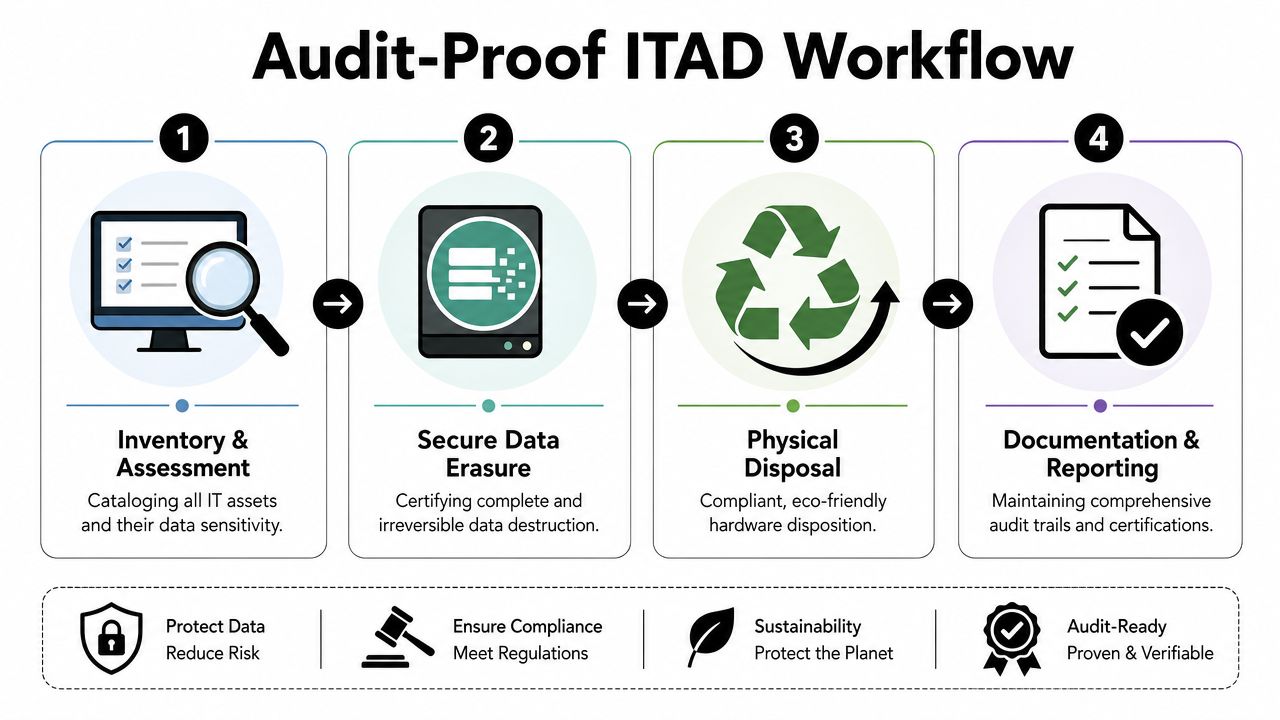
Stage one inventory and classification
Start with a pre-pickup asset register. Don't wait for loading day to figure out what's leaving the building.
At minimum, the list should reconcile:
- Asset identity by serial number, tag number, device type, and location
- Business ownership by department, custodian, or assigned user
- Data sensitivity based on likely content, not just device category
- Media type so sanitization can be matched correctly later
Many firms discover hidden scope. The server room is obvious. The neglected copier in a satellite office isn't. Neither is the conference room appliance, legacy firewall, or branch printer that stores documents.
Stage two decommissioning and separation from production
Once the inventory is validated, take the devices out of service in a way that's reversible only by authorized personnel. That means removing network access, logging the decommissioning event, and separating retired assets from anything still in production.
A strong control here is physical segregation. Don't leave collected assets in mixed staging areas with active equipment, furniture, or move materials. If the project involves broader cleanout work, the retired IT stream should stay distinct from general surplus and non-electronic debris.
For firms reviewing storage room access, cabinet restrictions, or equipment area control, physical environment discipline matters as much as media handling. Broader facility security thinking around secure Australian data is useful because it reinforces a simple truth. If unauthorized people can touch the assets before destruction, your paperwork won't save you.
Practical rule: If a device can still be plugged in, powered up, or swapped after it's marked for disposal, it isn't yet under a strong disposal control.
Stage three sanitization matched to the media
This is the point where teams often oversimplify. “We wiped the drive” sounds sufficient until someone asks what standard was used, whether the media supported overwriting, whether the process was verified, and what happened to failed or damaged devices.
A workable internal policy usually distinguishes between:
- Reusable media where approved sanitization can be verified
- High-risk media where physical destruction is the safer option
- Embedded or non-obvious storage that requires asset-specific review
The right decision depends on the device, the condition of the media, and the sensitivity of the data likely stored on it. Financial firms commonly reference NIST 800-88 or DoD 5220.22-M methods in their guidance because auditors and security teams want a recognized logic behind the chosen method.
Stage four documented final disposition
Final disposition only counts when the paperwork closes the chain. That includes serialized certificates, custody logs, and confirmation that recycling or remarketing occurred only after data handling was completed.
A simple operating model looks like this:
| Workflow point | Control output |
|---|---|
| Pre-pickup review | Approved asset register |
| Pickup and verification | Reconciled tags and custody signoff |
| Sanitization or destruction | Method record tied to the asset |
| Recycling or remarketing | Final disposition record and certificate set |
This is also where integrated service coordination matters. If your project includes office furniture, fixtures, cable scrap, storage room cleanout, and retired IT, keep those scopes separate operationally even if one vendor handles the broader logistics through commercial removal services. Blending them too early creates confusion about what was controlled as IT and what was hauled away as non-IT assets.
How to Select the Right ITAD Partner in Atlanta
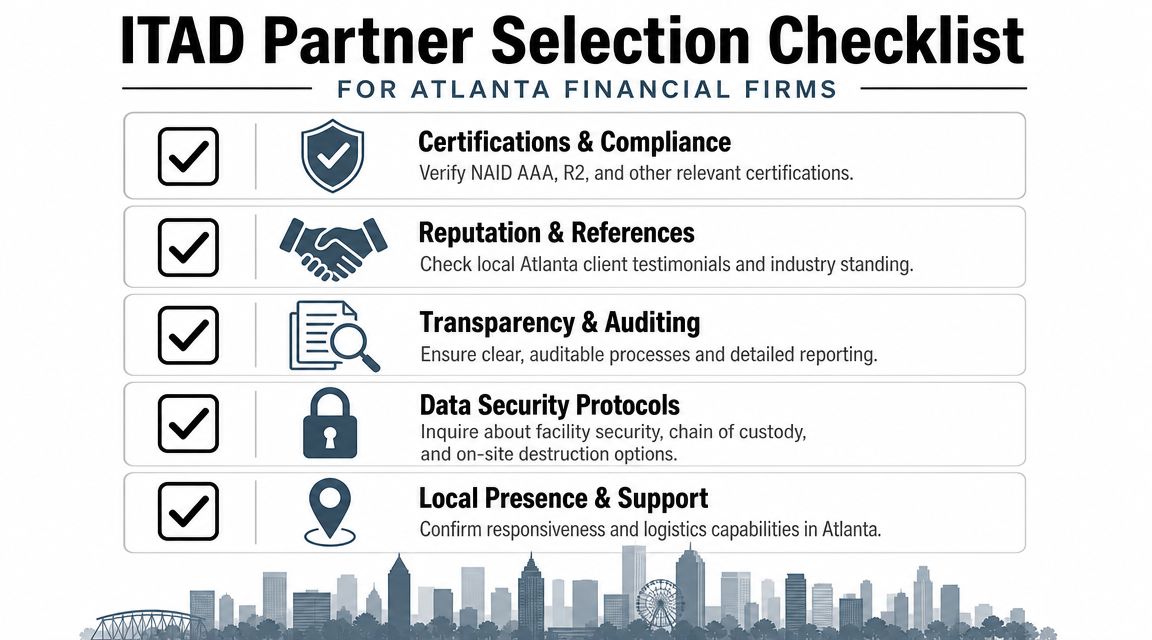
A low quote tells you almost nothing about whether a vendor can protect a financial firm. What matters is whether the provider operates like a controlled disposition partner or like a hauler with a recycling outlet.
The industry has already made that distinction. IT disposal has shifted from simple recycling to documented IT asset disposition, centered on secure data destruction, chain of custody, auditing, and downstream tracking. That evolution matters especially in finance because retired devices often contain regulated data and require auditable transfer of liability. It's also become standard enough that major providers position themselves around end-to-end lifecycle management rather than one-time disposal, as described in this overview of modern ITAD.
Questions worth asking before pickup day
A strong vendor conversation should get specific fast.
- What exactly gets serialized. If the answer is vague, the reporting will be vague too.
- How custody is documented at transfer. You want named handoff points, not general assurances.
- Which media types are sanitized versus destroyed. Different assets need different handling.
- What happens to peripherals with embedded storage. Many gaps often hide here.
- When documentation is issued. Delayed paperwork creates audit exposure and internal rework.
You should also ask who their downstream partners are and how those relationships are governed. A vendor may handle front-end pickup well and still introduce risk later if downstream processing isn't traceable.
What a finance-ready partner looks like
The right partner usually shows a few traits in plain view:
| Signal | What it suggests |
|---|---|
| Detailed intake questions before scheduling | They understand scope control |
| Clear discussion of chain of custody | They know liability doesn't transfer by assumption |
| Comfort with audits and procurement review | Their process can survive documentation requests |
| Separation of logistics and data handling controls | They understand mixed-project risk |
The wrong partner often sounds simpler. They'll promise a fast cleanout, broad acceptance of “anything electronic,” and generic destruction language. That may work for an informal office purge. It doesn't work for a broker-dealer, wealth manager, lender, insurer, or payments business.
For Atlanta teams that want to understand how a local commercial operator presents its broader service model and operating philosophy, the company background at Fulton Junk Removal is a useful example of how logistics capability and responsible downstream handling can sit under one roof. The key is making sure the IT side is treated as controlled disposition, not as just another pickup category.
The best ITAD partner isn't the vendor that says yes to everything. It's the one that defines custody, scope, and documentation before the first asset moves.
The Proof Package Mastering Your Chain of Custody
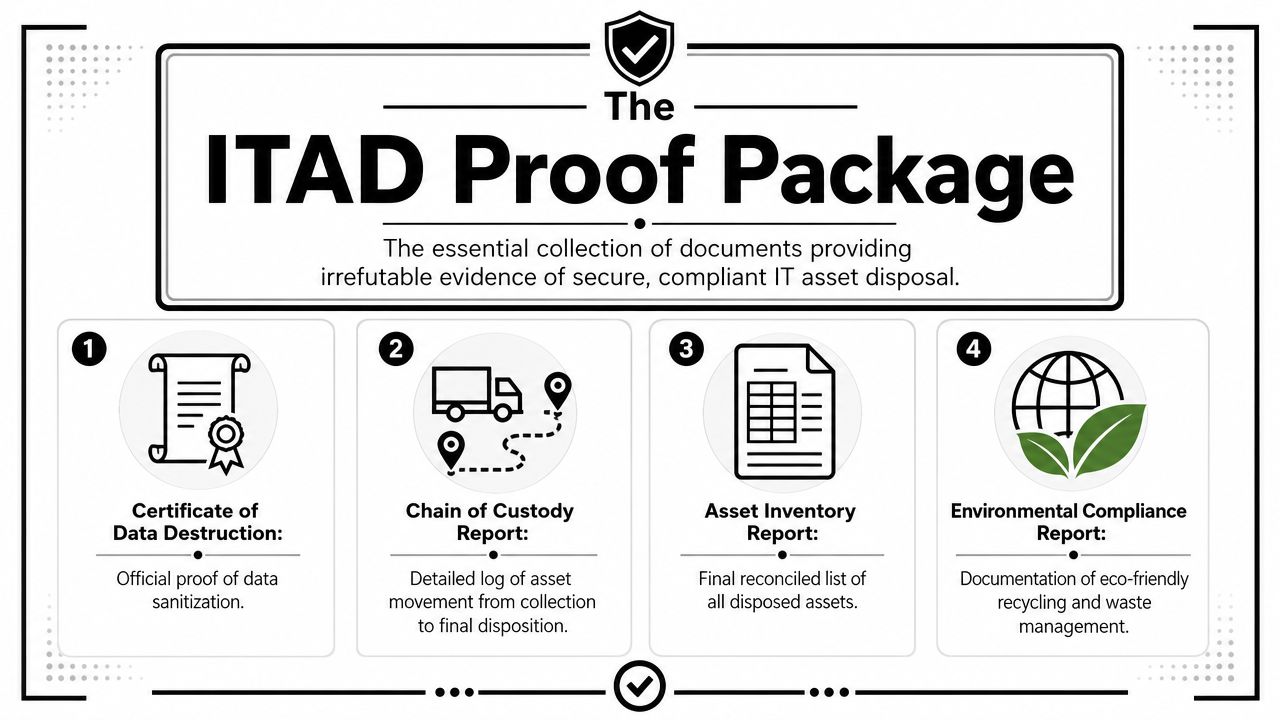
The most useful output of an ITAD project isn't the empty storage room. It's the proof package your firm can retain for audit, legal, procurement, and compliance review.
That's the gap many vendors leave open. They'll remove equipment and maybe send a destruction certificate, but they won't deliver a complete evidentiary file. For Atlanta financial firms, the more valuable standard is a proof package built around certificates of destruction, serialized asset inventories, downstream vendor records, and clear retention timelines, which is the practical gap highlighted in Beyond Surplus guidance for Atlanta ITAD services.
What belongs in the package
A proof package should let a reviewer answer four questions without chasing emails.
- What assets left control
- Who handled them at each stage
- How data was sanitized or destroyed
- What final disposition occurred
Those answers usually sit across several documents, not one.
- Serialized asset inventory that reconciles planned pickup against actual received assets
- Chain-of-custody record showing each handoff from site release to processing
- Certificate of Destruction tied to the specific assets or media handled
- Downstream disposition record covering recycling, resale, or material recovery after data controls were completed
What makes documentation audit-ready
A certificate that only says “all materials destroyed” is weak. Auditors and internal reviewers usually want enough detail to trace the record back to an actual asset population.
Look for fields such as:
- Pickup date and location
- Device identifiers
- Method used for sanitization or destruction
- Authorized signatures or named custody transfers
- Final processing outcome
- Retention guidance for the records
Just as important, your internal team should decide where this package lives after the project closes. If procurement has one copy, IT has another, and compliance gets neither, the firm still has a control problem.
Where firms lose the evidentiary chain
In practice, the biggest documentation failures happen in mixed-responsibility events. Office moves are a good example. Movers disconnect some devices. Facilities stages others. IT pulls a few drives. A recycler picks up what remains. Weeks later, no one can reconcile who transferred what.
When assets move across movers, facilities, IT, and recyclers, the real risk is often the gap between handoffs, not the final destruction event.
That's why the proof package should be assembled as a controlled deliverable, not as an afterthought. Teams that want to sharpen internal policy language often benefit from reviewing examples and operational articles in a dedicated commercial cleanout and disposal blog, then translating those lessons into formal custody and retention procedures.
Simplify Compliance with Bundled Junk Removal and ITAD
Most Atlanta financial firms don't struggle because they lack intent. They struggle because disposal projects usually arrive bundled with other operational demands. There's an office move underway. Furniture has to come out. Storage areas need to be cleared. General debris, fixtures, and obsolete equipment all leave the building at the same time.
That's where fragmented vendor coordination creates risk. One provider handles furniture. Another handles bulk removal. A separate ITAD vendor manages electronics. Internal teams spend more time coordinating handoffs than controlling them. Each transfer adds another place for asset counts, signoffs, or timelines to slip.
A bundled model is often cleaner. Fulton Junk Removal handles the physical removal side of commercial cleanouts, while Beyond Surplus supports the responsible recycling and electronics processing side. That structure makes practical sense for financial firms because it reduces the number of vendors touching the project while preserving a distinct track for IT-related disposition.
Why the bundled approach works better
The advantage isn't just convenience. It's control.
- Single logistics lead reduces confusion on pickup day
- Separated processing streams help keep regulated IT assets distinct from furniture and general surplus
- Responsible recycling support makes sustainability reporting easier
- Less internal coordination means facilities, operations, and IT can work from one plan
This matters most during branch closures, headquarters relocations, mergers, remodels, and storage room purges. Those are exactly the situations where firms are tempted to solve everything with a general hauler and deal with paperwork later. That usually costs more time internally and creates avoidable audit friction.
What to expect from a better operating model
A strong bundled project still keeps disciplines separate. General office contents can move on one track. Data-bearing assets move on another. The benefit is that your team doesn't have to orchestrate three disconnected vendors to make that happen.
For firms trying to reduce administrative drag while improving environmental handling and documentation, a direct conversation through the Fulton Junk Removal contact page is the practical next step. The best outcome is a project plan where cleanout, recycling, and IT disposition support each other instead of competing for attention.
If your team is planning an office move, technology refresh, branch closure, or storage room cleanout, Fulton Junk Removal can help you coordinate the physical removal side while supporting a more responsible, documentation-driven disposal process through Beyond Surplus. That combination gives Atlanta businesses a cleaner path to compliance, sustainability, and operational efficiency without treating sensitive equipment like ordinary junk.
