
8 Facility Management Best Practices for 2025
In today's competitive commercial landscape, facility management has evolved from a behind-the-scenes cost center into a strategic driver of operational efficiency, employee well-being, and corporate sustainability. Simply keeping the lights on is no longer enough. Modern property managers, warehouse operators, and office managers are now expected to be masters of technology, sustainability, and data analytics. This guide explores eight essential facility management best practices that address these modern challenges head-on.
We will move beyond theory to provide actionable strategies tailored for today's operational demands. You will learn how to implement a robust preventive maintenance program, optimize space utilization, and integrate powerful software to streamline workflows. To truly embrace the new era of facility excellence, a comprehensive understanding of technological tools is vital, as detailed in the ultimate guide to facility management applications.
Furthermore, this guide emphasizes a critical component of modern facility management: sustainable waste handling. We'll explore how integrated services, like the partnership between Fulton Junk Removal for hauling and its parent company, Beyond Surplus, for responsible electronics and materials recycling, can simplify compliance and bolster your sustainability reporting. This circular, eco-friendly approach not only diverts significant waste from landfills but also transforms your disposal process into a value-added component of your corporate responsibility strategy. From implementing predictive maintenance to pioneering waste-reduction initiatives, these proven strategies will help you reduce costs, mitigate risks, and transform your facilities into high-performing, sustainable assets that provide a clear competitive advantage.
1. Implement a Data-Driven Preventive Maintenance (PM) Program
Transitioning from a reactive "fix-it-when-it-breaks" model to a proactive preventive maintenance (PM) program is one of the most impactful facility management best practices you can adopt. This systematic approach involves scheduling regular inspections, servicing, and component replacements on critical assets based on time, usage, or performance data. The goal is to address potential issues before they lead to catastrophic failures, ensuring operational continuity and maximizing asset value.
Instead of waiting for an HVAC unit to fail during a summer heatwave, a PM program schedules tune-ups in the spring. This strategy is employed by industry leaders to maintain peak performance. For example, Amazon's fulfillment centers rely on meticulous PM schedules for their conveyor systems to avoid costly disruptions, while major theme parks use PM to ensure the safety and reliability of their attractions, achieving near-perfect uptime.
Why It's a Top Practice
A data-driven PM program moves maintenance from an operational expense to a strategic investment. By tracking asset performance and maintenance history, you can optimize schedules, predict failures with greater accuracy, and allocate resources more effectively. This proactive stance significantly reduces emergency repair costs, extends the functional lifespan of expensive equipment, and minimizes unexpected downtime that can halt business operations.
The following infographic highlights the compelling financial and operational returns of a well-executed PM program.
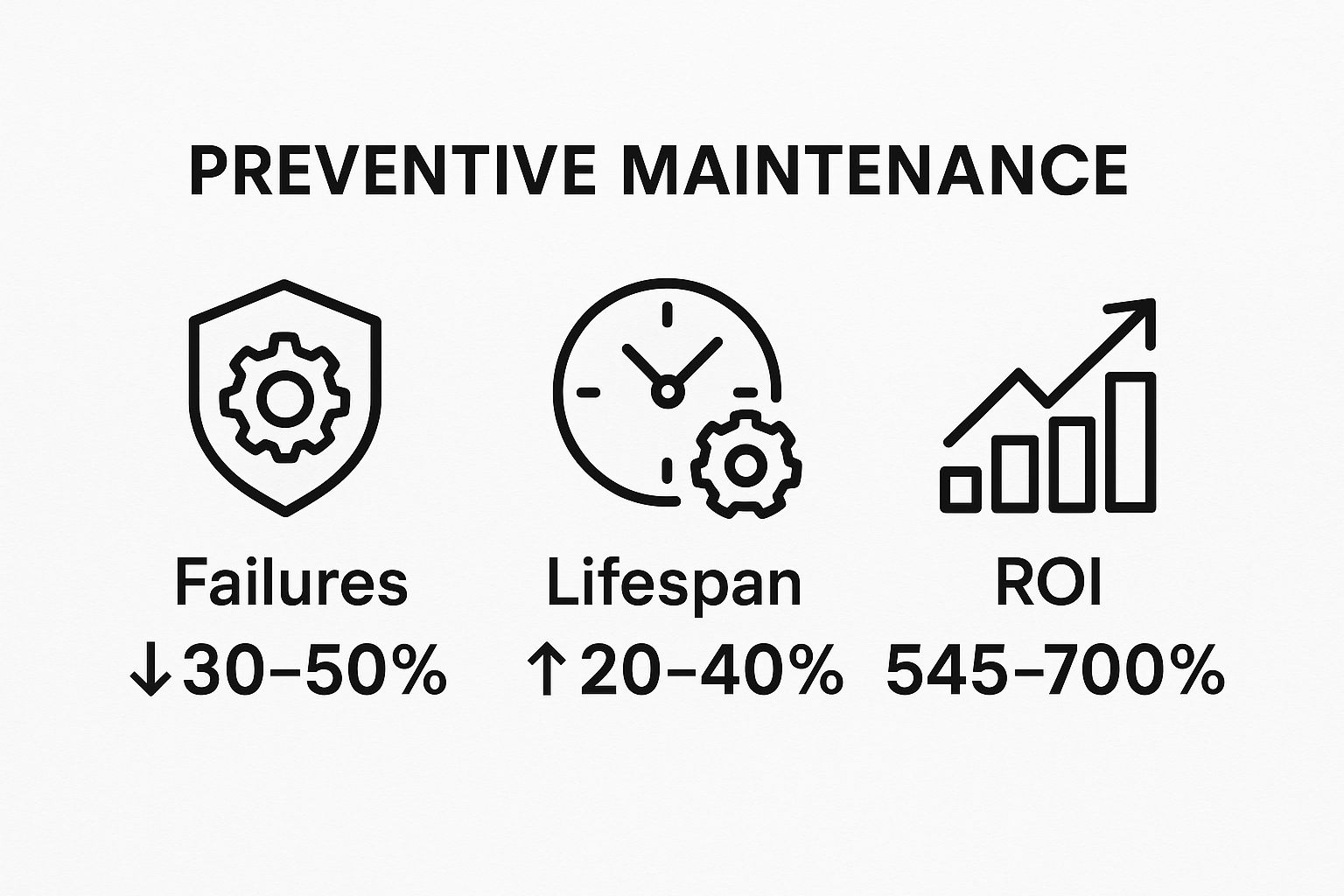
These statistics reveal that PM programs drastically cut down on equipment failures while delivering a remarkable return on investment.
How to Implement a PM Program
Getting started requires a structured approach. Follow these actionable steps to build an effective program:
- Prioritize Critical Assets: Begin by identifying equipment whose failure would cause the most significant disruption to your operations. Focus your initial efforts on high-value, high-impact assets like HVAC systems, electrical panels, and key production machinery.
- Establish Baselines: Use manufacturer recommendations as a starting point for maintenance schedules. As you collect data, adjust these timelines based on your facility's unique operational demands and environmental conditions.
- Leverage Technology: Implement a Computerized Maintenance Management System (CMMS). This software automates scheduling, tracks work orders, manages inventory, and provides the data needed for continuous improvement.
- Train and Document: Ensure your maintenance team is thoroughly trained on all PM procedures and understands the importance of detailed documentation. Consistent data entry is crucial for the program's success.
- Review and Refine: A PM program is not static. Review your maintenance data and asset performance quarterly to identify trends, adjust schedules, and refine your strategy.
When decommissioning old equipment during a PM cycle, consider a sustainable disposal partner. Fulton Junk Removal offers bundled junk removal and recycling pickups for commercial facilities. They work directly with Beyond Surplus to ensure that outdated electronics, machinery, and other materials are responsibly recycled, helping you meet sustainability goals.
2. Implement an Integrated Workplace Management System (IWMS)
Moving beyond disconnected spreadsheets and single-purpose software, an Integrated Workplace Management System (IWMS) is a powerful, centralized platform that unites core facility functions. This approach consolidates real estate portfolio management, space planning, maintenance operations, capital projects, and sustainability tracking into a single source of truth. The goal is to break down data silos and provide a holistic view of your entire facility ecosystem, enabling smarter, data-driven strategic decisions.
An IWMS empowers managers to see how a lease renewal decision impacts maintenance budgets or how new space utilization trends affect energy consumption. For example, Johnson & Johnson leverages an IWMS to manage its massive 265 million sq ft global portfolio, while Microsoft uses its system to optimize workspace design and resource allocation for over 150,000 employees. This level of integration is a cornerstone of modern facility management best practices.
Why It's a Top Practice
An IWMS transforms facility management from a collection of reactive tasks into a cohesive, strategic business unit. By centralizing data, it unlocks powerful analytics and reporting capabilities, allowing you to optimize resource allocation, reduce operational costs, and improve the workplace experience. This comprehensive oversight ensures that real estate assets are fully utilized, maintenance is efficient, and long-term capital planning is aligned with organizational goals, providing a significant competitive advantage.
This centralized control helps streamline operations from top to bottom, from managing individual work orders to planning multi-year capital projects.
How to Implement an IWMS
A successful IWMS implementation requires careful planning and a phased approach. Follow these actionable steps to ensure a smooth transition and maximize your return on investment:
- Conduct a Thorough Needs Assessment: Before evaluating vendors like IBM TRIRIGA or Planon, map your current processes and identify key pain points. Define clear objectives for what the IWMS must achieve for your organization.
- Secure Executive and Departmental Buy-In: An IWMS impacts multiple departments. Gain sponsorship from leadership and involve stakeholders from IT, finance, and operations early to ensure the system meets everyone's needs.
- Start with a Pilot Program: Roll out the IWMS in a single department or location first. This allows you to test workflows, gather feedback, and resolve issues on a smaller scale before a full-scale deployment.
- Prioritize Data Hygiene: Clean, standardize, and consolidate your existing data before migration. Inaccurate or inconsistent data will undermine the system’s effectiveness from day one.
- Invest in Training and Change Management: A new system is only as good as the team using it. Develop a comprehensive training program and a communication plan to manage the transition and encourage user adoption.
When your IWMS identifies assets for decommissioning, integrating a responsible disposal process is key. A commercial service like Fulton Junk Removal simplifies this by managing the removal of old office furniture, equipment, and e-waste. They partner directly with Beyond Surplus to ensure materials are recycled or repurposed, making sustainability reporting easier.
3. Energy Management and Sustainability Programs
Integrating a strategic energy management and sustainability program is a hallmark of modern, efficient facility management. This practice moves beyond simple cost-cutting to encompass a comprehensive approach to monitoring, controlling, and reducing a facility's overall environmental footprint. It involves a suite of initiatives, from deploying energy-efficient technologies and renewable energy sources to implementing robust waste reduction and recycling programs, all aimed at achieving sustainability goals while enhancing the bottom line.
This forward-thinking approach is championed by global leaders. For example, Google utilizes AI to cut its massive data center cooling costs by 40%, and Apple now powers all of its corporate facilities worldwide with 100% renewable energy. Similarly, Walmart has successfully reduced energy consumption by 18% across more than 6,000 stores simply by upgrading to LED lighting and optimizing HVAC systems.
These examples prove that sustainability is not just an ethical choice but a powerful financial strategy, making it one of the most critical facility management best practices today.
Why It's a Top Practice
A dedicated energy and sustainability program transforms operational liabilities into strategic assets. By actively managing consumption, you gain control over volatile utility costs, mitigate regulatory risks associated with environmental mandates, and enhance your brand's reputation among eco-conscious stakeholders. This proactive stance not only generates significant long-term savings but also improves the work environment, boosts property value, and ensures your operations are resilient for the future.
How to Implement This Program
Building an effective program requires a methodical and data-driven strategy. Follow these steps to create a meaningful impact:
- Conduct a Comprehensive Energy Audit: Start by identifying where and how energy is being consumed in your facility. A professional audit will reveal key areas for improvement and provide a baseline for measuring success.
- Prioritize Low-Cost, High-Impact Measures: Begin with quick wins like upgrading to LED lighting, installing programmable thermostats, and sealing air leaks. These actions offer a fast return on investment and build momentum for larger projects.
- Set Measurable Goals: Establish clear, quantifiable targets to guide your efforts, such as "reduce overall energy consumption by 25% within five years." This provides a benchmark for tracking progress and demonstrating value.
- Engage and Educate Stakeholders: Foster a culture of sustainability by involving employees and tenants in awareness campaigns. Simple behavioral changes can collectively lead to significant energy and waste reductions.
- Leverage Technology and Incentives: Use sub-metering to pinpoint areas of energy waste and explore utility company rebate programs or Power Purchase Agreements (PPAs) to make larger investments in renewable energy more affordable.
When it comes to waste reduction, a circular approach is essential. A partner like Fulton Junk Removal provides a comprehensive solution for commercial facilities like offices and warehouses. Working hand-in-hand with its parent company, the certified recycler Beyond Surplus, Fulton ensures that unwanted materials are diverted from landfills. This integrated service simplifies your waste management and makes sustainability reporting easier to manage.
4. Space Utilization and Workplace Optimization
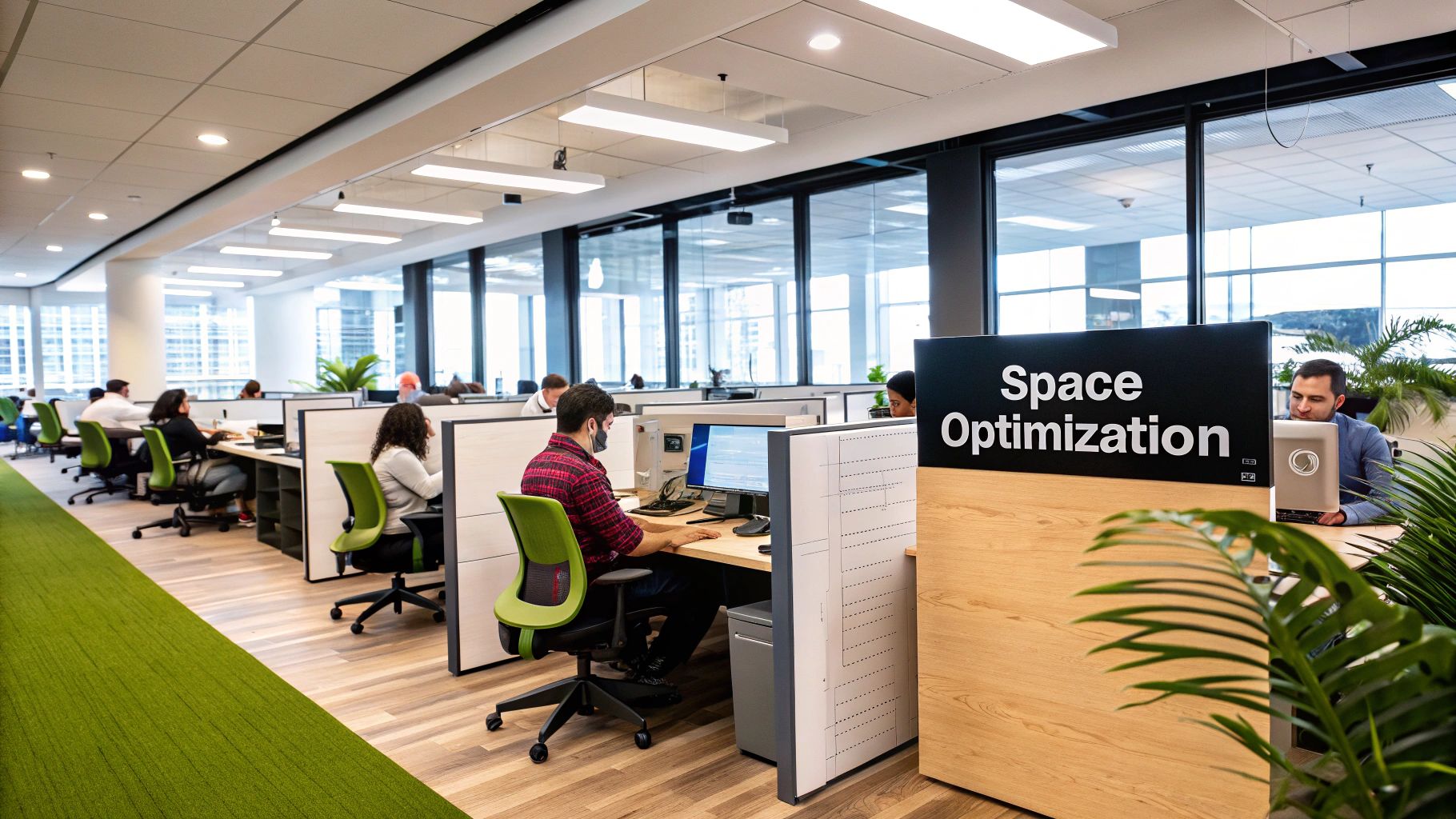
Adopting a data-driven approach to space utilization is a modern facility management best practice that transforms physical workspaces into strategic assets. This practice involves analyzing how spaces are used, implementing flexible designs, and aligning the real estate portfolio with actual organizational needs. It moves beyond simply providing desks and focuses on creating an environment that enhances productivity, collaboration, and employee well-being, especially with the rise of hybrid work models.
The goal is to shift from static, assigned seating to dynamic, activity-based environments. For example, Dropbox implemented its "Virtual First" model, converting traditional offices into collaborative "Studios" for focused teamwork, while Salesforce reduced its office footprint by 30% by analyzing utilization data and reconfiguring layouts, which also improved employee satisfaction scores.
Why It's a Top Practice
Effective space optimization directly impacts the bottom line by eliminating underused, expensive real estate and reducing associated operational costs like utilities and maintenance. Beyond cost savings, it creates a more engaging and effective workplace. By providing a variety of purpose-built spaces-like focus rooms, collaborative lounges, and social hubs-facility managers can better support diverse work styles, boosting employee morale and attracting top talent. This strategic alignment ensures every square foot of the facility delivers tangible value.
How to Implement Space Optimization
A successful transition requires careful planning, data analysis, and employee involvement. Follow these steps to optimize your workspace:
- Conduct a Utilization Study: Before making any changes, gather data for 3-6 months using sensors or manual counts to understand how your current space is actually used. Aim for a 60-70% utilization rate to ensure cost-effective operations.
- Engage Employees: Involve your team in the design process through surveys and workshops. Their feedback is crucial for creating a space that meets their needs, which drives higher adoption rates.
- Provide Workspace Variety: Design a mix of environments that support different activities. This includes quiet zones for focused work, open areas for collaboration, private rooms for calls, and social spaces to foster community.
- Leverage Technology: Implement workplace management platforms like Robin to enable easy desk booking, room reservations, and wayfinding. This technology simplifies the user experience in a flexible environment.
- Review and Adjust: Space needs are not static. Use occupancy data to review and adjust space allocations quarterly. This iterative approach ensures the workplace continually evolves with your organization's needs.
When reconfiguring your office, you'll inevitably have outdated furniture, fixtures, and electronics. For a sustainable clear-out, partner with a service like Fulton Junk Removal. They work directly with Beyond Surplus to ensure that old office equipment and e-waste are responsibly recycled, helping your facility meet its sustainability goals and simplify compliance reporting.
5. Computerized Maintenance Management System (CMMS) Utilization
Adopting a Computerized Maintenance Management System (CMMS) is a foundational facility management best practice that transforms disorganized tasks into a streamlined, data-backed operation. This software acts as the central command center for all maintenance activities, automating work order management, tracking asset history, managing inventory, scheduling preventive tasks, and generating detailed performance reports. It serves as the digital backbone for proactive maintenance teams.
Leading organizations leverage CMMS to achieve peak operational efficiency. For instance, Toyota utilizes a CMMS to maintain 99.8% equipment availability in its manufacturing plants, while Hilton Hotels standardized its system to improve maintenance response times by 40%. Similarly, major institutions like Stanford University rely on a CMMS to manage over 15 million square feet of facilities, achieving an impressive 95% work order completion rate.
Why It's a Top Practice
A CMMS replaces spreadsheets, paper trails, and disjointed communication with a single source of truth. By centralizing all maintenance data, facility managers can make informed decisions, justify budgets with hard data, and prove the value of their maintenance efforts. This technology is critical for optimizing labor allocation, minimizing asset downtime, ensuring regulatory compliance, and controlling spare parts inventory, ultimately reducing operational costs and improving service delivery.
How to Implement a CMMS
A successful CMMS rollout hinges on careful planning and execution. Follow these actionable steps for a seamless implementation:
- Start with Clean Data: Before implementation, conduct a thorough audit of all assets. Populate your system with accurate, standardized data, including asset names, locations, serial numbers, and maintenance histories.
- Prioritize Mobile Accessibility: Choose a mobile-friendly platform to empower technicians in the field. Mobile access allows for real-time work order updates, instant access to asset information, and on-the-spot documentation, which dramatically increases adoption and efficiency.
- Assign a System Administrator: Designate a CMMS champion or administrator responsible for maintaining data integrity, training users, and generating reports. This role is crucial for long-term success.
- Standardize Workflows: Create and enforce standard codes for work order types, priorities, and asset categories. Consistency is key to generating meaningful reports and Key Performance Indicators (KPIs) like Mean Time Between Failures (MTBF).
- Train and Review: Provide comprehensive, ongoing training for all users. Schedule monthly or quarterly reviews of CMMS reports to track PM compliance, identify performance trends, and continuously refine your maintenance strategy.
As part of your asset management strategy within the CMMS, tracking an asset's entire lifecycle from acquisition to disposal is key. When equipment reaches its end-of-life, Fulton Junk Removal provides integrated services to remove outdated machinery and office furniture. They partner with Beyond Surplus to ensure that all e-waste and recyclable materials are processed responsibly, simplifying your sustainability reporting and compliance.
6. Standard Operating Procedures (SOPs) and Documentation
Establishing and maintaining comprehensive Standard Operating Procedures (SOPs) is a cornerstone of effective facility management. This practice involves creating formalized, written instructions that clearly document routine operations, maintenance tasks, emergency responses, and safety protocols. The goal is to create a reliable, repeatable framework that ensures consistency, quality, and compliance across all facility functions, reducing dependency on any single individual's knowledge.
This structured approach is critical for large-scale operations where consistency is non-negotiable. For example, McDonald's uses a detailed playbook to ensure uniform quality across its 40,000+ global locations, while NASA’s extensive SOPs are fundamental to the success and safety of complex space missions. Likewise, major hospital systems like Johns Hopkins maintain thousands of SOPs to guarantee patient safety and operational integrity.
Why It's a Top Practice
Formal documentation transforms tribal knowledge into a scalable, trainable, and auditable asset. SOPs are vital for onboarding new team members, ensuring regulatory compliance, and maintaining operational continuity during staff turnover. By standardizing procedures, you minimize errors, improve safety outcomes, and create a clear baseline for performance measurement and continuous improvement. This is a key component of a robust facility management best practices portfolio.
Well-defined SOPs provide a clear roadmap for every task, from routine cleaning to complex equipment shutdowns, empowering your team to perform their duties confidently and correctly every time.
How to Implement SOPs
Developing effective SOPs requires a collaborative and systematic effort. Follow these steps to create documentation that your team will actually use:
- Involve Frontline Staff: Engage the technicians and staff who perform the work daily. Their direct involvement ensures that SOPs are accurate, practical, and reflect real-world conditions.
- Use Clear and Simple Language: Write in a straightforward manner, avoiding jargon and overly technical terms. The goal is clarity, not complexity. Whenever possible, use photos, diagrams, or even short videos for intricate procedures.
- Standardize Your Format: Create a consistent template for all SOPs. Include sections for purpose, scope, responsibilities, required equipment, step-by-step instructions, and safety warnings. This makes them easier to read and follow.
- Ensure Digital Accessibility: Store all SOPs in a centralized, cloud-based location that is easily accessible to staff, including mobile-friendly formats for field access. This ensures everyone is working from the most current version.
- Schedule Regular Reviews: An SOP is a living document. Plan to review and update all procedures annually, or immediately following an incident, to incorporate lessons learned and new best practices.
When your SOPs call for asset decommissioning or office cleanouts, a documented process is essential. Partnering with a service like Fulton Junk Removal simplifies this. They work with certified recycling partners like Beyond Surplus to handle everything from office furniture to outdated electronics, providing documentation that supports your waste management and sustainability SOPs.
7. Vendor and Contract Management
Effective facility management rarely happens in a vacuum; it relies on a network of skilled third-party service providers. A structured approach to vendor and contract management is a critical practice that transforms these relationships from simple transactions into strategic partnerships. This involves a systematic process for selecting, onboarding, managing, and evaluating contractors for services ranging from janitorial and landscaping to specialized HVAC and electrical work. The goal is to ensure high-quality service delivery, optimize costs, and mitigate risks associated with outsourcing.
Leading companies use this practice to maintain high operational standards and achieve significant savings. For example, Target employs detailed vendor scorecards to evaluate over 200 facility service providers quarterly, ensuring consistent performance across its stores. Similarly, global real estate firms like CBRE manage vast vendor networks for their corporate clients, often reducing facility-related costs by 15-25% through strategic sourcing and negotiation. These examples show how rigorous oversight leads to superior outcomes.
Why It's a Top Practice
Mastering vendor and contract management directly impacts your budget, operational efficiency, and compliance. A well-defined system prevents overspending, ensures services meet agreed-upon standards, and protects your organization from liability. By establishing clear service level agreements (SLAs) and monitoring performance, you hold vendors accountable and ensure you receive the value you paid for. This strategic oversight is fundamental to modern, efficient facility operations.
For effective outsourcing and partnership management, gaining a deep understanding of contractor management is paramount. Properly vetting and managing external partners is key to a successful facility management strategy.
How to Implement Vendor and Contract Management
Building a robust vendor management program requires a clear, step-by-step process. Follow these actionable guidelines:
- Develop Clear SLAs: Define your expectations in writing. Create Service Level Agreements with specific, measurable, and time-bound performance metrics for every vendor. This includes response times, quality standards, and reporting requirements.
- Conduct Regular Performance Reviews: Don't wait for a problem to arise. Schedule quarterly business reviews with key vendors to discuss performance against SLAs, address challenges, and plan for future needs.
- Maintain a Qualified Vendor Pool: Avoid single-sourcing vulnerabilities by maintaining a pre-qualified list of at least two to three vendors for each critical service category. This promotes healthy competition and provides backup options.
- Use Competitive Bidding Strategically: Re-bid major service contracts every 3-5 years. This practice ensures you are receiving competitive market rates and allows you to reassess your service needs and vendor capabilities.
- Verify Credentials and Insurance: Before signing any contract, verify that the vendor holds all necessary licenses, certifications, and adequate insurance coverage (e.g., general liability, workers' compensation). This protects your facility from potential liabilities.
When sourcing vendors for waste disposal, look for partners who offer comprehensive solutions. For example, Fulton Junk Removal works directly with its parent company, Beyond Surplus, to provide integrated junk removal and certified electronics recycling. This partnership helps property managers streamline waste streams and meet sustainability goals by ensuring materials are responsibly diverted from landfills.
8. Emergency Preparedness and Business Continuity Planning
Developing a comprehensive emergency preparedness and business continuity plan is a critical facility management best practice that safeguards people, assets, and operations. This proactive strategy involves identifying potential risks, creating detailed response protocols, and establishing procedures to ensure your business can recover quickly from disruptions. It moves an organization from a state of vulnerability to one of resilience, prepared to handle anything from natural disasters to technological failures.
Leading organizations demonstrate the power of this planning. After the 9/11 attacks, many New York financial institutions activated their business continuity plans and resumed operations within 24 hours from alternate locations. Similarly, Toyota's robust supply chain resilience planning allowed it to recover much faster than competitors after the 2011 earthquake and tsunami in Japan, showcasing the immense value of foresight.
Why It's a Top Practice
A well-documented and regularly tested plan minimizes chaos and damage during a crisis. It ensures clear lines of communication, establishes an orderly chain of command, and provides actionable steps to protect employees and mitigate operational downtime. By anticipating potential failures, you can implement redundancies like backup power and data systems, drastically reducing the financial and reputational impact of an unexpected event. This strategic foresight is essential for maintaining stakeholder trust and ensuring long-term viability.
How to Implement an Emergency Preparedness Plan
Building a resilient operation requires a methodical and continuous effort. Follow these actionable steps to create an effective plan:
- Conduct Annual Risk Assessments: Identify potential hazards specific to your location and industry. Analyze risks from natural disasters, security threats, pandemics, and critical system failures to understand your vulnerabilities.
- Develop Scenario-Specific Responses: Create clear, documented procedures for different emergencies, such as fires, floods, active shooter incidents, or power outages. Each plan should detail evacuation routes, communication protocols, and immediate actions.
- Establish a Clear Chain of Command: Define roles and responsibilities for an emergency response team. Ensure everyone knows who is in charge and what their specific duties are during a crisis.
- Maintain and Test Backup Systems: Regularly test critical infrastructure like backup generators, uninterruptible power supplies (UPS), and off-site data backups. This ensures they will function when you need them most.
- Drill, Review, and Refine: Conduct regular drills and tabletop exercises for various scenarios. Use the lessons learned from these drills and any real incidents to continuously update and improve your plans.
When a crisis necessitates clearing out damaged areas or decommissioning a temporary site, efficient and responsible debris removal is key to recovery. Fulton Junk Removal provides rapid response for clearing out damaged equipment, furniture, and materials. Working with its partner Beyond Surplus, it ensures that any salvageable electronics and metals are responsibly recycled, helping you manage post-emergency cleanup in an environmentally compliant and sustainable manner.
Best Practices Comparison Matrix: Facility Management
| Item | Implementation Complexity 🔄 | Resource Requirements ⚡ | Expected Outcomes 📊 | Ideal Use Cases 💡 | Key Advantages ⭐ |
|---|---|---|---|---|---|
| Preventive Maintenance (PM) Program | Moderate to High – scheduling, CMMS integration | Medium – staff training, CMMS tools | Reduces failures 30-50%, extends lifespan 20-40%, ROI 545-700% | Operations with critical assets needing uptime | Proactive failure reduction, cost savings, compliance |
| Integrated Workplace Management System (IWMS) Implementation | Very High – 6-18 months, complex software | High – investment $50k-$500k+, training | Centralized data, improved decisions, reduces real estate costs 15-30% | Large enterprises needing unified facility management | Centralized analytics, workflow automation, real estate optimization |
| Energy Management and Sustainability Programs | High – capital investment, technology upgrades | High – equipment, expertise, audits | Energy cost reduction 20-40%, regulatory compliance, tax incentives | Facilities targeting energy savings and sustainability goals | Cost savings, reputation boost, environmental impact |
| Space Utilization and Workplace Optimization | Medium – sensor installation, culture change | Medium – sensors, software, employee engagement | Reduces real estate costs 15-30%, improves satisfaction | Organizations with hybrid or flexible work models | Space cost reduction, employee satisfaction, data-driven planning |
| CMMS Utilization | Medium – data migration, user adoption | Medium – software, training | Increases productivity 25-30%, reduces admin time 50%, improves uptime | Maintenance teams needing operational efficiency | Productivity boost, inventory control, compliance support |
| Standard Operating Procedures (SOPs) and Documentation | Medium – time-intensive documentation | Low to Medium – staff time, digital tools | Consistent operations, reduces training time 40-50%, fewer errors | All operations requiring standardization and compliance | Training efficiency, quality consistency, knowledge preservation |
| Vendor and Contract Management | Medium – ongoing management and reviews | Medium – administrative resources | Cost savings 10-20%, improved quality, risk mitigation | Organizations managing multiple service providers | Cost control, risk reduction, service quality improvement |
| Emergency Preparedness and Business Continuity Planning | High – detailed planning, drills, coordination | High – resources for planning, backup systems | Faster recovery 50%, less financial impact 40% | Organizations requiring risk mitigation and disaster readiness | Risk reduction, compliance, resilience, safety assurance |
Building Your Facility's Future, One Best Practice at a Time
The journey toward operational excellence in facility management is not a destination, but a continuous cycle of assessment, implementation, and refinement. The eight pillars we have explored, from establishing a robust Preventive Maintenance (PM) program to mastering Emergency Preparedness, are not isolated strategies. Instead, they form an interconnected ecosystem where improvements in one area create positive ripple effects across the entire operation. Implementing an Integrated Workplace Management System (IWMS), for example, directly enhances your ability to track space utilization, manage maintenance schedules, and even monitor energy consumption, weaving several best practices into a single, powerful platform.
Adopting these facility management best practices is about making a fundamental shift from a reactive, "firefighting" model to a proactive, strategic one. It's the difference between merely keeping the lights on and creating an environment that actively enhances productivity, ensures safety, and supports corporate sustainability goals. A well-documented set of Standard Operating Procedures (SOPs) empowers your team with clarity and consistency, while a strategic approach to vendor management transforms transactional relationships into valuable partnerships that drive efficiency and innovation.
Turning Knowledge into Actionable Strategy
The true value of these insights lies in their application. It can feel overwhelming to overhaul an entire system at once, so the key is to begin with incremental, high-impact changes.
- Start with an Audit: Begin by evaluating your current operations against the eight practices discussed. Where are the most significant gaps? A simple self-assessment can reveal low-hanging fruit, such as formalizing your PM schedule or digitizing key documentation that still lives in filing cabinets.
- Prioritize and Pilot: Select one or two areas for initial focus. Perhaps your energy bills are consistently high, making a sustainability audit a top priority. Or maybe vendor contracts haven't been reviewed in years, presenting an opportunity for cost savings and improved service levels. Pilot a new process in a controlled area before a full-scale rollout.
- Leverage Strategic Partnerships: You do not have to manage every facet of your facility in-house. A crucial aspect of modern facility management is identifying and partnering with specialists who align with your objectives. This is especially true for functions like waste management and asset decommissioning.
A prime example of a strategic partnership involves managing office cleanouts, relocations, or regular decluttering. This process often generates a complex mix of waste, from old furniture to outdated electronics. Choosing a vendor that simplifies this process while upholding your environmental commitments is a powerful application of facility management best practices.
A forward-thinking vendor doesn't just haul junk; they become an extension of your sustainability program. While most junk removal companies take everything to the landfill, eco-friendly partners recycle to minimize waste and maximize reuse, helping you meet compliance standards and enhance your corporate image.
This integrated approach is precisely what makes partners like Fulton Junk Removal so valuable for offices, warehouses, and property managers. Working in tandem with its parent company, Beyond Surplus, it provides a seamless solution for commercial clients. Fulton handles the physical junk removal, and Beyond Surplus ensures that all electronic waste, metals, and other recyclable materials are responsibly processed. This bundled service not only streamlines logistics but also provides clear documentation for your sustainability and compliance reporting, turning a routine operational task into a demonstrable corporate responsibility win. By implementing these practices and choosing the right partners, you transform your facility from a cost center into a strategic asset that is resilient, efficient, and prepared for the future.
Ready to streamline your office cleanouts and enhance your sustainability efforts? Partner with Fulton Junk Removal for a comprehensive solution that handles everything from junk hauling to responsible e-waste recycling through Beyond Surplus. Visit Fulton Junk Removal to see how their integrated services can support your facility management goals.
