
A Practical Guide to Office Furniture Disposal
When it's time to clear out an office, the process involves a lot more than just getting rid of unwanted furniture. It's about responsibly managing those assets, whether that means donation, recycling, or, as a last resort, hauling them away. A modern, sustainable approach looks beyond the landfill, focusing instead on strategic partnerships that align with your company’s environmental goals.
Rethinking Your Office Clear-Out Strategy
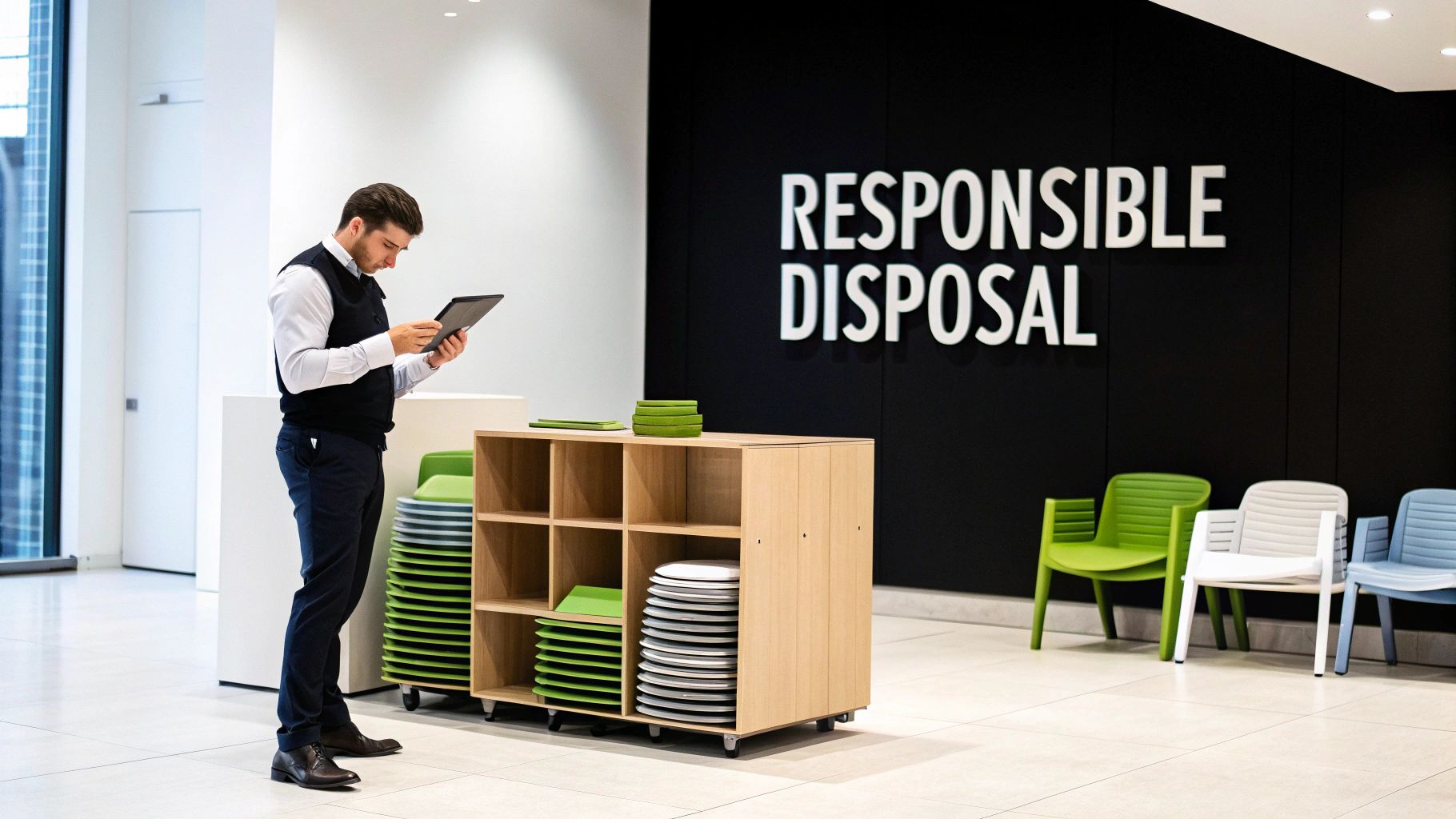
The old way of handling an office cleanout is officially broken. Just calling a hauler to drag desks, chairs, and cubicles to the nearest dump isn't just wasteful—it's a massive missed opportunity for businesses, warehouses, and property managers to walk the talk on corporate responsibility.
Today, a smart office furniture disposal plan is a core part of modern operations. It has a real, direct impact on your brand’s reputation and sustainability credentials.
Instead of just "getting rid of stuff," you should see this as managing end-of-life assets. This simple shift in mindset turns a logistical nightmare into a powerful part of your company's Environmental, Social, and Governance (ESG) strategy.
The Environmental Impact of Outdated Disposal Methods
The scale of the furniture waste problem is staggering. In the U.S. alone, we toss over 12 million tons of furniture every year, and a jaw-dropping 80% of it goes straight into landfills. Commercial offices are a huge part of that number, highlighting a massive inefficiency in how businesses typically handle these projects.
While most junk removal companies take everything to the landfill, we recycle through Beyond Surplus to minimize waste and maximize reuse. This old-school approach doesn't just contribute to overflowing landfills; it wastes perfectly good materials that could have been repurposed or recycled. For any business that takes its environmental commitments seriously, this is a problem that demands a better solution.
A thoughtful clear-out strategy does more than just empty a room; it reflects your company’s commitment to sustainability and responsible resource management. It’s a tangible action that speaks louder than words on a mission statement.
An Integrated Model for Modern Businesses
The right way to do this is with an approach that integrates junk removal with a solid recycling and repurposing framework. This is where an integrated partnership, like the one between Fulton Junk Removal and Beyond Surplus, really shines. Fulton Junk Removal operates under Beyond Surplus, offering a circular, eco-friendly solution that goes beyond traditional junk hauling.
Here’s how it works:
- Fulton Junk Removal takes care of the hands-on logistics, efficiently clearing out your office, warehouse, or commercial space.
- Beyond Surplus steps in to ensure everything we collect is processed responsibly, with a sharp focus on recycling electronics, metals, and other valuable materials.
This circular, eco-friendly model transforms a costly disposal headache into a streamlined, sustainable process. For offices, warehouses, and property managers, Fulton handles the junk removal, and Beyond Surplus ensures responsible recycling, making compliance and sustainability reporting easier. As you map out your clear-out plan, it’s vital to think through the operational and environmental risks, which can be managed by understanding your business risk management framework.
By adopting a model like this, you’re not just meeting your operational needs—you're proving your commitment to a healthier planet. This appeals to environmentally conscious homeowners and businesses alike.
First Things First: Inventory and Assess Your Furniture
Before you pick up the phone to schedule a removal, the single most important thing you can do is figure out exactly what you have. This isn't just about counting chairs; it's a strategic assessment that gives you the power to make smart, cost-effective, and sustainable choices for every single item.
Think of it as creating a game plan. A proper inventory stops last-minute surprises, gets you a far more accurate quote, and often uncovers value in items you might have written off as junk. Trying to manage an office cleanout without one is a recipe for chaos and wasted money.
Sort Everything for Maximum Value
The whole point of this exercise is to break down that mountain of "stuff" into clear categories based on its condition. This helps you see your assets not as one big problem, but as a collection of items with different, better destinations than the local dump.
Go through your office and tag every piece of furniture with one of these four conditions:
- Reusable: This is the good stuff. Furniture that's in solid, working condition and could be used by another business tomorrow. Think desks with minor scuffs, perfectly good task chairs, or sturdy filing cabinets.
- Repairable: These are items with minor issues—a wobbly chair leg, a stuck drawer, a small tear in the upholstery—but are otherwise structurally sound. They’re often perfect for donation to charities that have refurbishment programs.
- Recyclable: Furniture that's broken beyond repair but is made of valuable materials. This is where you salvage metal desk frames, aluminum chair bases, and certain plastics that can be given a second life.
- Waste: This category should be your last resort and your smallest pile. It's for items that are hopelessly damaged, made of non-recyclable composite materials (like cheap particle board), or simply can't be salvaged.
Build Your Master List
A simple spreadsheet is your best friend here. Create a master list that captures all the key details. This document will become the playbook for your entire project, keeping everyone on the same page.
Here’s a simple structure you can copy and paste:
| Item ID | Item Type | Quantity | Condition (Reusable/Repairable/Recyclable/Waste) | Primary Material | Dimensions (WxDxH) | Notes |
|---|---|---|---|---|---|---|
| CH-001 | Task Chair | 50 | Reusable | Metal, Fabric | 24"x24"x40" | Fully functional, minor wear |
| DS-001 | L-Shaped Desk | 15 | Repairable | Wood Veneer, Metal | 72"x72"x30" | Some laminate is peeling |
| CB-001 | Cubicle Panel | 40 | Recyclable | Fabric, Metal | 60"x2"x66" | Outdated, fabric stained |
| BK-001 | Bookshelf | 5 | Waste | Particle Board | 36"x12"x72" | Severe water damage |
This detailed log is gold. When you call a service like Fulton Junk Removal, you can hand over this spreadsheet and get a quote that's actually accurate, with no surprises. It shows you’ve done your homework and helps us understand the job’s scope—especially when it comes to separating recyclable metals and materials for our partners at Beyond Surplus.
An accurate inventory does more than just count things; it quantifies your opportunity. It shows you exactly how much you can divert from the landfill, which is great data for your company's sustainability or ESG reports.
By taking the time to assess and document every piece, you turn a messy chore into a well-managed project. You'll be ready to coordinate with donation centers, satisfy recyclers, and make sure your removal day goes off without a hitch.
Choosing the Right Disposal Path for Your Assets
Once you’ve got that detailed inventory in hand, it’s time to make the big decisions. This is where you decide where every single desk, chair, and cabinet is headed. The goal isn’t a one-size-fits-all solution; it’s about creating a smart, layered approach that keeps as much as possible out of the landfill.
A good plan almost always involves a mix of donation, recycling, and professional hauling. The right path for each item really depends on its condition, your timeline, and your company’s sustainability goals.
This flowchart breaks down the simple but effective thought process for every piece of furniture you have.
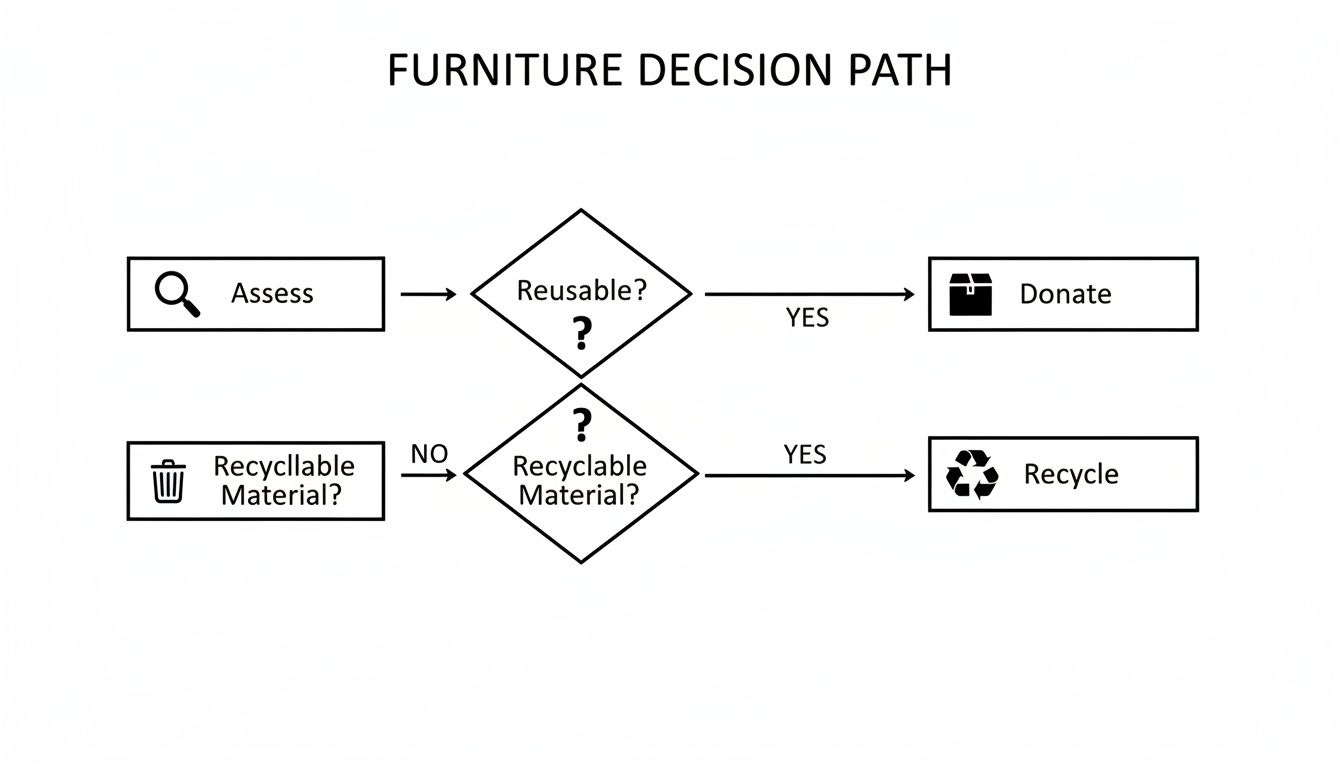
The key takeaway is to always look for reuse potential first. Recycling is the next best step, and the landfill should always be the absolute last resort.
The Donation Route for Reusable Furniture
Donating furniture that’s still in good shape is a fantastic first option. You’re giving your assets a second life, helping out local organizations, and you might even get a tax benefit out of it. But let's be real—donating a whole office of furniture isn't like dropping off a bag of clothes.
Most charities have pretty strict rules about what they’ll take. Everything needs to be clean, structurally sound, and ready to use. That desk with the huge coffee stain and peeling veneer? Or the chair with the torn upholstery? They’ll likely get rejected, and then you’re back to square one.
If you’re thinking about donation, keep these tips in mind:
- Contact Charities Early: Non-profits need time to figure out logistics for a big pickup. Get in touch with local schools, community centers, or charities way ahead of your move-out date.
- Confirm Logistics: Don't assume they can handle it. Ask if they have the staff and trucks for a commercial-scale job. Many don’t.
- Get Documentation: Always, always get a receipt for your donation. You'll need it for your records and tax purposes.
The Recycling Imperative for End-of-Life Assets
For furniture that’s seen better days but is made of valuable materials, recycling is the only responsible choice. This is where a specialized partner isn't just helpful—it's essential. Think about items like cubicles, metal filing cabinets, and office chairs. They’re complex mixes of wood, metal, plastic, and fabric.
A dedicated recycling facility, like our partner Beyond Surplus, has the right equipment to actually break these items down. They can separate steel frames from fabric panels and plastics from wood composites, making sure every material goes to the right place. This is especially critical for any electronics (e-waste), which contain hazardous materials and require certified handling.
Companies are feeling the pressure to be more sustainable. The global furniture recycling market, valued at $4,312.1 million in 2025, is expected to grow at a 3.4% CAGR to over $5,800 million by 2033. This isn't just a trend; it's a response to tougher waste regulations and a bigger focus on ESG goals.
Professional Hauling The Smart Way
Finally, you'll have items that can't be donated and aren't part of your main recycling plan. This is where you need a professional removal service. But be careful—not all junk removal companies are the same. A lot of them have only one destination in mind: the local dump.
Here’s where an integrated service changes the game.
Fulton Junk Removal works hand-in-hand with Beyond Surplus to recycle electronics, metals, and other materials responsibly. We divert items from landfills and ensure they’re repurposed or recycled.
We can offer a bundled junk removal + recycling pickup, where all electronic waste and recyclable materials are directly processed by Beyond Surplus. This makes life so much easier for property managers and businesses. This integrated model means you get one coordinated service that handles it all—donation drop-offs, certified recycling, and, only as a last resort, final disposal.
To make the decision a bit easier, here’s a quick comparison of your main options.
Comparing Office Furniture Disposal Options
| Disposal Method | Best For | Key Benefit | Main Challenge |
|---|---|---|---|
| Donation | Good-condition, functional items | Community support & potential tax deduction | Charities have strict acceptance criteria & limited pickup capacity |
| Self-Managed Recycling | Bulk quantities of uniform materials (e.g., all metal cabinets) | High material recovery rate & sustainability credentials | Finding facilities, sorting materials, and managing logistics is complex and time-consuming |
| Integrated Junk Removal | Mixed assets of varying conditions (donate, recycle, junk) | One-stop solution, landfill diversion, and simplified logistics | Requires choosing a partner with a genuine recycling-first model, not just a hauler |
Each path has its place, and the best strategy uses all three. By understanding these pathways, you can build a flexible and effective plan. Your inventory list will tell you how much can be donated, how much can be recycled, and what truly needs to be hauled away as junk.
Explore the full range of our commercial junk removal services to see how we can help execute your plan from start to finish.
Preparing for a Smooth Removal Day
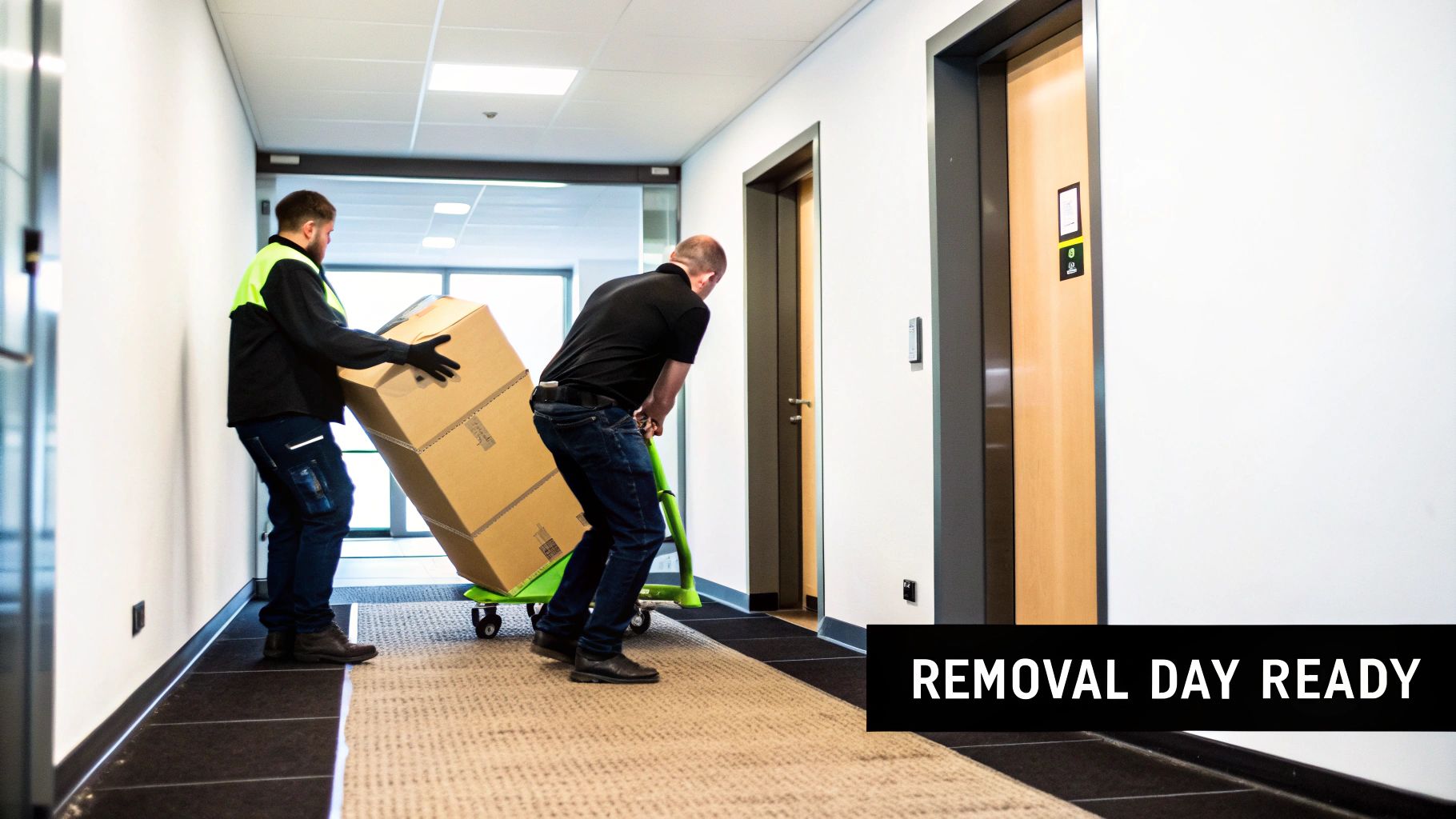
Successful office furniture disposal isn’t just about the heavy lifting; it’s about solid, upfront planning. The difference between a chaotic, delay-filled day and a seamless operation often comes down to the logistical groundwork you lay before the removal crew even shows up.
Honestly, it’s about anticipating the small hurdles that can turn into massive problems. From coordinating with your building’s management to ensuring every desk and chair is clearly marked, a little preparation goes a very long way. Think of it as choreographing a complex dance—when everyone knows their steps, the entire performance runs smoothly and efficiently.
Coordinate With Building Management
Before you do anything else, talk to your property manager. This step is completely non-negotiable for any business in a shared commercial building, and I’ve seen projects grind to a halt because it was overlooked.
You'll need to schedule specific times for the removal, which almost always involves booking exclusive access to service elevators or loading docks. Many buildings have strict rules about when large items can be moved to avoid disrupting other tenants. Forgetting to book these resources in advance means your crew might show up, ready to work, only to find they have no way to get the furniture out of the building.
Be sure to confirm these key details:
- Elevator and Loading Dock Access: Reserve specific time slots well in advance.
- Insurance Requirements: Get a Certificate of Insurance (COI) from your removal partner and provide it to your property manager.
- Protection for Common Areas: Ask about the requirements for protecting floors, walls, and doorways in shared hallways and lobbies.
Clear the Way for the Crew
Imagine trying to navigate a dozen L-shaped desks through a maze of boxes, disconnected computer cables, and stray office supplies. It’s a recipe for inefficiency and, more importantly, a huge safety hazard. One of the most helpful things you can do is create clear, unobstructed pathways from the furniture all the way to the exit.
This means moving smaller, non-furniture items out of the way before the crew arrives. Just stack boxes against walls, coil up loose cords, and make sure there’s a wide, easy-to-navigate route through every part of the office. This simple action can drastically cut down on the time—and therefore the cost—of your removal project.
Pro Tip: If you can, partially disassemble extra-large items like conference tables or modular workstations. While a full-service crew can handle this, doing some of the prep work yourself can save a surprising amount of time on removal day.
Label Everything with Clear Intentions
Your inventory spreadsheet was for planning; now it's time to bring that plan to life with physical labels. Use large, brightly colored stickers to mark every single piece of furniture with its intended destination. This system kills any guesswork and lets the removal team work quickly and accurately.
I recommend a simple, color-coded system:
- Green for 'DONATE': For all items in good shape heading to a charity.
- Blue for 'RECYCLE': For furniture designated for material recovery.
- Red for 'JUNK': For the few items that are true waste and heading for disposal.
This visual shorthand is incredibly effective, especially for bigger projects. When the crew walks in, they can immediately see what goes where, ensuring your carefully planned donation and recycling efforts are executed perfectly.
This is especially vital when you’re using an integrated service. For example, when you partner with a team like Fulton Junk Removal, we coordinate directly with Beyond Surplus to process all recyclable materials. Clearly separating these items on-site ensures all electronic waste, metals, and other recyclables are routed correctly without any mix-ups. It makes the entire process more efficient and supports accurate sustainability reporting later on.
By taking these practical steps, you set the stage for a fast, safe, and stress-free removal. Check to see if your office is located within our Atlanta-area office furniture disposal service areas and let us help you manage the logistics from start to finish.
How to Select the Right Removal Partner
Picking the right removal partner is hands-down the most critical decision you'll make in this entire process. It's the difference between a smooth, responsible clear-out and a logistical nightmare that ends with your company's assets getting dumped in a landfill.
The right partner isn't just a hauling service. They're a strategic ally who understands your sustainability goals and knows how to make the process efficient. When you're vetting companies, you have to look past the price tag. A standard junk hauler sees a pile of furniture; a true partner sees a collection of assets that need to be managed responsibly.
Vetting Potential Vendors
You need to ask questions that get to the heart of a company's commitment to landfill diversion. If a vendor gets cagey or can't give you a straight answer about their recycling process, it’s because they probably don’t have one. Their ability to back up their "green" claims is what separates a genuinely eco-friendly service from one just using it as a marketing buzzword.
Here are the non-negotiable questions to ask every potential partner:
- What's your landfill diversion rate? Don't accept a vague answer. Ask for specific percentages and find out how they track this data. A company serious about sustainability will have this information ready to go.
- Can you provide sustainability documentation? This is essential for any company with ESG reporting requirements. You'll need diversion reports that detail the total weight of materials recycled, donated, and disposed of.
- What’s your experience with large-scale office clear-outs? A crew that typically handles residential junk is not equipped for a commercial project. Ask for case studies or references from other local businesses.
- How do you handle e-waste? Electronics require certified, secure recycling. Confirm they have a dedicated, compliant process for computers, monitors, printers, and other IT assets.
The Advantage of a Circular Economy Partner
This is where a circular, eco-friendly provider like Fulton Junk Removal really shines. Most junk removal companies see the landfill as their primary, easiest option. Our entire business model is built around avoiding it. We don't just offer recycling as an add-on; it's baked into our DNA.
Fulton Junk Removal works hand-in-hand with our partner, Beyond Surplus, to ensure that electronics, metals, and other complex materials are processed responsibly. This integrated approach guarantees that your end-of-life assets are repurposed or recycled, not just discarded.
This partnership lets us offer a unique, bundled service that property managers and businesses love. We handle all the furniture and junk removal logistics, and Beyond Surplus ensures every single recyclable item is properly processed. It's a single, coordinated pickup that simplifies your project and makes compliance reporting effortless. For a deeper look into our company's mission, learn more about the Fulton Junk Removal story.
Decoding Quotes and Understanding True Value
When quotes start rolling in, resist the urge to jump at the lowest number. High collection and transportation costs are often the biggest barrier to effective office furniture recycling, sometimes making up a huge portion of the total expense.
In the U.S., where over 12 million tons of furniture hits landfills each year, the logistics for heavy items like cubicles can make sustainable options seem too expensive for some companies. A rock-bottom quote might just be hiding the fact that the company is taking the easy way out and heading straight to the dump. Instead, look for a quote that transparently details all the services provided, including labor, transportation, and any recycling processing fees.
Finally, always confirm a potential partner carries adequate insurance, including general liability and workers' compensation. Ask for a Certificate of Insurance (COI) that you can provide to your building management—this is a standard requirement for almost all commercial properties.
Once you’ve chosen your partner, keeping track of their performance and compliance is key to a smooth project. Tools like contractor management software can help streamline this. Ultimately, choosing a fully insured, transparent, and sustainability-focused partner is the best investment you can make for a successful and responsible office clear-out.
Common Office Furniture Disposal Questions
An office clear-out always kicks up a lot of questions. From timelines and costs to the nitty-gritty of documentation, getting straight answers is the only way to move forward with confidence. Here are a few of the most common things we hear from businesses and property managers about the office furniture disposal process.
What Is the Most Cost-Effective Disposal Method?
Honestly, the most budget-friendly route comes down to your furniture's condition and the sheer volume you’re dealing with. If you have a small number of items in good, usable shape, donation is a fantastic first choice. It can be free, and you might even get a tax benefit.
But for a large-scale cleanout with a mix of everything—some reusable, some recyclable, some at the end of its life—an integrated service almost always wins. A provider like Fulton Junk Removal rolls hauling and certified recycling (through partners like Beyond Surplus) into one package. This just makes the logistics easier and is often cheaper than trying to coordinate separate vendors for trash, metal recycling, and e-waste. A trip to the dump might look cheap on paper, but the hidden labor and compliance costs add up fast.
The true cost of disposal isn't just the hauling fee. It's the total expense of logistics, labor, and potential compliance risks. An integrated, recycling-first model often provides the best overall value.
Can I Get Documentation for Sustainable Disposal?
Yes, but you absolutely have to confirm this upfront with your partner. Your standard junk hauler who just makes a run to the landfill is not going to provide this. This is one of the biggest benefits of working with a sustainability-focused service: getting official diversion reports.
These documents are non-negotiable for a modern business. They give you hard numbers, like the total weight of materials kept out of landfills and a breakdown of where everything went. This data is critical for:
- ESG Reporting: It provides tangible proof for your Environmental, Social, and Governance reports.
- Corporate Responsibility: It shows your company is truly committed to sustainability, not just talking about it.
- Compliance: It helps you meet local or industry-specific waste regulations.
Services built on a circular model, like the partnership between Fulton Junk Removal and Beyond Surplus, are designed to provide this documentation. It makes your sustainability reporting accurate and straightforward.
What Happens to Truly Unsalvageable Furniture?
Look, even with the best intentions, some pieces are just too damaged or made of materials that can't be recycled. In those rare cases, the landfill is the last and only option.
But a responsible partner doesn't give up that easily. Before anything gets labeled as "trash," it goes through a serious disassembly process. At a facility like Beyond Surplus, for instance, items are broken down into their core components. We’re talking about salvaging every last recyclable part—metal frames are pulled from wood tops, and different plastics are sorted for processing. This detailed work ensures that only the absolute bare minimum, the truly non-recoverable stuff, ends up in a landfill.
How Far in Advance Should I Schedule a Removal?
For any large-scale office decommissioning project, give yourself a buffer. We recommend planning and scheduling your removal at least two to four weeks in advance. This breathing room is a game-changer for a smooth operation.
That timeframe gives you enough space to do a proper inventory, get a few quotes to compare, and coordinate all the logistics with building management—like booking service elevators and clearing the loading dock. It also helps ensure your preferred provider is actually available, especially during the busy moving seasons. While a week's notice might fly for a small job, planning ahead is the best way to avoid last-minute stress and expensive delays.
Ready to get a jump on your project? Feel free to contact us to discuss your timeline and we can put together a free estimate.
Navigating an office furniture clear-out doesn’t have to be a headache. With a solid plan and the right partner, you can make sure your project is handled responsibly, efficiently, and with sustainability in mind. Fulton Junk Removal is here to help you manage the entire process, from the first look to the final report.
