
Recycle Atlanta: Your Complete 2026 Guide
A lot of people in Atlanta start with the same good intention. They’ve got a garage full of old paint cans and broken appliances, an office storage room stacked with retired monitors, or an apartment turnover that left furniture, cardboard, and random electronics behind. They want to recycle what they can. Then the practical questions start. What goes in the blue bin, what has to go elsewhere, what can’t sit curbside, and who documents any of it for a business or property owner?
That confusion is normal. Atlanta has made real progress, but recycle atlanta isn’t as simple as tossing everything reusable-looking into one container and hoping the system sorts it out. The city program works for a defined set of materials. Outside that lane, the process becomes much more specialized, especially for multifamily properties, office cleanouts, warehouse debris, e-waste, and anything that carries compliance risk.
Your Guide to Recycling in Atlanta
A property manager in Atlanta usually doesn’t call about recycling first. They call because a tenant moved out, maintenance piled broken shelving by the dumpster, and there are bags of mixed material nobody wants to sort. An office manager does the same thing after an IT refresh, when old keyboards, cables, monitors, and cardboard fill a conference room. Homeowners run into it during moves, estate cleanouts, and renovations.
What trips people up is that Atlanta has several recycling paths, not one. There’s the city’s curbside program for standard household materials. There are specialty drop-off options for items that can’t go in the blue bin. Then there’s the private side of the market, where businesses and property managers need pickup, sorting, documentation, and secure handling that public systems weren’t built to provide.
That’s why local context matters. Recycling advice that works in another metro often doesn’t fit Atlanta’s rules, accepted materials, or service gaps. If you need a local frame of reference before arranging pickup or disposal, Fulton’s Atlanta service area coverage helps confirm where support is available.
Recycle atlanta works best when you match the material to the right channel. Curbside for standard recyclables. Specialty facilities for problem items. Professional hauling when volume, compliance, or mixed loads make self-sorting unrealistic.
The practical approach is simple. Use the city program where it fits. Don’t force non-accepted items into that stream. And if you’re handling a cleanout with mixed materials, plan for diversion before the truck is loaded, not after.
How Atlanta's Curbside Recycling Program Works
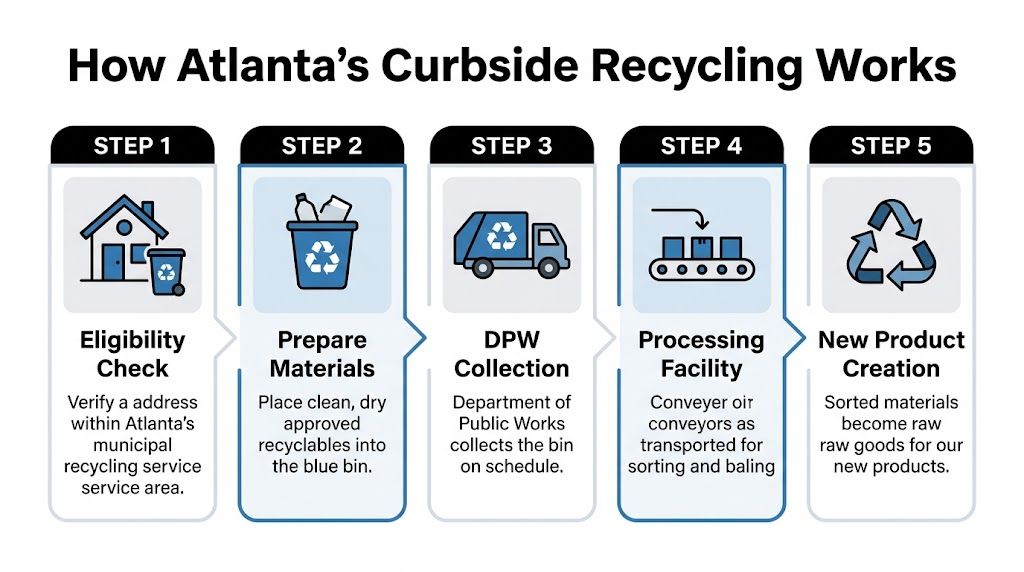
Atlanta’s curbside program is a single-stream recycling system. That means residents place approved recyclables together in the blue bin rather than sorting paper, metal, glass, and plastic into separate containers. The Department of Public Works collects those materials, and contractor Pratt Industries processes the mixed stream.
Think of it as a city-scale sorting line. The easier residents make that job by putting in clean, accepted items only, the better the recovery result. The more bags, food residue, electronics, or random trash mixed in, the more the system slows down and the more good material gets lost.
What the city program does well
Atlanta’s curbside system has improved meaningfully. Since 2017, a city initiative cut contamination from 41% down to 10%, which the reporting describes as a 31% reduction, and the city’s recycling participation rate doubled from 11% to 23% by 2022, according to the Atlanta recycling audit coverage in the AJC.
That matters operationally. Lower contamination means fewer loads are compromised by non-recyclable material, and more of what residents set out can move through the recycling stream instead of being discarded downstream.
Where the limits show up
Progress doesn’t mean the system covers everything people need. The same AJC reporting notes that Atlanta collected nearly 19,800 tons of recyclables in FY2023, and the city’s recycling rate remained 23%, which is still below the EPA benchmark of 26% to 32% in that same reporting. In practice, that tells you two things. First, curbside is important. Second, curbside alone won’t carry Atlanta’s full diversion needs.
Here’s how residents should think about the process:
- Confirm service eligibility. The city program applies to municipal curbside customers within the service area.
- Use the blue bin for standard recyclables only. Keep materials loose unless city guidance says otherwise.
- Keep items clean and dry. Wet cardboard and food-coated containers create avoidable problems at the facility.
- Leave specialty waste out. Electronics, chemicals, bulky debris, and many move-out materials need a different path.
Practical rule: The blue bin is not a cleanup shortcut. If an item needs explanation before you toss it in, it probably needs a different recycling channel.
Why contamination still happens
Most contamination doesn’t come from bad intentions. It comes from people trying to recycle more than the system can accept. A small office dumps cords, batteries, and shredded paper into one bin. A resident bags recyclables in plastic grocery bags. A turnover crew throws broken furniture on top of cardboard and calls it mixed recycling.
That’s where recycle atlanta often breaks down. The public system works when the load is predictable. Once the material stream becomes mixed, bulky, or security-sensitive, the city program stops being the right tool.
Accepted vs Banned Items for Your Blue Bin
The fastest way to recycle better in Atlanta is to stop guessing. If you run a small office, manage a household, or oversee a rental property, your blue bin should hold routine recyclables only. It should not become the overflow container for move-out debris, broken gadgets, or maintenance scraps.
Atlanta curbside recycling cheat sheet
| Accepted in Blue Bin | Keep Out of Blue Bin |
|---|---|
| Paper and cardboard such as mail, boxes, and paper packaging | Food waste and heavily food-soiled containers |
| Plastic bottles, tubs, and jugs if they’re empty and reasonably clean | Plastic bags and film that wrap around sorting equipment |
| Metal cans and similar household metal containers | Electronics such as cords, printers, laptops, and monitors |
| Glass bottles and jars because Atlanta accepts glass curbside | Textiles including clothing, linens, and fabric scraps |
| Mixed standard household recyclables placed loose in the bin | Bulky items like furniture, shelving, and large plastic objects |
What usually causes trouble
The main issue isn’t the accepted list. It’s the “close enough” list people invent on the fly.
- Bagged recyclables create sorting problems. Even if the contents are recyclable, the plastic bag itself can contaminate the load.
- Tanglers like cords, hoses, and string lights don’t belong in curbside recycling. They wrap around machinery and slow processing.
- Electronics should stay out, even if they contain metal or plastic. They need dedicated handling.
- Construction leftovers like scrap wood, drywall, flooring, and fixtures are not blue-bin material.
A simple sorting standard
Use one question before putting anything in the bin: is this a normal household container or paper product that Atlanta’s curbside system is designed to process?
If the answer is yes, it probably belongs there. If the item is bulky, mixed-material, hazardous, or powered by a battery or cord, keep it out.
Clean cardboard, bottles, cans, and jars help the system. “Wishcycling” hurts it.
For small offices, the best habit is to separate desk-area recycling from cleanout waste. Daily recycling and one-time disposal aren’t the same stream, and combining them is where most contamination starts.
Beyond the Blue Bin for Specialty and Multifamily Recycling
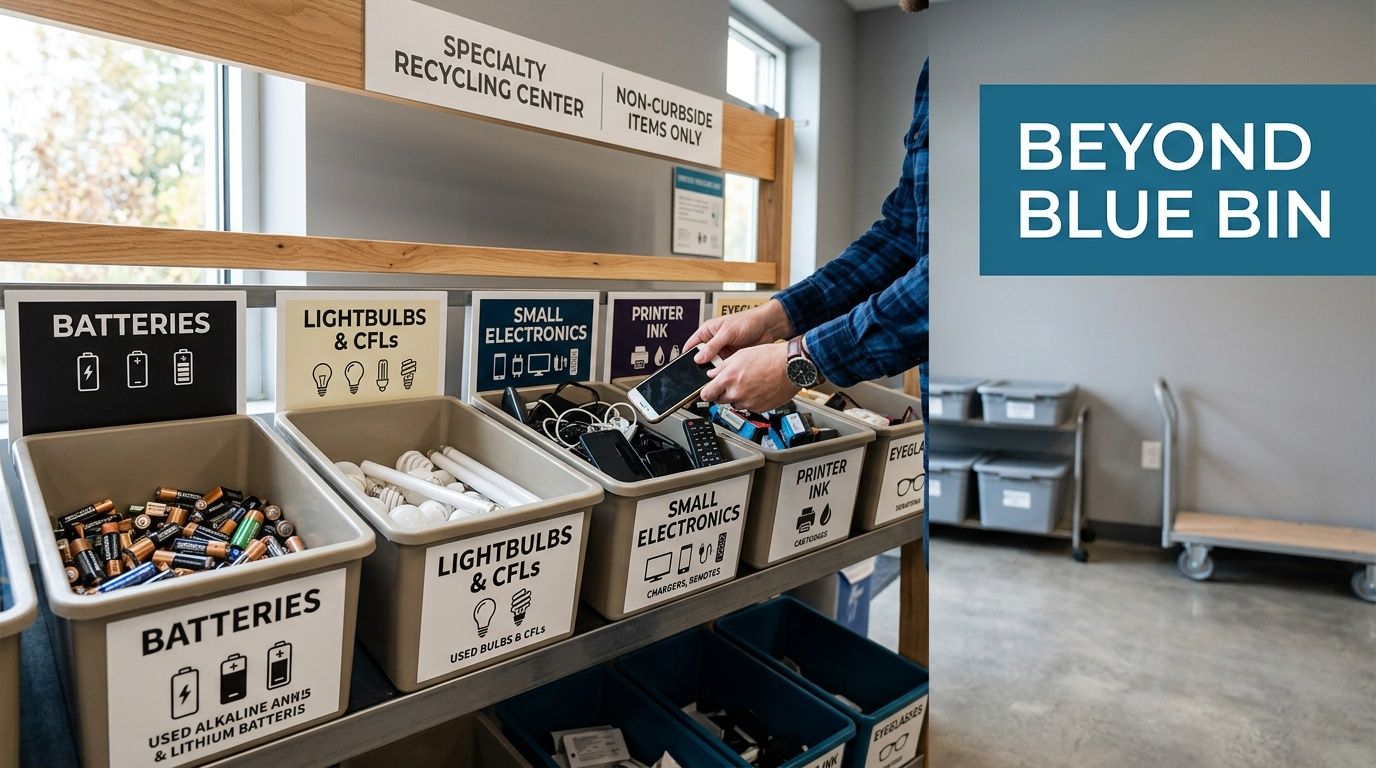
The blue bin covers routine material. It doesn’t solve the harder part of recycle atlanta, which is what to do with everything else. Paint, chemicals, mattresses, electronics, odd plastics, and bulky cleanout material don’t belong in curbside service. They need specialty handling, scheduled drop-off, or a pickup partner that already knows where each stream goes.
That’s where facilities like the Center for Hard to Recycle Materials, often called CHaRM, fit into the local context. CHaRM gives residents a route for items that sit outside normal curbside rules. It’s useful, but it also has a practical limitation. It’s a drop-off model, not a full cleanout solution for every apartment complex, office, or warehouse.
Why multifamily properties are the biggest gap
Multifamily recycling is where Atlanta’s system shows one of its clearest weak points. Reporting on the city audit found that Atlanta hasn’t enforced its ordinance requiring apartments and condos to provide recycling, and that gap contributes to the city’s 23% diversion rate, which sits below the EPA’s 26% benchmark, according to Fox 5 Atlanta’s audit coverage.
For property managers, that creates a messy middle. Residents expect recycling. The ordinance exists. But building layouts, dumpster enclosure space, contamination, and weak resident education often leave no reliable daily process.
What works in apartment and condo settings
A multifamily property usually needs more than bins. It needs rules, placement, signage, and pickup coordination.
- Dedicated recycling areas work better than shared trash zones where everything gets mixed.
- Turnover planning matters. Unit cleanouts create cardboard, furniture, textiles, and electronics all at once.
- Resident instructions need to be plain. If the sign is vague, contamination follows.
- Overflow control is essential. Once bins fill up, tenants start using whatever container is open.
Multifamily recycling fails when management treats it as a bin problem. It’s an operations problem.
Where specialty centers fit and where they don’t
For a homeowner with a few problem items, a specialty center can be enough. For a building manager dealing with recurring move-outs, maintenance debris, abandoned belongings, and scattered e-waste, drop-off alone isn’t realistic. Staff time disappears, contamination rises, and recyclables end up in the trash stream because no one has capacity to separate them correctly.
That’s why multifamily recycling in Atlanta often needs a private operating plan, not just access to a public program.
Navigating E-Waste and Hazardous Material Disposal
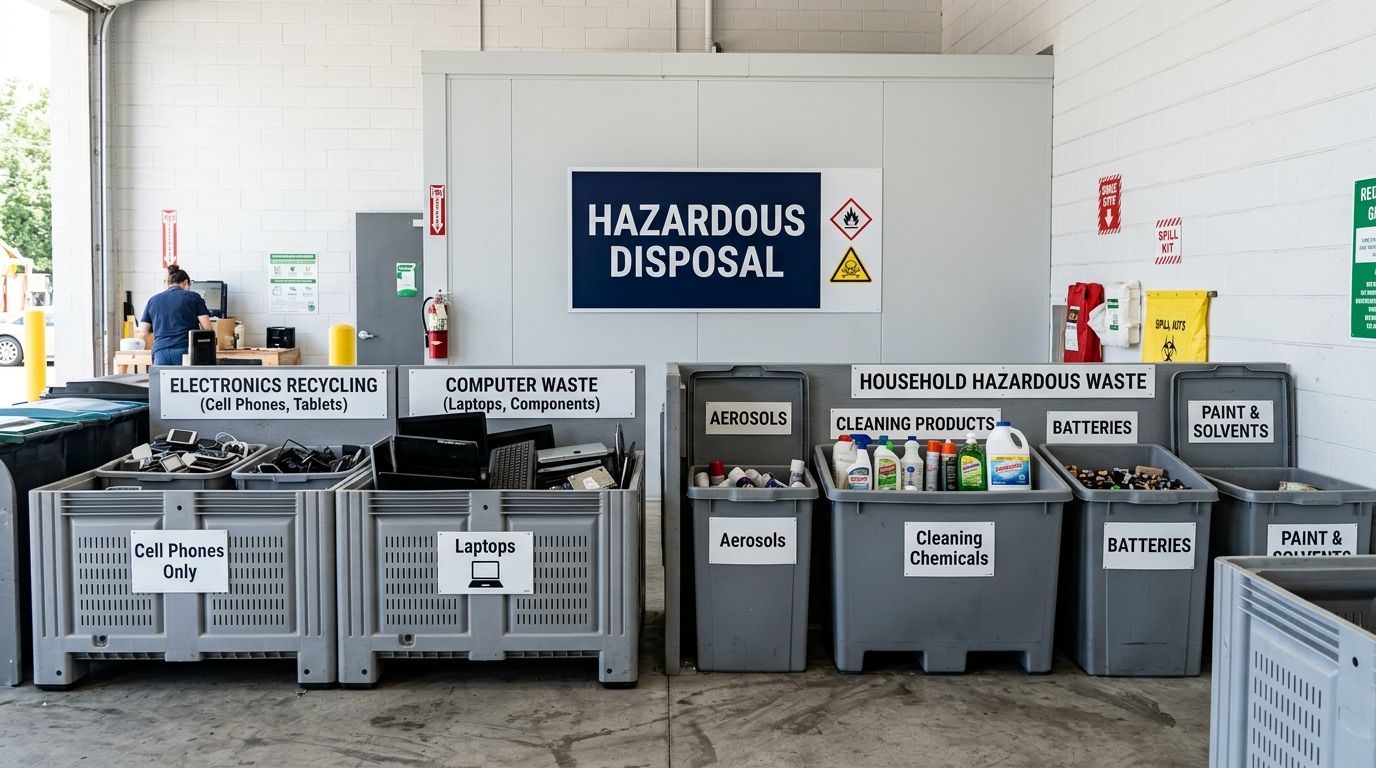
Electronics and hazardous materials are the two categories people most often mishandle during cleanouts. They also carry the most risk. A monitor, laptop, server, printer, battery, or networking device looks like ordinary junk when it’s stacked in a storeroom, but disposal rules change once data, regulated components, and downstream handling enter the picture.
The same goes for paints, chemicals, solvents, and similar materials from maintenance rooms, warehouses, and renovation work. These items don’t belong in standard trash or curbside recycling. They need segregation before pickup, not after loading.
Why e-waste requires a different standard
For business clients, the first issue isn’t only environmental. It’s data security. Retired hard drives, servers, mobile devices, and networking gear can hold sensitive information long after the equipment is out of service. If that material leaves your building without a documented chain of custody, disposal becomes a compliance problem.
Atlanta businesses should look for R2v3 certified handling for electronics. According to this overview of Atlanta electronics recycling standards, partnering with an R2v3 certified facility supports zero-landfill disposition and NAID AAA certified data destruction, with serial-number-specific certificates of destruction that matter for HIPAA, SOX, and GLBA compliance.
What to ask before releasing electronics
If you’re an office manager, IT director, or facilities lead, ask direct questions:
- Will assets be tracked by serial number?
- Is data destruction documented?
- Does the downstream processor provide certificates of destruction?
- Is the material going through a certified recycling chain rather than general disposal?
Those questions matter more than broad promises about being “green.” Responsible e-waste handling is procedural. The paperwork is part of the service.
If you want more context on cleanout planning, equipment handling, and local disposal logistics, Fulton’s junk removal blog resources cover related scenarios businesses run into during office and property cleanouts.
Hazardous materials need separation early
Hazardous material disposal usually goes wrong at the staging phase. Someone packs paint, aerosols, cleaners, batteries, and random shop chemicals into the same pile as cardboard and old furniture. Once that load is mixed, sorting gets harder and disposal options shrink.
A safer process looks like this:
- Isolate questionable items first. Don’t place them in mixed junk.
- Label by category. Even simple separation helps downstream handling.
- Keep electronics apart from chemical waste. They are different streams with different processors.
- Document what left the site. Businesses especially need that paper trail.
The cheapest disposal option on day one often becomes the most expensive mistake when data security or hazardous handling wasn’t documented.
The Commercial Recycling Challenge for Atlanta Businesses
A lot of business owners assume recycling gets easier at scale. In practice, it often gets harder. A household might have cardboard, bottles, and a few old electronics. A business cleanout can include cubicles, server racks, pallet wrap, shelving, damaged inventory, obsolete devices, whiteboards, packaging, and construction debris from reconfiguration work. Those materials don’t move through one simple channel.
That’s the central problem with recycle atlanta for commercial users. The city and nonprofit ecosystem can help with certain streams, but businesses rarely generate only one stream at a time. They generate mixed loads on deadlines.
The real obstacle isn’t intent
Commercial teams usually want to divert more material. What they lack is a system that matches the pace of operations.
A warehouse manager doesn’t have time to send staff to multiple drop-off sites during a reset. A contractor can’t stop a renovation to separate every recyclable fragment by hand. An office move creates a short window where everything has to leave quickly, including items that don’t belong in landfill.
Waste360’s coverage of Atlanta’s recycling gaps notes that a major unsolved issue for businesses is the scalable disposal of commercial waste like server racks, office furniture, or construction debris, forcing many companies to landfill materials that could have been recovered while also increasing disposal costs. You can read that discussion in Waste360’s reporting on hard-to-recycle materials in Atlanta.
Common failure points in business cleanouts
- Mixed loads at the dock. Cardboard, scrap metal, furniture, and e-waste arrive in one pile.
- No chain of custody. IT assets leave without formal destruction documentation.
- Tight turnover schedules. Real estate and facilities teams prioritize speed, then lose diversion opportunities.
- Bulky materials overwhelm staff. Office furniture and warehouse fixtures take labor to break down and route correctly.
For businesses evaluating cleanup partners, Fulton’s company background and service approach gives a useful example of what to look for in a local operator that understands cleanouts beyond simple trash hauling.
Why standard hauling often falls short
A standard hauler can remove material fast. That doesn’t mean the load was managed correctly. If the provider treats everything as one disposal stream, businesses lose reuse options, recycling options, and reporting value.
That trade-off shows up most clearly in three situations:
| Scenario | What usually goes wrong |
|---|---|
| Office cleanout | Electronics and furniture get loaded together with general junk |
| Warehouse reset | Metals, pallets, packaging, and obsolete equipment aren’t separated |
| Property turnover or renovation | Recoverable fixtures and debris go out as mixed waste |
Commercial recycling works when removal is planned around material categories, compliance needs, and timing. It fails when the only goal is to clear the floor by end of day.
The Complete Solution for Junk Removal and Certified Recycling
The most effective recycling programs in Atlanta don’t rely on luck or good intentions. They rely on process. If a site team wants real landfill diversion, someone has to identify the material streams before loading, route those streams to the right downstream partners, and document what happened after pickup. That’s the difference between basic hauling and an integrated junk removal plus certified recycling model.
Atlanta already has proof that data-driven waste operations work. The city’s SmartCity pilot used analytics to reduce recyclables going to landfills by 83%, according to Routeware’s account of the Atlanta SmartCity pilot. The lesson for businesses isn’t that every property needs a municipal pilot. It’s that smarter routing, better visibility, and pre-haul decision-making change outcomes.
What a complete operating model looks like
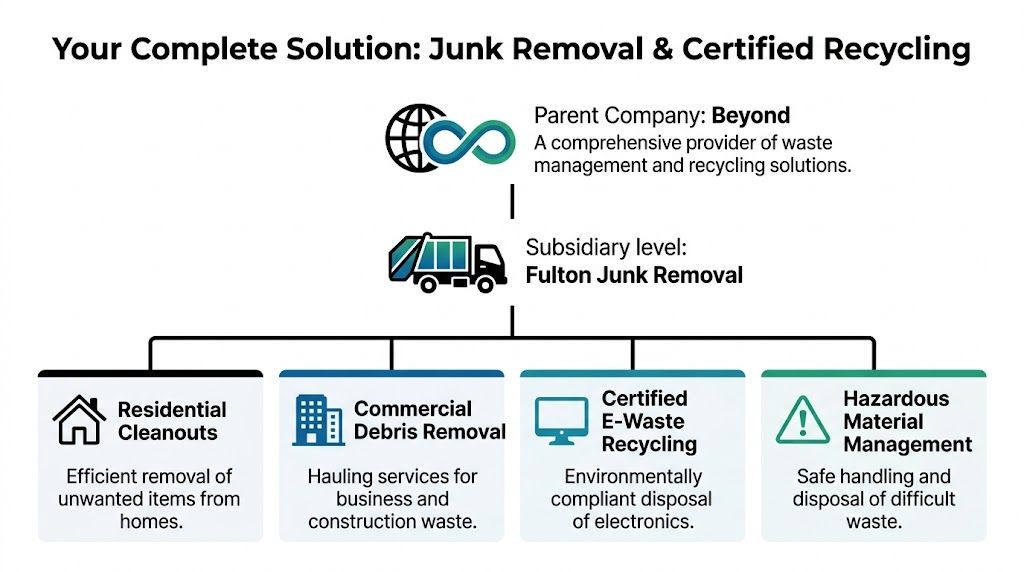
For commercial and property-based projects, the stronger model combines onsite removal with downstream recycling and reuse channels. That means one coordinated service handles pickup, while specialized recycling partners process electronics, metals, and other recoverable materials appropriately.
Under the Beyond Surplus model, that’s the practical advantage. Fulton Junk Removal handles the physical cleanout and haul-away. Beyond Surplus supports the recycling side for electronics, metals, and other materials that are not suitable for direct dumping. The result is a cleaner chain from pickup to processing.
Why this matters more than a low hauling quote
A low quote can clear a room. It can’t prove where the material went.
Businesses, warehouses, office managers, and property teams often need more than a receipt. They need records that support internal sustainability reporting, tenant expectations, procurement standards, or regulated data destruction. A combined junk removal and recycling process is stronger because it accounts for what’s in the load before the truck leaves.
Here’s what that typically improves:
- Mixed material handling by separating standard junk from recyclable metals, electronics, and reusable items
- Operational simplicity because the customer doesn’t have to coordinate multiple vendors
- Documentation quality when the load includes assets or material categories that need traceability
- Landfill reduction because sorting is built into the service plan rather than treated as an afterthought
Data-driven removal is the practical edge
The best providers think like operators, not just drivers. They assess the site, identify likely diversion streams, estimate labor needs, and plan the route so the material doesn’t bounce around unnecessarily between stops. If you want a plain-language explanation of what route optimization entails, that overview is useful because it shows why sequencing, dispatch logic, and pickup planning affect both efficiency and service quality.
Field advice: If the vendor can’t explain how they separate, route, and document different material types, they’re probably quoting a disposal job, not a diversion job.
For businesses reviewing local options, Fulton’s service lineup for cleanouts and removal is built around that broader operating model. It’s designed for offices, warehouses, property turnovers, events, and mixed-load pickups where traditional curbside rules don’t come close to covering the full scope of work.
What works and what doesn’t
A few trade-offs are worth stating plainly.
What works
- Pre-haul site reviews
- Separate handling for electronics and other sensitive materials
- Pickup plus downstream recycling coordination
- Diversion reporting for customers who need records
What doesn’t
- Treating all material as one load
- Using the blue bin as a catch-all for cleanouts
- Waiting until after pickup to decide what can be recycled
- Assuming a standard junk receipt is enough for compliance or ESG reporting
That’s the gap many Atlanta businesses are trying to close. Public recycling is useful. Specialty drop-off helps. But mixed commercial waste needs an operator who can do the hauling and the material routing in one system.
Atlanta Recycling Questions Answered
Can a business rely on a junk hauling receipt for sustainability reporting
Usually, no. A hauling receipt shows that material was removed. It doesn’t necessarily show what was recycled, what was diverted, what was securely destroyed, or where the load ultimately went. Businesses that track sustainability performance or need compliance support usually need more detailed diversion documentation.
What’s the best way to handle an office cleanout with electronics, furniture, and cardboard together
Treat it as a mixed-material project from the start. Separate IT assets from general furniture and loose recyclables before pickup if possible, even if that separation is basic. The more clearly those streams are identified upfront, the easier it is to route them correctly and keep recyclable material out of disposal loads.
Are multifamily properties in Atlanta required to offer recycling
Atlanta has an ordinance requiring multifamily properties to provide recycling, but enforcement has been a major gap, as noted earlier from the city audit reporting. For owners and managers, the practical takeaway is that waiting for better city enforcement doesn’t solve current operational issues. Buildings still need a workable process for resident use, contamination control, and turnover waste.
What should never go into a curbside blue bin during a cleanout
Keep out electronics, chemicals, batteries, furniture, renovation debris, textiles, and bagged mixed waste. Those items either require specialty handling or they contaminate the recycling stream and reduce the value of the load.
How do companies simplify pickup when they have several waste types at once
They work with a provider that can stage the job, identify material categories, and coordinate downstream recycling instead of sending everything into one disposal path. That’s especially important for offices, warehouses, and property managers working on deadlines.
If you need to discuss a specific cleanout, building turnover, or commercial pickup, Fulton’s contact page for scheduling and estimates is the right place to start the conversation.
If you need a local partner that can handle haul-away and responsible recycling in one process, Fulton Junk Removal offers Atlanta-area cleanouts backed by the Beyond Surplus circular model. That gives offices, warehouses, property managers, and homeowners a practical way to remove junk, divert recyclable material, and simplify documentation without juggling multiple vendors.
