
Prevent Data Breaches During IT Disposal in Atlanta: Secure Your Data
To prevent data breaches during IT disposal in Atlanta, you need more than just a standard junk hauler. You need a certified partner that guarantees secure data destruction. This means having a formal policy in place, using certified sanitization methods like physical shredding, and demanding a full chain-of-custody paper trail for every single device. For Atlanta offices, it’s the only real way to make sure your sensitive business and customer information is gone for good.
The Hidden Data Risks in Your Old Office Equipment
That dusty server in the back closet or the stack of old laptops in a storeroom isn't just clutter—it's a ticking time bomb of data risk. All too often, Atlanta businesses treat IT disposal as an afterthought, something to be dealt with during a chaotic office move or an annual cleanout. This oversight is exactly where catastrophic data breaches begin.
Breaches don't always come from sophisticated hackers hitting your live network. More often than not, they start with discarded equipment that was never properly wiped. Imagine an office manager hiring a general junk hauler to clear out old tech. If those devices get tossed in a landfill or resold as-is, the sensitive data they hold is there for the taking. While most junk removal companies take everything to the landfill, we recycle through our partner, Beyond Surplus, to minimize waste and maximize reuse.
A Financial and Reputational Landmine
The consequences are very real. Reported U.S. data breaches skyrocketed to an all-time high of 3,322 incidents in 2025. A staggering 80% stemmed from attacks targeting hard-to-change personally identifiable information (PII) like Social Security numbers—data often pulled from improperly disposed IT equipment. According to the 2026 data breach report on blog.barracuda.com, financial services led with 739 breaches, followed by healthcare at 534, and professional services at 478. These are the very sectors that form the backbone of Atlanta's economy.
For any business in Atlanta’s finance, healthcare, or professional services industries, secure IT disposal isn't an optional line item. It's a non-negotiable part of risk management and protecting your brand.
A single compromised hard drive can expose thousands of customer records, leading to hefty regulatory fines, costly litigation, and irreparable damage to your company's hard-earned trust.
What’s Hiding on Your Old Devices?
It's easy to underestimate just how much sensitive information is lurking on old equipment. We're talking about much more than just old emails and documents. Before you toss that old computer or server, think about the kind of data that might still be on it.
| IT Asset | Common Data Types Stored | Potential Business Impact if Breached |
|---|---|---|
| Laptops & Desktops | Employee credentials, customer PII, financial reports, HR files, company IP | Major data breach, identity theft, financial fraud, reputational ruin |
| Servers | Centralized customer databases, financial records, proprietary software, trade secrets | Complete operational disruption, massive regulatory fines, loss of competitive edge |
| Smartphones & Tablets | Email access, passwords, contact lists, GPS location history, two-factor authentication | Unauthorized access to corporate networks, personal data compromise |
| Printers & Copiers | Scanned documents (contracts, IDs), stored print jobs, network access credentials | Exposure of confidential documents, internal network vulnerability |
| Network Routers | Network configurations, passwords, access logs, firewall rules | Network takeover, man-in-the-middle attacks, widespread data interception |
Simply deleting files or formatting a drive is not enough. That data is still there and can be easily recovered with widely available software tools, leaving you wide open to a breach.
Focussed on commercial services, Fulton Junk Removal operates under Beyond Surplus, providing a circular, eco-friendly solution that goes beyond traditional junk hauling. Fulton works hand-in-hand with Beyond Surplus to recycle electronics, metals, and other materials responsibly, diverting items from landfills to be repurposed or recycled. You can find more practical advice and business insights on the Fulton Junk Removal blog.
Building Your Ironclad IT Asset Disposal Policy
Alright, let's move past the "why" and get straight to the "how." A strong defense against a data breach during equipment disposal starts with a documented plan. Frankly, creating a formal IT Asset Disposal (ITAD) policy is the single most important thing your Atlanta business can do to protect itself.
This isn't about some generic template you download online. It’s about building a practical framework your team can actually use. This policy becomes your company’s playbook, eliminating the guesswork and ensuring everyone—from IT to the building manager—knows their exact role in protecting sensitive data. Without it, I’ve seen critical steps get missed, accountability disappear, and companies left wide open to risk.
Defining Your Data-Bearing Assets
First things first: you need to spell out exactly what a data-bearing asset is. This sounds basic, but it’s a huge point of failure. Your policy needs to be crystal clear, leaving zero room for interpretation.
Think well beyond just computers. Your list has to be exhaustive.
- Workstations and Laptops: The obvious ones, of course.
- Servers: The heart of your company's data infrastructure.
- Mobile Devices: Company phones and tablets are packed with emails, contacts, and direct access to your network.
- External Hard Drives & USBs: These small, portable devices are so easy to forget, yet they can hold massive amounts of sensitive information.
- Networking Equipment: Routers and firewalls hold configuration data and access logs—a potential goldmine for bad actors.
- Office Multifunction Printers: This is the one everyone forgets. Modern printers have internal hard drives that store a digital copy of every single document scanned, copied, or printed.
When you create a specific list like this, you create a clear trigger for your entire disposal process. If an item is on this list, it must follow your secure ITAD protocol. No exceptions.
Establishing Clear Roles and Responsibilities
Once you know what you’re protecting, you have to decide who is protecting it. A policy without assigned roles is just a piece of paper that collects dust on a server. For any Atlanta business, especially those in healthcare, finance, or law, clear accountability isn't just a good idea—it's non-negotiable.
Your policy must outline who does what.
- IT Manager: This person owns the data sanitization process. They are responsible for making sure every device is properly wiped or tagged for physical destruction and for keeping the technical logs to prove it.
- Facilities or Operations Manager: They handle the physical world—managing the logistics of asset removal, coordinating with your disposal vendor, and ensuring the chain of custody is solid from the moment equipment leaves your office.
- Property Manager (for commercial buildings): They play a key role in overseeing tenant move-outs, making sure departing companies follow compliant disposal rules and don’t just abandon data-filled servers in a back closet.
Key Insight: The partnership between IT and Facilities is what makes or breaks a secure disposal plan. IT secures the data; Facilities secures the physical assets and logistics. Your policy needs to formally connect these two functions to create a workflow that’s both seamless and secure.
Creating Your Asset Inventory and Chain of Custody
You can't protect what you don't track. An asset inventory is the absolute backbone of a good ITAD policy. Before any device leaves your control, it has to be logged with its asset tag, serial number, device type, and its final destination (e.g., wiped for reuse, slated for shredding).
This inventory is the starting point for your chain of custody protocol. This is the documented paper trail that follows every single asset from your office to its final destruction. When you work with a vendor, this is the document they sign at pickup, confirming exactly what they took. It’s your undeniable proof of secure handling.
Finally, make sure ITAD is built directly into your employee offboarding checklist. When someone leaves the company, their laptop, phone, and any other devices must be immediately returned, inventoried, and routed into the disposal process. This simple step closes one of the most common security gaps. These exact processes are designed to be supported by our full scope of business junk removal and recycling services for Atlanta-area companies.
Choosing the Right Data Destruction Method
Hitting ‘delete’ on a file or doing a quick format is practically an open invitation for data thieves. For Atlanta businesses, choosing how you erase old data isn't just a tech task—it’s one of your most important security decisions.
I’ve seen too many companies learn this lesson the hard way, thinking a formatted drive was clean, only to discover their sensitive data was easily recovered. That's a costly mistake. The key is to match the destruction method to your data's sensitivity, your budget, and any compliance rules you have to follow.
Let's break down the main options so you can make the right call.
Software-Based Wiping: Your Digital Eraser
Software-based wiping, often called data sanitization, uses specialized programs to write random characters over every single part of a hard drive. It's like digitally shredding a document by overwriting it so many times the original information is gone for good.
This is the go-to method for devices you plan to refurbish, resell, or redeploy within your company. The gold standard here is the NIST 800-88 guideline. If a vendor offers software wiping, you need to confirm they follow this standard and can prove it.
Key Takeaway: Software wiping is perfect for assets you want to reuse, as it keeps the hardware intact. But it’s only effective if the process is certified and complete—a failed wipe is no better than no wipe at all.
Degaussing: The Magnetic Scramble
Degaussing is a much more aggressive approach. It uses an incredibly powerful magnetic field to blast magnetic storage media like traditional hard disk drives (HDDs) and old backup tapes. This scrambles the magnetic bits where data is stored, instantly destroying the information and rendering the drive useless.
A few critical things to know about degaussing:
- It only works on magnetic media. It does absolutely nothing for Solid-State Drives (SSDs), which are in most modern laptops, servers, and USB drives.
- This process makes the hard drive permanently inoperable. There’s no coming back from a degauss.
- It's incredibly fast and efficient for clearing out large batches of older HDDs.
If your office has closets full of old magnetic drives, degaussing is a powerful tool to prevent data breaches during IT disposal in Atlanta.
The decision tree below helps map out the right path for your equipment—from identifying it as a data-bearing asset to ensuring it enters a secure disposal workflow.
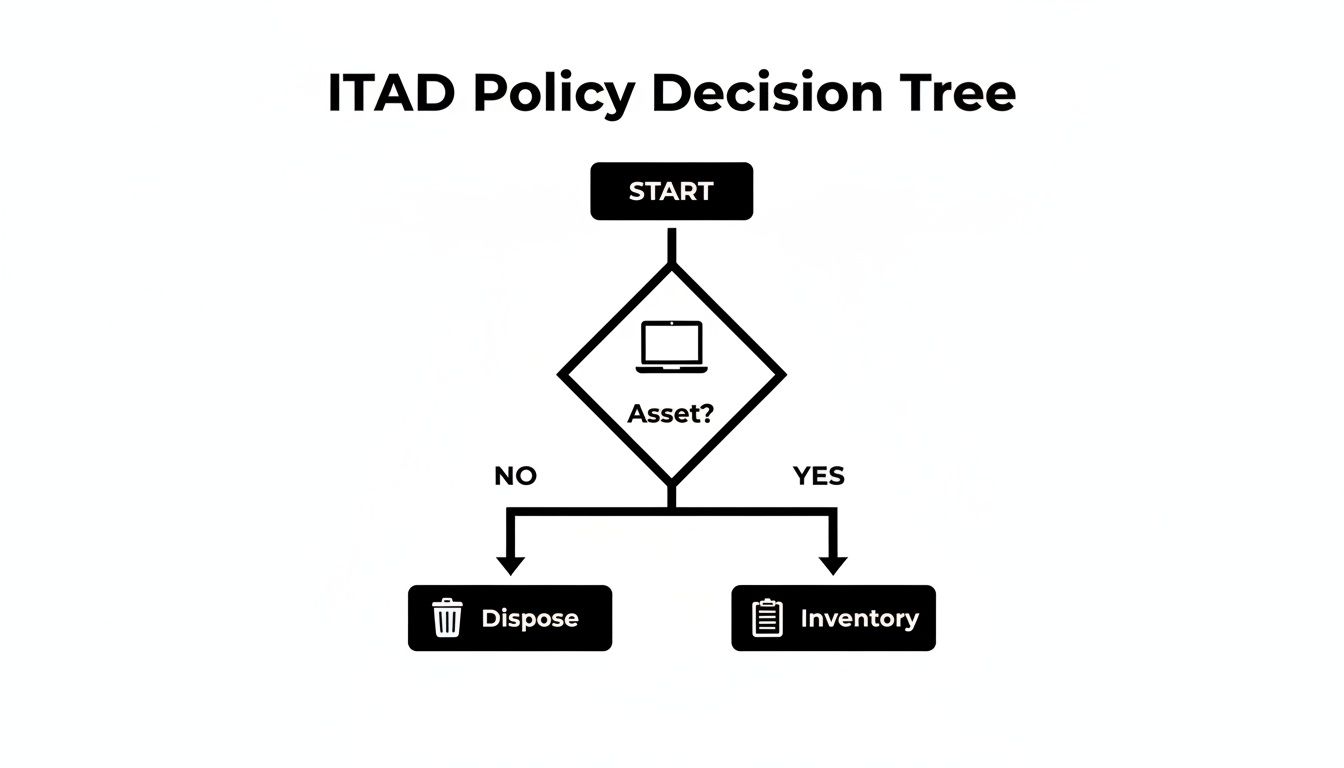
This visual highlights the crucial first step: figuring out if an item holds data. If it does, a secure inventory and disposal process is non-negotiable.
Physical Destruction: The Ultimate Guarantee
When your data is so sensitive that you can’t afford even a sliver of risk, physical destruction is the only answer. This is the final, absolute solution for hardware containing top-tier intellectual property, critical financial data, or protected health information.
Physical destruction means shredding, crushing, or pulverizing the device into tiny pieces that can never be put back together. For SSDs, which can't be degaussed, shredding is the industry best practice. It gives you absolute visual proof that your data is gone forever. This is where Fulton Junk Removal, working hand-in-hand with Beyond Surplus, ensures your equipment is not just hauled away but securely and responsibly destroyed. You can learn more about our eco-friendly, circular approach on our About Us page.
The threats are only getting more sophisticated. By 2025, an estimated 16% of all data breaches will involve attackers using AI for things like phishing and deepfakes. These advanced tactics can exploit tiny remnants of data left on improperly disposed hardware. Worse yet, 63% of breached organizations have no AI governance policies in place, making secure e-waste erasure more vital than ever to fight a global cybercrime industry projected to hit $10.5 trillion annually by 2025.
How to Vet Your IT Disposal Vendor in Atlanta
The security of your retired IT assets is only as good as the partner you trust to handle them. For procurement managers and facilities directors in Atlanta, choosing an IT disposal vendor is a decision with massive security implications. One wrong move, and your sensitive company data could end up in a local landfill or, even worse, on the black market.
This is where you see the stark difference between a standard junk hauler and a specialized, integrated service. A regular junk removal company might be great for clearing out old desks, but they almost always lack the certifications and secure processes needed for data-bearing electronics. For them, the default destination is the dump, creating a perfect storm of environmental hazards and data breach risks.
When you outsource IT disposal, doing your homework through thorough vendor due diligence isn't just a good idea—it's essential. You need a partner who sees your old hard drives not as junk, but as a liability that demands a meticulous, documented process to neutralize.
The Non-Negotiable Certifications to Demand
Before you even think about getting a quote, you need to check a vendor's credentials. Certifications aren't just fancy badges for a website; they are hard-earned proof that a third-party auditor has verified the vendor’s processes for security, environmental responsibility, and worker safety.
For any Atlanta business serious about locking down its data during IT disposal, these are the certifications you absolutely must see:
- NAID AAA Certification: This is the undisputed gold standard for data destruction. It confirms a vendor follows strict security protocols for handling and destroying media, including a secure chain of custody, rigorous employee screening, and controlled facility access. If a vendor isn't NAID AAA certified, they aren’t a serious data destruction partner. Period.
- R2 (Responsible Recycling) Certification: The R2 standard covers the entire lifecycle of electronics recycling, from environmental impact and worker health to data security. An R2-certified facility guarantees your e-waste is managed responsibly, not just exported to developing countries or tossed into a landfill.
- e-Stewards Certification: This is another highly respected environmental certification that sets an incredibly strict standard for electronics recycling and data destruction. It has a zero-landfill policy and flat-out prohibits the export of hazardous e-waste.
A vendor holding these certifications has invested significant time and money into building a trustworthy, compliant operation. The absence of them is a major red flag, signaling that your data and your company's reputation are on the line.
Questions to Ask Every Potential Vendor
Once you've shortlisted certified vendors, it’s time to dig deeper. The way a vendor answers these questions will tell you everything you need to know about the real quality of their service and their commitment to your security.
- Can you provide a detailed, written chain-of-custody process, from pickup to final destruction?
- Do you issue a Certificate of Destruction for every single data-bearing device? Can I see a sample?
- Are your employees background-checked and formally trained in secure data handling procedures?
- Is data destruction performed in-house at your certified facility, or do you subcontract it to another company?
- Do you offer onsite data destruction services, like mobile hard drive shredding?
- What are your data sanitization standards? (You're looking for an answer like NIST 800-88).
- Can you provide sustainability reports detailing how much material was recycled versus landfilled?
A confident, professional vendor will have clear, immediate answers. Any hesitation or vague responses should make you wary.
The Fulton Junk Removal and Beyond Surplus Difference
This vetting process is exactly why an integrated model like ours is so effective for offices, warehouses, and property managers in Atlanta. We bridge the gap between general junk removal and specialized IT Asset Disposition (ITAD). Fulton Junk Removal handles the comprehensive cleanout of your office or facility—removing furniture, debris, and general clutter.
At the same time, our parent company, Beyond Surplus, manages the entire secure IT asset disposal process from start to finish. As a certified recycling expert, Beyond Surplus ensures all your electronics are handled according to the highest industry standards for data security and environmental compliance. This bundled approach simplifies everything. To see how we can help with your next project, learn more about our Atlanta junk removal services.
You get one point of contact, one coordinated pickup, and two specialized outcomes: a clean, empty space and fully compliant, secure data destruction. This makes sustainability reporting and compliance documentation effortless, turning a complex risk management task into a simple, streamlined solution.
The Fulton Junk Removal and Beyond Surplus Advantage
Choosing the right partner for your IT disposal is where theory hits the pavement. For Atlanta’s property managers, office managers, and warehouse operators, juggling multiple vendors for a single office cleanout can quickly become a logistical nightmare.
You end up hiring one company for furniture, another for e-waste, and maybe a third for secure data destruction. Each comes with its own contract, schedule, and potential for something to go wrong. That fragmented approach isn’t just inefficient; it’s risky.
This is exactly the problem our integrated service model was built to solve. Fulton Junk Removal is the commercial junk hauling service operating under Beyond Surplus, a certified circular, eco-friendly solution. The result? A single, cohesive solution that handles your entire cleanout from start to finish.
No more coordinating different teams or losing sleep wondering if your old electronics ended up in the right hands. You make one call, and we take care of the rest.
A Single Point of Contact for Total Peace of Mind
Picture this common scenario: you're decommissioning a 50-person office in Midtown Atlanta. You’ve got desks, chairs, filing cabinets, and general clutter to clear out. But you also have a server room filled with old racks, 75 laptops, a dozen network switches, and boxes of old hard drives.
Instead of managing three different vendors, you have one point of contact. Our Fulton Junk Removal team arrives to efficiently clear out all the furniture and non-technical items. At the same time, every single piece of electronic waste—from the server racks down to the last keyboard—is segregated and prepared for secure processing by our parent company, Beyond Surplus.
Fulton can offer a bundled junk removal + recycling pickup, where all electronic waste and recyclable materials are directly processed by Beyond Surplus. This appeals to environmentally conscious homeowners and businesses alike. For a busy property manager overseeing a tenant move-out, this radically simplifies logistics and guarantees compliance.
With our integrated model, you don't just get a clean space; you get documented proof that every asset was handled responsibly. It turns a complex compliance project into a stress-free process.
How We Make Compliance and Reporting Easy
These days, proving you disposed of assets responsibly is just as important as doing it. The risk of improperly handled IT equipment is enormous. In June 2025 alone, a staggering 16 billion user credentials were exposed in one of the largest data leaks ever recorded, compiled from breaches spanning years. This is a stark reminder of the threat posed by old hardware resurfacing with its data still intact. You can review the details of this and other major breaches in the June 2025 global data breach report on grcsolutions.io.
Our entire process is designed to give you the documentation needed to stand up to any audit.
- Certified Recycling: Beyond Surplus ensures your IT disposal complies with key standards like NAID AAA certification for data destruction. This is your guarantee that sensitive information from your old devices will never appear on dark web markets.
- Transparent Reporting: We provide detailed diversion reports that show you exactly what was recycled, repurposed, and kept out of Atlanta’s landfills.
- Certificates of Destruction: For every single data-bearing device that is destroyed, you receive a formal certificate—your undeniable proof of compliance.
This level of documentation makes sustainability and compliance reporting a breeze for your organization. For offices, warehouses, and property managers, Fulton handles junk removal, and Beyond Surplus ensures responsible recycling, making compliance and sustainability reporting easier. By partnering with us, you’re choosing a circular, eco-friendly solution that goes far beyond what traditional junk haulers can offer.
Learn more about our complete junk removal and recycling solutions by visiting the official Fulton Junk Removal website.
Answering Your Top Questions About Secure IT Disposal
When it comes to getting rid of old IT gear, we've heard it all. For property managers, IT directors, and office managers across Atlanta, the process is often filled with uncertainty. Getting it wrong can lead to some serious headaches, from data breaches to compliance penalties.
This isn't just about hauling away old tech. It’s about protecting your business. We've compiled the most frequent questions we get to give you clear, straightforward answers and help you handle your company's retired assets the right way.
Is Deleting Files or Formatting a Hard Drive Enough?
Absolutely not. This is hands-down one of the biggest and most dangerous myths we run into. Hitting "delete" on a file just removes a pointer; the actual data is still sitting on the drive, ready to be recovered with simple, widely available software.
Even a standard hard drive format can be reversed. To truly eliminate the risk of a data breach, you need professional-grade data sanitization. This means either using specialized software to overwrite the entire drive according to strict standards like NIST 800-88, or physically shredding the device into tiny pieces. For any business in Atlanta, the only way to be certain is to work with a certified vendor who provides a formal Certificate of Destruction.
What Documentation Should I Expect From My Vendor?
A reputable vendor will always provide a clear, indisputable paper trail. If they don't, that's a major red flag. This documentation is your only real proof that your assets were handled securely, and it's your best defense during an audit or security review.
At a minimum, you should always walk away with three key documents:
- A detailed inventory of all collected assets, complete with serial numbers, to establish accountability from the very start.
- A signed chain-of-custody form that tracks your equipment from your door to its final destination.
- A Certificate of Destruction (CoD) for every single device that holds data, confirming it was properly sanitized or destroyed.
For companies tracking sustainability metrics, our integrated service takes it a step further. We provide diversion reports that break down exactly how much material was recycled and kept out of landfills, helping you hit your environmental goals.
Can One Company Handle Both Office Junk and Secure E-Waste?
Yes, but you need an integrated service, not just a standard junk hauler. A general junk removal company is great for desks and chairs, but they usually mix everything together and take it to the dump. That’s a recipe for both environmental issues and massive data security risks.
Our model is built differently. As a service operating under Beyond Surplus, Fulton Junk Removal takes care of all your general office junk—old furniture, cubicle walls, you name it. At the same time, all your electronics are securely processed by Beyond Surplus, a certified recycling expert. This gives office and property managers one reliable contact for a complete, compliant, and eco-friendly cleanout.
How Do We Manage IT Disposal for Multiple Atlanta Locations?
Handling asset disposal across several offices, warehouses, or retail stores demands a partner with a standardized process and a wide service area. Your first step should be to create a clear, company-wide ITAD policy. Then, find a vendor who can execute that policy consistently everywhere you operate.
A partner that serves the entire Atlanta metro can schedule coordinated pickups for all your sites, whether you're in Alpharetta, Downtown, or near the airport. The process should be identical every time: secure chain of custody, certified data destruction, and consolidated reporting. It simplifies logistics for your team and ensures every location meets the same high bar for security and compliance. For more on protecting your company's information, you might find this article on data security useful.
Ready to streamline your office cleanout and ensure your data is securely destroyed? Fulton Junk Removal offers bundled junk removal and certified electronics recycling to make compliance and sustainability reporting easier for your Atlanta business. Get your free estimate today at https://fultonjunkremoval.com.
