
Commercial Electronics Recycling Services in Atlanta
Your Atlanta team clears one floor during an office move, swaps out a bank of aging laptops, or empties a warehouse corner that has turned into an electronics graveyard. Then the problem shows up. You're not dealing with ordinary junk anymore. You're dealing with devices that may still hold data, equipment that can't be treated like mixed debris, and a disposal record that may need to stand up to internal audit, landlord questions, procurement review, or sustainability reporting.
That's why commercial electronics recycling services in Atlanta need to be evaluated differently from general haul-away. A vendor can remove items fast and still leave your business exposed. The gap usually isn't pickup. It's documentation, chain of custody, and what happens after the truck leaves your site.
Your Business Needs More Than a Dumpster
A dumpster works for broken shelving, packaging waste, and non-sensitive debris. It does not work for desktops, servers, networking gear, printers, access-control hardware, tablets, phones, and storage-bearing devices mixed into a cleanout.
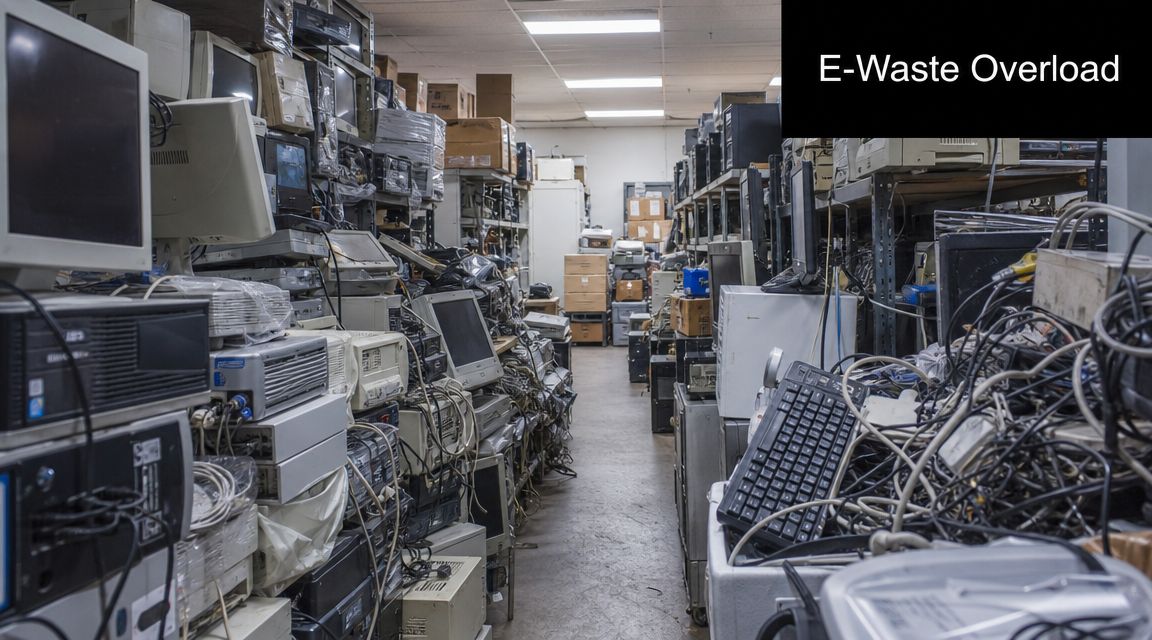
The scale of the issue is no longer theoretical. Global e-waste generation reached 62 million metric tonnes in 2022, and only 22.3% was formally collected and recycled according to these e-waste statistics. The same source notes that total volume could reach 82 million tonnes by 2030 if current trends continue. For Atlanta businesses, those figures show why secure pickup and documented diversion from landfill are now baseline expectations, not premium extras.
What usually triggers the problem
Most commercial electronics recycling jobs start inside a larger operational event:
- Office relocation: old monitors, docking stations, desk phones, and cable piles surface during move prep.
- IT refresh: replaced laptops and retired peripherals need controlled disposition.
- Facility cleanup: storage rooms, warehouse mezzanines, and vacant suites reveal years of accumulated equipment.
- Furniture decommissioning: electronics almost always show up alongside cubicles, conference tables, and task seating.
If your project includes both workstations and furniture, it helps to review a practical resource for office furniture decommissioning before pickup day so the scope is separated correctly.
The operational mistake to avoid
Businesses get into trouble when they split the job the wrong way. One vendor takes “junk.” Another handles “electronics.” Nobody owns the full workflow. Inventory is incomplete, chain-of-custody gets sloppy, and the paperwork arrives late or not at all.
Practical rule: If a cleanout includes anything with storage, serial numbers, asset tags, or compliance risk, treat the project as a controlled disposition job, not a trash job.
Teams that need a combined cleanout and recycling workflow usually start with a provider that can coordinate both streams through one process, such as commercial removal and recycling services. That approach reduces handoffs, which is where most documentation problems begin.
Why Simple Disposal Fails Atlanta Businesses
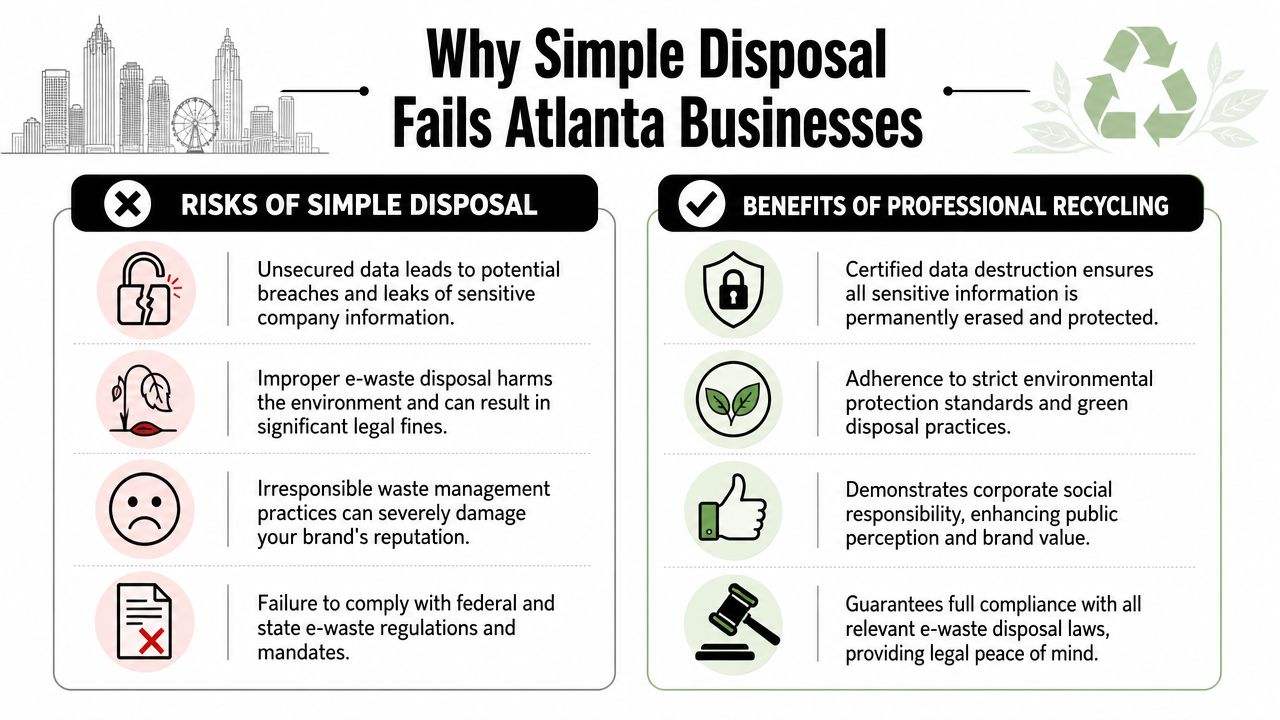
The easiest option is usually the riskiest one. A general hauler says they can take everything in one load, the site gets cleared quickly, and everyone moves on. That looks efficient until someone asks what happened to the drives, where the materials went, or what documentation exists for the equipment that left the building.
The hidden liabilities
Electronics create three kinds of exposure at once. Most businesses focus on one and underestimate the other two.
| Exposure area | What goes wrong with simple disposal | What a professional workflow addresses |
|---|---|---|
| Data security | Drives, copiers, laptops, and network gear leave without controlled handling | Tracking, secure collection, and documented destruction |
| Environmental handling | Mixed loads get treated like general waste instead of managed material streams | Sorting for reuse, dismantling, and responsible downstream processing |
| Compliance records | The business gets a hauling receipt, not an auditable record | Asset logs, destruction records, and recycling documentation |
A truckload receipt proves removal. It does not prove responsible handling.
Why “we recycle” isn't enough
A surprising number of vendors rely on broad language. They say the load is secure, certified, green, or zero-landfill. Those terms may describe intent, but they don't answer procurement or audit questions.
Ask simple follow-ups and weak programs fall apart:
- Which devices were collected?
- Were serial numbers recorded?
- Who handled the equipment after pickup?
- How was data destroyed?
- What final documents will the business receive?
If the answer is vague, the risk stays with your company.
A disposal vendor should be able to explain the paper trail before pickup day, not after someone asks for proof.
Brand and landlord risk show up fast
Improper handling doesn't just create internal headaches. It can affect lease closeout, client confidence, and your public sustainability posture. Property managers, operations leads, and IT directors all care about different things, but they converge on one practical standard: the equipment must leave the site securely, and the records must be clear enough that nobody has to reconstruct events later.
That's where simple disposal fails. It removes the visible clutter while preserving the invisible liability.
The Pillars of Compliant E-Waste Recycling
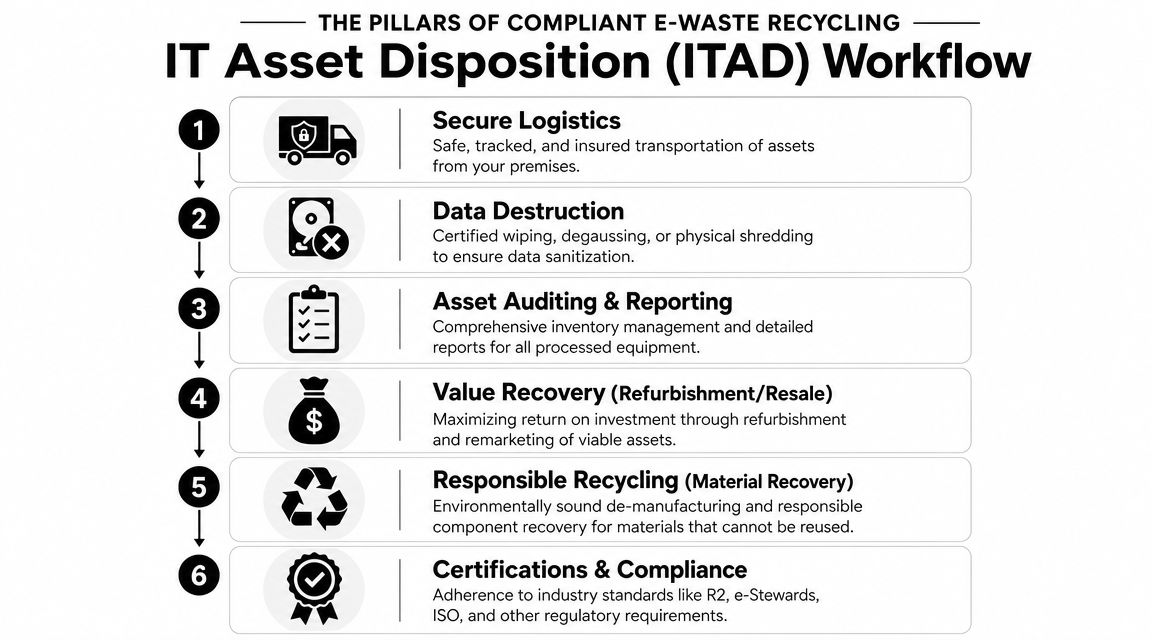
Professional commercial electronics recycling services in Atlanta should run as an IT asset disposition workflow, not as a bulk junk pickup with a recycling label attached. One Atlanta recycling resource states that business-grade programs should combine on-site pickup, secure chain-of-custody, certified data destruction, and downstream component-level processing. The same source notes that inventorying serial numbers and asset tags before pickup is a standard control because it preserves traceability and supports compliance documentation, as outlined in this overview of business e-waste recycling in Atlanta.
Secure chain of custody
Chain of custody starts before the truck arrives. The best operators don't treat pickup day as discovery day. They want a scoped list of locations, equipment types, loading conditions, and any assets that require separate handling.
On site, the discipline is straightforward:
- Identify assets: tag the rooms, racks, offices, or cages where equipment sits.
- Capture traceability: record serial numbers and asset tags when the project requires item-level reporting.
- Separate streams: reusable equipment, destruction-only devices, and non-electronic debris shouldn't be mixed together.
- Control movement: equipment should move through a documented handoff, not a casual pile-and-load routine.
Here, many generic junk crews struggle. They're built for labor and volume. Commercial electronics work requires labor plus control.
Certified data destruction
Data destruction is not a side note. It's one of the core service lines in the job. Businesses often remember laptops and hard drives, but forget multifunction copiers, firewalls, phones, and server equipment that may also retain configuration data or stored information.
A credible program should tell you which destruction method applies to which asset category. It should also explain what you'll receive afterward. That can include a certificate of destruction, itemized reporting, or both depending on the project.
If a company has already suffered a device failure and needs to determine whether any business-critical data can still be retrieved before disposition, it may make sense to speak with trusted data recovery specialists before authorizing destruction. That decision should happen up front, not after the drives are gone.
Devices should never move into a recycling stream until the business has decided whether they are for reuse, resale, wiping, or physical destruction.
Responsible downstream processing
A disciplined recycler doesn't stop at pickup and shredding. The downstream path matters because not all equipment should meet the same end.
Some assets still have reuse value. Those should be evaluated for refurbishment or redeployment. Others have no practical second life and need component-level processing so usable commodities can be recovered and landfill disposal minimized.
This is also where mature operators stand apart from convenience-only providers. They can explain how mixed IT loads are broken down, what goes to refurbishment, what goes to material recovery, and what documentation supports that outcome.
Why integrated coordination matters
Cleanouts rarely involve electronics only. There are chairs, pallet racking, obsolete fixtures, damaged shelving, loose debris, and office contents that need to move at the same time. A coordinated team with background on Fulton Junk Removal can align the junk-removal side with the Beyond Surplus recycling stream so the non-electronic material and the controlled electronics flow don't interfere with each other. That matters because a mixed-load operation is exactly where chain-of-custody errors tend to occur.
How to Choose Your Atlanta Recycling Partner
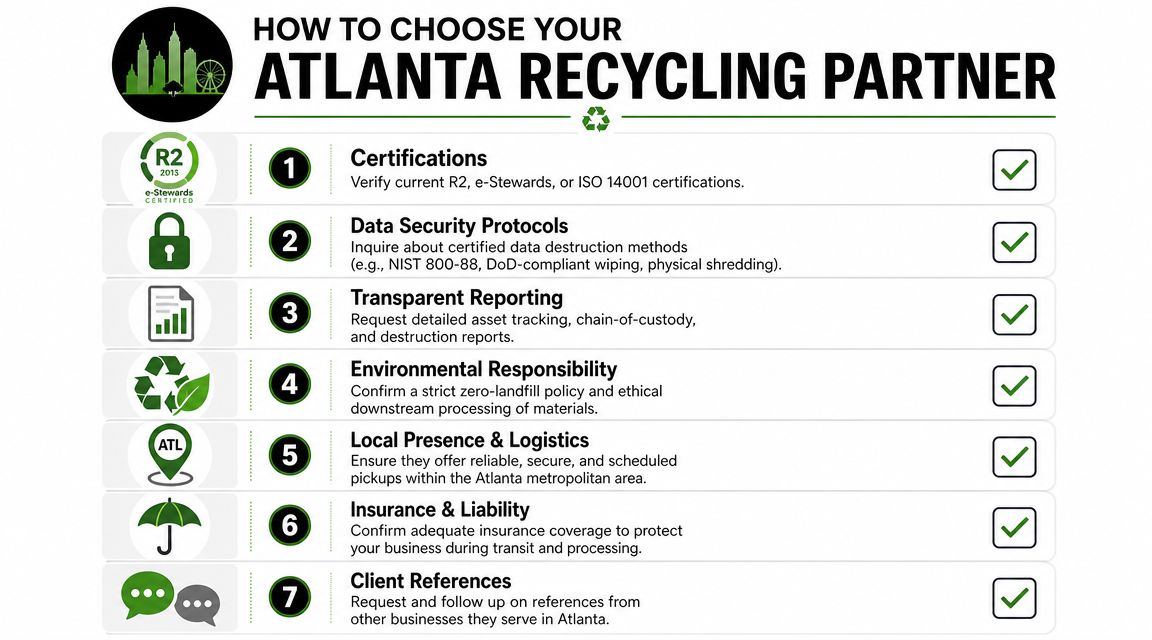
Vendor selection gets easier once you stop listening for green marketing language and start asking for operational proof. One underserved issue in the Atlanta market is commercial chain-of-custody and documentation. Businesses increasingly need proof of responsible handling, such as serialized asset tracking, recycling certificates, or diversion reports, to support audits, vendor risk management, and sustainability reporting, as discussed by Atlanta e-waste guidance on documentation needs.
The questions that separate real programs from loose ones
Use procurement language. Don't ask, “Are you certified?” Ask, “Which current certifications apply to this service line, and can you share documentation?” Don't ask, “Do you wipe drives?” Ask, “Which media is wiped, which is shredded, and what report format do you provide after processing?”
Here's the practical checklist I'd use:
- Ask for sample reporting: request a sample certificate of destruction, recycling certificate, and diversion report.
- Define chain-of-custody steps: ask how assets are inventoried, loaded, transferred, and reconciled after receipt.
- Clarify the unit of tracking: determine whether reporting is by pallet, by load, by device category, or by serialized asset.
- Review downstream transparency: ask what happens to reusable devices versus material recovery loads.
- Confirm project fit: a vendor strong in residential drop-off may not be equipped for office moves, decommissions, or property turnovers.
What good answers sound like
Strong vendors answer directly and in sequence. They describe intake, pickup controls, data handling, reporting, and final documentation without forcing you to drag each detail out of them.
Weak vendors answer with slogans. They recycle responsibly. They're secure. They care about the environment. None of that helps your facilities team when legal, IT, procurement, or a landlord asks for records.
Buying advice: If you can't see the paperwork before the job, assume the paperwork after the job will be incomplete.
A short screening framework
| Ask this | Why it matters | Red flag response |
|---|---|---|
| What documents do we receive after pickup? | Establishes whether reporting is real or improvised | “We can provide something if needed” |
| How do you track assets from site to processing? | Tests chain-of-custody discipline | “Our team keeps everything together” |
| How do you separate reuse from destruction? | Shows whether value recovery and security are controlled | “We decide once it gets back” |
| Can you support landlord or audit requests later? | Checks record retention mindset | “That depends on the job” |
If you're collecting quotes for an upcoming cleanout, use that checklist before sending any scope details through a generic form. It's better to start the conversation with a provider through a direct commercial pickup inquiry so the project requirements, documentation needs, and pickup conditions are clear from the start.
Pricing Timelines and Integrated Services
Commercial electronics recycling pricing is rarely one simple line item. The job may include pickup labor, device handling, item-specific charges for certain heavier or harder-to-process equipment, reporting requirements, and non-electronic cleanout work happening in parallel.
Atlanta's market is mature enough that many providers have built processes around business scheduling. One local recycling resource notes that qualifying businesses within 50 miles of Atlanta can receive a complimentary pickup, that many small electronics are accepted for free, and that some heavier items such as TVs and CRT monitors may carry fees. The same source also describes commercial drop-off options with published retail hours at locations including Best Buy, Staples, and Verizon, showing how the local ecosystem is set up for convenience and routine business operations through Atlanta electronics recycling options and pickup details.
What affects cost
The fastest way to get a usable quote is to separate your scope into categories:
- Electronic assets requiring control: laptops, desktops, servers, networking gear, phones, copiers, drives.
- General commercial junk: furniture, fixtures, shelving, packaging, misc. debris.
- Special handling items: older display units, oversized equipment, or anything difficult to move or process.
- Documentation level: basic load-level confirmation is different from serialized reporting.
That last point matters. The more precise the reporting requirement, the more structured the intake process has to be.
What affects timing
Project timelines depend less on “how much stuff” than on access and decision-making. Delays usually come from freight elevator scheduling, loading dock restrictions, missing asset lists, after-hours building rules, and unresolved questions about which equipment is for remarketing versus destruction.
Office managers and facilities directors can speed up the job by confirming:
- Site access conditions
- Internal approvals for destruction
- Staging locations
- Who signs off on final paperwork
Why bundled service often wins
Separate vendors create duplicate site walks, duplicate scheduling calls, and finger-pointing when electronics are mixed into general cleanout piles. A combined junk removal and recycling workflow reduces those handoffs.
That's the practical value of the Fulton Junk Removal and Beyond Surplus model. Fulton handles the broader commercial cleanout scope, while Beyond Surplus processes the electronics and recyclable materials through a circular workflow designed to reduce landfill disposal and make sustainability reporting easier. For offices, warehouses, and property managers, the benefit isn't marketing language. It's fewer vendors, fewer scope gaps, and cleaner documentation at the end of the job.
Real-World Scenarios for Atlanta Businesses
The easiest way to judge commercial electronics recycling services in Atlanta is to look at the jobs that tend to break ordinary vendors.
Office manager during a relocation
An office manager is closing one floor and downsizing into a smaller suite. The obvious work is furniture removal. The less obvious work is under every desk and in every storage closet: monitors, docking stations, desk phones, label printers, old access points, and a stack of retired laptops waiting for “someone from IT” to decide their fate.
The wrong approach sends one crew for furniture and another later for electronics. By then, devices have been moved twice, some power adapters are missing, and nobody has a clean list of what left the floor.
The better approach uses one coordinated project plan. Furniture goes out through the general cleanout stream. Electronics are segregated, inventoried as needed, and moved through controlled recycling and destruction. The office manager gets a single operational contact and documentation that fits the move-out file instead of a pile of disconnected receipts.
Property manager handling an abandoned commercial unit
A property manager inherits a vacated space with back-office electronics, broken fixtures, and random storage leftovers. Speed matters because the suite needs to be turned quickly. But speed without control creates risk if a former tenant's equipment still contains data or if the landlord later asks how materials were handled.
In this kind of job, the value is in triage. Clear the non-sensitive bulk fast, isolate the electronics, and keep records tight enough that the turnover file is defensible later. Managers working across the city often look first for a provider with an established Atlanta service area for commercial cleanouts so scheduling and dispatch don't become another delay.
Vacant-unit cleanouts fail when the crew treats every item as debris. Commercial space almost always contains a second stream that needs controlled handling.
IT director decommissioning a server environment
An IT director is retiring old rack equipment after an infrastructure change. This isn't a “junk job” in any meaningful sense. It's a security project with logistics attached.
The equipment may include servers, switches, firewalls, UPS components, rails, drives, and labeled hardware tied to internal asset records. The IT director needs chain-of-custody confidence, a clear destruction path for storage media, and documentation that aligns with internal governance. They also need the physical removal done without disrupting the facility team's broader decommissioning work.
The vendors that handle this well understand both sides. They can work in a controlled, asset-aware manner for the rack equipment while still integrating with the larger site cleanup happening around it.
From Clutter to Compliance with Fulton Junk Removal
Most businesses don't struggle to find someone willing to haul things away. They struggle to find a process that stands up after the pickup is over. That's the real dividing line in commercial electronics recycling.
If you're evaluating vendors, focus on the essential requirements. You need a defined chain of custody, a clear data-destruction process, responsible downstream handling, and documentation that matches your internal risk profile. If a provider can't explain those points plainly, they're not ready for commercial work.
A practical review of facility cleanout insights and disposal guidance can help teams think through the broader operational side, especially when electronics are only one part of a larger move, turnover, or warehouse cleanup.
For Atlanta businesses, the most efficient path is often an integrated one. When general junk removal and controlled electronics recycling are coordinated together, site logistics get simpler, reporting gets cleaner, and your team spends less time managing handoffs between vendors. That's what matters to facilities, IT, procurement, and property operations alike.
If your office, warehouse, retail space, or commercial unit needs a cleanout that includes electronics, furniture, or mixed material streams, contact Fulton Junk Removal for a free, no-obligation estimate. The team can coordinate removal with responsible recycling through Beyond Surplus so your project is cleared efficiently and documented properly.
