
Electronics Recycling for Atlanta Medical Offices: Secure E-Waste Guide 2026
For medical offices in Atlanta, electronics recycling is more than just spring cleaning. It’s a crucial process that involves partnering with a certified vendor to securely dispose of outdated IT and medical equipment, all while staying compliant with HIPAA and environmental laws. Focussed on commercial services, Fulton Junk Removal operates under Beyond Surplus, a circular, eco-friendly solution that goes beyond traditional junk hauling. This isn't just about hauling away junk; it requires verifiable data destruction and responsible handling of hazardous materials—a specialized service that integrated specialists like Fulton Junk Removal and Beyond Surplus are built for.
The Risks of Improper E-Waste Disposal in Healthcare
For Atlanta's busy medical practices, managing outdated electronics is far more than a simple cleanup task—it's a critical issue of compliance and security. The healthcare industry sees a high turnover of diagnostic tools, patient monitoring systems, and administrative IT gear. Every single retired device, from a computer at the front desk to a specialized lab machine, carries a double threat: it's both an environmental hazard and a major data security risk.
Medical offices have unique hurdles when it comes to managing their IT infrastructure and protecting patient data. This often requires specialized IT solutions for healthcare offices to keep everything secure and compliant. When those electronics finally reach their end of life, the responsibility doesn't just vanish. Just tossing them in a dumpster is not an option and can open your practice up to serious liabilities.
The Environmental and Regulatory Burden
Old electronics are chock-full of hazardous materials that can cause real harm if they end up in a landfill. These substances can easily contaminate local soil and water, creating a long-term public health problem.
- Lead and Mercury: Commonly found in older CRT monitors and some flat-screen displays, these heavy metals are extremely toxic.
- Cadmium: You'll find this in rechargeable batteries and certain types of wiring.
- Flame Retardants: Used in plastic casings, these chemicals can stick around in the environment for decades.
Here in Georgia, the Environmental Protection Division (EPD) works under federal EPA guidelines and has very specific rules for disposing of this kind of waste. Failing to comply can result in steep fines and serious damage to your practice’s reputation. Smart, environmentally-conscious businesses know that responsible disposal is a non-negotiable part of their social responsibility.
Improper disposal of just one computer can leak a cocktail of toxic materials right into the local ecosystem. For a medical practice—a pillar of community health—being a good environmental steward isn't just good practice. It’s essential for your brand's integrity.
HIPAA Compliance and Data Security Risks
Even more urgent for any medical office is the sensitive data living on these old devices. Every patient chart, billing record, and diagnostic image is classified as Protected Health Information (PHI) under the Health Insurance Portability and Accountability Act (HIPAA). A single discarded hard drive that hasn't been professionally sanitized can trigger a massive, and costly, data breach.
The fallout from a HIPAA violation is severe. We're talking about fines that can climb into the millions, mandatory patient notifications that shatter trust, and irreparable harm to your practice's credibility. It’s a dangerous misconception that just deleting files is enough. Data can often be recovered from wiped drives without professional-grade sanitization techniques. For a deeper dive, check out our guide on how to navigate the complexities of compliance and security.
This is where having a specialized, integrated service model becomes so valuable. Fulton Junk Removal works hand-in-hand with Beyond Surplus to recycle electronics, metals, and other materials responsibly. While most junk removal companies take everything to the landfill, we recycle through Beyond Surplus to minimize waste and maximize reuse. This unique partnership ensures a much better path for your e-waste.
Fulton can offer bundled junk removal + recycling pickup, where all electronic waste and recyclable materials are directly processed by Beyond Surplus. This makes the entire cleanout a breeze for offices, warehouses, and property managers. All your electronics are recycled responsibly, materials are diverted from landfills, and compliance and sustainability reporting is made easier. It's an approach that directly tackles the two biggest risks of medical e-waste: environmental harm and data security.
Preparing Your Medical E-Waste for Secure Disposal
Before our truck even arrives at your Atlanta medical office, the most important work has already begun inside your facility. Proper preparation isn't just about making pickup day smoother; it’s about building an ironclad, auditable chain of custody from the very start.
Taking control of your e-waste before a partner gets involved is fundamental for HIPAA compliance. It empowers your staff, minimizes risk, and shows you’re serious about protecting patient data.
The first move is to identify and separate everything destined for recycling. This is about more than just old desktop computers. Medical offices generate a unique stream of electronic waste, and your team needs to know what to look for.
The diagram below shows just how quickly that pile of outdated equipment can become a major liability—and how a certified recycling process is your best defense.
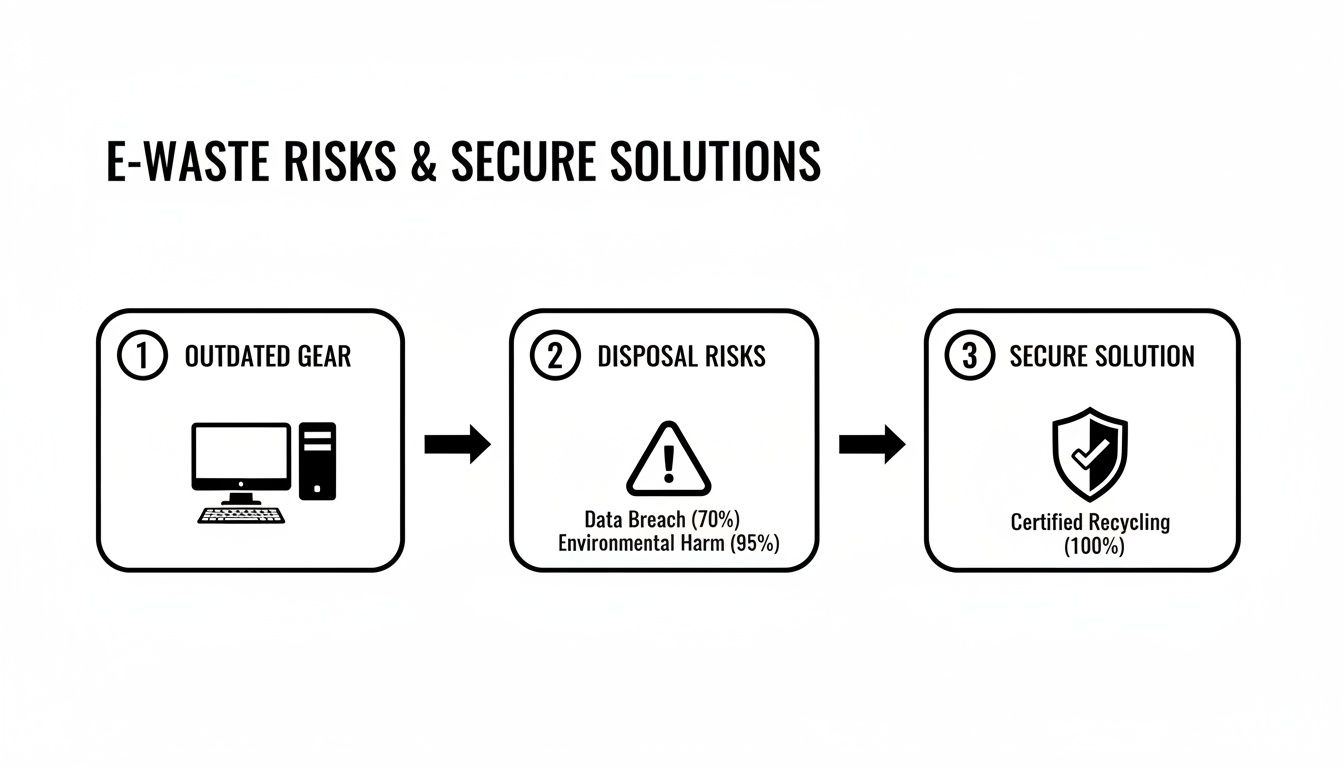
As you can see, turning a potential risk into a secure, closed-loop solution starts with a solid internal plan.
To help your team get started, here’s a quick guide to common e-waste found in healthcare settings and the first steps to take.
| Common E-Waste in Atlanta Medical Offices and Initial Prep Steps | ||
|---|---|---|
| E-Waste Category | Examples | Key Preparation Action |
| Administrative & IT Gear | Desktop Computers, Laptops, Servers, Printers, Phones | Inventory serial number and confirm if device stored PHI. |
| Diagnostic & Monitoring | EKG/ECG Machines, Ultrasound Probes, Patient Monitors | Log device type, serial number, and department of origin. |
| Laboratory Equipment | Centrifuges, Analyzers, Spectrometers | Confirm device has been cleaned of biohazards. Inventory asset tags. |
| Peripherals & Accessories | Keyboards, Mice, Monitors, Power Cords, Scanners | Bundle like items together. No detailed inventory needed for these. |
| Data Storage Media | External Hard Drives, USB Drives, Backup Tapes | CRITICAL: Separate and clearly mark as containing PHI. |
This table serves as a simple starting point. The goal is to get your staff comfortable with identifying and sorting these items correctly before they are moved.
Creating a Comprehensive E-Waste Inventory
Once you’ve gathered the items, it's time to create a detailed inventory. Think of this less as a simple list and more as the first official document in your compliance trail. This log is your proof of control during a HIPAA audit.
For every device, your log should track:
- Asset Type: (e.g., Laptop, Server, Infusion Pump)
- Serial Number: The device’s unique identifier.
- Asset Tag Number: Your own internal tracking ID, if you use one.
- Physical Location: The room or department it came from (e.g., "Front Desk," "Lab 2").
- PHI Status: A simple "Yes" or "No" to flag if it stored Protected Health Information.
A basic spreadsheet is perfect for this. When your recycling partner arrives, you'll have a complete, verifiable record ready to go, making the handover seamless and accountable.
Isolating and Staging Your Assets
With your inventory complete, the final step is to physically move all the equipment to a designated staging area. This is a non-negotiable step in a busy medical office where you can’t have old equipment cluttering hallways or interfering with daily operations.
Find a secure, low-traffic spot—like a storage closet or an unused room—to consolidate everything awaiting pickup.
Pro Tip: Use brightly colored stickers or tags to clearly label every device that held PHI. This is a simple visual cue that immediately tells our removal team which assets require the highest level of security and specialized data destruction handling.
Isolating the equipment prevents it from being accidentally thrown out with regular trash or mistaken for general office junk. It also makes the actual pickup incredibly efficient. When the Fulton Junk Removal crew is on-site, we can head directly to the staged area and get to work without disrupting your staff or patients.
This prep work fits perfectly with our bundled junk removal and e-waste recycling service. Our team can clear out old furniture, filing cabinets, and other non-hazardous junk while our integrated partner, Beyond Surplus, handles the electronics you’ve already prepped. It’s a dual-system approach that ensures everything is removed in a single visit, but your sensitive e-waste follows its own strict, secure, and fully compliant recycling path.
How to Ensure HIPAA-Compliant Data Destruction
When a device reaches the end of its life in your Atlanta medical practice, the big question isn't if you'll destroy the data on it, but how. Just deleting files or reformatting a drive is like putting a "Do Not Disturb" sign on a hotel room door—it offers a false sense of security, but anyone with the right key can still get in.
To satisfy the ironclad requirements of HIPAA's Privacy and Security Rules, data destruction has to be absolute, permanent, and—most importantly—verifiable. This is more than just wiping a drive clean. It’s about making sure Protected Health Information (PHI) is gone for good, protecting your practice from a breach that could be professionally devastating.
The risks here aren't just theoretical. Think about the sheer volume of old electronics healthcare facilities generate. In 2026, data showed Georgia clinics were creating 2,500 tons of e-waste yearly, with a shocking 70% ending up in landfills before certified recyclers stepped up their game.
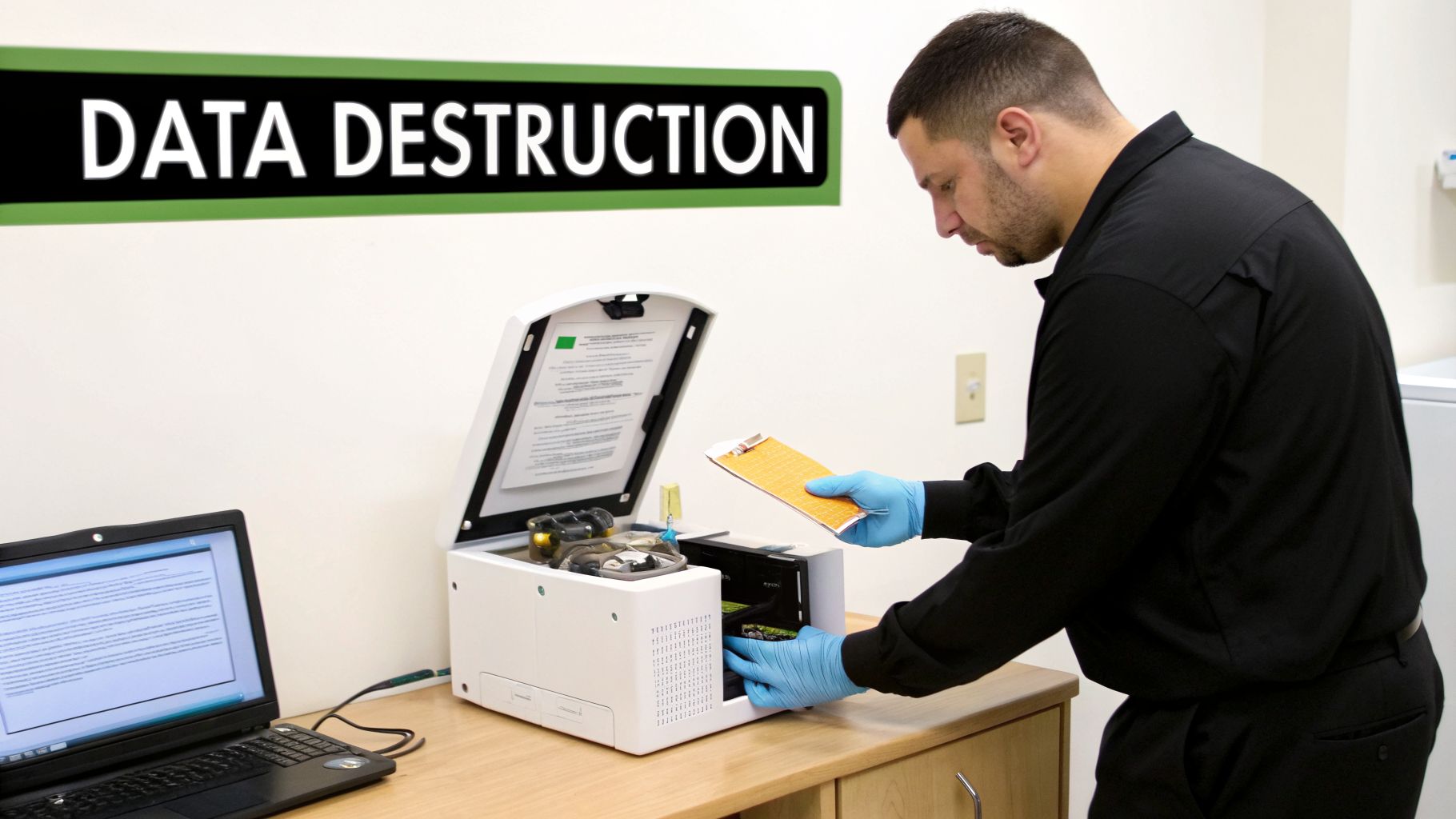
Today, thanks to our integration with Beyond Surplus, Fulton Junk Removal helps divert 800 tons of that waste through specialized, eco-friendly haul-aways. We ensure that items like old servers and lab PCs go through a NIST-compliant data wiping process—destroying 100% of patient information—before they’re dismantled for recycling.
Understanding Data Sanitization Methods
There are really only two HIPAA-compliant paths for true data destruction: software-based wiping and good old-fashioned physical destruction. The best method for you will depend on the device and your practice’s internal policies.
Software-Based Wiping (NIST 800-88 Standard): This approach uses special software to completely overwrite a drive with random data, making the original information impossible to pull back up. It follows the NIST 800-88 Guidelines for Media Sanitization, which is the gold standard for federal agencies. It’s a great option for newer, working hard drives (HDDs) and solid-state drives (SSDs) that might be refurbished and given a second life.
Physical Destruction: When a drive is old, busted, or your policy simply demands no-questions-asked annihilation, physical destruction is the only way to go. I'm not talking about taking a hammer to it in the back alley. This is a controlled process like industrial shredding, which grinds the device into tiny, confetti-like fragments. It’s the required method for things like backup tapes, CDs, DVDs, and other legacy media.
To truly appreciate why these methods are so critical, it helps to understand how easily data can be pulled from discarded devices. Getting insights from professionals with data recovery expertise can be an eye-opener and will help you build much stronger destruction protocols.
Why a Certificate of Data Destruction Is Non-Negotiable
In the world of HIPAA compliance, if you can't prove it, you didn't do it. Simple as that.
After your devices are wiped or shredded, your recycling partner absolutely must give you a Certificate of Data Destruction (CoDD). This is the legal document that serves as your official record, proving you met your obligations under HIPAA.
Without a CoDD, you have no way to verify that your patient data was handled securely, leaving you completely exposed in an audit. This is where the integrated partnership between Fulton Junk Removal and Beyond Surplus becomes so crucial. You get a team that knows exactly what documentation you need. You can learn more about our commitment to responsible services and how we operate.
A legitimate CoDD will always include these key details:
- Your Practice’s Name and Address: Clearly identifying your facility.
- The Recycling Vendor's Information: Their name, address, and contact details.
- A List of Destroyed Assets: This should list the serial numbers for each individual hard drive or device.
- Method of Destruction: Specifies whether it was NIST 800-88 wiping or physical shredding.
- Date of Destruction: Pinpoints the exact day the process was completed.
- A Statement of Confidentiality: An affirmation that the vendor accepts responsibility.
- An Authorized Signature: Signed by a representative from the recycling company.
This certificate is more than just a piece of paper—it's your legal shield. You need to store it with your HIPAA compliance records indefinitely. It's the final, vital step that closes the loop on a device's lifecycle and proves you did your due diligence.
Our partner, Beyond Surplus, provides this essential documentation for every single pickup. This streamlined process—from junk removal by us to certified data destruction by them—gives Atlanta medical offices a clear, compliant, and defensible solution for all their electronics recycling needs.
Onsite Pickup vs. Drop-Off: What's Right for Your Practice?
When you’ve finally sorted and prepped all your practice’s old electronics, you’re left with one last logistical hurdle: getting them to the recycler. For a busy Atlanta medical office, the choice between a professional onsite pickup and a DIY drop-off is a big one. It directly affects your staff’s time, your operational budget, and even safety.
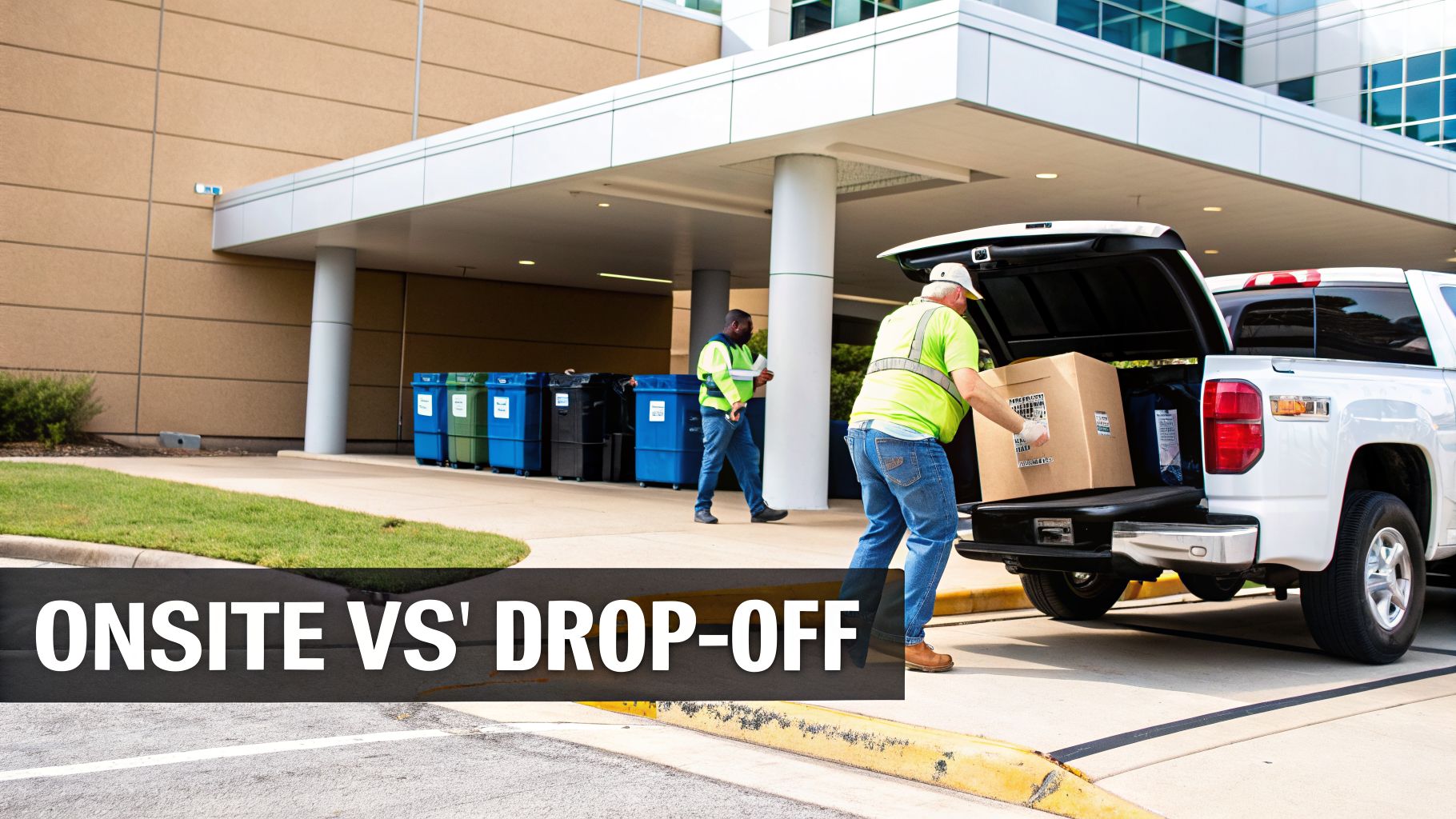
Sure, managing a drop-off yourself might look like it saves a few bucks on paper. But think about the real cost. You’ll have to pull staff away from patients and administrative work to load, transport, and unload everything. We're often talking about heavy, awkward equipment like old servers or diagnostic machines.
Beyond the lost productivity, you’re also taking on a safety risk. Are your employees trained to lift and move this kind of equipment? An injury can be far more costly than any pickup fee.
This is where a scheduled onsite pickup service just makes sense. A professional crew shows up with the right dollies, tools, and muscle to get the job done quickly and safely, letting your team stay focused on what they do best.
The Clear Advantage of Onsite Pickup for Medical Facilities
Honestly, for any medical office recycling more than a couple of desktop computers, onsite pickup is the only practical option. The biggest win is the time it saves. Your staff isn’t roped into a manual labor project, and your practice keeps running smoothly.
A professional pickup brings some major practical benefits:
- Minimal Disruption to Your Office: The removal is fast and self-contained. We’re in and out, so your team can keep working without interruption.
- Reduced Liability and Better Safety: Our trained movers know how to handle bulky, heavy equipment. This prevents workplace injuries and the liability that comes with them.
- It’s Just Simpler: Forget trying to borrow a truck, planning a route, or checking a recycler's drop-off hours. One call, and it’s all handled.
This is especially true when you're dealing with a large-scale cleanout, like moving offices, a big equipment upgrade, or finally emptying that packed storage unit. Trying to haul dozens—or hundreds—of old assets yourself is a massive drain on your resources.
The Real Game-Changer: The Bundled Approach
The true power of a professional service shines when you can solve multiple problems at once. This is where Fulton Junk Removal, operating with Beyond Surplus, offers something truly unique for Atlanta's commercial clients.
Think about this common scenario: your office is getting a refresh. You’ve got a pile of old computers and monitors, but you also have old desks, chairs, filing cabinets, and other junk to get rid of. Instead of calling two or three different companies, one bundled service can clear it all out in a single visit.
This integrated approach is a massive efficiency boost. Fulton Junk Removal offers a bundled junk removal + recycling pickup to handle all your needs at once.
- Junk Removal: Our crew will haul away all the non-hazardous junk you have—think furniture, fixtures, old carpets, and general office clutter.
- Electronics Recycling: At the same time, all electronic waste and recyclable materials are collected and directly processed by Beyond Surplus for secure data destruction and certified recycling.
This bundled service is a lifesaver for office managers, property managers, and warehouse supervisors. It simplifies everything, from scheduling to compliance reporting, by consolidating all your disposal needs with one trusted provider. You can explore more about our comprehensive commercial services and see how we can build a solution for your facility.
With one coordinated visit, your entire cleanout is done. That’s countless staff hours and logistical headaches you just got back.
Picking the right e-waste partner is easily the most critical decision you'll make in this entire process. For an Atlanta medical office, this isn't about finding some random service to haul away old gear. It's about trusting a partner with your data security, your compliance, and frankly, your practice's reputation.
The right partner brings peace of mind. The wrong one? That can open you up to some serious risks you just don't need to take.
The first thing you should look for is their certifications. I can't stress this enough: only consider vendors with credentials like R2 (Responsible Recycling) or e-Stewards. These aren't just fancy logos on a website; they represent tough, third-party audited standards for data security, environmental safety, and worker protection.
A certified recycler is held accountable for everything, from how they track a single device to how they take it apart. This guarantees a strict, documented process that protects your practice from start to finish.
The Fulton Junk Removal and Beyond Surplus Advantage
This is where our unique setup gives the Atlanta medical community a real advantage. Fulton Junk Removal operates as a circular, eco-friendly solution that goes beyond traditional junk hauling, working hand-in-hand with Beyond Surplus. It’s an integrated model built specifically for commercial clients like medical offices, warehouses, and property managers.
Most junk removal companies just take everything—furniture, electronics, clutter—and dump it in a landfill. Our model is completely different. Fulton Junk Removal handles the physical junk removal, and Beyond Surplus ensures responsible recycling. We divert items from landfills and ensure they’re repurposed or recycled.
This means you get a single, seamless service for a total office cleanout, but with the expert-level security needed for electronics recycling for Atlanta medical offices.
What to Demand from Your E-Waste Partner
Beyond those top-tier certifications, there are a few non-negotiables you should require from any potential partner. These are the things that separate a true professional from a basic "scrap guy."
- A Verifiable Zero-Landfill Policy: They must guarantee that no part of your electronics will ever see a landfill. This means they are committed to either refurbishing, dismantling for parts, or breaking down materials for commodity recovery.
- Transparent Chain-of-Custody Reporting: You need a clear, documented trail from the moment your assets leave your office. This isn’t optional. It should include detailed inventory lists and transfer receipts.
- Comprehensive Data Destruction Services: As we’ve covered, this must include options for NIST 800-88 compliant data wiping and physical shredding, backed by a Certificate of Data Destruction.
In Georgia, strict EPA and EPD regulations require compliant disposal, which is why medical offices need certified recyclers who offer these exact policies. The Fulton Junk Removal and Beyond Surplus ecosystem gives Atlanta medical offices seamless pickups for non-biohazard electronics, ensuring HIPAA-compliant data destruction and full chain-of-custody reports. Last year alone, we diverted an estimated 500 tons of e-waste from Georgia landfills.
For more on regional rules, you can check out this helpful overview of e-waste recycling in Atlanta.
A Typical Engagement From Start to Finish
To give you a better idea of how this works, let’s walk through what a typical job looks like with us. We’ve designed the process to be clear, secure, and totally stress-free.
First, you’ll reach out for a free estimate. We'll talk through the amount and type of junk and electronics you need gone and figure out the best approach.
Next, our professional, uniformed crew arrives at your Atlanta office on time. We do all the heavy lifting, loading everything from old desks and filing cabinets to your sensitive medical equipment. All general junk is separated right away for responsible disposal.
All of your e-waste is then securely transported directly to the Beyond Surplus facility. There, their team inventories every single asset, performs certified data destruction, and dismantles the equipment for recycling.
Finally, you get all the paperwork you need for your records. This includes your Certificate of Data Destruction for HIPAA compliance and a sustainability report detailing the weight and types of materials we kept out of the landfill.
This integrated system is built to make compliance and sustainability reporting easy for your office. The documentation you receive provides concrete proof for audits and supports your facility's environmental goals, showcasing your commitment to responsible practices.
Choosing a partner is all about building trust. For medical offices that need a reliable, local solution, the combined strength of Fulton Junk Removal and Beyond Surplus offers a complete, accountable, and eco-friendly answer. If your office is in the city, you can learn more about our services in Atlanta and how we can help.
Frequently Asked Questions on Medical E-Waste Recycling
Even with the best-laid plans, recycling electronics for a medical office always brings up a few questions. We get calls all the time from practice managers and IT directors across Atlanta, so we've put together answers to the most common ones we hear.
What Types of Medical Equipment Do You Accept?
We handle a huge range of non-biohazard electronic equipment. It's not just about the computers and monitors in the admin office. Through our partner, Beyond Surplus, we also process all sorts of specialized healthcare technology.
This includes things like:
- Administrative Gear: Computers, servers, printers, and entire phone systems.
- Diagnostic & Lab Equipment: EKG/ECG machines, centrifuges, and analyzers.
- Patient Monitoring Devices: Bedside monitors and vital sign trackers.
- Data Storage: External hard drives, backup tapes, and USB drives.
As long as the equipment is free from any biological contaminants, we can make sure it's processed securely and responsibly.
A lot of people think recyclers only take standard office IT. The reality is that a big chunk of medical e-waste comes from specialized clinical devices—all of which hold sensitive data and require secure handling.
How Does Pricing Work for Commercial Clients?
Our pricing for commercial jobs is based on the volume and types of materials you need removed. We'll typically build a custom quote that covers the entire scope of the work.
The real advantage for medical offices is our bundled service. Fulton Junk Removal can give you a single, straightforward quote to clear out all the general office junk—think old furniture, cubicle walls, and other waste—while also managing the pickup of your electronics for certified recycling through Beyond Surplus. This integrated approach saves you money and a logistical headache compared to hiring two different companies.
What Happens to Devices with Embedded Batteries?
This is a great question. Devices with embedded or non-removable batteries, like tablets, medical handhelds, or certain laptops, are everywhere now and require special care.
Our recycling partner, Beyond Surplus, is fully equipped to manage these items. Their technicians carefully dismantle each device to remove the batteries before any shredding or recycling takes place. This is crucial for preventing fire hazards and ensuring those lithium-ion batteries are sent to a specialized facility for proper recycling. You should never try to remove these batteries yourself—our certified process handles it safely.
What Documentation Will I Receive for My Records?
For any medical facility, proper documentation isn't just a good idea—it's the foundation of your compliance. After your electronic assets are processed, you'll get two critical documents:
- Certificate of Data Destruction: This is your proof that all data on your hard drives and media was destroyed according to NIST 800-88 standards. It includes the serial numbers of the destroyed devices, giving you a clear, auditable trail for HIPAA.
- Certificate of Recycling: This report breaks down the types and weights of materials that were responsibly recycled. It confirms your facility's commitment to a zero-landfill policy and provides great data for your sustainability goals.
These documents are your official proof of due diligence. If you're ready to set up a compliant and transparent recycling program for your facility, you can reach out to us directly to talk through your specific needs.
