
HIPAA Compliant Electronics Recycling Atlanta: Secure Data Disposal in 2026
For any Atlanta business upgrading its computers, the question of what to do with the old ones is a minefield of risk. But for healthcare providers, medical offices, and property managers handling protected health information, HIPAA compliant electronics recycling in Atlanta isn't just about proper disposal—it's about survival.
Getting this wrong is like leaving patient charts in an open dumpster. It’s a direct path to massive liability.
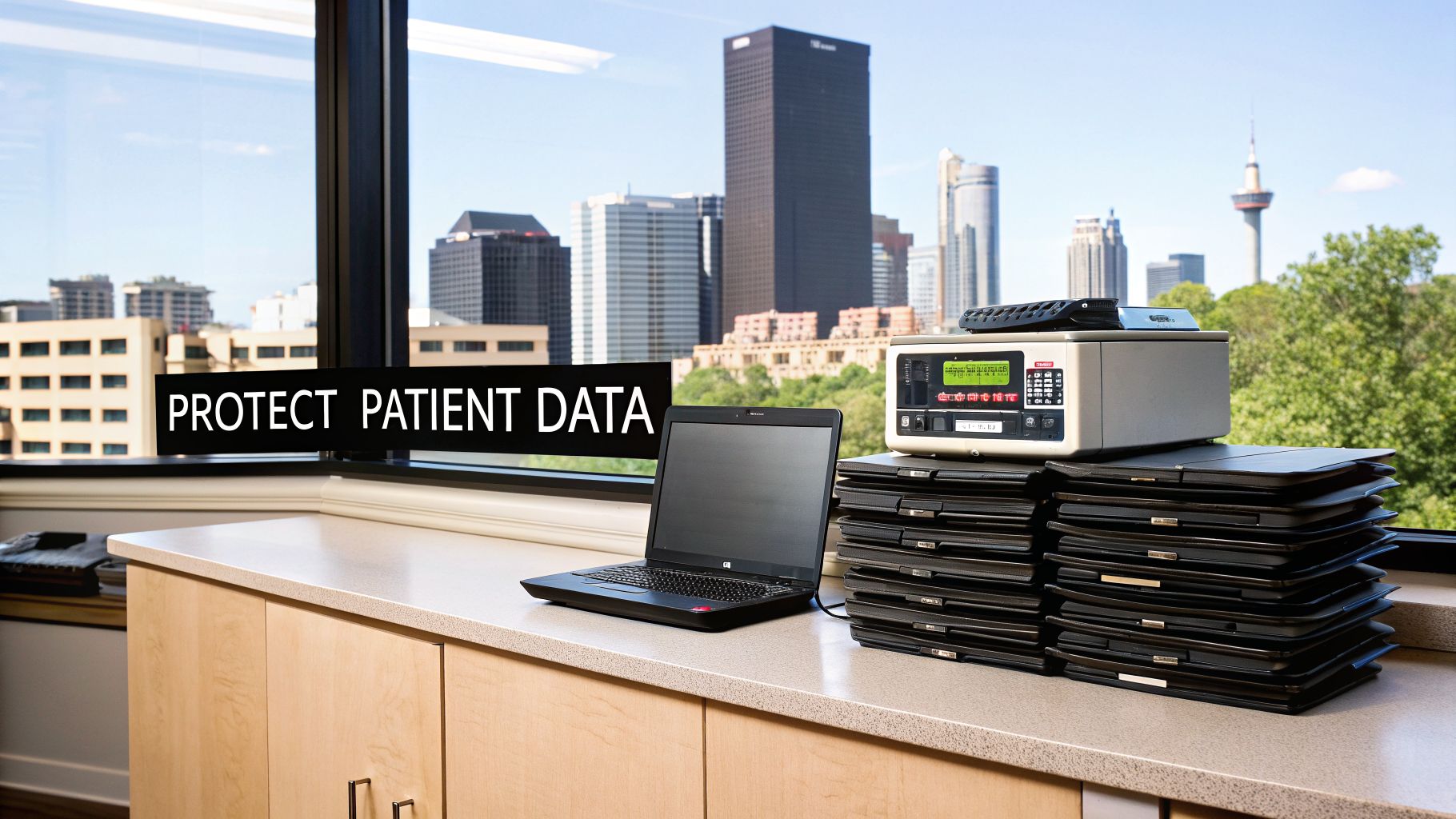
Why Compliant Electronics Recycling Matters in Atlanta
Let’s get practical. Imagine your medical office, warehouse, or commercial property is finally getting that long-overdue renovation. The project creates a mixed bag of junk: old furniture, outdated fixtures, and a closet full of retired computers, printers, and hard drives.
Here’s where things get dangerous. Most junk removal companies would just haul it all to a landfill, creating a huge compliance gap. Every single device containing electronic protected health information (ePHI) just became a ticking time bomb for a data breach.
The High Stakes of Non-Compliance
Simply tossing out old electronics isn’t just a bad idea—it’s a direct violation of federal law. The HIPAA Security Rule (45 CFR §164.312) is crystal clear: you must use secure disposal methods to protect patient data.
The penalties for ignoring this are staggering, with fines ranging from $10,000 to $50,000 per violation. These can quickly snowball into the millions, as past HHS enforcement actions have repeatedly shown.
But this isn't just about dodging fines. It's about protecting your organization's good name. A single data breach can shatter patient trust, ruin your brand, and trap you in costly legal battles for years.
Key Takeaway: End-of-life electronics aren’t just clutter; they're a significant liability. Treating them like regular trash exposes your organization to immense financial penalties and irreversible reputational harm.
An Integrated Solution for Atlanta Businesses
This is where a smarter, circular approach makes all the difference. Focussed on commercial services, Fulton Junk Removal operates under Beyond Surplus, a circular, eco-friendly solution that goes beyond traditional junk hauling. Instead of juggling separate vendors for junk hauling and certified IT asset disposal, an integrated service streamlines the entire cleanout.
Think about the partnership between Fulton Junk Removal and our parent company, Beyond Surplus.
- Fulton Junk Removal handles junk removal, efficiently clearing out general clutter like office furniture, cubicle walls, and warehouse junk.
- Beyond Surplus ensures responsible recycling. Fulton works hand-in-hand with Beyond Surplus to recycle electronics, metals, and other materials responsibly, diverting items from landfills so they’re repurposed or recycled.
This bundled service is a game-changer for offices, warehouses, and property managers. Fulton handles the junk removal, and Beyond Surplus ensures responsible recycling, making compliance and sustainability reporting easier. It cuts down on vendor headaches and provides a rock-solid guarantee that every piece of electronic waste is processed securely.
This dual-focus model covers your compliance needs and your sustainability goals, offering a complete, no-gaps solution for any junk removal project in Atlanta.
Decoding HIPAA Rules for Secure Data Destruction
When your Atlanta office gets rid of old electronics, just hitting 'delete' on a hard drive is like trying to wipe permanent marker off a whiteboard. It might look like the data is gone, but for anyone who knows where to look, it’s still right there. For any organization that handles electronic protected health information (ePHI), that simple oversight isn't just a mistake—it's a massive compliance failure waiting to happen.
The HIPAA Security Rule is crystal clear: when a device reaches its end of life, any ePHI on it must be rendered completely, totally, and permanently unrecoverable.
To turn that legal requirement into a real-world process, the government points everyone to a single, official playbook: the NIST 800-88 Guidelines for Media Sanitization. This is the definitive framework for making sure data is gone for good. Any vendor providing HIPAA compliant electronics recycling in Atlanta absolutely must live and breathe these protocols.
NIST 800-88 Data Destruction Methods Explained
Think of data destruction as having three levels of intensity, each designed for different types of information. The NIST 800-88 guidelines outline these methods—Clear, Purge, and Destroy—to help you match the security level to the data's sensitivity. For HIPAA, only one truly makes the grade.
| Method | Description | Best For | HIPAA Compliant? |
|---|---|---|---|
| Clear | Uses basic software to overwrite data. This is what a standard "factory reset" does. | Non-sensitive data on devices being reused internally. | No. Easily defeated by common data recovery software. |
| Purge | Uses advanced software or degaussing (a powerful magnetic field) to make data recovery significantly harder. | High-security internal reuse where destruction isn't feasible. | Maybe, but risky. Not recommended for ePHI; auditors may not accept it. |
| Destroy | Physical destruction of the storage media through shredding, disintegration, or pulverization. | ePHI, classified data, and any sensitive information. The only foolproof method. | Yes. Data recovery is physically impossible. |
For any healthcare provider, insurer, or business associate handling ePHI, the path to compliance is simple. The Destroy method is the only one that delivers 100% certainty and eliminates all risk.
The Business Associate Agreement: A Legal Handshake
HIPAA’s rules don’t just apply to you; they extend to every single vendor you hire who could possibly interact with ePHI—and that definitely includes your electronics recycling partner. You can’t just hand over a pallet of old computers and hope for the best. You are legally required to have a Business Associate Agreement (BAA) signed and in place.
A BAA is a formal, written contract that legally binds your recycling vendor to the exact same HIPAA security and privacy standards you follow. It makes them directly liable for any data breaches that happen on their watch.
This document is your non-negotiable first line of defense. Without a signed BAA, your organization remains 100% responsible for any data breach your vendor causes. When working to understand HIPAA, it's critical to know how agreements like these protect health information when third parties are involved. A good overview on Business Associate Agreements (BAA) can offer key insights into these vendor responsibilities.
Any legitimate, experienced e-waste recycling partner won't just agree to sign a BAA—they will insist on it before they touch your equipment. If a vendor hesitates or is reluctant to sign, consider it an immediate red flag. It’s a clear signal they aren’t prepared to handle the legal weight of HIPAA compliance.
Why You Need an Unbroken Paper Trail
If a HIPAA auditor showed up at your Atlanta office tomorrow, could you prove exactly what happened to that old server in your storage closet? “We gave it to a recycler” isn’t going to cut it. The only thing standing between your organization and a hefty fine is a rock-solid, unbroken paper trail.
This is where Chain of Custody documentation becomes your legal shield. Think of it like tracking a certified package. Every single time it changes hands, someone signs for it. A compliant electronics disposal partner must provide this same obsessive level of tracking for every device containing ePHI.
What Is a Chain of Custody?
A Chain of Custody is a chronological log that tracks every touchpoint for your electronic assets. It starts the second a technician scans a hard drive at your Atlanta facility and only ends when that same drive is physically shredded and its serial number is logged as destroyed.
This document is your legally defensible proof that you met your obligations under the HIPAA Security Rule. It’s what you’ll hand an auditor to answer their most pressing questions:
- Who had your assets at every step of the process?
- What specific devices were disposed of, tracked by serial number?
- When did each transfer of custody happen?
- Where were the assets taken, stored, and ultimately destroyed?
Without this log, you’re flying blind. You have no verifiable proof that your patient data wasn't lost, stolen, or mishandled after it left your control.
The Certificate of Data Destruction: Your Compliance Seal
The final, non-negotiable piece of the puzzle is the Certificate of Data Destruction (CoDD). This isn't just a simple receipt—it's a formal, legally binding document confirming that your data was permanently and irreversibly eliminated.
A valid CoDD is your ultimate proof of compliance. It attests that your devices were destroyed according to NIST 800-88 standards, making data recovery impossible. A compliant certificate must include:
- Unique Serial Numbers: A detailed list of every single hard drive or device that was destroyed.
- Method of Destruction: A clear statement on how the data was sanitized (e.g., physical shredding).
- Date and Location: The specific date and location where the destruction occurred.
- Transfer of Custody: A record of the final transfer from your organization to the recycler.
- Authorized Signature: The signature of an official from the recycling facility, attesting to the destruction.
This certificate officially closes the loop on your liability. It's the document that proves you did everything right.
The diagram below breaks down the different data sanitization methods outlined in the NIST 800-88 guidelines, which any certified recycler will follow.
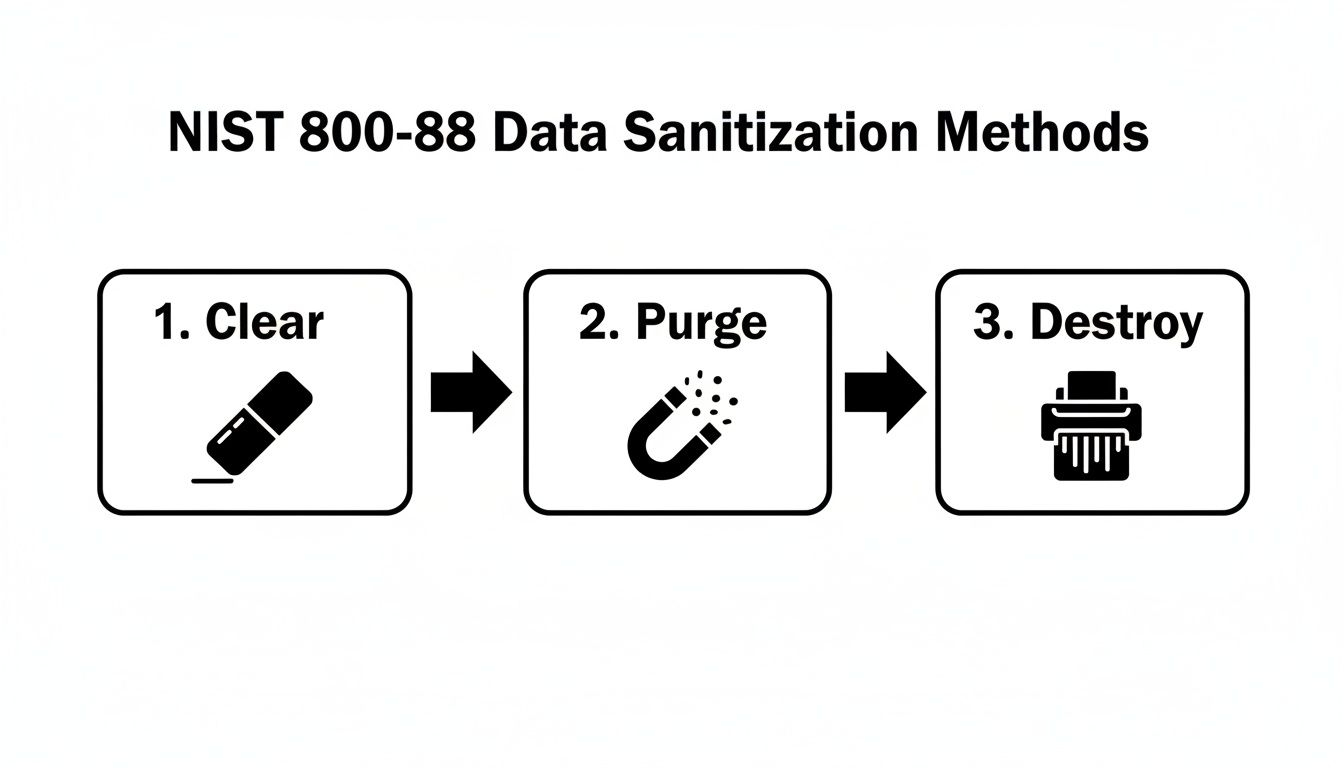
As you can see, methods like "Clear" and "Purge" aren't enough for HIPAA. Only the "Destroy" method provides the physical finality needed to guarantee patient data can never be recovered.
Beyond Compliance: Diversion Reporting for Your ESG Goals
Today, smart Atlanta businesses know that secure electronics disposal is about more than just staying compliant. It's a chance to prove your commitment to corporate social responsibility. That’s where Diversion Reporting comes in.
A diversion report is a document that quantifies exactly how much electronic waste your company kept out of landfills. It provides tangible data—by weight and material type—on everything that was responsibly recycled, refurbished, or repurposed.
This report gives you the hard numbers needed for your company’s ESG (Environmental, Social, and Governance) initiatives. It’s powerful data for sustainability reports, helps win over environmentally-conscious stakeholders, and reinforces your brand as a responsible community leader. When you learn more about a junk removal company's mission and eco-friendly practices, you see how this aligns perfectly with modern business values.
By choosing an integrated provider like Fulton Junk Removal, you get the ironclad compliance of a CoDD and the powerful sustainability metrics of a diversion report. It’s a complete solution that protects your data, your reputation, and the planet.
How to Choose a HIPAA Compliant Recycling Partner
Picking the right partner for HIPAA compliant electronics recycling in Atlanta is the most critical decision your organization will make in this entire process. This isn’t about hiring someone to haul away old office junk; it’s about trusting a vendor with your most sensitive data and your legal reputation.
For IT directors, office managers, and compliance officers, one bad choice here can have catastrophic results. Think of it like this: you wouldn't ask a general family doctor to perform open-heart surgery. You need a specialist with proven, specific skills for a high-stakes procedure. A standard junk hauler simply isn't equipped for the technical and legal demands of ePHI disposal. You need a certified expert.
The Non-Negotiable Vendor Checklist
To protect your organization, any potential recycling partner must meet a core set of non-negotiable criteria. Use this checklist as your first line of defense when evaluating vendors in Atlanta. If a company fails on any of these points, walk away.
R2v3 or e-Stewards Certification: These are the gold standards in the electronics recycling industry. A certified vendor has passed rigorous third-party audits covering data security, environmental compliance, and worker safety. It’s concrete proof they have the systems to handle your assets responsibly.
Willingness to Sign a Business Associate Agreement (BAA): As we've covered, a BAA is a legally binding contract that holds your recycler directly liable for protecting your ePHI. Any legitimate, experienced partner will insist on signing one before they even touch your equipment. Any hesitation is a massive red flag.
On-Site Data Destruction Capabilities: While secure off-site destruction is a good standard, the ability to perform on-site shredding provides an unmatched layer of security. This allows your team to physically witness hard drives and other media being destroyed before they ever leave your building, completely eliminating any chain of custody risks.
Expert Insight: Top-tier recyclers build their entire service model around these standards. For example, many R2v3 certified facilities use NIST 800-88 data destruction protocols—which actually exceed DoD requirements—and provide full chain-of-custody tracking with a BAA to ensure you're always ready for an OCR audit. You can read more on how certified recyclers in Atlanta operate to see these practices in action.
When vetting potential partners, it's crucial to ask pointed questions that go beyond a simple "yes" or "no." The table below outlines what to ask and why it's so important for protecting your Atlanta-based organization.
Vendor Vetting Checklist for HIPAA Compliant Recycling
| Verification Point | Why It Matters | What to Look For |
|---|---|---|
| Current Certifications | Certifications like R2v3 and e-Stewards are non-negotiable. They verify a vendor's processes for data security, environmental safety, and accountability. | Ask for a copy of their current certificate. Verify the name and address match, and check the expiration date. |
| Business Associate Agreement (BAA) | This legal contract makes the vendor directly liable for any breaches of your ePHI. Without it, the liability remains entirely on your organization. | The vendor should proactively offer a BAA. Review it to ensure it clearly outlines their responsibilities and breach notification procedures. |
| Data Destruction Methods | You need to know exactly how your data will be destroyed. The method must meet or exceed the NIST 800-88 standard. | Do they offer on-site shredding? Do they provide a Certificate of Data Destruction with serialized reporting for each hard drive? |
| Chain of Custody Documentation | This is the paper trail that proves your assets were handled securely from the moment they left your office until their final disposition. | Ask to see a sample chain-of-custody form. It should track asset tags or serial numbers, dates, and signatures at every handoff point. |
| Insurance Coverage | Proper insurance, especially data breach and pollution liability coverage, protects you financially if something goes wrong. | Request a Certificate of Insurance (COI). Look for General Liability, Errors & Omissions (Data Breach), and Pollution Liability policies. |
A vendor who can confidently and transparently provide all of this documentation is one you can trust. If they can't, they are not equipped to handle your sensitive materials.
The Advantage of an Integrated Service Model
For busy offices, warehouses, and property managers, logistics can be a real headache. An office decommission or a large-scale cleanout often involves both general junk and sensitive electronics. Trying to juggle multiple vendors—one for the furniture and another for the IT assets—is not only inefficient but also dramatically increases the risk of a compliance mistake.
This is where an integrated service model offers a huge strategic advantage. Fulton can offer bundled junk removal + recycling pickup, where all electronic waste and recyclable materials are directly processed by Beyond Surplus. This model rolls two critical functions into a single, seamless operation.
- Fulton Junk Removal takes care of the bulk junk removal. Their team can clear out old desks, chairs, cubicle walls, and other non-hazardous debris, getting your space cleared out fast.
- Beyond Surplus handles the secure electronics recycling. All electronics are segregated on-site and processed directly by a certified, eco-friendly recycling expert.
With a bundled approach, every single item is handled correctly. There’s no chance of a hard drive full of ePHI accidentally ending up in a dumpster with old office chairs. You get one point of contact, one transparent quote, and one team managing the entire project from start to finish.
This simplifies logistics and makes your compliance and sustainability reporting practically effortless. If your project involves more than just electronics, exploring a company's full range of commercial junk removal and recycling services can save you a ton of time and resources, turning a complex headache into a streamlined and secure process.
Streamlining Your Office Cleanout with an Integrated Service
Let’s be honest. Managing an office decommission, warehouse clear-out, or an end-of-lease move can feel like juggling chainsaws. The logistics are a nightmare, and the compliance risks are huge. You've got furniture and fixtures to get rid of, but you also have that closet full of old computers, servers, and hard drives packed with sensitive data.
This is where many companies stumble. They’ll hire a standard junk hauler for the bulky items and then try to find a separate, certified vendor to handle the electronics. This approach doubles your vendor management, creates scheduling headaches, and opens up a dangerous gap where a hard drive could easily get tossed into the wrong pile.
An integrated service closes this gap for good.
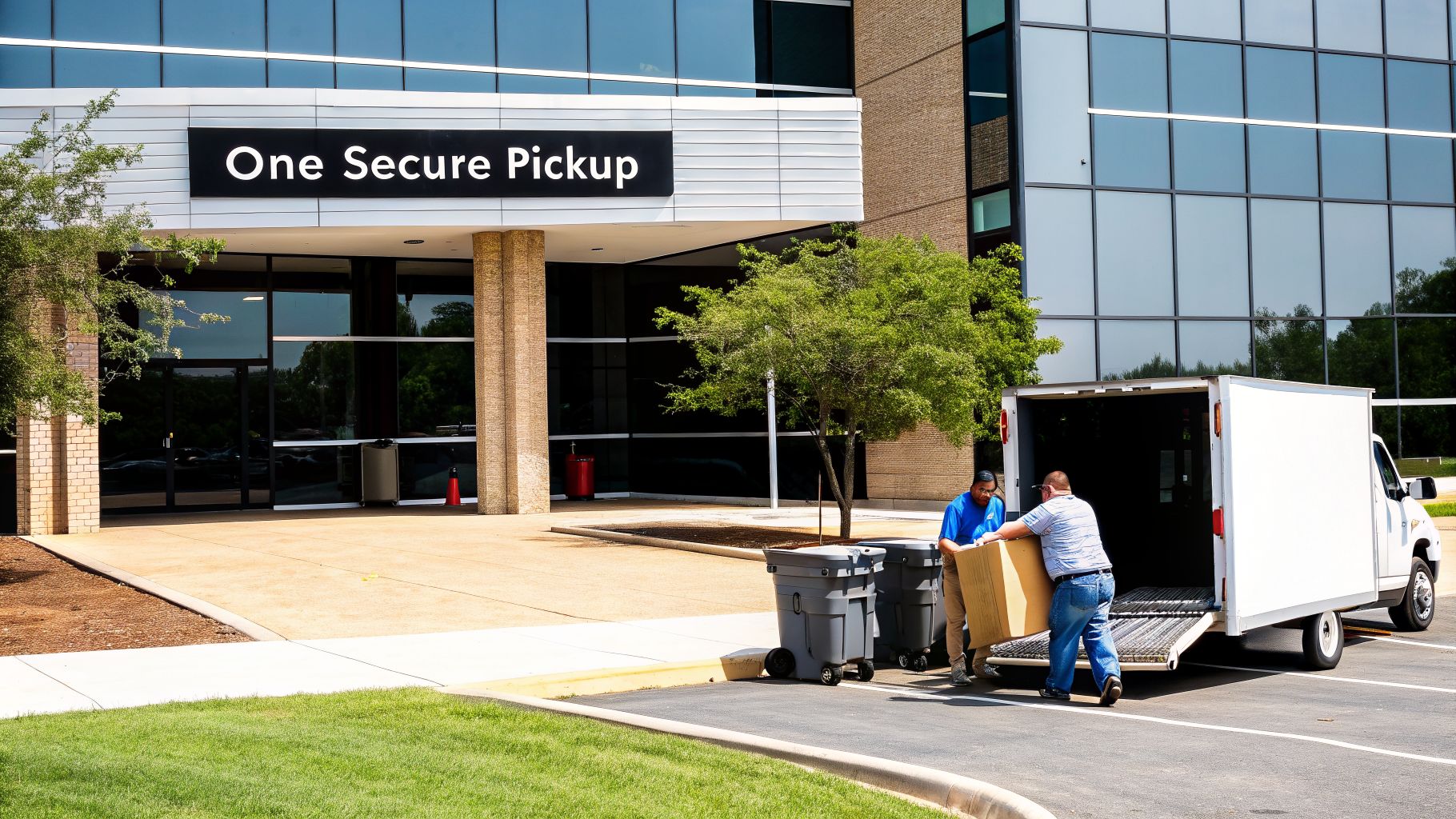
The Integrated Model in Action
Imagine your Atlanta team is overseeing a full office cleanout. Instead of making two sets of calls and trying to coordinate two different crews on-site, a single team arrives ready to handle everything.
This is the power of the Fulton Junk Removal and Beyond Surplus partnership. It’s a seamless, two-in-one solution built specifically for commercial clients.
- Junk Removal Handled: The Fulton Junk Removal crew gets to work, efficiently clearing out all the general clutter—desks, chairs, partitions, shelving, and old equipment. They know how to work quickly to minimize disruption to your business.
- Electronics Secured: At the same time, every piece of electronic waste is carefully segregated on-site. Every laptop, monitor, printer, and server is set aside for direct processing by our parent company, Beyond Surplus, a certified e-waste recycling specialist.
This bundled approach means nothing gets missed. There is zero risk of a device containing ePHI getting mixed in with general debris and ending up in a landfill. The entire project is managed under one umbrella, turning a complex, high-stakes job into a simple, secure operation.
A Single Solution for Property Managers and Offices
For Atlanta’s property managers, IT directors, and office managers, this model solves multiple problems at once. Consider the logistical challenges faced by large facilities. For Atlanta's property managers and IT directors at facilities like Grady Memorial Hospital (with its 953 beds), partnering with certified recyclers like Fulton Junk Removal—part of the Beyond Surplus family—ensures zero-landfill policies and easy access to diversion reports. You can discover more details on how top Atlanta facilities handle e-waste compliance.
This unified approach makes compliance and sustainability reporting effortless. Instead of chasing down paperwork from multiple vendors, you get a single, consolidated set of documents.
You receive one transparent price, one point of contact, and one final report that includes both a Certificate of Data Destruction for your HIPAA compliance and a Diversion Report for your ESG initiatives.
When considering a comprehensive approach to clearing out your workspace, remember the importance of engaging in responsible office cleanouts that cover every aspect of the project.
Benefits for Warehouses and Commercial Spaces
This model is especially powerful for warehouses and large commercial properties that generate a mix of bulky junk and electronic waste. An integrated team can clear out entire facilities, from heavy-duty shelving and obsolete machinery to old POS systems and networking equipment.
Fulton Junk Removal handles the heavy lifting, while Beyond Surplus guarantees every single data-bearing device is securely processed. It’s the most efficient way to ensure your HIPAA compliant electronics recycling in Atlanta is handled correctly, without sacrificing speed or simplicity.
You get a clean slate for your property and the ironclad peace of mind that comes with certified, documented data destruction.
Your Next Steps for Secure E-Waste Disposal
That storage closet full of old electronics? It's more than just junk. Every retired server, laptop, and hard drive collecting dust is a potential liability, holding sensitive data and creating a compliance risk. But there's a straightforward way to handle it.
For your Atlanta business, the right partner can turn this complex problem into a simple, responsible solution. The path forward is much easier than you might think.
A Clear, Actionable Plan
Getting started is a simple, three-step process. No juggling multiple vendors, no worrying about compliance gaps—just complete peace of mind.
- Inventory Your Assets: First, take a quick inventory of your old IT equipment. Make a list of everything that needs to go, from servers and computers to printers and mobile phones.
- Get a Single Estimate: Instead of trying to coordinate a junk hauler and a separate IT specialist, just make one call. An integrated provider can give you a single, no-obligation estimate that covers both the general junk removal and the secure electronics recycling.
- Schedule Your Pickup: Once you’re ready, schedule a pickup that fits your timeline. A professional team will arrive and handle everything from there—ensuring your data is destroyed, your e-waste is recycled sustainably, and all the paperwork is in order.
Fulton Junk Removal works hand-in-hand with our parent company, Beyond Surplus, to offer a bundled junk removal and HIPAA compliant electronics recycling Atlanta service. We’ve designed our process to be seamless.
While most junk removal companies take everything to the landfill, we recycle through Beyond Surplus to minimize waste and maximize reuse. This circular, eco-friendly solution appeals to environmentally conscious homeowners and businesses.
A Unified Solution for Commercial Needs
This integrated model is perfect for offices, warehouses, and property managers handling cleanouts. Fulton Junk Removal takes care of the physical junk removal, and Beyond Surplus makes sure every single device is processed securely. It simplifies your logistics and makes sustainability and compliance reporting a breeze.
You get a clean, usable space back, plus the certified documentation to prove every asset was handled correctly. It’s the most efficient way to turn an e-waste liability into a secure and sustainable clean slate.
Ready to take the next step? To learn more or to request a single, no-obligation estimate for your entire project, please contact Fulton Junk Removal today.
Frequently Asked Questions About HIPAA Compliant Recycling
When you’re dealing with old electronics that once held patient data, a lot of questions come up. We get it. Here are some quick, straightforward answers to the most common questions we hear from Atlanta businesses about HIPAA compliant electronics recycling, helping you stay secure and compliant.
What Devices Require Secure Data Destruction?
The short answer? Any electronic device that has ever stored, processed, or even just passed through ePHI needs secure data destruction. It's easy to remember the obvious stuff, but the list is longer than you might think.
We’re talking about a whole range of equipment:
- Computers and Laptops: The most common places you'll find stored ePHI.
- External Hard Drives & SSDs: These portable drives are often used for backups or moving files between systems.
- Servers and Network Attached Storage (NAS): The central hubs where your organization's data lives.
- Smartphones and Tablets: Mobile devices are frequently used to check patient records or access secure portals.
- Printers and Scanners: This one surprises people. Many modern office machines have internal hard drives that save a copy of every document scanned or printed.
If a piece of equipment has a memory chip, the safest bet is to assume it requires certified destruction.
Is a BAA Needed for a Junk Removal Company Handling E-Waste?
Yes, 100%. If a junk removal company is picking up your old IT assets, a Business Associate Agreement (BAA) is non-negotiable. Under HIPAA, any vendor who handles devices containing ePHI is legally considered a Business Associate, and they are required to sign a BAA with you.
This is a critical point: even if their main job is "junk removal," the second they take possession of those devices, they become a Business Associate. A vendor's refusal to sign a BAA is a massive red flag that they are not qualified to handle your sensitive materials.
In a major healthcare city like Atlanta, this is non-negotiable. With major systems like Northside Hospital (621 beds) and Emory Healthcare (11 hospitals) generating huge volumes of retired IT gear, the need for properly vetted partners is absolutely essential. You can learn more about Atlanta's e-waste landscape and compliance needs.
What’s the Difference Between Standard Recycling and Certified Destruction?
There's a world of difference, and it all comes down to security. Standard recycling is only focused on recovering materials—breaking down electronics to get the valuable metals and plastics out. It offers zero guarantees for your data and won't give you the paperwork you need for a HIPAA audit.
Certified data destruction, on the other hand, is a security process first and a recycling process second. It uses NIST 800-88 compliant methods, like physical shredding, to make absolutely sure your data is gone for good and can never be recovered. This process also generates a Certificate of Data Destruction and a complete chain of custody report—your legal proof that you did everything right. To dive deeper into compliant and sustainable practices, check out other articles on our blog.
For a simple solution that merges commercial junk removal with certified, secure electronics recycling, just partner with Fulton Junk Removal. We work directly with Beyond Surplus to make sure your entire office cleanout is efficient, compliant, and sustainable. You can get a single quote for the whole project at https://fultonjunkremoval.com.
