
IT Equipment Disposal for Atlanta Schools: Secure, Eco-Friendly Solutions
Tackling IT equipment disposal for Atlanta schools is a massive headache, one that’s growing bigger—and more expensive—with every new 1-to-1 device program. For too many districts, old, outdated disposal methods are punching holes in the budget and creating serious data security risks. What used to be a simple storage problem has quickly turned into a major liability. A smart, professional disposal strategy is the only way to protect student data and keep your finances in check.
The High Stakes of School Tech in Atlanta
If you're managing a school's device fleet, you know the constant battle against lost, damaged, and obsolete tech. The shift to digital-first learning has turned what was once a trickle of old computers into a flood of retired equipment. For schools across the Atlanta area, the reality is sobering: device loss and replacement costs are spinning out of control.
This isn't just a hypothetical problem—it comes with a huge price tag. At the end of a recent school year, Atlanta Public Schools saw students return only about 37,525 of the 40,000 devices they had distributed. That left 5,765 laptops, Chromebooks, and iPads completely unaccounted for. The district was forced to spend $3.5 million just on replacements.
Why Old Disposal Methods Are Failing
In the age of 1-to-1 device programs, just piling old electronics into a storage closet simply won't work anymore. Those old-school, manual disposal methods create huge financial and security headaches that can impact the entire institution.
What starts as a few dozen outdated laptops quickly becomes a mountain of e-waste, bringing several distinct problems with it:
- Budgetary Drain: Storing obsolete tech eats up valuable space that could be used for teaching. More importantly, failing to track and properly dispose of these assets leads to inflated replacement costs and budgetary black holes, just like the massive spend by Atlanta Public Schools.
- Data Security Risks: Every single retired device contains a hard drive, potentially filled with sensitive student information, employee records, and administrative data. Improper disposal—like just handing devices over to a standard junk hauler—leaves all that information vulnerable.
- Compliance Nightmares: Schools are required to follow strict data privacy regulations. A single misplaced hard drive can lead to non-compliance penalties, legal trouble, and serious damage to your reputation in the community.
A professional IT equipment disposal strategy isn't just an operational cost; it’s a critical investment in your school's financial health and data security. It turns a liability into a managed, secure, and compliant process.
The Advantage of an Integrated Solution
This is where a modern, integrated approach to junk removal and electronics recycling makes all the difference. While most junk removal companies take everything to the landfill, we recycle through our parent company, Beyond Surplus, to minimize waste and maximize reuse.
Focussed on commercial services, Fulton Junk Removal operates under Beyond Surplus, a circular, eco-friendly solution that goes beyond traditional junk hauling. We work hand-in-hand with Beyond Surplus to recycle electronics, metals, and other materials responsibly. This partnership allows us to offer bundled junk removal and recycling pickup, where all electronic waste is directly processed by Beyond Surplus.
For Atlanta-area schools, offices, warehouses, and property managers, this means one point of contact can manage the removal of everything from old furniture and classroom clutter to, most importantly, all your electronic waste. Fulton Junk Removal handles the physical junk removal, and Beyond Surplus ensures responsible recycling, making compliance and sustainability reporting easier. This integrated system diverts items from landfills, ensures they’re repurposed or recycled, and appeals to environmentally conscious businesses and school systems. For commercial junk removal services in Atlanta, our integrated system offers a clear, secure advantage.
When it's time to clear out old school technology, you're dealing with more than just finding room in the budget for new gear. Improperly handling IT equipment disposal for Atlanta schools opens a can of worms—legal liabilities, environmental hazards, and massive data security risks. Just tossing old devices in a dumpster or calling a standard junk hauler isn't just a bad idea; it can put your school on the hook for serious penalties.
You have to get this right to protect your students, your staff, and the school's reputation.
The environmental problem alone is getting harder to ignore. Georgia is drowning in e-waste, and our schools are a big part of the reason why. With a relentless 6.7% annual growth in school tech purchases like laptops and Chromebooks, the pile-up is staggering. The state was already dealing with 29,100 tonnes of electronic waste back in 2017. That number is on track to hit a whopping 52,000 tonnes by 2027. This makes responsible IT disposal a non-negotiable part of being a good community steward.
Hazardous Materials in School E-Waste
Those old electronics collecting dust in your storage closets aren't just taking up space. They are packed with hazardous materials that can do real, lasting damage if they leak out of a landfill and into our soil and groundwater.
A single storage room of old tech could easily contain:
- Lead: Found in the glass of old CRT monitors and the solder on countless circuit boards.
- Mercury: Used to backlight flat-panel displays and in various types of batteries.
- Cadmium: A key component in rechargeable batteries and some older circuit boards.
- Flame Retardants: These chemicals are applied to plastic casings and are known to be persistent pollutants that don't break down easily.
Handling this stuff isn't a job for just anyone. A certified e-waste recycling partner, like our parent company Beyond Surplus, has the specialized processes to safely extract and manage these toxic materials. Standard junk removal companies simply aren't equipped for this, and they can’t protect you from the environmental liability.
IT Disposal Options for Atlanta Schools
To make the best choice, it helps to see the options side-by-side. Each method comes with its own set of risks and benefits, especially for a school environment where data security and compliance are paramount.
| Disposal Method | Data Security Risk | Environmental Impact | Compliance & Reporting | Best For |
|---|---|---|---|---|
| Certified ITAD Vendor | Low | Low | High | Schools, healthcare, businesses with sensitive data. |
| OEM Take-Back Program | Low-Medium | Low-Medium | Medium | Organizations buying large volumes from a single brand. |
| General Recycler | Medium-High | Medium | Low | Non-sensitive household electronics, not for school data. |
| Standard Junk Hauler | High | High | None | General trash and furniture, never for electronics. |
| Donation/Resale | High | Low | None | Simple, non-data devices, but requires in-house wiping. |
As the table shows, a certified ITAD (IT Asset Disposition) vendor is the only option that effectively manages all the risks associated with school equipment disposal.
Data Security Compliance and FERPA
Even more critical than the environmental rules is your absolute duty to protect student data. Every single device—from a front-office PC to a student's tablet—likely contains personally identifiable information (PII). This data is strictly protected under the Family Educational Rights and Privacy Act (FERPA).
Failing to completely destroy that data before a device leaves your control isn't just an oversight—it's a violation of federal law. The fallout from a data breach is something no school can afford.
Consequences can include:
- Crippling Fines: Financial penalties that can blow a hole in any school's budget.
- Loss of Federal Funding: The ultimate penalty for severe or repeated FERPA violations.
- Total Loss of Trust: A data breach can permanently damage your relationship with parents and the community.
- Lawsuits: Your school district could face legal action from the families of affected students.
Protecting data doesn't stop at your firewall. It extends all the way through the device's lifecycle. A solid plan for e-safety and IT security must include a compliant disposal process.
The Importance of a Clear Chain of Custody
So, how do you prove you did everything right? With a documented chain of custody. This is your auditable paper trail that tracks every single device from the moment it leaves your school to its final destruction. It's non-negotiable for proving compliance and protecting your institution.
A proper chain of custody requires a vendor that provides serialized tracking of your assets. But most importantly, it ends with a Certificate of Data Destruction. This is the official document that confirms the hard drives from your specific devices were wiped or physically shredded according to a recognized standard like NIST 800-88.
Without that certificate, you have no verifiable proof of compliance. In the event of an audit or data incident, you're left completely exposed.
A Practical Playbook for School IT Equipment Disposal
Feeling buried under old laptops, tablets, and desktops? It’s a familiar scene in schools everywhere. Forget the dense, theoretical manuals. This is our real-world playbook for getting your school’s IT disposal process under control—a guide built for busy IT and operations staff right here in Atlanta. We’re focused on making this manageable, from the first inventory count to the final pickup.
But first, let's be clear about what’s at stake. Mishandling old tech isn't just a clutter problem; it's a direct line to serious risk.
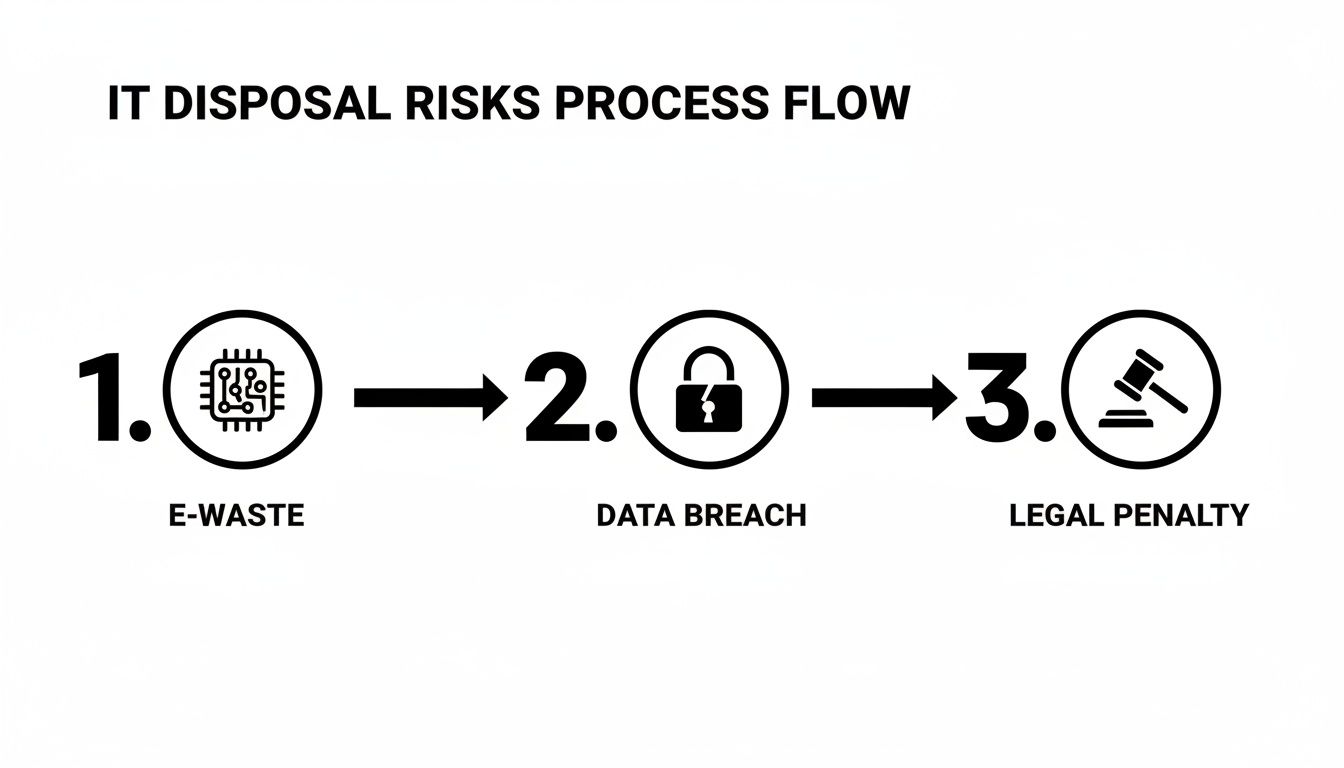
As you can see, what starts as simple e-waste can quickly escalate into a data breach, leading to significant legal and financial penalties. This is why a solid plan is non-negotiable.
Start with Triage and Categorization
Before you do anything else, you need a clear picture of what you're dealing with. Don't worry about creating a perfect, line-by-line inventory just yet. The goal here is a quick-and-dirty sort to understand the scope of your project.
Start grouping your retired equipment into a few basic categories. This initial triage immediately makes the mountain of gear feel less intimidating. We recommend these buckets:
- High-Value Resale: Newer items like MacBooks or high-spec laptops that still have some market value.
- Donation-Ready: Functional but older tech—think working desktops and monitors—that could be a huge help to a nonprofit.
- Recycling Only: This is for the broken, obsolete, or heavily damaged devices that are strictly e-waste.
- Junk and Peripherals: Don't forget the mess of keyboards, mice, old cables, and other accessories that don't hold data.
Once you’ve done this, you’re no longer looking at one giant problem. You’ve got a few smaller, more manageable piles.
Establish a Secure Staging Area
Okay, you've sorted the equipment. Now, where does it all go? I’ve seen countless schools make the mistake of piling old tech in an empty classroom or a busy hallway. This is not just a logistical headache; it’s a massive security risk.
You need a dedicated, secure space for staging. This should be a locked room or a caged-off area in a warehouse with strictly limited access. Only authorized staff should have the key. This single step prevents theft and, more importantly, stops anyone from grabbing a device that might still contain sensitive student or faculty data.
A dedicated staging area isn't a luxury; it's a foundational part of a secure chain of custody. It’s the first step in ensuring that every device is accounted for from the moment it’s decommissioned until it leaves your premises.
This is also where a streamlined service model makes a huge difference. A partner like Fulton Junk Removal, working with Beyond Surplus, already knows these logistics. We can help you plan a cleanout that fits your school’s calendar, arranging a single, coordinated pickup for everything—from the junk peripherals to the sensitive electronics. No more juggling multiple vendors and conflicting schedules.
Coordinating Between Departments
Here’s where many IT equipment disposal for Atlanta schools projects get stuck: a lack of coordination. This isn’t a one-person job. It’s a team sport that requires clear communication between IT, facilities, and administration.
Your IT team owns data security—they know which devices need to be wiped. Facilities manages the physical space and the muscle needed to move everything. And administration holds the budget and ensures the entire process is compliant. When these teams don't talk, nothing moves.
To get everyone on the same page:
- Hold a kickoff meeting. Get all the key players in a room (or on a call) to agree on roles, responsibilities, and the timeline.
- Create a shared inventory. A simple Google Sheet or Excel file that everyone can access is perfect for tracking what’s where.
- Appoint one project lead. This is crucial. Having a single person as the point of contact eliminates confusion and keeps the momentum going.
With everyone aligned, the process moves from planning to action in a fraction of the time. It also makes working with an outside partner incredibly simple. Your project lead can coordinate directly with us at Fulton Junk Removal to schedule one pickup for everything. We'll handle the general junk, while our partners at Beyond Surplus manage the secure recycling of the electronics. You can explore our comprehensive services to see how we bundle it all together for you.
By breaking the project down into these simple phases—triage, staging, and coordination—you can turn an overwhelming chore into a clear, actionable plan. This approach makes IT equipment disposal for Atlanta schools not just doable, but efficient and secure.
Choosing the Right IT Disposal Partner in Atlanta
When it's time to clear out old technology, it’s tempting to call the first junk hauler you find. For IT equipment disposal for Atlanta schools, however, that’s a decision filled with risk. A standard junk hauler’s job is to clear space fast, and that usually means everything—including your sensitive data—gets tossed into a landfill. For any school, this is a direct path to data breaches and serious compliance violations.
Picking the right partner requires a completely different approach. You aren't just hiring a truck; you're handing over your students' data, your school's reputation, and your legal compliance to a vendor. The stakes are far too high to get it wrong. A real IT Asset Disposition (ITAD) partner builds their entire process around security, compliance, and environmental stewardship.
The Non-Negotiable Vendor Checklist
To properly vet a potential partner, you need to know exactly what to ask for. Don't let a low-ball price distract you from verifying their core capabilities. Any legitimate ITAD vendor will have no problem providing proof for every item on this list.
Here are the absolute must-haves for any electronics disposal partner you're considering:
- R2 or e-Stewards Certification: These aren't just logos for a website. They are the top global standards for responsible electronics recycling, requiring independent audits for data security, environmental safety, and worker protection.
- Verifiable Data Destruction: Ask to see a sample Certificate of Data Destruction. This is your proof that every single hard drive was wiped or physically destroyed according to NIST 800-88 standards. A simple receipt won't cut it—you need serialized, auditable proof.
- Robust Liability Insurance: A qualified partner must carry specialized insurance, including pollution liability and errors and omissions coverage. This is what protects your school if something goes wrong during transport or processing.
If a potential partner can’t produce these certifications and documents, it’s a major red flag. It tells you they don't have the proper infrastructure to handle the security and regulatory demands of a school system.
The Advantage of an Integrated Model
One of the biggest logistical headaches for school administrators is juggling multiple vendors for a single cleanout project. You might have one company for old desks and furniture, a second for e-waste, and a third for document shredding. This is where a truly integrated service model makes a world of difference.
Focussed on commercial services, Fulton Junk Removal operates under Beyond Surplus, a circular, eco-friendly solution that goes beyond traditional junk hauling. You make one phone call, and we coordinate the entire process.
While most junk removal companies take everything to the landfill, we recycle through Beyond Surplus to minimize waste and maximize reuse. Fulton Junk Removal can offer a bundled junk removal and recycling pickup, where all electronic waste and recyclable materials are directly processed by our parent company, Beyond Surplus.
The Fulton Junk Removal and Beyond Surplus Partnership
Our integrated model is perfect for busy school administrators, offices, warehouses, and property managers across Atlanta. Fulton Junk Removal handles the heavy lifting and logistics of the junk removal, while our parent company, Beyond Surplus, provides the certified recycling that makes compliance and sustainability reporting easier. It’s a seamless workflow built specifically for commercial clients.
Fulton works hand-in-hand with Beyond Surplus to recycle electronics, metals, and other materials responsibly. This circular approach diverts items from landfills and ensures they’re repurposed or recycled, which appeals to environmentally conscious homeowners and businesses. You get one streamlined process, guaranteed compliance, and a team that truly understands the security and scheduling needs of an educational environment. To learn more about this unique approach, you can read about the mission behind Fulton Junk Removal.
With our integrated partnership, you don't just clear out your storage rooms. You also meet every environmental and data security obligation without the hassle of managing multiple contractors.
Turning Surplus Tech into Community Wins

Let’s be honest. IT equipment disposal for Atlanta schools usually feels like a chore—a line item on the budget that’s all about cost, compliance, and logistical headaches. But what if you could flip that script?
What if your school’s retired devices, instead of being a liability, could become a lifeline for another school or a game-changer for a student right here in Atlanta? That’s not just wishful thinking. It's what happens when you adopt a smarter, circular approach to disposal.
By finding a partner who sees the value in refurbishment and reuse, you can transform a routine cleanout into a real community victory. It's a powerful way to show your school is committed to sustainability in a way that goes far beyond classroom lessons.
The Power of Refurbishment and Donation
The truth is, many devices being phased out are still perfectly functional. A four-year-old laptop might not meet your district’s current standards, but after a secure data wipe and some light TLC, it can serve another school or nonprofit for years to come. This is where the circular economy gets real.
That stack of old tech in your storage closet isn't e-waste; it's a potential computer lab. In a diverse metro area like Atlanta, where digital equity is a constant struggle, this makes a huge difference. Your old laptops could power a job training program or help a neighboring district get a new initiative off the ground.
Thinking beyond simple disposal is a mindset shift. It turns a cleanout into a community-building activity, demonstrating that your school is an active and engaged partner in the broader educational ecosystem.
This isn’t just a theory; we see it happen firsthand. Donating and recycling IT gear isn't just "green"—it can be a lifeline for Atlanta-area schools facing device shortages. A fantastic example is when Tri-Cities High School in Fulton County received 90 brand-new Acer laptops, valued at over $16,000, through a TSA surplus program. It filled a massive gap for a summer program where students previously had no computers at all. You can read the full story of how surplus federal computers benefited Atlanta students to see the impact.
How a Circular Approach Reduces Costs
Forget the warm-and-fuzzies for a second and let's talk budget. This model has a direct financial upside.
Every single device that can be refurbished, donated, or resold is one less item you have to pay a fee to recycle. When you’re dealing with hundreds or thousands of assets, those savings add up fast, turning what was purely a cost into a smart cost-reduction strategy.
The trick is to work with a partner who gets the entire value chain. Most junk removal companies just see a truckload destined for the dump. At Fulton Junk Removal, we operate differently because we work hand-in-hand with our parent company, Beyond Surplus.
This unique structure lets us offer a seamless, bundled service. Our Fulton Junk Removal team handles the heavy lifting and physical cleanout, while the experts at Beyond Surplus manage the secure data destruction, responsible recycling, and refurbishment.
This circular model is a win-win: your school minimizes waste, lowers disposal costs, and actively supports digital inclusion right here in our community. These are the kinds of tangible eco-friendly sustainability actions that make a real difference.
Want to see how our integrated service can create these community wins for your school? To discuss a bundled junk removal and recycling pickup, contact our team today.
Answering Your School’s Top E-Waste Questions
When it's time to dispose of old IT equipment, Atlanta school administrators always have a lot on their minds. The process touches everything from data security to complex logistics, and you need clear, straightforward answers to move forward with confidence.
We get these questions all the time. Here are the most common ones we hear from schools, along with the practical answers you need for your next cleanout.
What Data Security Certifications Should We Look For?
This is, without a doubt, the most important question. Schools handle an enormous amount of sensitive student data protected by FERPA, so you can't afford to take chances. Your disposal partner must have verifiable certifications.
The two non-negotiables are R2 (Responsible Recycling) and e-Stewards. These aren't just logos for a website; they are rigorous standards that legally require strict data destruction protocols. These protocols are built on the NIST 800-88 guidelines, the federal government's own playbook for media sanitization.
The most crucial part of this process is the serialized Certificate of Data Destruction you receive afterward. This document is your official, auditable proof that every single hard drive was either securely wiped or physically destroyed. Our partnership with Beyond Surplus ensures this level of certified security is built into every school project we handle.
Can You Take Old Furniture and Junk Along with the Electronics?
Yes, absolutely. It’s one of the most common requests we get. Schools are often doing a full-scale renovation or cleanout, not just an IT refresh. Coordinating separate vendors for desks, chairs, and computers is a logistical nightmare, which is why our integrated service is so effective.
You only need to make one call. Our bundled junk removal and electronics recycling service was designed for this exact scenario.
- Fulton Junk Removal takes care of all the non-hazardous junk—think broken desks, old metal filing cabinets, worn-out classroom chairs, and general clutter.
- Our electronics partner, Beyond Surplus, securely manages all the IT assets, from chromebooks and servers to monitors and networking cables.
We handle all the sorting right there on-site. This ensures every piece of electronics is sent for secure, certified processing while all other junk is removed responsibly, saving you the cost and headache of managing two different crews.
How Is the Cost for School IT Disposal Determined?
Several things factor into the final cost, and any good partner will give you a free, transparent estimate upfront with no strings attached. Pricing generally depends on the volume and type of equipment, your school's location in the Atlanta area, and any special services you might need, like on-site hard drive shredding.
But it's a mistake to view this as just another expense. It's an investment in risk management. The potential cost of a data breach fine or replacing assets that went missing far outweighs the fee for professional, documented disposal.
Plus, a savvy partner can often find ways to offset your costs. By identifying devices with remaining resale or refurbishment value, our process can actually generate a return that lowers your school's overall expense.
What Is a Diversion Report and Why Do We Need One?
A diversion report is a simple but powerful document. It measures, by weight, exactly how much of your material was "diverted" from the landfill through recycling and reuse. For any school with sustainability goals or district-level reporting requirements, this report is essential.
It gives you tangible proof of your school's commitment to the environment. The certified diversion reports provided through our partner, Beyond Surplus, are perfect for:
- Community Communications: Show parents and local stakeholders that your school is a responsible environmental steward.
- Grant Applications: Back up funding requests for technology and sustainability programs with hard data.
- Internal Audits: Provide clear, measurable results for your district’s ESG (Environmental, Social, and Governance) targets.
It turns a necessary operational task into a measurable win for your school’s green initiatives. You can discover more helpful insights and tips on our official blog about managing waste responsibly.
When your school needs a seamless, secure, and eco-friendly solution for a complete cleanout, trust Fulton Junk Removal. Our bundled services combine traditional junk hauling with certified electronics recycling, making compliance and sustainability reporting easy. Get your free estimate today!
