
retail store closing procedures: Your Complete Exit Playbook
Closing a retail store is more than just locking the doors for the last time. It's a complex, multi-stage process that requires a solid plan to protect your assets, fulfill your legal obligations, and exit gracefully. Think of it as a structured series of steps designed to shut down a physical location efficiently, legally, and with as little financial fallout as possible.
From the first thoughts of closure to handing over the keys, a well-thought-out plan is your best defense against chaos.
Your Strategic Retail Closing Blueprint
Let's be honest: closing a store is a massive undertaking. In an economic climate where closures are all too common, you can't afford to just wing it. A strategic blueprint is your operational guide, turning a potentially stressful situation into a manageable, step-by-step process.
Your closing strategy should kick off months before your final day. It’s about building a clear timeline, putting together a dedicated closing team, and opening up clear lines of communication with everyone involved—employees, suppliers, and your landlord. Without this groundwork, you’re almost guaranteed to miss critical tasks that could lead to financial penalties or legal headaches down the road.
Assembling Your Master Checklist
The heart of your blueprint is a master checklist. This isn't just a simple to-do list; it's the single source of truth for your entire team, broken down into phases with clear responsibilities assigned for every single task.
A solid checklist should cover all your bases:
- Legal & Financial: This is where you notify landlords, comb through lease termination clauses, settle up with suppliers, and handle final payroll and tax filings.
- Inventory & Assets: Here, you'll map out liquidation sales, figure out how to offload unsold stock, and decide what to do with all the fixtures, furniture, and equipment.
- Employee Management: It’s all about clear communication—outlining the closure timeline, explaining severance packages, and offering support to your team during a tough transition.
- Property Cleanout: The final push. This includes scheduling a deep clean, taking down all signage, and making sure the space is left in "broom-swept" condition to meet your lease requirements.
A detailed checklist is your safety net. It breaks the overwhelming job of closing a store into smaller, achievable actions. This is absolutely essential for keeping up momentum and morale when things get tough.
Before diving into the nitty-gritty, it's helpful to see the entire process from a bird's-eye view. This checklist table outlines the core phases and objectives you'll be navigating.
Essential Retail Closure Checklist
| Phase | Key Action Items | Primary Goal |
|---|---|---|
| Phase 1: Pre-Closure Planning | Review lease, create a budget, form a closing team, set the timeline. | Establish a clear, strategic foundation for a smooth shutdown. |
| Phase 2: Execution & Liquidation | Announce closure, begin liquidation sales, manage employee transitions. | Maximize asset recovery while minimizing operational disruptions. |
| Phase 3: Final Wind-Down | Settle accounts, finalize payroll, cancel services and permits. | Fulfill all financial and legal obligations to avoid future liabilities. |
| Phase 4: Property Cleanout | Dispose of remaining assets, remove fixtures, deep clean the premises. | Return the property to the landlord in the required condition. |
| Phase 5: Final Handover | Conduct final walkthrough, return keys, close business accounts. | Officially complete the closure process and dissolve the business entity. |
This table serves as your high-level roadmap, ensuring you stay focused on the right priorities at each stage.
Understanding the Current Retail Environment
The retail world is always in flux, and knowing the bigger picture can help shape your exit strategy. By mid-2025, retailers across the US had already shuttered around 6,000 stores, leaving an estimated 123.7 million square feet of commercial space empty. This trend is largely driven by economic pressures like inflation and soaring operational costs.
This isn't just a statistic—it's a signal. In this environment, an efficient and cost-effective exit strategy is critical to preserving capital.
Ultimately, a successful shutdown comes down to being proactive. This means planning for every step, including the final—and often underestimated—task of clearing out the property. Thinking ahead about how you’ll handle everything from the last bits of inventory to bulky display cases is a game-changer. Looking into professional junk removal services early in the process can save you a world of time and stress during those final, hectic weeks.
Managing Your Financial and Legal Obligations
Let’s be honest—the financial and legal side of closing a retail store can feel like walking through a minefield. Getting these details right from the start is non-negotiable. It’s what protects you from future liabilities and guarantees a clean, compliant shutdown.
Your first move? Pull out your lease agreement and supplier contracts.
Start by formally notifying your landlord in writing, making sure you stick to the exact notice period laid out in your lease. These documents often have early termination clauses, and yes, they can come with some hefty penalties. But don't just send a letter and hope for the best. A proactive, transparent conversation with your property manager can open the door to negotiating a better exit and potentially ease the financial sting.
This infographic breaks down the entire process, from initial planning to the final handshake.
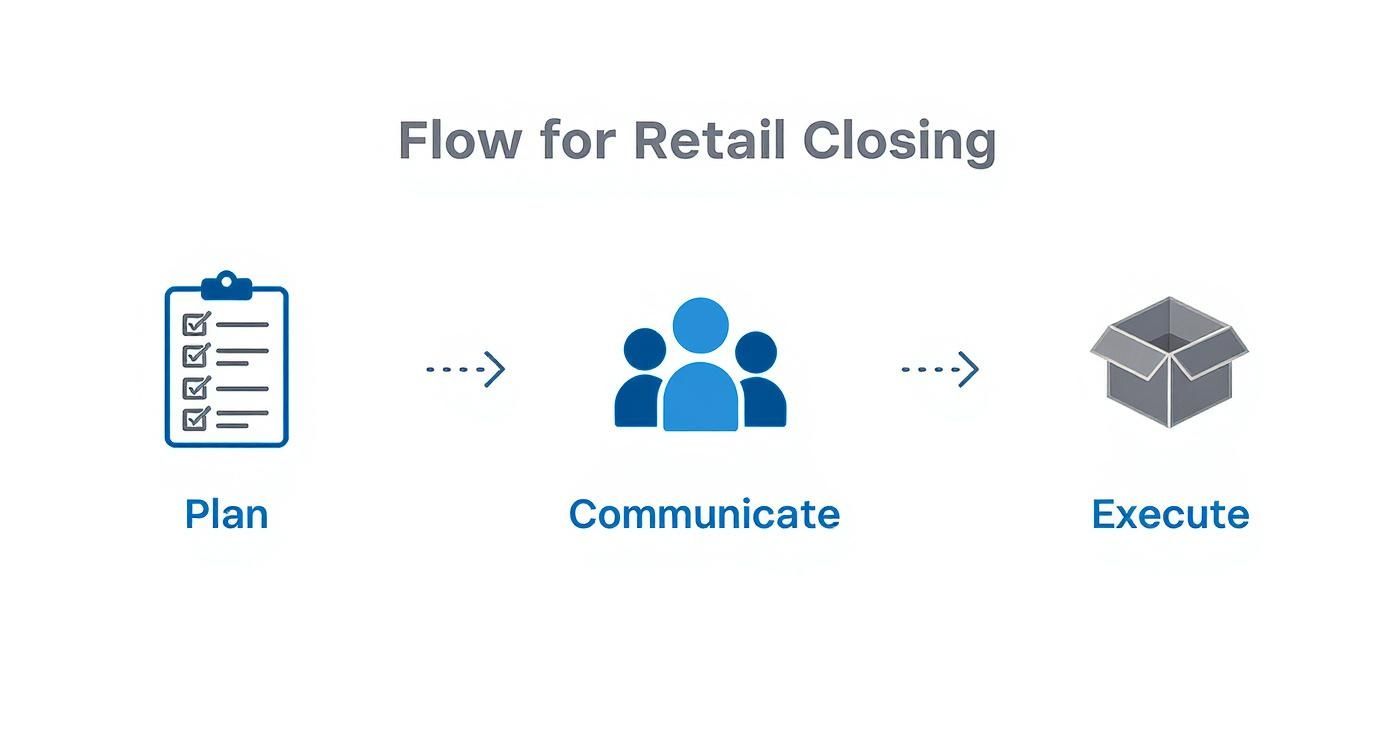
As you can see, a structured approach—plan, communicate, execute—is what separates a smooth transition from a chaotic one.
Settling Accounts and Final Filings
While you're dealing with the lease, you also need to settle up with suppliers and vendors. Make a complete list of every creditor and reach out to arrange those final payments. Trust me, you want to maintain good relationships here. You never know when you'll cross paths with these partners again in a future venture.
Your tax obligations don't disappear just because the doors are locked. You’ll have to file final sales tax returns, wrap up payroll taxes, and submit a final income tax return for the business. Following a solid sales tax compliance guide is absolutely critical, especially when you're reconciling all those last-minute liquidation sales.
The broader economy often adds a sense of urgency to these steps. In the UK's retail sector, for instance, the turmoil has been intense, with projections showing 17,350 store closures in 2025 alone, potentially leading to over 200,000 job losses. Conditions like these make meticulous financial management during a closure more important than ever.
Why Professional Counsel Is a Smart Move
Bringing in legal and financial advisors early isn't an expense—it's an investment in a clean getaway. An attorney can dissect the dense language in your lease and negotiate on your behalf. Meanwhile, an accountant will make sure every financial report and tax form is filed correctly and on time.
They also provide invaluable guidance on sensitive issues like employee severance packages, ensuring you handle terminations with compassion and in full compliance with labor laws. This expertise is what helps you sidestep costly legal battles down the road.
At the end of the day, a well-managed closure is a testament to your professionalism. You can learn more about how a structured approach makes all the difference by reading about our team and commitment at Fulton Junk Removal.
A Practical Guide to Inventory and Asset Liquidation
Once you have a firm closing date on the calendar, your attention needs to pivot to one of the most demanding parts of the process: turning your remaining inventory and assets back into cash. This isn't just about selling things off; it's about doing it strategically to maximize your return.
The classic "going out of business" sale is usually the first play. You can start with a modest discount, then get more aggressive as the final day approaches. To really make this work, it helps to understand effective strategies for selling unwanted items. The goal is to attract bargain hunters without giving away the farm on day one.
But let's be realistic—even the most successful sales will leave you with unsold stock. This is where professional liquidation firms can be a lifesaver. They'll often buy the rest of your inventory in one bulk transaction. You'll get a lower price per item, of course, but they clear your shelves in a single move, which is a massive win for your timeline.
Dealing with Fixtures, Furniture, and Equipment
Inventory is just one piece of the puzzle. Your store is full of fixtures, furniture, and equipment (FF&E)—we're talking shelving units, POS systems, display cases, and back-office furniture. Unloading these can be tricky, but you have options:
- Sell to Other Businesses: Get in touch with local retailers or startups. They're often looking for quality used equipment at a good price.
- Online Marketplaces: Platforms like Facebook Marketplace or specialized sites for things like restaurant equipment can connect you with a surprisingly large pool of buyers.
- Auction Houses: If you have high-value or unique items, a local auction house might be the best way to get a competitive price.
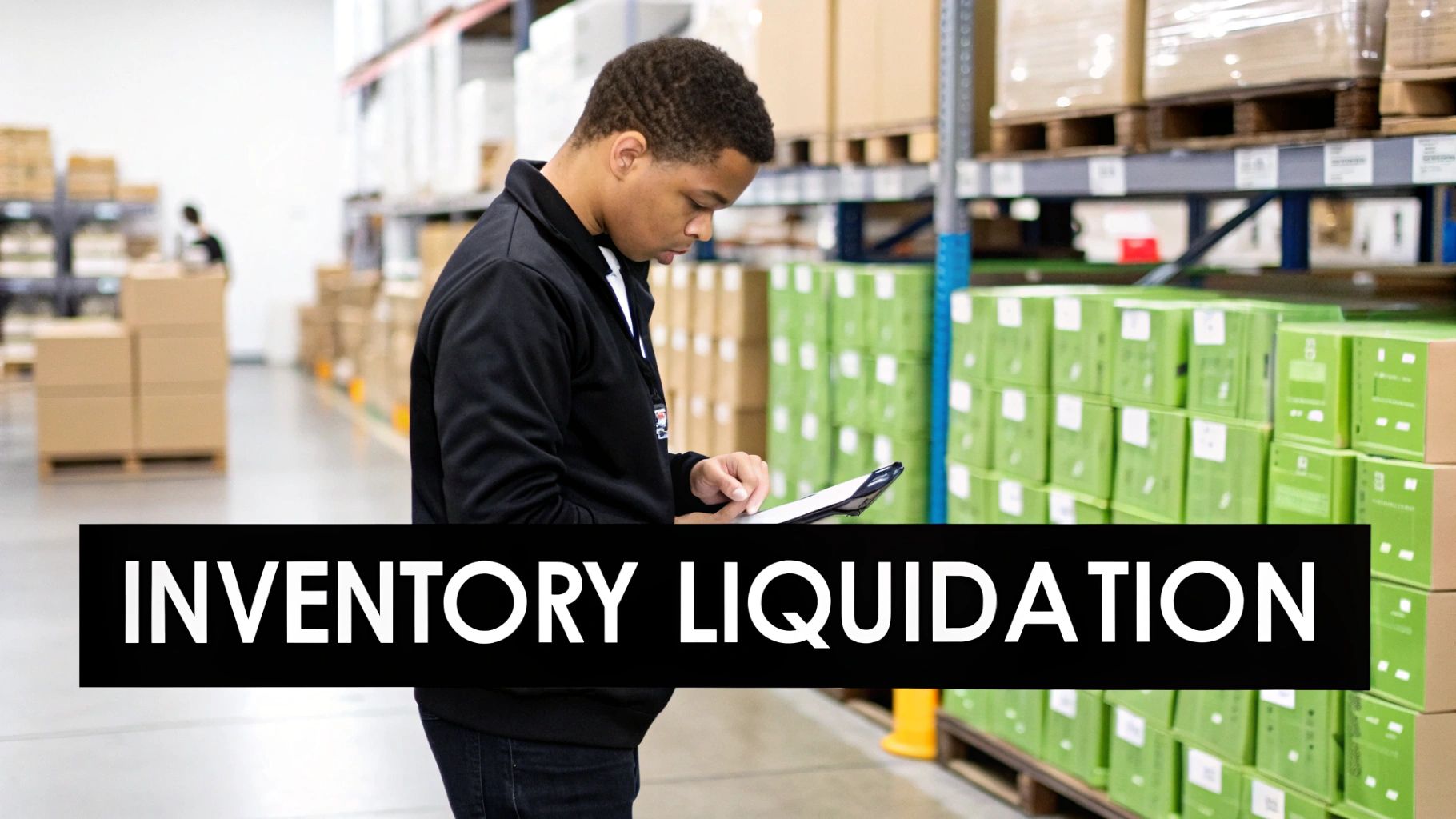
So, what happens with the stuff that just won't sell? This is a common stumbling block. While most junk removal companies take everything to the landfill, we recycle through Beyond Surplus to minimize waste and maximize reuse. This is a much smarter way to handle asset disposition.
For property managers and business owners, this is where eco-friendly partners become invaluable. A sustainable exit not only aligns with corporate responsibility goals but also simplifies compliance and reporting.
Instead of paying to dump perfectly usable materials, you can work with a partner who gets the circular economy. This is what we do. Fulton Junk Removal works hand-in-hand with Beyond Surplus to recycle electronics, metals, and other materials responsibly. We make sure items are diverted from landfills and given a new life, an approach that's becoming non-negotiable for businesses that want a clean, sustainable exit.
An Integrated Approach to Final Asset Disposition
For the items with zero resale value—think broken displays, worn-out office chairs, or ancient electronics—an integrated junk removal and recycling service is the most efficient path forward. This is especially true for property managers, warehouses, or any business overseeing multiple closures.
Fulton Junk Removal handles the physical removal of all unwanted items, and our partner, Beyond Surplus, ensures responsible recycling. This integrated process makes compliance and sustainability reporting easier for offices, warehouses, and property managers.
This bundled service takes the entire cleanout off your plate, makes sustainability reporting a breeze, and guarantees your exit is as green as it is clean. To explore more ideas for responsible business practices, check out our guide on the https://fultonjunkremoval.com/blog/.
Executing the Final Cleanout and Property Handover
The final cleanout is the last major hurdle standing between you and getting that security deposit back. This is where you have to meet the "broom-swept condition" clause that’s almost certainly in your lease agreement. It means the space needs to be completely empty and reasonably clean—but it's a lot more than just a quick sweep. It’s the process of completely erasing your store’s presence from the property.

Honestly, this is where professional help really pays off. The sheer volume of what’s left behind—from bulky furniture and stubborn fixtures to all the accumulated odds and ends—can feel impossible to manage on your own. Bringing in an integrated service streamlines the whole thing, handling the heavy lifting so you can focus on the final handover.
Your Essential Cleanout Checklist
To make sure nothing gets missed, you need a structured approach. Your final cleanout should be just as organized as your liquidation sale, covering every single inch of the store.
Your checklist should include things like:
- Removing All Signage: This means exterior signs, window decals, and any other branded materials left inside.
- Patching and Painting: Fix any holes in the walls from shelving or displays. A quick coat of paint to match the original color goes a long way.
- Fixture and Shelving Removal: Take apart and haul out all remaining store fixtures, gondolas, and shelving units.
- Deep Cleaning: This is crucial. Floors, restrooms, back offices, and any storage areas must be cleaned to meet your lease terms.
- Waste and Debris Disposal: Properly get rid of all trash, broken items, and anything else that didn't sell or get claimed.
This comprehensive effort is what ensures a smooth property handover and protects you from potential penalties or arguments with the landlord.
The goal is to leave the space in a condition that a new tenant could immediately begin their own build-out. Thinking from the property manager's perspective is the key to a successful final walkthrough.
The Advantage of an Integrated Junk Removal and Recycling Partner
For business owners and property managers, juggling the cleanout can be a logistical nightmare. Trying to coordinate different vendors for junk hauling, electronics recycling, and deep cleaning is both inefficient and expensive. A bundled service is a total game-changer here.
For example, Fulton can offer bundled junk removal + recycling pickup, where all electronic waste and recyclable materials are directly processed by Beyond Surplus. This means one phone call handles everything. The junk removal team manages the heavy lifting of old furniture, displays, and general debris. At the same time, the recycling partner makes sure all e-waste and metals are handled responsibly and kept out of landfills.
This integrated approach makes lease compliance and sustainability reporting seamless. You get the peace of mind knowing your cleanout is both efficient and eco-conscious. To see how this all comes together, learn more about the comprehensive services offered by Fulton Junk Removal.
The final walkthrough with your landlord is the moment of truth. When you present a clean, empty space, you’re in the best possible position to close this chapter on positive terms. Hand over the keys, get your security deposit back, and move forward, confident that you’ve managed a professional and complete exit.
Finalizing Your Business Closure
Just because the doors are locked and the space is empty doesn't mean you're done. The final phase of closing your retail store is all about tying up the administrative loose ends to officially dissolve the business. Skipping these steps can leave you vulnerable to lingering liabilities, so a clean, thorough wrap-up is non-negotiable.
Your first calls should be to the utility companies—electricity, gas, water, internet, and phone services. You'll want to schedule final meter readings and disconnections to stop future bills from showing up. At the same time, get a mail forwarding service set up to a secure address. This is critical for catching important tax documents, legal notices, or final vendor invoices that might arrive after you've handed over the keys.
Protecting Your Brand and Managing Records
With the physical store gone, your online presence is the last thing customers will see. It's incredibly important to manage this digital footprint to protect your reputation and avoid confusion.
Here’s what that looks like in practice:
- Update Your Website: Post a clear, professional message right on your homepage announcing the closure. Thank your customers for their support over the years and provide contact info for any final inquiries.
- Manage Social Media: Pin a similar closure announcement on all your social media channels. You can decide to deactivate the accounts later, but a final message prevents people from thinking you've just vanished.
- Update Online Listings: This one is easy to forget but so important. Mark your business as "permanently closed" on your Google Business Profile, Yelp, and other local directories. It keeps potential customers from driving to an empty storefront.
Handling these final details properly ensures you leave a positive, lasting impression.
A tidy administrative exit is just as important as a clean physical one. It’s the final step in protecting your personal and financial interests, allowing you to move on to your next venture without looking back.
Beyond your digital footprint, you have to securely manage your business records. Tax laws require you to keep financial records, employee files, and other key documents for several years. Store these files, whether they're physical or digital, somewhere secure but accessible. This isn't just a good idea; it's a legal requirement.
The reality is, a modern shutdown has gotten a lot more complicated. Retail store closing procedures today involve a multi-layered strategy that covers everything from inventory management and lease negotiations to the final administrative tasks that ensure a clean legal break. To get a better sense of these operational challenges, discover more insights on modern retail closures.
Finally, once every account is settled and all the paperwork is filed, you can legally dissolve your business entity with the state. Whether you’re an LLC, corporation, or sole proprietorship, there's a formal process to follow. I strongly recommend consulting with a legal professional for this last step to make sure it's done right.
For any last-minute questions about wrapping up your closure, feel free to contact our team for guidance.
Frequently Asked Questions About Store Closures
Closing up a retail store brings a flood of last-minute questions, whether you're the retailer managing the final markdown or the property manager getting ready for a new tenant. Getting straight answers is key. Here’s a rundown of the most common things people ask when they get to this stage.
The whole process can feel like a monster, but if you break it down piece by piece, it’s much more manageable.
How Long Does It Typically Take to Close a Retail Store?
There’s no magic number, but a good rule of thumb is anywhere from 30 to 90 days. This timeline can stretch or shrink depending on your lease terms, how much inventory you're sitting on, and any state or local rules you need to follow.
A few key milestones really drive this schedule. You’ll need to give your landlord notice (usually 30-60 days), sell off every last piece of stock, and handle the final cleanout. To avoid a mad dash at the finish line, start mapping out your plan at least three to four months before your lease is up.
What Is the Best Way to Dispose of Leftover Inventory and Fixtures?
Your first move should always be a massive liquidation sale. The goal is to turn as much merchandise into cash as you can. Once the sale is over and the dust settles, you can offload the rest in bulk to a professional liquidator. It’s a fast way to clear the shelves, even if you don't get top dollar for every item.
But what about the stuff nobody wants? I’m talking about old metal shelving, displays that have seen better days, or broken electronics. For that, an eco-friendly disposal service is your best bet. A partner like Fulton Junk Removal is perfect for this phase. They work directly with Beyond Surplus to make sure these materials get properly recycled, which keeps you out of trouble with landfill fees and makes sustainability reporting a breeze.
A classic mistake is underestimating just how much non-saleable stuff you have. Factoring in responsible disposal early in your retail store closing procedures saves a world of headaches later and keeps you compliant with environmental standards.
What Are Common Mistakes to Avoid When Closing a Store?
The biggest slip-ups almost always come down to three things: poor communication with your staff, misjudging how long it takes to liquidate everything, and dropping the ball on the final cleanout. If your lease demands a "broom-swept" condition and you ignore it, you can kiss your security deposit goodbye.
Another huge error is just tossing everything in a dumpster. Not only can this lead to fines, but it also doesn't align with modern corporate responsibility. The smartest move is to hire a professional service that handles both the junk removal and the certified recycling. This ensures you’re meeting every requirement from your landlord and the EPA for a clean, compliant exit.
Ready to ensure your store's final cleanout is handled professionally and responsibly? Fulton Junk Removal offers bundled junk removal and recycling services to make your property handover seamless. Learn more and get your free estimate at https://fultonjunkremoval.com.
