
Top Telecom Consulting Services Dallas for Business
Your office internet bill went up again. Your team complains that calls sound choppy on Microsoft Teams or a hosted VoIP line. A carrier rep says your current contract is “standard,” but the fine print is dense, the add-on charges keep showing up, and nobody internally has time to compare providers across the Dallas market.
That's where a lot of businesses start looking into telecom consulting services Dallas. Not because telecom is exciting, but because it's expensive, operationally critical, and easy to get wrong. One bad contract renewal, one poorly planned cloud voice rollout, or one unsecured hybrid setup can create months of avoidable cost and disruption.
A good telecom consultant helps you slow the chaos down. They look at what you're paying for, how your network performs, where security gaps may exist, and which vendors fit your business. In a market as dense and competitive as Dallas, that outside perspective matters.
Navigating Dallas's Complex Telecom Landscape
A Dallas business owner usually notices telecom problems in pieces, not all at once. First, the monthly bill feels too high. Then a conference call drops during a customer meeting. Then a remote employee says the VPN is sluggish, and a provider invoice includes services nobody remembers approving.

That pattern is common because telecom touches everything. Internet circuits, voice platforms, mobile devices, conferencing tools, cloud connectivity, carrier contracts, failover planning, and compliance all sit in the same operational stack. When one piece is weak, the business feels it fast.
Where Dallas businesses get stuck
Dallas isn't a simple telecom market. It's one of the country's major telecom centers, and that creates both opportunity and confusion. The U.S. telecom services market was valued at USD 468.08 billion in 2023 and is projected to grow, with Dallas-headquartered AT&T playing a major role, according to Grand View Research's U.S. telecom services market analysis.
For a business buyer, that scale doesn't make decisions easier. It usually means more vendors, more packages, more overlapping offers, and more room for waste.
Common pain points I see include:
- Contract confusion: Term lengths, renewal clauses, service credits, and bundled pricing often hide the true cost.
- Performance mismatch: A company buys “business-grade” service but still struggles with call quality, latency, or unstable remote access.
- Tool sprawl: Teams use Zoom, Teams Phone, mobile devices, SIP trunks, and internet circuits without one clear owner tying the pieces together.
- Security blind spots: Cost gets reviewed every month. Voice security, decommissioned gear, and hybrid access controls often don't.
If your telecom setup feels fragmented, that usually means nobody has stepped back and designed it around the business as a whole.
What consulting changes
Telecom consulting isn't about adding another vendor. It's about giving your business a guide who can audit the environment, translate provider language, and push decisions toward cost control, performance, and lower risk.
For a Dallas company, that often starts with very practical questions:
- Are you paying for services you don't use?
- Do your circuits and voice tools match how your team operates?
- Is your provider contract protecting you, or protecting the carrier?
- Have you treated telecom security as a business risk, not just an IT detail?
Those questions separate routine frustration from strategic control.
What Exactly Is a Telecom Consultant
A telecom consultant is best understood as a general contractor for your company's connectivity. Your IT team may handle day-to-day tickets, user support, device setup, and application issues. A telecom consultant steps back and looks at the bigger system. Carriers, contracts, voice platforms, mobile plans, cloud connectivity, resilience, and compliance.
That distinction matters because many business owners assume their internal IT staff should already own all of this. Sometimes they do part of it. Usually they don't have the time, market visibility, or contract negotiating power to manage every telecom decision thoroughly.
How the role differs from in-house IT
Your internal IT team is typically focused on keeping people productive. They troubleshoot Wi-Fi, onboard staff, manage endpoints, support collaboration tools, and react when something breaks. A telecom consultant works alongside that team but from a different angle.
They typically help with:
- External market evaluation: Comparing carrier options, pricing structures, and service models across the Dallas area.
- Contract interpretation: Reviewing billing terms, renewal triggers, service commitments, and penalties.
- Strategic design: Aligning voice, internet, cloud, and mobility decisions with growth plans and risk tolerance.
- Independent oversight: Recommending what fits the business, rather than what a single provider wants to sell.
If your team needs broader technical advisory help beyond telecom, a resource like Pratt Solutions can help frame how outside technical consulting fits with internal operations and project delivery.
What a consultant actually does in practice
Let's make it concrete. Say you run a multi-location business in Dallas with an office, a warehouse, and a hybrid sales team. Calls drop in one building, invoices come from multiple carriers, and your wireless costs keep creeping up.
A telecom consultant won't just tell you to “upgrade the network.” They should ask:
- Which applications are sensitive to latency and packet loss?
- Which users need mobile-first plans versus desk-based voice tools?
- Are there duplicate services across locations?
- Do your failover options protect revenue-generating operations?
- How are voice systems, mobile devices, and cloud apps secured?
That last question gets overlooked too often. Plenty of firms still approach telecom consulting like it's only about bill reduction. Cost matters, but Dallas businesses also need someone who treats cybersecurity and compliance as part of telecom architecture. Voice systems, SIP connections, mobile endpoints, and edge infrastructure can all become exposure points if they're poorly planned.
Practical rule: If a consultant only talks about savings and never asks about risk, compliance, or hybrid work security, you're not getting full telecom consulting. You're getting partial expense management.
When it makes sense to bring one in
You usually don't hire a telecom consultant because everything is fine. You bring one in when a trigger forces the issue.
Typical triggers include:
- A contract renewal is coming up
- You're opening or consolidating locations
- VoIP or UCaaS performance is inconsistent
- Bills are rising without a clear reason
- A cloud migration changes traffic patterns
- Leadership wants stronger oversight of security and compliance
In other words, the consultant's role is to give structure to telecom decisions that otherwise stay reactive.
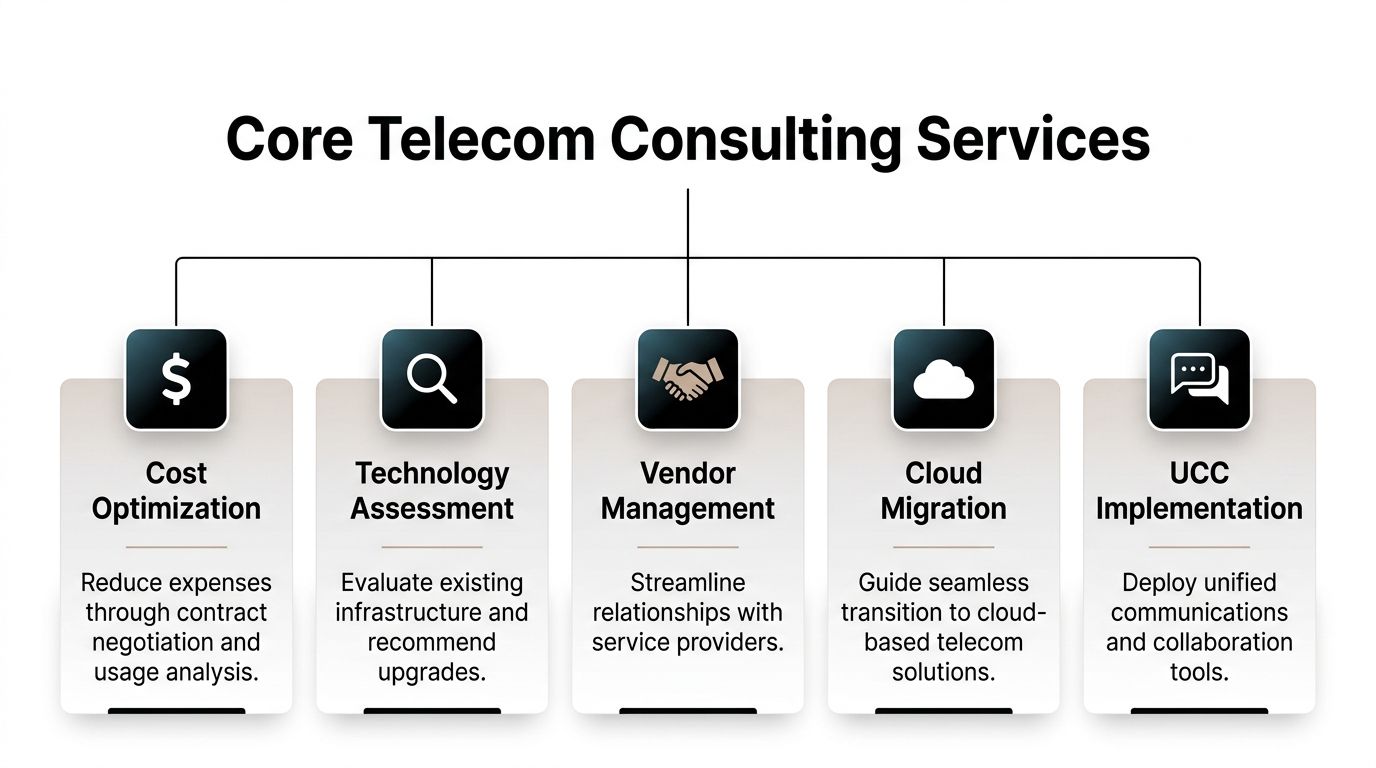
Core Telecom Consulting Services Explained
Businesses usually hear “telecom consulting” and think of invoice audits. That's only one piece. In Dallas, the stronger firms go much further, using analytics, architecture planning, migration support, and vendor management to improve both cost and operations. Some consultants now use AI-driven analytics to automate service delivery and reduce OPEX by up to 25% through predictive traffic forecasting and root cause analysis, as described by B12 Consulting's telecom consulting overview.
Network audit and cost optimization
This is the service most companies need first. A consultant reviews invoices, inventory, contracts, and service usage to identify waste. The goal isn't just to ask for a discount. It's to find circuits you no longer need, voice features nobody uses, duplicated services after office moves, or pricing tiers that no longer fit your headcount.
A proper audit also checks whether you're paying for business-critical resilience in the right places. Some sites need redundancy. Others are overbuilt and overpriced.
Vendor sourcing and contract negotiation
Dallas businesses often get stuck comparing several providers with different terms, installation timelines, and support models. A consultant narrows that down.
Instead of collecting a pile of carrier quotes and guessing, you get structured comparisons around service levels, contract flexibility, implementation risk, and operational fit. This is one area where external perspective saves time because the consultant has usually seen how providers behave after the sale, not just during the pitch.
The cheapest quote often becomes the most expensive decision if service credits are weak, support is slow, or the handoff into deployment falls apart.
UCaaS and VoIP strategy
Voice has changed. Many businesses no longer run a traditional phone system in a back closet. They run cloud calling, contact center tools, mobile clients, and collaboration platforms across multiple locations and remote users.
A telecom consultant helps decide whether your business needs a full UCaaS rollout, a hybrid voice model, SIP trunking, or a cleanup of an already messy environment. They also help map call flows, number management, user groups, call recording needs, and resilience planning.
If you're evaluating cloud transitions more broadly, it can help to compare your telecom plan against a wider bespoke cloud adoption consultancy approach so your communications stack doesn't drift away from your overall cloud strategy.
Network design and implementation support
This service matters when the business is moving, expanding, renovating, or re-architecting a site. The consultant helps specify internet circuits, secondary connectivity, handoff requirements, coverage planning, provider coordination, and cutover sequencing.
For offices, this may focus on user experience and collaboration reliability. For warehouses or industrial sites, it may focus on mobility, coverage, and uptime under tougher operating conditions.
Mobility and device planning
Mobile costs can develop into one of the messiest telecom categories. New lines get added. Old devices stay active. Plans don't match usage. Executives need different support than warehouse teams or field technicians.
A consultant can review carrier plans, line assignments, device policies, and lifecycle controls so mobility supports the business instead of drifting into unmanaged spend.
Compliance and telecom security review
This is the service I wish more buyers asked for directly. Voice systems, conferencing tools, mobile endpoints, and edge connectivity all affect compliance posture. If your business handles sensitive customer information, healthcare data, financial records, or regulated communications, telecom decisions aren't just operational. They're legal and reputational.
A capable consultant should examine how your telecom environment supports secure access, controlled provisioning, clean offboarding, and documented vendor responsibilities.
Common Telecom Consulting Services and Their Business Impact
| Service | Primary Goal | Ideal For Businesses That… |
|---|---|---|
| Network audit and cost optimization | Identify waste, billing errors, and mismatched services | Suspect they're overspending or can't clearly map services to locations |
| Vendor sourcing and negotiation | Improve provider fit and contract terms | Are near renewal, opening locations, or unhappy with current carriers |
| UCaaS and VoIP strategy | Align calling and collaboration tools with real work patterns | Have hybrid teams, call quality issues, or aging phone systems |
| Network design and implementation | Build or upgrade connectivity with fewer rollout mistakes | Are moving offices, expanding, or redesigning infrastructure |
| Mobility management | Control mobile spend and device complexity | Support field teams, executives, or multi-role staff with different needs |
| Security and compliance review | Reduce exposure in telecom-related systems and processes | Need stronger controls for regulated data or hybrid access |
The Tangible Business Benefits of Telecom Consulting
The value of telecom consulting shows up when the business stops paying for confusion. Better contracts matter, but the main payoff is broader. Fewer outages. Faster repairs. Cleaner vendor relationships. Better visibility into what the company owns and uses.

One clear example is operational response. By deploying custom analytics models, consultants can reduce mean time to repair by up to 40% through predictive alerts and improve bandwidth optimization by 25%, according to Power BI Consulting's Dallas page. For a business that depends on voice, cloud apps, and customer response times, faster repair isn't a technical vanity metric. It's a direct productivity gain.
Lower costs without blind cuts
The first benefit many owners want is cost reduction. Fair enough. Telecom billing is full of legacy charges, unnecessary services, and poorly matched plans.
But smart savings don't come from cutting randomly. They come from matching service levels to actual business need. A site with constant customer traffic may need stronger redundancy than a back-office location. A mobile-heavy workforce needs a different plan structure than a desk-based accounting team.
In Dallas, consultants also help because they understand local carrier options and where providers are strong or weak in real deployments.
Better performance for daily work
Employees rarely say, “our telecom architecture is underperforming.” They say:
- calls sound robotic
- video meetings freeze
- remote logins lag
- customer hold times get worse
- a warehouse scanner keeps dropping signal
Those are telecom problems wearing business clothes. A consultant traces them back to network design, service quality, traffic patterns, or tool mismatch.
Stronger control over outages and support
One of the hidden gains from consulting is accountability. When your internal team is juggling users, devices, software, and multiple vendors, carrier issues often drag on because nobody owns the escalation path end to end.
A consultant changes that by documenting services, clarifying who is responsible, and building reporting around performance and support commitments.
Bottom line: The business benefits most when telecom stops being a series of isolated tickets and becomes an actively managed business system.
Better protection against security and compliance failures
This benefit is often underestimated until something goes wrong. A business may negotiate excellent rates and still expose itself through unsecured voice paths, weak deprovisioning, unmanaged mobile devices, or sloppy handling of retired telecom hardware.
That matters for regulated industries, but it also matters for any company that values continuity and trust. A telecom consultant with a security mindset will push beyond line-item savings and ask how your systems are provisioned, monitored, decommissioned, and documented.
For office moves, refreshes, or telecom hardware replacements, operations teams should also think about what happens after the gear comes off the network. Decommissioned phones, cabling, network peripherals, and old electronics still create compliance and sustainability tasks. Many firms plan the rollout but forget the disposal workflow.
Why Dallas Is a Unique Telecom Hub
Dallas businesses don't buy telecom in an ordinary market. The city has deep roots in the industry, and that history still shapes how providers operate, how enterprise networks grow, and why consulting demand stays high.

Dallas became a telecom epicenter after the 1984 Bell System divestiture, which led to the formation of Southwestern Bell, later tied to what became AT&T in Dallas, according to P&S Market Research's telecom consulting market analysis. That legacy didn't just create brand recognition. It created an ecosystem of carriers, engineers, service firms, and enterprise buyers who treat telecom as core infrastructure.
Why local knowledge matters here
In a smaller market, a consultant may only need broad technical competence. In Dallas, that's not enough. A local consultant should understand how DFW businesses buy, deploy, and support telecom across office towers, industrial properties, healthcare environments, retail footprints, and distributed operations.
The local market creates a few realities:
- Provider choice is wide: That sounds good until you have to compare offerings that look similar on paper but perform differently in practice.
- Growth moves fast: Companies relocate, add sites, merge teams, and shift to hybrid work quickly.
- Telecom overlaps with real estate decisions: A move across the metro can change carrier options, install timelines, and network design assumptions.
- Enterprise expectations are high: Dallas businesses often expect strong uptime, responsive support, and scalable cloud connectivity from day one.
Dallas rewards precision
This is why generic advice falls apart. A national template might tell you to “compare three providers” or “move to the cloud.” In Dallas, the better move is often more specific. Which provider serves that building well. Which circuit design supports that warehouse. Which voice model fits that compliance environment. Which contract terms matter in a market where companies scale and relocate often.
Local telecom consulting works best when the consultant understands not just the technology, but the buildings, provider habits, deployment friction, and business pace of the Dallas-Fort Worth area.
That local precision is what turns telecom from a recurring headache into a managed asset.
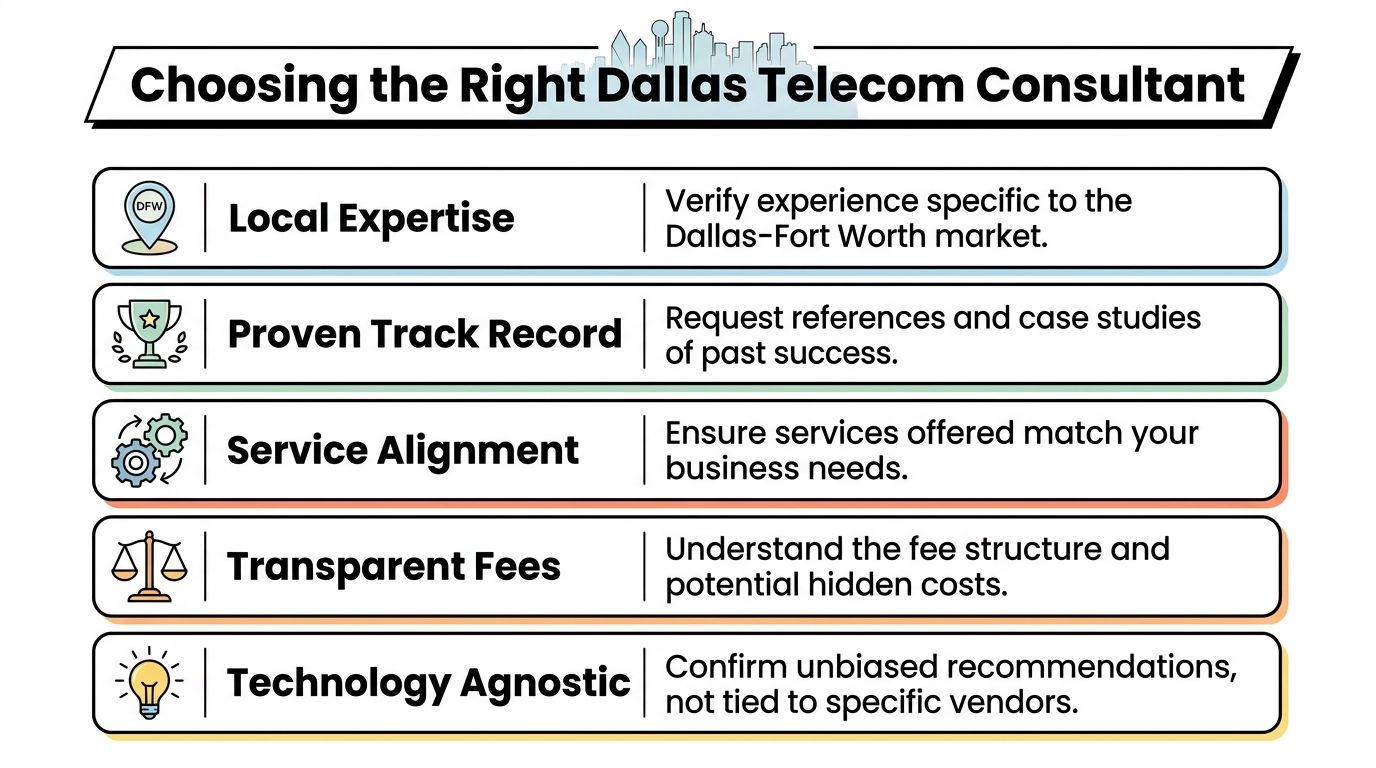
Choosing the Right Dallas Telecom Consultant
Hiring the wrong consultant can waste as much money as signing the wrong carrier contract. Plenty of firms can review a bill. Fewer can translate technical complexity into business decisions, and fewer still can do it while accounting for cybersecurity, compliance, and decommissioning risk.
That last point matters more than most buyers realize. A key issue in the market is how consultants handle cyber risk. One reviewed source notes a 28% surge in telecom breaches, with Dallas ranking high in Texas incidents, and warns that overlooking threat modeling can increase breach costs by 250%, as discussed by Prettyman's telecom consulting firm background page.
Start with their questions, not their pitch
The best consultants don't begin by selling a package. They begin by asking sharp questions. If the first meeting is mostly a slide deck about savings, be careful.
Listen for questions like these:
- How does your team work today? Office-based, remote, warehouse, field, or mixed?
- Which systems are business critical? Voice, ERP access, customer support, mobile dispatch, contact center?
- Where are the compliance obligations? Healthcare, finance, customer recordings, internal governance?
- What happens to retired hardware and old circuits? Is there a documented offboarding and disposal process?
- Who owns security decisions across telecom and IT?
Those questions tell you whether the consultant sees telecom as infrastructure, not just spend.
What to verify before you sign
A Dallas telecom consultant should be able to explain their process clearly. Not with buzzwords. With documents, checkpoints, and responsibilities.
Use this checklist during evaluation:
Local market experience
Ask where they've worked in DFW and what kinds of properties and business models they understand.Technical depth
They should be comfortable discussing VoIP, UCaaS, carrier contracts, mobile environments, cloud connectivity, and escalation paths in plain English.Security and compliance mindset
Ask how they address threat modeling, provisioning controls, vendor accountability, and hybrid access risks.Carrier neutrality
You want recommendations based on fit, not hidden loyalty to one provider.Implementation support
Strategy is useful. Support during cutovers, migrations, and issue resolution is where many projects succeed or fail.
Questions that reveal real competence
Don't ask only, “How much can you save us?” That's too narrow and easy to answer vaguely.
Ask these instead:
- What would you review in our current contracts before renewal?
- How do you evaluate voice and connectivity risk for hybrid teams?
- How do you coordinate with an internal IT department without creating overlap?
- What reports or dashboards do you provide after the assessment?
- How do you handle telecom equipment that's decommissioned during a refresh or relocation?
That last question is practical, not peripheral. Businesses often replace phones, networking accessories, cabling, conferencing hardware, and mobile equipment during telecom optimization. If nobody owns removal, recycling, and documentation, the project ends with clutter, possible data-handling concerns, and poor sustainability tracking.
A consultant who ignores end-of-life handling is only solving the front half of the telecom problem.
Watch for these red flags
Some warning signs show up quickly:
- They promise savings before reviewing anything
- They can't explain their security approach
- They avoid discussing contract language
- They push one platform for every business
- They have no plan for inventory accuracy
- They treat decommissioned equipment as someone else's issue
A strong consultant should make your environment simpler, more visible, and easier to govern. If their process sounds vague, their results usually will be too.
Your Next Steps for Telecom Optimization
If your telecom environment feels expensive, fragile, or harder to manage than it should be, you're probably not dealing with one isolated problem. You're dealing with a stack of decisions that were made at different times by different people, often without one clear owner.
That's why telecom consulting services Dallas are valuable when they're done right. The point isn't just to renegotiate a bill. It's to align connectivity, voice, mobility, security, and vendor management with how your business operates.
You don't need to fix everything at once. Start with one of two paths.
If you need action now
Choose a focused telecom assessment. Gather your current invoices, provider contracts, service inventory, and a short list of recurring complaints from staff. Then ask a consultant to review cost, performance, and security exposure together, not as separate projects.
That approach works well if you're close to renewal, planning a move, struggling with VoIP quality, or trying to reduce operational waste quickly.
If you're still evaluating options
Schedule an exploratory call and use it as a screening exercise. Ask the questions listed above. Pay attention to whether the consultant talks only about rates or whether they also address governance, resilience, and telecom-related cyber risk.
For many businesses, the smartest first move is getting a clean view of what they already have. Once that inventory is accurate, better decisions usually follow fast.
The goal isn't perfection. It's control. When you know what services you own, what risks sit inside them, and which vendors support your goals, telecom stops feeling like a monthly surprise.
If your telecom upgrade, office move, or infrastructure refresh leaves you with old phones, networking gear, cabling, electronics, or general business clutter to clear out, Fulton Junk Removal can help simplify the cleanup. Their commercial junk removal service works especially well for offices, warehouses, and property managers who need fast haul-away plus responsible recycling support through Beyond Surplus, making end-of-life disposal and sustainability reporting easier to manage.
