
Telecom Consulting Services Los Angeles: A How-To Guide
If you're running a business in Los Angeles, telecom problems rarely show up as one obvious emergency. They show up as a stack of smaller frustrations. Your team in Santa Monica says video calls lag. Your warehouse in the Valley has a different carrier and a different billing format. A Downtown office move stalls because building access, riser rules, and carrier coordination take longer than the lease team expected. Then the invoices land, and nobody is fully sure what you're paying for anymore.
That's where telecom consulting services Los Angeles businesses rely on can make a real difference. Not because a consultant magically fixes everything, but because someone needs to sort out carrier options, contracts, site constraints, implementation sequencing, and billing hygiene before costs drift and service quality slips.
Los Angeles adds complexity fast. Carrier footprints vary by block. Older buildings can slow installs. Multi-site businesses often inherit a patchwork of internet, voice, mobility, and support arrangements that made sense once but no longer fit how the company operates. If you have hybrid staff, cloud apps, or customer-facing operations, telecom becomes an operations issue, not just an IT line item.
Is Your LA Business Paying Too Much for Telecom
A common LA scenario looks like this. A company signs a lease in one neighborhood based on what the broker says is “well connected.” After move-in, the office manager finds out the preferred fiber provider isn't lit in the suite, the backup option is expensive, and the building's access process adds delays. Meanwhile, the old location is still billing for circuits that nobody canceled cleanly.
That's not rare. It's how businesses end up overpaying while still dealing with poor performance.
In Los Angeles, I see the same pressure points repeatedly. Hybrid work exposed weak network design. Multi-location operations exposed inconsistent contracts. Dense commercial real estate exposed how much install timelines depend on landlords, riser access, after-hours work windows, and who controls the telecom room.
The hidden cost isn't just the invoice
The monthly bill matters, but the larger cost is operational drag. Staff lose time chasing outages. Finance reviews invoices it can't easily validate. IT inherits vendor issues it didn't create. Leadership assumes the problem is “the carrier,” when the actual issue is usually a mix of bad inventory, outdated service design, and nobody owning the whole telecom stack.
Practical rule: If you can't explain what every active telecom service is for, you're probably carrying waste somewhere.
Los Angeles businesses also deal with neighborhood-level differences that national carriers don't explain well during the sales process. A service that works well in Century City may not be the best option for a site in Vernon or a converted building near the Arts District. That's one reason local operating context matters more than generic procurement advice.
If your company works across several service areas, it helps to think about telecom the same way you think about facilities coverage and field operations across regional service footprints. The mix of locations changes the right strategy.
What a consultant changes
A good telecom consultant doesn't just “find a cheaper provider.” They map what you have, identify what's unnecessary, pressure-test what your business needs, and handle the vendor friction most internal teams don't have time for. In LA, that often means solving for building realities as much as technical requirements.
What Telecom Consulting Services Can Do For Your Business
The telecom consulting market is large because the problem is large. The global telecom consulting market is valued at USD 27.5 billion in 2024 and projected to reach USD 49.52 billion by 2032, according to Wise Guy Reports' telecom consulting market analysis. That growth tracks with what businesses already feel on the ground. Network management is more complicated, cloud adoption changed traffic patterns, and remote or hybrid work made telecom decisions harder to ignore.
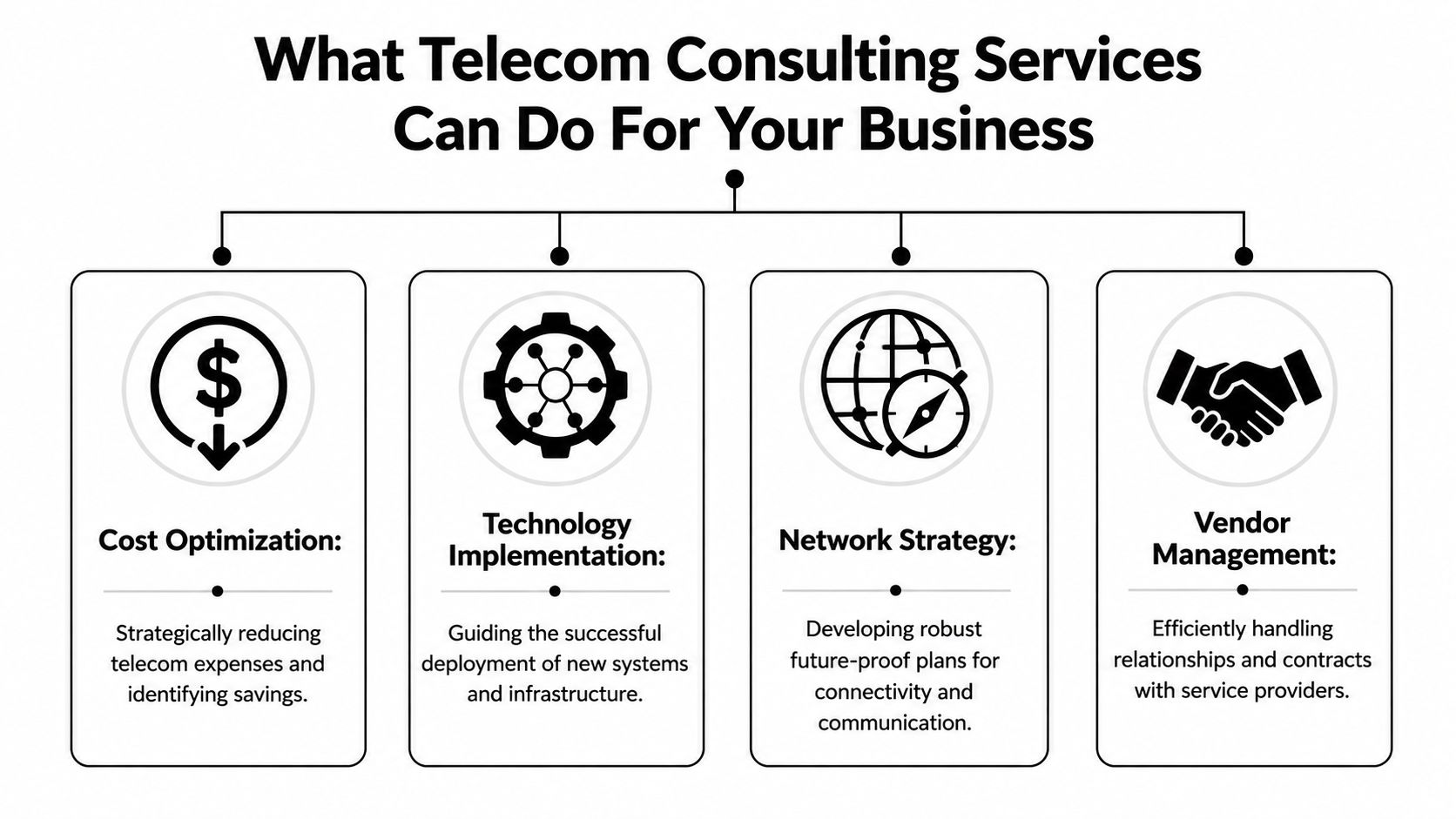
Four service pillars that matter in LA
Most telecom consulting engagements fit into four practical buckets.
Cost optimization and audit Many businesses start with this process. A consultant reviews invoices, inventories services, checks contract terms, and looks for circuits, lines, features, or locations that no longer match operations. For a manufacturing business in Vernon or a distributor with multiple utility accounts and service addresses, this work usually clears up years of billing confusion before anyone talks about a new rollout.
Technology implementation
This covers migrations and deployments. Think office internet cutovers, SD-WAN design, voice platform moves, wireless refreshes, or backup connectivity. In Los Angeles, implementation planning has to account for elevator reservations, limited rooftop access, after-hours building rules, and the simple fact that some landlords are more responsive than others.Network strategy
This is the long-view piece. A consultant should help you decide what your network should look like based on risk, growth, application use, and geographic spread. A retail brand with sites in Santa Monica and Pasadena doesn't need the same design logic as a post-production company moving large media files between editors and cloud systems.Vendor management
In vendor management, experienced consultants earn their keep. Carriers have their own processes, escalation paths, and contract language. Somebody has to challenge install dates, service credits, billing errors, and renewal terms. If that burden stays with your office manager or internal IT lead, it usually gets handled late.
LA examples where each service fits
A law firm in Century City may need a UCaaS strategy because its old phone system no longer supports hybrid attorneys and staff. A property manager may need help coordinating multiple carriers across buildings with different ownership structures. A creative agency in the Arts District may need a consultant to verify actual fiber availability before signing a lease extension.
What doesn't work is buying solutions in isolation. Businesses often jump straight to “we need new internet” when the underlying issue is poor failover design, weak internal ownership, or a voice platform that was never set up for the way staff now work.
The best telecom projects start with business operations, not with the carrier quote.
That same principle shows up in other IT environments too. If you want a useful outside perspective on how smaller organizations approach support trade-offs, this guide to IT support for London SMEs is worth reading. Different market, same lesson. Clarity beats tool sprawl.
Where businesses usually misjudge the scope
They underestimate inventory cleanup. They assume one vendor can solve every location. They treat voice, internet, mobility, and support as separate purchases instead of one operating system for communication.
If you're evaluating your own needs, it helps to list telecom alongside your broader operational stack, much like companies do when reviewing commercial service categories. Once you see all the moving parts together, priorities get clearer.
First Define Your Needs A Project Scoping Guide
Most bad telecom projects don't fail because the technology is impossible. They fail because the business never defined the assignment well enough. In telecom, that creates expensive noise fast. One stakeholder wants lower costs. Another wants redundancy. A third wants to move phone systems. Nobody agrees on the order of operations.
That planning gap matters. Even in telecom, digital transformation initiatives only have a 26% success rate, and the recommended 10-20-70 rule puts 70% of the effort on operational transformation and process planning, as outlined in McKinsey's research on unlocking success in digital transformations. The lesson is simple. Scope first. Buy second.

Start with your current state
Before you call any consultant, document what exists right now.
Locations in play
List every office, warehouse, retail site, and temporary space. Include relocations, renewals, and planned closures.Services by site
Note internet circuits, phones, mobile accounts, contact center tools, conferencing tools, and backup connections.Known issues
Write down recurring outages, billing confusion, poor support experiences, install delays, and user complaints.Current ownership
Identify who manages vendors, who approves invoices, who opens tickets, and who keeps inventory current.
This step sounds basic. It isn't. Many LA companies have enough real estate movement and vendor overlap that nobody has a clean current-state picture.
Define what success actually means
Don't ask for “better telecom.” Ask for a specific operating result.
Use questions like these:
- What hurts most today? Is it cost, uptime, support, poor call quality, inconsistent service across locations, or all of it?
- What business changes are coming? Office move, expansion, hybrid policy shift, warehouse opening, software migration, headcount changes.
- Where can you tolerate risk? Some sites need full resilience. Others can operate with a simpler design.
- What has to be standardized? Billing format, reporting cadence, carrier count, support workflow, voice platform, hardware ownership.
- What can't break during transition? Front-desk phones, customer support queues, alarm lines, payment systems, building systems.
If leadership can't rank priorities, the project will drift toward whoever talks to the carrier most often.
Build a short scoping document
Keep it tight. A useful scope document usually includes:
- Business summary
- Location list
- Current telecom environment
- Top pain points
- Desired outcomes
- Constraints and deadlines
- Internal decision-makers
If you want a sense of how operational teams document projects and recurring issues for outside help, a well-organized company blog archive can be a surprisingly useful reference point for clarity and consistency. This business operations blog is a good example of how to make practical topics easy to review.
A consultant can refine your scope. They shouldn't have to invent it from scratch.
How to Find and Vet Telecom Consultants in Los Angeles
Los Angeles is a strong market for telecom consulting because the operating environment is messy in all the usual ways. Multiple carriers, different building conditions, fragmented service histories, and lots of companies juggling cost control with growth. In North America, the telecom consulting market is the largest, generating USD 7,291.0 million in 2024, according to Bearstone's Los Angeles telecom consulting overview. That scale reflects a mature market where businesses often need help sorting through vendors and contracts, not just buying bandwidth.

Where to look beyond search results
A generic search will give you names. It won't tell you who understands LA.
Start with:
Peer referrals in your vertical
Ask companies with similar site patterns. Property groups, media firms, distributors, and professional services businesses often face very different telecom issues.LinkedIn searches tied to Los Angeles
Look for consultants discussing carrier management, office moves, multi-site rollouts, and TEM work, not just broad IT consulting.Local business networks
Chambers, trade groups, and operations communities can surface firms that have already worked through local building and carrier obstacles.Your own ecosystem
Commercial brokers, MSPs, low-voltage contractors, and facilities leads often know which consultants solve real implementation problems and which ones only sell strategy decks.
What a strong shortlist looks like
You're not looking for the prettiest website. You're looking for evidence of fit.
A promising consultant should show:
Local relevance
They should sound like they know the difference between dealing with a newer Westside office tower and an older industrial building with access constraints.Carrier independence
If they only ever seem to recommend one provider, be careful.Operational depth
Ask whether they handle invoice audits, disputes, order tracking, renewals, and escalation management, not just one-time procurement.Communication discipline
Their process should include documentation, regular updates, and clear responsibility lines.
In LA, local knowledge isn't a branding detail. It's often the difference between a clean cutover and a month of avoidable delay.
A company's own story can also tell you something about how it works. Even outside telecom, reviewing an about page that explains operating standards and service philosophy can help you spot whether a business thinks in systems or just in sales language. Apply that same filter here.
Critical Interview Questions and Red Flags to Watch For
By the time you interview telecom consultants, you shouldn't be asking broad questions like “So, what do you guys do?” You want to pressure-test judgment, not collect a sales presentation.
Strong interviews sound specific. Weak ones stay abstract.
Ask about LA operating realities
Start with questions that force the consultant to show local pattern recognition.
How do you evaluate carrier options across different LA submarkets?
A good answer should mention building availability, landlord constraints, installation practicalities, and the need to verify serviceability before committing.How do you handle office moves or new site activations in dense commercial buildings?
Listen for project sequencing, landlord coordination, riser access, demarc extension planning, and fallback options if the primary install slips.What's your process when a carrier says a date is firm and the site still isn't ready?
Good consultants talk about escalation, milestone tracking, and documenting dependencies early.
A red flag is any answer that treats telecom like a clean online purchase. In Los Angeles, it often isn't.
Ask how they manage accountability
You need to know whether they own outcomes or just recommendations.
Try these:
- Who tracks every order, install, and billing issue once the project starts?
- How do you document inventory so services don't get lost after a move or renewal?
- What reports do you give leadership, finance, and IT?
- How do you resolve disputes when a provider bills incorrectly or misses a commitment?
A weak consultant says, “We'll work with your team as needed.” That usually means your team is still doing the hard part.
A stronger consultant says who owns the ticket flow, what gets documented, and how often you'll get updates.
Good consultants reduce internal workload. If every answer ends with more tasks for your staff, you're hiring advice, not help.
Ask about independence and incentives
This part matters more than most buyers realize.
Use direct questions:
- Are you paid by any carrier, directly or indirectly?
- Do you recommend a limited set of providers, or do you assess the market based on fit?
- How do you handle situations where the cheapest option isn't the best operational option?
You don't need a consultant to hate carriers. You need one who isn't captured by them.
Red flags that should change the conversation
Some warning signs are subtle. Some aren't.
- They promise savings before reviewing invoices or contracts
- They avoid discussing failed projects or implementation friction
- They can't explain how they work with finance, IT, facilities, and operations together
- They push one vendor too early
- They speak in product names without tying them to your business process
- They won't define what happens after contracts are signed
If a consultant can't talk clearly about disputes, documentation, and rollout sequencing, they probably shine during procurement and disappear during execution. That's where many expensive mistakes start.
Decoding Proposals Pricing Timelines and Contract Essentials
A telecom proposal should make the work easier to understand. Many do the opposite. They blur the scope, leave assumptions unstated, and make the pricing look simpler than the delivery is.
Before you compare vendors, separate three things that often get mixed together: advisory work, implementation work, and ongoing management. If a proposal bundles all three without boundaries, you won't know what you're buying.
Comparing Telecom Consulting Pricing Models
Some consultants charge one way for strategy and another for support. That's normal. What matters is whether the pricing model matches the work.
| Pricing Model | Best For | Pros | Cons |
|---|---|---|---|
| Project fee | Office moves, audits, carrier selection, one-time migrations | Clear scope, easier budgeting, defined deliverables | Change requests can pile up if scope is vague |
| Monthly retainer | Ongoing vendor management, invoice review, support coordination | Consistent oversight, predictable rhythm, useful for multi-site operations | Can feel expensive if roles and outputs aren't defined |
| Savings-based fee | Expense reviews and contract optimization work | Aligns incentives around finding waste | Can create disputes over what counts as savings |
| Hybrid model | Businesses needing both one-time cleanup and ongoing management | Flexible, often realistic for messy environments | Harder to compare across proposals |
If you want a broader outside perspective on how consultants structure fees and package their work, this guide to consulting service pricing strategies is useful as a framing tool.
What to look for in the scope
A strong proposal states what the consultant will do, what the client must provide, and where the project ends.
Look for clear language around:
Discovery tasks
Invoice review, contract review, inventory gathering, stakeholder interviews, and site validation.Implementation support
Carrier coordination, order management, testing, porting oversight, escalation handling, and cutover planning.Operational handoff
Final inventory, documentation, billing validation, ownership transfer, and post-launch support period.
If those items are implied but not written, push back.
A vague scope usually benefits the seller. A precise scope protects both sides.
How to think about timelines
Businesses often underestimate telecom timelines because they think only about the service order, not the dependencies around it.
A realistic timeline usually includes these phases:
- Discovery and audit
Gathering invoices, contracts, inventories, and location details. - Solution design and carrier selection
Comparing options, checking serviceability, validating business fit. - Ordering and implementation coordination
Scheduling installs, managing landlord access, tracking milestones. - Cutover and verification
Testing, confirming service performance, validating billing. - Cleanup
Disconnecting old services, collecting credits, updating records.
An LA project can slow down for reasons that have nothing to do with the consultant's skill. Building management may delay access. A site survey may uncover construction requirements. A prior vendor may fail to release information cleanly. Your contract should address how delays are documented and who owns each dependency.
Use this RFP checklist before you request proposals
If you're sending an RFP or even a simple bid request, include enough detail to get usable responses.
Business context
Describe your company, location footprint, and key operating model.Current environment
List existing carriers, known services, major pain points, and upcoming changes.Objectives
Say whether the priority is cost control, reliability, hybrid work support, office relocation, simplification, or vendor management.Required services
Specify whether you want audit work, procurement support, implementation management, TEM support, or all of the above.Internal stakeholders
Name who will evaluate, approve, and participate.Expected deliverables
Ask for timelines, reporting format, ownership model, assumptions, and exclusions.
Contract essentials to review before signing
Don't let legal review happen after operations has already committed emotionally to the vendor. Review the contract with discipline.
Check for:
Scope of work
It should match the proposal exactly enough to enforce.Deliverables and milestones
Vague commitments create vague accountability.Change control
There should be a process for out-of-scope work.Termination rights
You need a clean exit path if the relationship goes sideways.Data and documentation ownership
Inventory records, contracts, reports, and billing data should remain accessible to your business.Communication cadence
Define status meetings, reporting, and escalation process.Fee structure and billing triggers
Make sure invoices tie to milestones or ongoing duties you can verify.Post-project support
Confirm what happens after the migration, audit, or rollout is complete.
If you're ready to start conversations with providers, use a formal intake process instead of ad hoc email threads. A clean contact workflow for service inquiries is a good reminder that clear requests lead to clearer responses.
The right consultant won't mind scrutiny. They'll welcome it, because disciplined buyers usually make better clients and better projects.
If your business is clearing out office space, decommissioning old telecom rooms, replacing outdated electronics, or managing a relocation alongside infrastructure changes, Fulton Junk Removal is worth a look. Through its connection with Beyond Surplus, Fulton can pair commercial junk removal with responsible recycling for electronics, metals, and reusable materials, which is especially useful for offices, warehouses, and property managers that need cleaner closeouts, easier sustainability reporting, and less landfill waste during operational transitions.
