
Telecom Equipment Disposal Near Me: Atlanta Guide (2026)
If you're searching for telecom equipment disposal near me in Atlanta, you're probably not dealing with one clean pile of equipment. It's usually a mixed mess. A few retired switches in the MDF. Old PBX shelves in a back room. Copper cabling from a floor reconfiguration. Handsets, patch panels, UPS units, dead batteries, and a stack of office junk that has nothing to do with IT but still has to leave the building before the next project starts.
That's where most disposal plans break down. One vendor wants the network gear. Another wants the scrap metal. A general junk hauler will take almost anything, but may not document where data-bearing devices went or how materials were processed. The result is delay, confusion, and a lot of internal follow-up for the facilities or IT manager who just wanted the site cleared without creating a compliance problem.
Your Atlanta Office Deserves a Better Telecom Disposal Plan
A common Atlanta scenario looks like this. An office relocates, consolidates floors, or upgrades from legacy voice hardware to cloud-based communications. The active equipment gets moved or replaced, but the retired gear stays behind because nobody wants to make the wrong call on disposal.
That backlog grows fast. Routers get boxed and forgotten. Switches stay mounted because no one has time to label what's safe to pull. Old handsets and structured cabling end up mixed with broken chairs, packaging, and random storage-room overflow. By the time someone searches for telecom equipment disposal near me, the issue isn't just recycling. It's space, security, project timing, and chain of custody.
The disposal side matters more than many teams realize. The world generated a record 62 million metric tons of e-waste in 2022, with telecom and IT equipment comprising roughly 12-15 million tons annually, and global recycling rates were only 22.3% according to the Global e-waste context summarized here. For an office manager or IT director, that isn't just a global headline. It's the reason a local pickup decision needs to be handled with more care than a standard haul-away.
The mixed asset problem is the real operational headache
Telecom cleanouts rarely happen in isolation. The same project often includes:
- Network hardware such as routers, switches, PBX components, rack accessories, and firewalls
- Infrastructure material like copper cabling, patch cords, power supplies, and wall-mounted telecom gear
- General business junk including shelving, outdated furniture, packaging, and non-electronic debris
Most vendors split those categories. That forces your team to coordinate multiple pickups, multiple internal approvals, and multiple paper trails. In practice, that's where delays start.
A better model is to treat the site as one decommissioning event, not three separate disposal problems. Teams that already manage technology more strategically often use frameworks like this IT asset lifecycle management guide to avoid making end-of-life decisions as an afterthought.
Practical rule: If your telecom disposal plan requires separate vendors for electronics, scrap, and junk, you're adding risk at the exact point where you need tighter control.
Why Atlanta teams want one accountable process
Facilities managers want the space back. IT wants data-bearing devices handled correctly. Procurement wants documentation. Sustainability teams want diversion records that can be used later. Nobody wants to chase three companies after the pickup.
That's why bundled removal and responsible downstream recycling have become more useful than the old “just haul it away” model. If you're comparing options for Atlanta pickups, it helps to look at a provider's full-service scope before you schedule. Reviewing available commercial removal and cleanout services can quickly show whether the company can manage mixed telecom and non-telecom assets in one coordinated job.
Preparing Your Telecom Equipment for Disposal
The smoothest pickups start before the truck arrives. Not because every device needs a full technical review, but because small preparation steps prevent expensive mistakes. When teams skip prep, they mislabel active assets, overlook embedded storage, and leave contractors standing around while someone hunts for access badges or closet keys.
For most offices, the right approach is simple. Build a basic inventory, identify the data risk, and stage the equipment so removal crews and recycling partners can work without guesswork.
Start with a workable inventory, not a perfect one
You don't need a massive asset management project to prepare for disposal. A spreadsheet is enough if it captures the details that matter operationally.
Include these fields:
- Asset type such as router, switch, PBX, firewall, handset system, or UPS
- Manufacturer and model so the downstream team can identify likely data-bearing or hazardous components
- Serial number or asset tag if it's visible and still readable
- Location such as IDF closet, server room, warehouse shelf, or floor number
- Disposition note that marks the item as recycle, resale review, or physical destruction candidate
This first pass helps in two ways. It reduces the chance that someone removes live equipment by accident, and it gives you a record to match against destruction certificates or recycling reports later.
One caution matters here. In a step-by-step NIST-oriented disposal workflow, incomplete inventories can lead to 30% non-compliance in audits according to the telecom disposal methodology outlined here. You don't need to overengineer the list, but you do need one.
Separate data-bearing gear from simple peripherals
A retired monitor and a retired voice gateway don't belong in the same mental category. One is mainly a materials-handling question. The other may contain configurations, credentials, logs, or stored communications data.
Mark equipment into three groups:
Clearly data-bearing
Routers, firewalls, switches with saved configurations, PBX systems, voicemail modules, telecom servers, and appliances with internal storage.Possibly data-bearing
IP phones with local memory, controller modules, embedded network devices, and specialty telecom hardware that doesn't look like a traditional computer.Non-data accessories
Cabling, empty racks, metal mounts, brackets, and passive components.
That grouping helps your internal teams avoid the biggest disposal mistake. Treating everything as scrap. It also helps if your legal, compliance, or security team asks which items required documented sanitization versus ordinary recycling.
If your team can't quickly tell whether a telecom device stores data, assume it might and route it for review.
Decommission equipment safely before pickup day
Physical prep is where office projects either stay organized or turn chaotic. Don't leave active disconnects, loose batteries, or unlabeled piles for the day of removal.
A clean prep checklist usually looks like this:
- Confirm service cutover: Make sure the replacement system is live and approved before anything is unplugged.
- Power down properly: Follow manufacturer shutdown procedures where needed instead of just pulling power.
- Disconnect and bundle: Separate patch cords, power cables, and copper runs into manageable groups.
- Remove wall and rack labels carefully: Keep asset tags that support your inventory record, but remove outdated labels that could expose system details.
- Stage by category: Put data-bearing gear in one zone, cable and metals in another, and non-electronic junk in a third area if space allows.
The payoff is practical. Your removal window is shorter, site access is cleaner, and the chain of custody starts in an orderly way instead of in a scramble.
Watch for the items teams forget
The hardest assets aren't always the largest. They're the ones tucked into telecom closets or mixed into storage after a migration.
Teams commonly miss:
- Legacy voicemail or call-recording modules
- Small SSD or flash-based storage inside appliances
- Battery backups and lithium-ion units
- Loose line cards and interface modules
- Copper spools and patch panels left after cabling work
Those overlooked items create the worst surprises later because they often sit outside the original project scope. A quick walkthrough with facilities and IT together usually catches most of them.
If your office is cleaning out more than telecom equipment, it helps to review practical examples from a broader Atlanta junk removal blog library to see how mixed-load pickups are typically staged. The key is keeping one coordinated list so telecom disposal doesn't get disconnected from the rest of the move, renovation, or closure work.
A simple pre-pickup checklist
| Task | Why it matters |
|---|---|
| Build a basic asset list | Supports custody, reporting, and internal signoff |
| Identify data-bearing devices | Prevents accidental scrap handling of sensitive equipment |
| Confirm systems are retired | Avoids removing gear that still supports active users |
| Stage assets by type | Speeds pickup and reduces handling confusion |
| Flag batteries and specialty items | Helps with safe transport and compliant downstream processing |
Preparation doesn't need to be fancy. It needs to be clear enough that no one has to guess what leaves, what gets sanitized, and what still belongs to the business.
Ensuring Compliant Data Destruction
Telecom hardware causes more disposal mistakes than standard office electronics because the data isn't always obvious. Everyone recognizes a laptop hard drive as sensitive. Fewer teams think the same way about a PBX module, a voicemail appliance, a managed switch, or a network gateway with saved credentials.
That blind spot is exactly why generic electronics recycling can be risky for telecom gear. The issue isn't only whether a device has storage. It's whether the recycler can identify it, sanitize it correctly, and document what happened.

Telecom devices hold more than people expect
Telecom systems often contain sensitive data beyond hard drives, such as call recordings and network logs, creating compliance risks under HIPAA and state wiretapping laws. A specialized recycler must certify destruction of this embedded data, which generic electronics recyclers often overlook, as noted in this telecom data security overview.
For Atlanta organizations in healthcare, finance, legal services, or any business with regulated communications, that matters immediately. A switch config may contain network structure. A voice platform may contain archived messages. A firewall or edge appliance may hold credentials or policy data that no one intended to leave the building untracked.
What NIST 800-88 actually means in practice
When a recycler or ITAD provider says they follow NIST 800-88, you should ask which method applies to which assets. The standard isn't one action. It's a framework with different levels of sanitization based on media type, reuse potential, and risk profile.
The three terms you'll hear are:
Clear
This is a logical sanitization step, such as overwrite or secure erase. In the telecom disposal workflow described in the earlier methodology source, “Clear” includes single-pass overwrite or ATA Secure Erase for SSDs, with a 95% success rate against software recovery in that framework.Purge
This is stronger. It can include degaussing for certain hard drives or cryptographic erase where appropriate. In that same methodology, “Purge” is described as 99.99% lab-proof.Destroy
This is physical destruction, such as shredding to very small particle sizes or other methods that make recovery impossible. In that framework, “Destroy” is treated as 100% irrecoverable.
Those methods aren't interchangeable. If the business plans to remarket or reuse suitable assets, logical sanitization may make sense for some devices. If the equipment is high-risk, old, damaged, or difficult to verify, physical destruction is often the safer choice.
Verification matters as much as the wiping method
A disposal vendor can use the right tool and still fail the process if verification is weak. That's where disciplined operators separate themselves from “we wiped it” claims.
The same methodology warns that skipping verification can create 15-20% residual data risks. It also calls for 100% read verification after overwrite procedures. That's the difference between a process and an assumption.
Field advice: Don't ask only “Do you destroy data?” Ask “How do you verify completion, and what document do you issue against the asset list?”
Good documentation usually ties each asset, or each approved batch, to a destruction or sanitization outcome. For regulated environments, that paper trail often matters as much as the physical act itself.
When destruction beats reuse
Circularity is valuable, but not every retired telecom asset should be remarketed. The wrong push for reuse can create more liability than value.
Physical destruction is usually the better path when:
- The device contains embedded storage that's difficult to verify
- The hardware is damaged or incomplete
- Your compliance team requires irrecoverable destruction
- The chain of custody has gaps
- The manufacturer's sanitization method can't be confirmed
For media that does go to physical destruction, some operators use shredding or pulverizing methods for HDDs and SSDs before material separation. That matters because telecom hardware often mixes steel, aluminum, circuit boards, batteries, and storage in one chassis.
Questions your vendor should answer without hesitation
Before you hand over retired telecom gear, ask for direct answers on these points:
| Question | Strong answer |
|---|---|
| Can you identify telecom equipment with embedded storage? | Yes, and we classify it before downstream handling |
| Which sanitization standard do you follow? | NIST 800-88 with method selection by media type and risk |
| Do you provide destruction certificates? | Yes, with traceable documentation |
| Can you separate sanitization from general hauling? | Yes, with controlled chain of custody |
| Do you handle mixed office and telecom loads? | Yes, without sending sensitive devices into generic junk streams |
If a vendor gets vague on any of these, keep looking. You don't want your disposal vendor learning telecom data risks on your project.
For companies that want to know who they're trusting before scheduling a site visit, reviewing a provider's operating background and handling philosophy helps. A page like about the Fulton Junk Removal team becomes useful in these instances, especially when mixed loads include both ordinary junk and devices that require documented downstream control.
Navigating Environmental and Regulatory Hurdles
The environmental side of telecom disposal gets underestimated because the hardware looks durable and ordinary. A switch chassis seems like metal and plastic. A cable bundle looks like scrap. In reality, retired telecom equipment can contain hazardous materials that create disposal risk long after the equipment stops carrying traffic.
That's why “take it all to the dump” is the wrong answer for this category. Even when the immediate concern is clearing a room fast, the downstream handling still matters.

The material risk is real
In 2022 alone, telecom operators discarded 1.8 million tons of obsolete network hardware worldwide, and that figure is projected to grow by 21% annually through 2030, according to this telecom e-waste analysis. The same source states that 70% of telecom plastics contain brominated flame retardants, which can release toxic dioxins if improperly incinerated.
That tells you two things right away. First, telecom disposal isn't a niche side issue anymore. Second, bad downstream handling can turn a routine cleanout into an environmental liability.
What responsible processing looks like
The best telecom recycling programs don't start with shredding everything on day one. They start by sorting, isolating hazards, and manually disassembling what should be recovered cleanly.
Manual disassembly matters because telecom equipment is a mix of value and hazard. Boards, metals, plastics, batteries, and cable all need different handling paths. If a recycler treats it all as one feedstock, you lose visibility and often lose recoverable material too.
A sound environmental workflow usually includes:
- Segregation at intake so telecom gear isn't mixed blindly with general debris
- Hazard isolation for batteries, mercury-containing parts, or lead-bearing components
- Downstream accountability so your company knows whether materials were reused, recycled, or destroyed
- Diversion reporting that supports internal sustainability and procurement documentation
Businesses don't get sustainability credit for “pickup completed.” They get it from documented downstream outcomes.
Compliance pressure doesn't disappear after the truck leaves
Even if a third party handles transport and processing, your organization still owns the vendor decision. If the equipment contains hazardous components or regulated data, the vendor becomes part of your risk profile.
That's why facilities leaders, EHS managers, and IT directors should look for disposal partners that align with recognized recycling and environmental controls rather than generic hauling promises. The strongest programs pair removal with certified electronics processing, not just volume-based disposal.
Here's the practical trade-off:
- Fast landfill disposal clears space quickly but creates obvious environmental and reputational problems.
- Unverified “electronics recycling” sounds better, but may still leave you with weak chain-of-custody and no clarity on actual downstream handling.
- Certified, documented recycling workflows take more discipline upfront, but they support compliance reviews, internal ESG reporting, and procurement scrutiny later.
Why Atlanta businesses should localize the plan
Atlanta offices, warehouses, clinics, and multi-site operations often manage telecom cleanouts during moves, consolidations, and refresh cycles under tight timing. That's exactly when shortcuts happen. A local provider with established service coverage makes coordination easier, especially when pickup windows, loading access, and building rules are all in play.
If you need local coverage context before planning a project, reviewing an Atlanta commercial cleanout service area is a practical first step. It helps confirm whether the vendor can support your building logistics without handing part of the work to another party.
Environmental review checklist
| Checkpoint | Why it matters |
|---|---|
| Does the vendor separate telecom electronics from general junk? | Mixed loads can hide hazards and weaken reporting |
| Are hazardous components isolated? | Batteries and certain board materials need controlled handling |
| Is downstream processing documented? | You need proof for compliance and sustainability reviews |
| Is landfill avoidance part of the operating model? | It reduces environmental exposure and supports diversion goals |
Telecom disposal isn't only about getting obsolete hardware out of the room. It's about avoiding the environmental shortcut that becomes tomorrow's audit question.
How to Choose the Right Disposal Vendor in Atlanta
The easiest way to compare vendors is to stop reading service pages like marketing and start treating them like a risk screen. If you ask the right questions early, weak vendors usually reveal themselves fast.
A lot of companies can remove old equipment. Far fewer can handle mixed telecom assets, data-bearing devices, hazardous components, and general junk in one accountable workflow. That's the standard worth using.
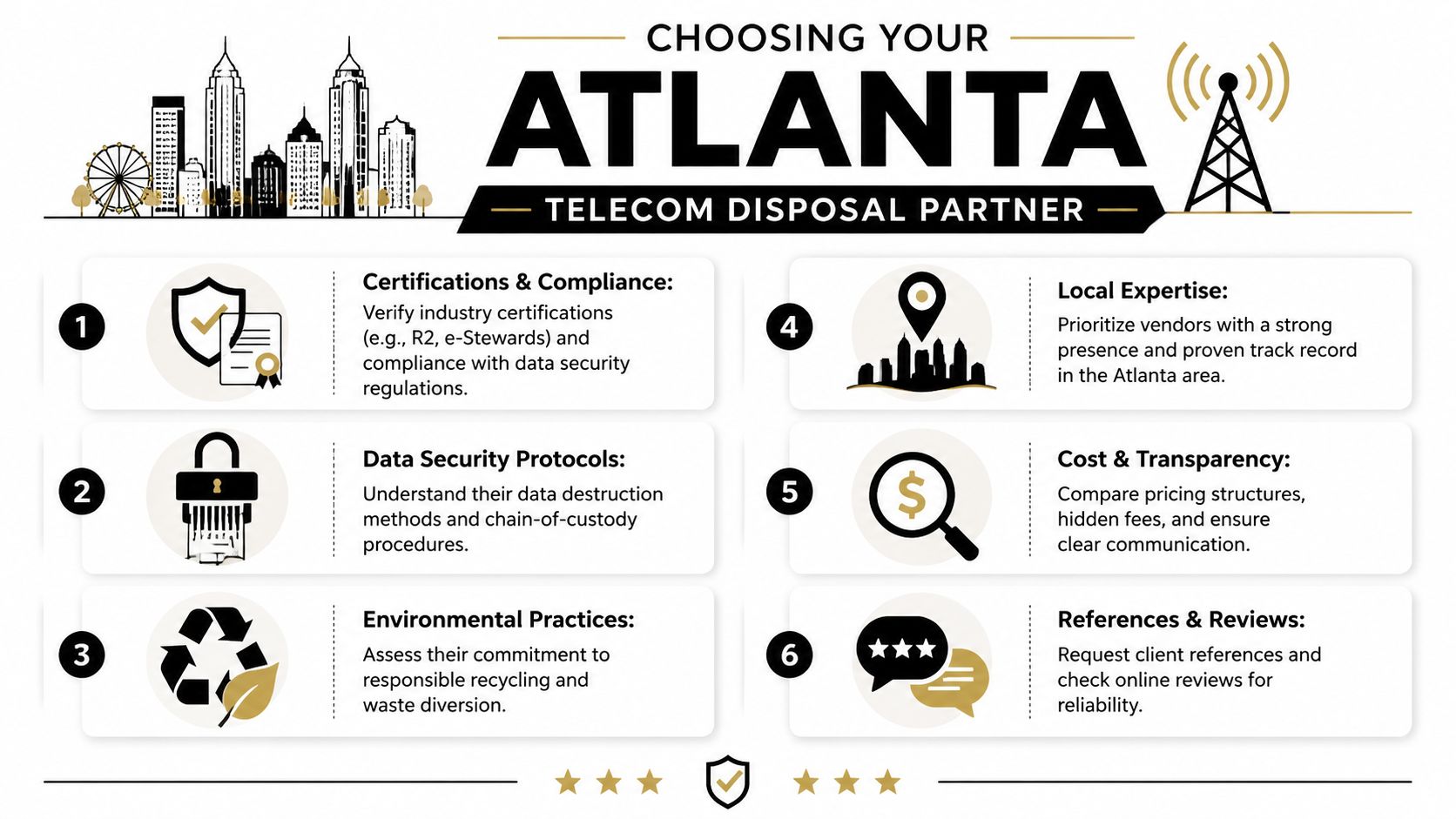
Ask how they process hardware, not just whether they recycle
One of the clearest quality indicators is how the vendor handles disassembly. Proper manual disassembly by trained technicians can achieve 85-95% material recovery from telecom equipment, while automated shredding can lead to 20% material loss and cross-contamination, according to this telecom recycling guide.
That distinction matters because “recycling” can describe very different outcomes. A vendor that relies too heavily on bulk shredding may still remove the gear from your site, but it won't deliver the same material recovery, transparency, or hazard control.
The questions that actually matter
Use this scorecard when evaluating any Atlanta vendor for telecom equipment disposal near me searches.
| Question to Ask | What to Look For (The Ideal Answer) |
|---|---|
| What certifications or standards do you operate under? | Clear alignment with recognized electronics recycling and secure handling practices |
| How do you handle data-bearing telecom gear? | A defined sanitization or destruction workflow with chain of custody |
| Can you process mixed loads? | Yes. Telecom equipment, general office junk, and recyclable material can be coordinated without splitting the project across vendors |
| What happens downstream to cabling, boards, metals, and plastics? | Specific, transparent processing paths rather than vague recycling language |
| Do you provide documentation after pickup? | Certificates for destruction where applicable and diversion or recycling reporting |
| How do you avoid material loss? | Sorting and manual disassembly where appropriate, not indiscriminate bulk shredding |
| Do you understand building logistics in Atlanta? | Experience with office towers, loading docks, scheduling windows, and occupied commercial spaces |
What weak answers sound like
Some red flags are obvious once you know what to listen for.
“We take all electronics.”
That's too broad unless they can explain telecom-specific handling and data controls.“Everything gets recycled.”
Ask where, how, and with what documentation.“We can wipe drives if needed.”
Telecom devices often involve more than obvious hard drives.“Just put it all in one pile.”
That may be fine for broken furniture. It's not enough for mixed telecom assets.
The right vendor sounds operational. The wrong vendor sounds generic.
Why the mixed-load capability matters most
This is the part many Atlanta businesses miss until they're in the middle of a move or upgrade. The disposal problem usually isn't telecom equipment alone. It's telecom equipment plus furniture, scrap, storage-room debris, packaging, and oddball items left behind by prior contractors.
That's why a single-service solution is usually more efficient than hiring a telecom recycler and a separate junk hauler. You reduce site coordination, keep one schedule, and lower the chance that sensitive gear gets dropped into the wrong stream.
When you evaluate vendors, don't just ask if they can take the routers. Ask if they can take the entire decommissioned environment responsibly.
The Fulton Junk Removal Process Logistics and Pricing
For Atlanta businesses, the biggest practical advantage in a bundled model is simpler project management. Instead of arranging one pickup for telecom hardware and another for general junk, the site can be cleared in one coordinated service window, with the electronics side routed through Beyond Surplus for responsible downstream processing.
That matters when your team is already juggling movers, contractors, building management, and internal signoff. The less vendor choreography you need, the fewer chances there are for delays or mix-ups.
What the process usually looks like
Most projects follow a straightforward sequence:
Initial contact and site discussion
You describe the location, the volume, and the types of material involved. If the load includes data-bearing telecom gear, that should be flagged early.Estimate and scope confirmation
For many commercial jobs, an on-site estimate makes sense because access conditions, elevator rules, rack removals, and mixed material types affect labor and logistics.Pickup scheduling
Timing is coordinated around your office operations, loading dock availability, and any building restrictions.Removal and segregation
General junk is removed efficiently, while telecom equipment and electronics are separated for appropriate downstream handling through Beyond Surplus.Final documentation
Depending on the assets involved, the business can receive destruction documentation for data-bearing devices and diversion reporting for recyclable material.
Pricing works best when it's transparent
For most commercial cleanouts, pricing should be explained in plain terms before the work starts. The key variables are usually volume, labor, access difficulty, and the handling requirements for electronics or specialty materials.
What you want to avoid is a vague quote that changes once the crew sees telecom closets, cabling runs, or mixed disposal categories. A clear estimate should reflect the actual job conditions, especially if your office has both standard junk and sensitive infrastructure in the same pickup.
What to have ready before scheduling
A smooth project usually starts with a short internal checklist:
- Access details such as dock instructions, parking, elevator reservations, or after-hours rules
- Asset notes on any telecom devices that may contain data
- Point of contact from facilities, IT, or operations on pickup day
- Approval path for estimates and final signoff
- Any reporting requirements your company needs for internal compliance or sustainability records
If you're ready to line up a site visit or ask about a mixed commercial load, the most direct next step is to contact the Fulton Junk Removal team. The practical benefit is that one provider can handle the cleanout while Beyond Surplus manages the electronics recycling side, which makes the paper trail easier to manage afterward.
Frequently Asked Questions About Telecom Disposal
Can we dispose of a small amount of telecom gear, or is this only for large office projects
Both situations come up. Some businesses only need a few racks of retired network hardware removed. Others need a full office cleanout that includes telecom equipment, furniture, and storage-room debris. The important part is identifying data-bearing devices before pickup.
Do old phones and switches really need data destruction review
Often, yes. Telecom equipment can hold call records, voicemail data, saved credentials, and network configurations. If the device stores or processes communications data, it shouldn't be treated like ordinary scrap.
What if our telecom gear is mixed with non-electronic junk
That's common. In practice, mixed loads are one of the main reasons businesses look for a single-service solution. The right provider should be able to separate ordinary junk from electronics and route each category correctly.
What documents should we expect after the job
That depends on the assets involved, but businesses often need some combination of destruction documentation for sensitive devices and diversion reporting for recycled material. Ask for that before scheduling, not after pickup.
Is on-site sorting worth the effort
Usually, yes. Even a basic level of sorting helps prevent sensitive equipment from getting folded into general debris handling. It also makes final reporting cleaner and reduces confusion on pickup day.
If your Atlanta office needs a practical answer for telecom equipment disposal near me, Fulton Junk Removal gives you a simpler path. The team handles commercial junk removal, and through Beyond Surplus, electronics and telecom equipment are routed for responsible recycling and documented processing. That means fewer vendors to manage, a cleaner chain of custody, and an easier way to clear space without treating sensitive telecom gear like ordinary trash.
