
A Practical Guide to Disassembling a Couch for Any Move
Ever tried to jam a big, bulky couch through a doorway that’s just a little too narrow? It almost always ends in frustration, scuffed-up walls, and maybe even a gouge in the furniture itself. Here’s a little secret from the pros: disassembling a couch is often a necessary first step for a smooth move or disposal. It can turn a seemingly impossible job into something totally manageable, saving you from costly repairs and a whole lot of stress.
Why Taking Your Couch Apart Is a Smarter Move
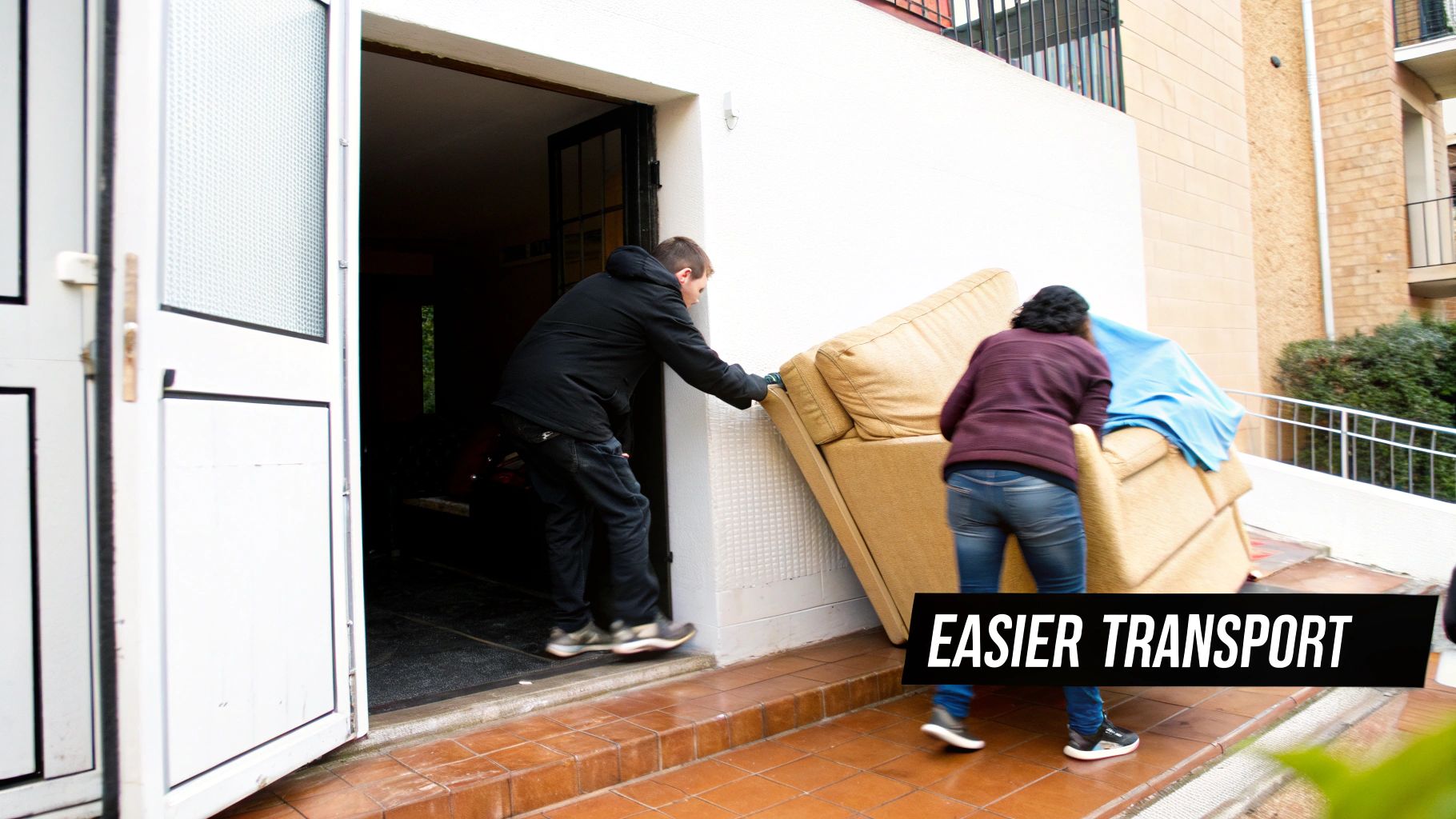
Wrestling a fully assembled sofa is a classic moving day headache. Whether you’re up against a tight apartment stairwell, a sharp hallway corner, or trying to squeeze it into a storage unit, that oversized couch can quickly become your biggest enemy. A bit of disassembly work upfront can prevent a world of pain later.
This isn’t just a problem for homeowners. It’s a major logistical challenge for businesses and property managers, too. Taking a couch apart makes everything from office relocations to clearing out rental units much simpler. When you break it down into smaller, lighter pieces, you seriously cut down the risk of property damage.
The Urban Living Challenge
In cities, taking apart furniture has become more of a necessity than a choice. With over 56% of the world's population now living in urban areas, spaces are getting tighter. Modern apartment doorways often average just 32 inches wide, but a standard three-seater sofa can easily be 90 inches long. Do the math—it’s just not going to fit.
It's no surprise that the global market for furniture disassembly and moving services is now valued at around $15 billion annually. Beyond just getting it out the door, breaking down your furniture is also a great strategy for optimizing furniture storage options, especially if you're storing it long-term.
Taking the time to disassemble a couch not only protects your walls and doorways but also makes the entire moving process more efficient. It transforms a heavy, awkward item into manageable pieces that one or two people can handle safely.
More Than Just Moving
The benefits don't stop once you get it through the door. A disassembled couch is far easier to transport, donate, or recycle. Many donation centers have limited space and might have to turn away a massive sofa they can't easily move or store.
Responsible disposal also becomes much more straightforward. At Fulton Junk Removal, we’ve found that disassembled furniture allows for better sorting of materials. This means we can more effectively separate the wood, metal, and textiles for proper recycling, keeping them out of landfills. It's a key consideration for both environmentally conscious homeowners and businesses alike. For more tips on decluttering and removal, feel free to explore other articles on our junk removal blog.
Your Essential Toolkit for a Smooth Disassembly
Before you even think about flipping that couch over, let's talk tools. Getting this part right is the single biggest factor between a quick, clean job and a frustrating afternoon filled with stripped screws and scratched floors. It's like cooking—having your ingredients prepped and ready makes all the difference.
You don't need a full mechanic's workshop, but a few specific items are non-negotiable. Many couches, especially modern ones, are held together with serious bolts that your average screwdriver just can’t handle. Trying to force it is a recipe for disaster.
To make things simple, I've put together a quick checklist of the tools that will get you through almost any couch disassembly project.
Essential Toolkit for Couch Disassembly
| Tool | Primary Use | Pro Tip |
|---|---|---|
| Socket Wrench Set | Removing the heavy-duty bolts connecting the arms, back, and legs. | Get a set with an extension bar. It’s a lifesaver for reaching bolts buried deep in the frame. |
| Screwdrivers | For smaller screws on decorative panels, dust covers, or recliner mechanisms. | A multi-bit screwdriver is great, but make sure you have both Phillips and flathead options. |
| Adjustable Wrench | Gripping nuts and bolts in tight spots where a socket won't fit. | Wrap the jaws in a bit of tape to avoid scratching any finished wood or metal surfaces. |
| Staple Puller | Safely removing upholstery fabric to access the frame underneath. | Much more effective (and safer for your hands) than prying staples out with a flathead. |
| Work Gloves | Protecting your hands from splinters, sharp metal edges, and hidden staples. | Choose a pair with a good grip. You'll thank yourself when handling heavy frame pieces. |
| Safety Glasses | Shielding your eyes from flying debris, especially when dealing with springs. | Recliner and sleeper sofa springs can be under a lot of tension. Don't skip these. |
Having these basics on hand will cover 90% of couch disassembly scenarios you're likely to encounter.
Keep Yourself (and Your Home) Safe
Taking apart a couch isn't just about the furniture; it’s about making sure you and your home come out of it unscathed. You’ll be dealing with sharp metal edges, hidden staples, and surprisingly heavy wooden frames.
Always put safety first. A good pair of work gloves will save your hands from nasty cuts and splinters. Safety glasses are a must if you're working on anything with springs or tensioned parts that could snap.
Don't forget to protect your space. Lay down a few old towels or a moving blanket to prevent your floors from getting scratched up. It also makes sweeping up dust and debris at the end a whole lot easier.
One last pro tip: grab a magnetic tray or a few Ziploc bags for all the hardware you remove. Labeling the bags ("Arm Bolts," "Leg Screws") is a brilliant move if you ever plan on putting the couch back together.
If you get halfway through and realize the job is bigger than you thought, don't force it. When you're dealing with a complex sectional or a heavy sleeper sofa, sometimes the smartest tool is the phone. The team at Fulton Junk Removal has the right equipment and experience to handle the entire job for you, from disassembly to responsible disposal.
How to Disassemble Different Types of Couches
Every couch is a bit of a puzzle. While the basic idea is the same, taking apart a sprawling sectional is a whole different ballgame than wrestling with a sleeper sofa. You'll need a unique game plan for each.
Let's walk through the disassembly process for the three most common types you’ll find in any home.
This diagram breaks down the core stages of any couch disassembly project. Stick to this simple workflow—prepare your area, take it apart piece by piece, and keep your hardware organized—and you'll get through it without a hitch.
Honestly, following these three fundamental steps—Prepare, Disassemble, Organize—is the single best way to avoid losing parts or damaging the furniture, which happens all the time in DIY moves.
Tackling a Sectional Sofa
Sectionals are king of the living room, but they're a nightmare to move. The good news? Their modular design is your biggest ally. The trick is finding the interlocking metal brackets that clamp each section together.
These brackets are almost always hidden on the sides of each module. You'll need to lift the cushions and feel along the fabric-covered frame to find where they meet. Typically, one side will have a male connector (like a post or hook) and the other will have a female connector (a slot or receiver).
Here’s how to separate them:
- Lift and Separate: Grab a partner and lift one section straight up. You’ll need to clear about four to six inches for the brackets to disengage. Don't try to pull it sideways first.
- Pull Apart: Once the brackets are clear, you can gently pull the section away from its neighbor. Be careful not to drag it, as you could bend or break the connectors.
- Document the Process: Before moving on, snap a quick photo of the brackets. If you ever plan to put this thing back together, you’ll be glad you did.
How to Handle a Recliner
Recliners look intimidating, but they're surprisingly easy to break down once you know the secret. The backrest is the heaviest, most awkward part, and on most models, it’s designed to come right off.
Look for small locking levers or clips on the metal tracks where the back connects to the base. They're usually on the outside of the tracks, sometimes hidden under a fabric flap. Use a flathead screwdriver or even just your fingers to flip these levers up. That's it—the back is now unlocked.
With the levers released, the back should slide straight up and off its tracks. This one move makes the recliner drastically lighter and much easier to handle. Just remember to check for power cables on electric models. Always disconnect them from the base before trying to lift the back off.
Taking apart a recliner is a perfect example of working smarter, not harder. By removing the back, you can cut the weight and bulk by nearly half, making it a one-person job instead of a two-person struggle.
Breaking Down a Sleeper Sofa
Sleeper sofas are the heavyweights, no question. The culprit is the dense mattress and solid steel bed frame hiding inside. Your first mission is to get both of those out to shed as much weight as possible.
Start by unfolding the bed mechanism all the way. The mattress is usually just held on by a few straps or simply rests on the frame. Lift it out and get it out of your way.
Now, focus on the bed frame itself. You need to unbolt it from the main wooden structure of the sofa. It’s almost always attached with four to six heavy-duty bolts. A socket wrench is your best friend here. Carefully remove these bolts, but make sure to support the metal frame as you take out the last one. You don't want it crashing down and damaging your floor.
Once the bed frame is out, the sofa is just a heavy, hollow shell. It's still bulky, but it’s a world away from the beast it was before.
This kind of work is a major reason the furniture assembly services market is exploding, projected to hit $35 billion by 2035. In North America, where the market commands over 35% of revenue, professionals handle 12 million couch-related moving jobs every year, and disassembly makes up 40% of that work. The numbers don't lie: professional disassembly can slash damage claims by a staggering 65% compared to DIY attempts. You can read the full market analysis on furniture services to see the data for yourself.
Eco-Friendly Disposal and Recycling Solutions
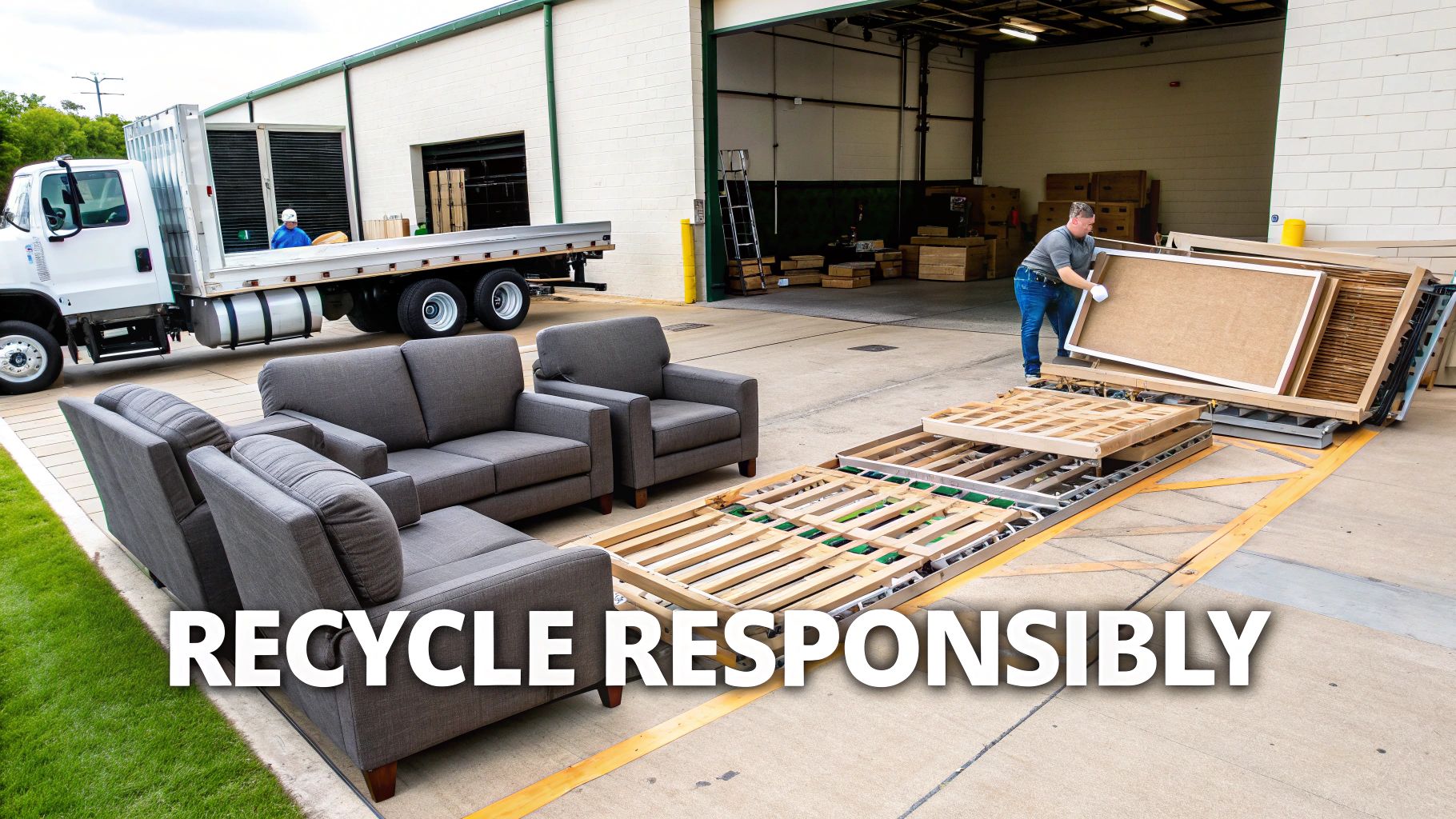
Alright, your couch is in pieces. Now what? The easiest path might seem to be the landfill, but that decision comes with a serious environmental price tag. A disassembled couch is really just a pile of raw materials—wood, metal, fabric, and foam—most of which can be recycled or find a new purpose.
Choosing a sustainable route does more than just keep a bulky item out of a landfill. It gives those materials a second chance. Instead of adding to the waste problem, you become part of a circular solution that benefits the whole community.
The Landfill Problem
Couches are a landfill operator's nightmare. They’re huge, they don’t compress, and they’re full of materials that can take centuries to break down. This puts a massive strain on our waste management systems and wastes resources that could have been recovered.
Responsible disposal is a much smarter choice. It starts with identifying the different materials in your old couch and finding the right places for them to go. This is where a professional, eco-conscious junk removal service can make a world of difference.
The real win after taking a couch apart isn't just getting it out of your house—it's making sure its parts don't become permanent garbage. A circular approach turns an old piece of furniture from a disposal headache into a resource.
A Smarter, Greener Alternative
Not all junk haulers are the same. A lot of them take the path of least resistance, which is a straight shot to the local dump. But there's a better way to operate—one that puts recycling and reuse ahead of just throwing things away.
Fulton Junk Removal operates under Beyond Surplus, a circular, eco-friendly solution that goes beyond traditional junk hauling. While most junk removal companies take everything to the landfill, we work hand-in-hand with Beyond Surplus to recycle electronics, metals, and other materials responsibly. This integrated system ensures items are diverted from landfills and repurposed.
This unique partnership offers a significant benefit for environmentally conscious homeowners and businesses. For offices, warehouses, and property managers, Fulton handles the junk removal, and Beyond Surplus ensures responsible recycling, making compliance and sustainability reporting easier.
How You Can Contribute to the Circular Economy
If you'd rather handle the disposal yourself, there are several great options that align with a greener mindset. The first step after disassembling your couch is to sort the components.
- Donate Usable Parts: Are the cushions, slipcovers, or wooden legs still in good shape? Local animal shelters often love old cushions for bedding, and community art projects might have a use for leftover fabric or wood.
- Find Specialized Recyclers: Do a quick search for recycling centers in your area that take specific materials. Many facilities specialize in recycling wood, metal, or foam. You can usually find drop-off locations with a simple online search.
- Let the Pros Handle It: For a guaranteed eco-friendly outcome, Fulton can offer a bundled junk removal and recycling pickup. All electronic waste and recyclable materials are directly processed by Beyond Surplus, minimizing waste and maximizing reuse. Our comprehensive junk removal and recycling services are designed to manage the entire process responsibly.
When to Skip the DIY and Call in the Pros
Sometimes, the smartest tool in your toolbox is the phone. While tackling a couch disassembly yourself can be satisfying, there are definitely times when stepping back and calling a professional is the right move. Knowing when to wave the white flag can save you a world of frustration, potential injury, and expensive damage.
Take a vintage or antique sofa, for instance. These pieces are a whole different ballgame. They often feature delicate, complex joinery that modern power tools can absolutely shred. What might look like a simple bolt could be part of an intricate, handcrafted connection. One wrong move and you could cause irreparable damage to a valuable or sentimental piece of furniture.
Weight is another huge red flag. Even if you manage to break the couch down, you might be left with frame sections that are still monstrously heavy and awkward. The steel frame from a sleeper sofa or a solid oak arm section can easily top 100 pounds. Trying to wrestle something like that down a flight of stairs without the right gear or technique is just asking for trouble—for your back and your walls.
The Real Value of a Professional Service
This is exactly where Fulton Junk Removal comes in. We offer a completely stress-free alternative. Our team doesn't just show up to haul stuff away; we provide a full-service experience that includes careful, expert disassembly. We handle the entire process, so you don't have to lift a finger—or a wrench.
Our real value is measured in what we prevent:
- No Property Damage: We’ve navigated more tight corners and narrow stairwells than we can count. We know how to do it without scuffing walls or scratching your beautiful hardwood floors.
- Zero Risk of Injury: Our trained crews use proper lifting techniques and specialized equipment to move heavy components safely. It protects you, and it protects our team.
- Giving You Your Time Back: A disassembly project that could eat up your entire weekend is often a job we can knock out in just a fraction of the time.
Choosing a professional isn't about giving up. It's a smart, strategic decision to protect your property, your back, and your valuable time. It turns a weekend-wrecker of a project into a simple, hands-off solution.
An Integrated, Eco-Friendly Solution
Our service goes beyond just getting the couch out of your house. For homeowners and businesses who care about sustainability, we offer a seamless, eco-friendly option. We bundle junk removal and recycling pickups, and all the materials we collect are processed directly by our partner, Beyond Surplus.
This means the wood, metal, and any electronic components from your old furniture are responsibly recycled, not just dumped in a landfill.
This is the perfect solution for all kinds of situations. Homeowners get a fast, easy cleanout. Property managers and businesses get a reliable partner that makes unit turnovers and office clear-outs incredibly efficient. Most importantly, you get the peace of mind that comes from knowing the job will be done right, from start to finish.
If you’ve looked at your couch and decided a professional touch is the way to go, you can easily schedule your hassle-free removal with us today.
Common Questions We Hear About Taking a Couch Apart
Even after you've got a game plan, a few questions always seem to pop up right when you're about to get started. We get it. Here are some of the most common things people ask us, with quick answers to get you through the job with confidence.
How Long Does It Really Take to Disassemble a Couch?
Honestly, it all comes down to the couch itself. A simple two-piece sectional? You could be done in 20-30 minutes once you figure out where the connecting brackets are hiding.
But if you're wrestling with a big sleeper sofa that has a heavy, bolted-in bed frame, you could easily be looking at an hour or more. That's especially true if it's your first time tackling a project like this. Always give yourself more time than you think you'll need—rushing is how you end up with stripped screws and torn fabric.
What Should I Do if a Screw Is Stripped?
A stripped screw is the classic DIY headache, but don't panic. It's usually fixable. First, try the old rubber band trick: place a wide rubber band over the screw head before putting your screwdriver in. The rubber often gives you just enough extra grip to get it moving.
If that doesn't work, a screw extractor bit for your drill is a lifesaver. It’s designed to bite into the damaged metal and reverse the screw right out.
Pro Tip: The best way to deal with a stripped screw is to avoid it completely. Always use the right size and type of screwdriver bit, and apply firm, steady pressure when you turn. Don't force it.
Can Every Couch Be Taken Apart?
Most modern couches are actually designed to come apart. It just makes shipping and delivery so much easier. Sectionals, recliners, and sleeper sofas are almost always built in modules you can separate.
However, some older, custom-built, or high-end vintage pieces might have glued and dowelled joints. These were never meant to be separated. If you can't find any obvious bolts, brackets, or clips, it's a safe bet you're dealing with a solid, one-piece frame.
For offices, warehouses, and property managers juggling a mix of furniture, Fulton Junk Removal offers a much simpler solution. Our crews handle the removal, and our partner, Beyond Surplus, makes sure everything is recycled responsibly. It makes sustainability reporting and compliance a breeze.
Beyond just taking it apart, you might be wondering about general upkeep, like learning how to clean a fabric couch to keep your furniture looking its best.
To see how we integrate our services with an eco-friendly mission, you can learn all about Fulton Junk Removal’s commitment to sustainability.
When the DIY approach feels like too much, or you just want it gone now, Fulton Junk Removal is ready to step in. Our professional team handles the entire process, from disassembly to eco-friendly disposal, so you don’t have to lift a finger. Get your free, no-obligation estimate today by visiting us at https://fultonjunkremoval.com.
