
Certified IT Equipment Disposal Services in Atlanta 2026
Old laptops in a storage room usually signal a bigger operational problem. The same goes for stacked monitors in a warehouse corner, decommissioned switches in a server closet, or a move-out floor where furniture and retired IT gear are mixed together because no one wants to touch the disposal plan.
For Atlanta businesses, that backlog isn't just clutter. It's a mix of data risk, environmental liability, and logistics friction. If drives leave the building without proper sanitization, you create exposure. If reusable assets get tossed with general junk, you lose value. If electronics move through an undocumented chain of custody, compliance gets harder the minute audit questions start.
The practical fix is to treat disposal as a managed business process, not an afterthought.
Why Smart IT Equipment Disposal Matters in Atlanta
An Atlanta office refresh often looks simple at first. New laptops arrive, old docking stations get unplugged, monitors come off arms, and suddenly an IT manager or facilities lead has a pile of equipment that no one wants to store and no one should throw in a dumpster.
That's where many organizations make the wrong decision. They treat obsolete electronics like bulk trash, when the primary concern is controlled disposition. Old desktops, servers, access points, batteries, and displays carry different risks. Some hold sensitive data. Some still have reuse value. Some need specialized recycling because of the materials involved.
The scale of the problem is much larger than one office cleanout. The world generated about 62 million metric tons of e-waste in 2022, and only 22.3% was formally collected and recycled. The same UN reporting projects annual e-waste could reach 82 million metric tons by 2030 if current trends continue, as noted in this overview of electronics recycling near Atlanta.
Local cleanouts create high-consequence waste streams
Atlanta's business environment makes this especially relevant. Office turnover, renovations, warehouse relocations, tenant improvements, and tech refreshes can create large bursts of retired equipment all at once. In those moments, disposal decisions get compressed into tight timelines.
That pressure leads to bad habits:
- Mixed loads: Electronics get loaded with furniture, shelving, and general debris.
- Loose custody: Drives and devices change hands without serialized records.
- Landfill leakage: Recyclable material gets treated as ordinary haul-away.
- No proof: Teams finish the pickup but can't produce documentation later.
Practical rule: If your disposal vendor can't tell you what happens to each device after pickup, you don't have a disposal process. You have a removal event.
For organizations operating in the city, smart planning starts with choosing a provider that can manage both the physical cleanout and the compliance side. If your equipment is spread across offices, storage rooms, and mixed-use spaces, local coordination matters just as much as recycling knowledge. That's one reason businesses looking for service coverage often start with an Atlanta junk removal team that understands commercial pickups.
Disposal affects more than floor space
A clean room is nice. A defensible process is better.
When disposal is handled correctly, you reduce breach exposure, support sustainability reporting, and keep reusable equipment in circulation longer. When it's handled poorly, the consequences show up later in legal reviews, insurance questions, and internal audits.
Beyond the Dumpster What IT Disposal Services Include
A lot of vendors say they handle electronics. That phrase is too vague to be useful. Real IT equipment disposal services in Atlanta should cover three separate functions, because each solves a different problem.
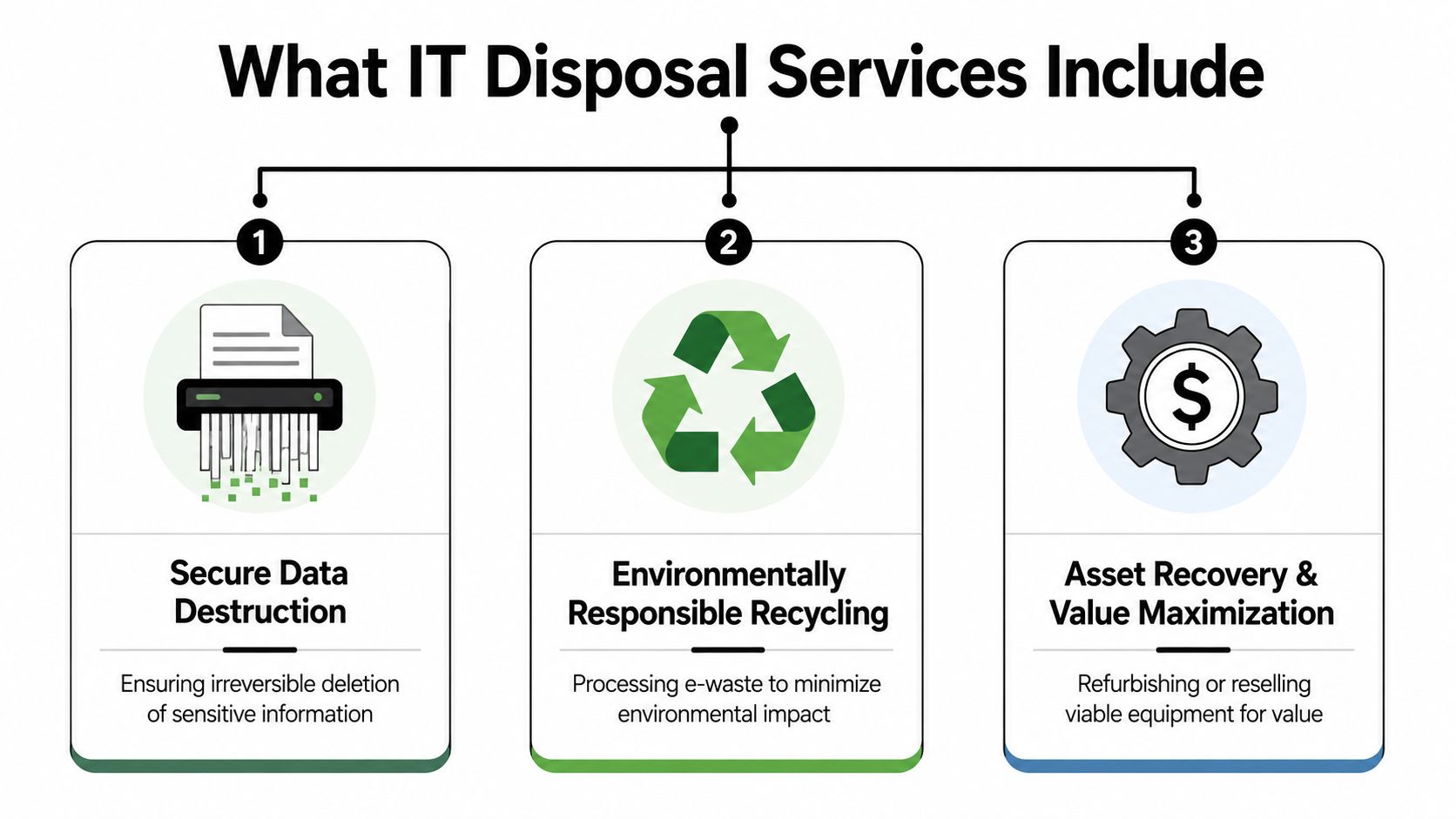
Secure data destruction
This is the control point that matters most for regulated businesses and any company with customer, employee, financial, or operational data on retired devices. Industry guidance commonly used by enterprise ITAD programs follows NIST SP 800-88-style media sanitization, which separates methods into clearing, purging, and destroying media based on sensitivity and reuse requirements, as described in this overview of data center ITAD services.
In practice, that means the method should match both the hardware and the risk.
- Logical wipe: Appropriate when a drive is being prepared for controlled reuse and the media type supports reliable sanitization.
- Cryptographic purge or secure erase: Common for SSD workflows where standard overwrite assumptions may not be enough.
- Physical destruction: Used when reuse isn't required, when the media is damaged, or when policy requires destruction.
What doesn't work is the casual version of disposal. Pulling a drive and dropping it in a bin isn't a policy. Neither is assuming a “factory reset” did the job.
Environmentally responsible recycling
Recycling is not the same thing as hauling electronics away. Responsible recycling means separating recoverable materials, routing equipment through proper downstream channels, and keeping hazardous components out of the general waste stream.
That's especially important when a site cleanout includes mixed materials such as wire, power supplies, batteries, rack hardware, printers, and peripheral devices. A vendor that handles only junk removal may move the load efficiently but still fail the material recovery side.
Most disposal failures happen after the truck leaves. The critical question is what processing discipline exists downstream.
Asset recovery and value maximization
Some retired devices still have operational or component value. Business-grade laptops, networking gear, servers, displays, and accessories may be candidates for refurbishment, resale, part harvesting, or redeployment.
Inventory discipline plays a critical role. Before pickup, many teams benefit from using structured asset lists or tools similar to this guide to essential inventory software for businesses. Better inventory records make pickup faster, support serialized reporting, and help separate scrap from equipment that deserves a reuse decision.
A disposal provider should be able to answer three basic questions:
- What needs to be destroyed for security reasons
- What can be recycled responsibly
- What still has recovery potential
If they can't distinguish those categories, they're not running a complete IT disposition program. They're just moving material. For companies planning broader cleanouts, that's why it helps to look at providers with a range of commercial removal and recycling services, not just a truck and a labor crew.
Navigating Compliance for IT Disposal in Georgia
Georgia businesses operate in a practical gray zone with electronics disposal. There isn't one simple statewide take-back framework that resolves every commercial need, so organizations have to build defensible internal processes instead of assuming the state has already standardized the path.
Georgia is not among the handful of states with the most extensive consumer e-waste laws, so Atlanta businesses often rely on commercial IT asset disposition vendors to meet internal ESG, audit, and data-security requirements rather than a single statewide take-back system, according to this summary of Georgia ITAD considerations.

Documentation is what protects you
For an Atlanta facilities manager, the compliance question usually isn't “Can someone take this stuff away?” It's “Can we prove the equipment was handled correctly?”
That proof comes from documentation such as:
- Serialized asset records: Which device left the site
- Transfer logs: When custody changed hands
- Sanitization or destruction records: What method was applied
- Recycling documentation: Where non-reusable material went
- Project summaries: What was removed from a site or department
Without those records, disposal becomes difficult to defend in an audit or internal review. That's true whether you manage a corporate office, a medical practice, a law firm, a school, or a multi-tenant property.
Industry rules still apply even without a simple state program
Healthcare, finance, legal, education, and government-adjacent environments all carry privacy expectations that extend into end-of-life device handling. If your team works around protected health information, this guide to HIPAA-compliant IT solutions is a useful reference point for the broader operational controls regulators expect around systems and data.
The disposal mistake I see most often is separation of duties without separation of responsibility. One contractor removes office contents. Another company handles drives later. Someone inside the organization keeps an incomplete spreadsheet. Then a year later no one can reconstruct what happened.
Compliance takeaway: A pickup receipt is not the same thing as a chain-of-custody record.
That's why vendor background matters. Before scheduling any project, review how the company describes its process, what kind of commercial work it handles, and whether it understands cleanup plus compliance as one workflow. An overview of Fulton Junk Removal shows the kind of service model businesses should be looking for when junk removal and responsible downstream handling need to work together.
A Checklist for Choosing Your Atlanta Disposal Partner
Plenty of vendors can load a truck. Far fewer can handle retired IT assets in a way that satisfies security, sustainability, and operational reporting requirements. If you're evaluating IT equipment disposal services in Atlanta, the fastest way to separate serious providers from general haulers is to ask better questions.
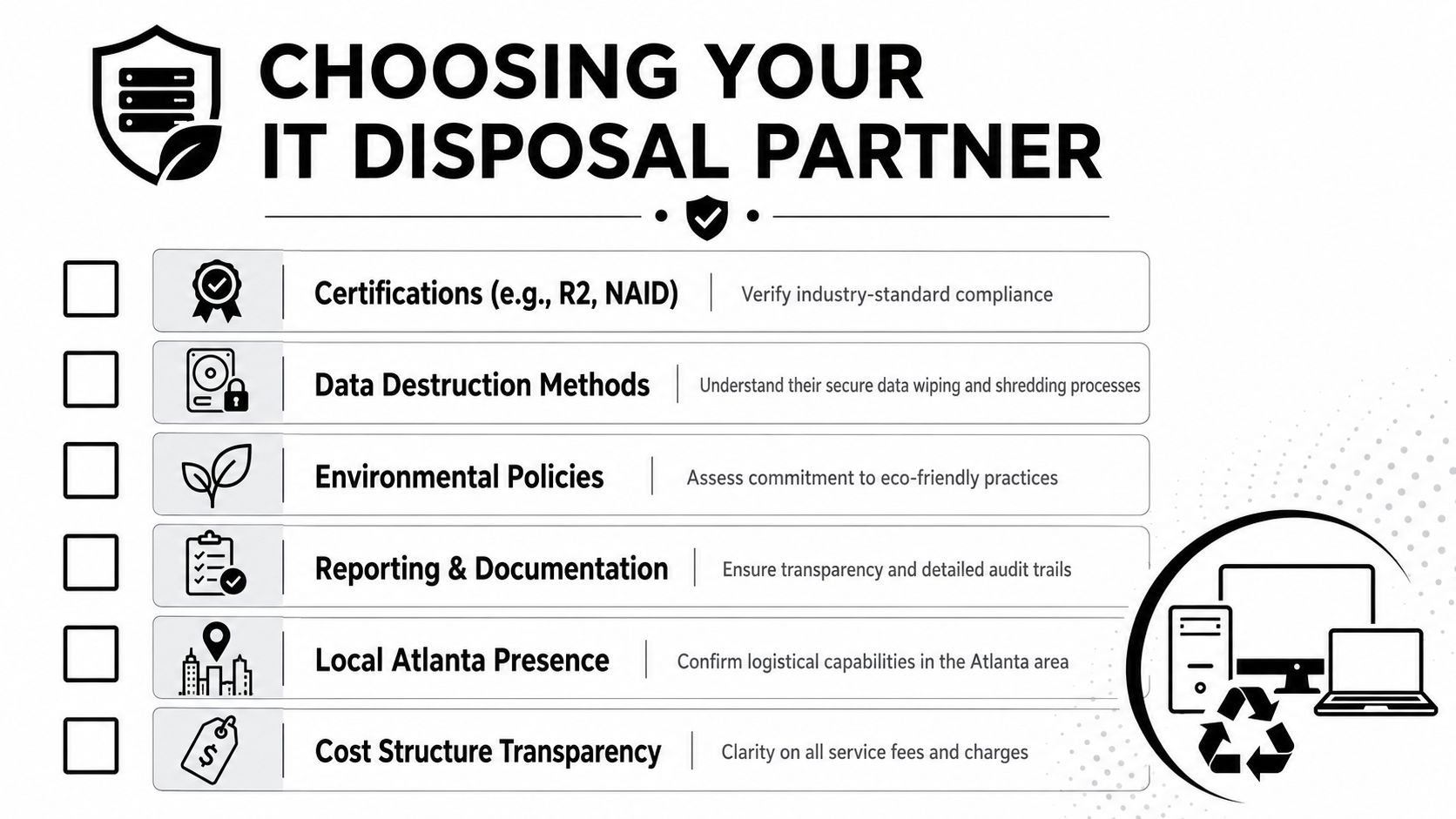
The backdrop matters. The UN's Global E-waste Monitor 2024 reports the world generated 62 million metric tons of e-waste in 2022 and only 22.3% was formally collected and recycled, which is why a provider's auditable recycling process matters so much, as summarized in this review of server equipment recycling and disposal.
The questions that expose weak vendors
A strong disposal partner should welcome scrutiny. If answers are vague, rushed, or heavily sales-driven, that's useful information.
| Question | Why It Matters |
|---|---|
| How do you document chain of custody from pickup through final processing? | You need a verifiable record, not a verbal assurance. |
| What data destruction methods do you use for HDDs, SSDs, and other media? | Different media types require different sanitization approaches. |
| Can you provide serialized reporting for removed assets? | Auditability depends on asset-level detail. |
| What happens to equipment that still has reuse value? | A reuse-first process can preserve value and reduce unnecessary scrap. |
| How do you handle non-reusable electronics downstream? | Responsible recycling requires more than simple collection. |
| Do you support mixed commercial cleanouts with both junk and IT equipment? | Many Atlanta projects involve offices, storage rooms, and common areas all at once. |
| What documentation will we receive after the job? | Reporting closes the loop for compliance, insurance, and sustainability records. |
| Who is responsible if equipment is inaccessible, scattered, or mixed with other materials? | Site conditions affect labor, timing, and risk. |
What to inspect beyond the sales pitch
Ask to see process clarity, not just brand language.
- Certifications and standards awareness: A provider should speak clearly about recognized disposal and data handling practices, not dodge specifics.
- Media-specific handling: HDDs, SSDs, backup devices, and embedded storage shouldn't be treated as one category.
- Downstream transparency: You should know whether equipment is reused, dismantled, or recycled through vetted channels.
- Insurance and operational controls: This matters when crews work in occupied buildings, loading docks, medical offices, or managed properties.
Look for reuse judgment, not just removal capacity
AI infrastructure growth, server refresh pressure, and cloud-driven hardware turnover have made one old disposal model obsolete. “Take everything and shred it” is easy to schedule, but it's often the wrong economic and environmental answer.
The better partner can distinguish among redeployable equipment, remarketable hardware, and true end-of-life scrap. That flexibility matters most when you're decommissioning a server room, consolidating offices, or clearing a warehouse with mixed assets.
If every device gets the same disposition outcome, your vendor is optimizing for speed, not for your risk profile or asset value.
One more practical point. Local presence matters. Atlanta jobs often involve loading dock windows, building access rules, tenant coordination, freight elevators, and traffic timing. A vendor may have strong paperwork but weak field execution. You need both.
How Fulton Junk Removal and Beyond Surplus Streamline Disposal
Most businesses don't struggle because they lack disposal options. They struggle because the process gets fragmented. One vendor handles furniture and general junk. Another handles electronics. Someone else is supposed to track serial numbers. The result is duplicated scheduling, extra touches, and preventable custody gaps.
The integrated model is simpler. A single coordinated workflow handles the site cleanout and routes IT equipment into the proper downstream process instead of forcing your team to stitch vendors together manually.
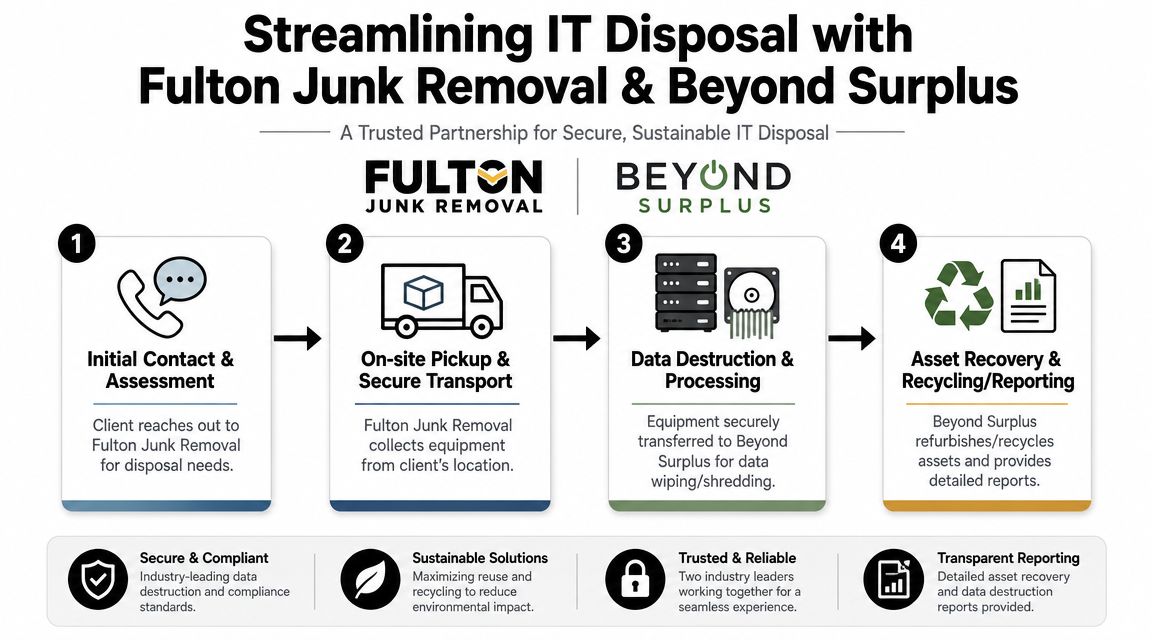
What the integrated workflow looks like
For Atlanta offices, warehouses, and property-managed sites, the handoff points are where projects usually break down. An integrated junk removal and ITAD structure reduces those handoffs.
Assessment of the site
The team identifies what is general debris, what is recyclable material, and what is IT equipment requiring controlled handling.On-site removal
Crews clear the space, collect equipment, and stage materials for transport without forcing the client to arrange separate pickups.Secure downstream transfer
Electronics move into the recycling and data-destruction side of the process rather than disappearing into a general hauling stream.Reporting and closeout
The client receives the documentation needed to support internal records and sustainability reporting.
Why this solves a real Atlanta problem
This model works because commercial disposal projects are rarely pure IT jobs. They're mixed-environment jobs. A law office move may include desks, chairs, cubicles, file storage, printers, monitors, docking stations, and network hardware all in the same project window. A warehouse office cleanout might include shelving, scrap metal, obsolete workstations, scanners, and telecom gear.
When you split those streams across unrelated vendors, your team has to coordinate timing, access, building rules, and accountability across each one. That creates friction and often delays possession turnover or project closeout.
One option in the local market is Fulton Junk Removal, which operates with Beyond Surplus as part of an integrated removal and recycling model. In practical terms, that means general haul-away and electronics recycling can be handled in one coordinated service path instead of by disconnected providers.
What tends to work better than separate vendors
Separate vendors can work when the project is narrow and highly controlled, such as a small batch of laptops already boxed, inventoried, and isolated. That's not how most commercial cleanouts happen.
The integrated approach is usually stronger when you're dealing with:
- Office relocations: Mixed furniture, fixtures, and retired electronics
- Warehouse and back-office cleanouts: Equipment spread across multiple zones
- Property turnovers: Tight timelines and access coordination
- Renovation prep: Material separation before demolition or remodeling
- Multi-department refreshes: Assets coming from several teams at once
One coordinated chain of custody is easier to manage than two or three partial chains that someone inside your company has to reconcile later.
That's the key advantage. Not marketing simplicity, but operational simplicity. Fewer handoffs. Fewer assumptions. Fewer chances for equipment to leave the controlled process.
Understanding Logistics and Costs in the Atlanta Metro
Cost questions are reasonable, and they should be answered plainly. For IT disposal projects, pricing usually depends on the type of equipment, quantity, site access, labor required, and level of data handling involved.
A small pickup of boxed peripherals is different from a multi-floor office decommission. A clear loading dock is different from equipment scattered across suites, storage rooms, and mezzanines. Drives that need documented destruction create a different workflow than cable bins and empty chassis.
What usually affects the quote
The factors below tend to move a project up or down:
- Equipment mix: Servers, batteries, monitors, and loose peripherals all require different handling.
- Volume and layout: Concentrated staging is easier than collecting material from multiple rooms or floors.
- Access conditions: Elevators, dock reservations, stairs, and after-hours building rules affect labor time.
- Bundled scope: Combining cleanout work with electronics pickup is often more efficient than scheduling separate vendors.
- Documentation needs: Serialized tracking and destruction records add process steps, which is appropriate when compliance matters.
What the scheduling process should look like
A well-run provider should make the process predictable. You ask for an estimate, describe the equipment and site conditions, confirm access details, and get a scope that reflects the actual job. On pickup day, the crew should already know whether they're handling a simple removal, a controlled electronics load, or a mixed commercial cleanout.
For businesses north of the city or managing multi-site properties, local routing matters too. Service-area familiarity helps providers schedule efficiently and avoid surprises around access and timing in places like Sandy Springs commercial pickup zones.
The main thing to avoid is vague pricing paired with vague process. If a vendor can't explain what drives cost, they probably can't explain what happens to the equipment either.
Your IT Equipment Disposal Questions Answered
What kinds of IT equipment can usually be picked up?
Most commercial disposal projects include a mix of desktops, laptops, monitors, servers, switches, routers, printers, phones, cables, UPS units, and accessories. Many jobs also include non-IT items such as desks, shelving, or general office debris. The important question isn't just whether a vendor will take the material. It's whether they separate IT assets from general junk and route them correctly.
Can one pickup handle both office junk and obsolete electronics?
Yes, and that's often the most efficient setup for a move, renovation, or tenant turnover. Mixed pickups reduce scheduling complexity because the client doesn't have to coordinate separate crews for furniture, debris, and electronics. It also lowers the chance that devices get left behind in closets, cabinets, or storage areas because one vendor assumed the other would take them.
What paperwork should a business ask for after disposal?
Ask for documentation that matches the sensitivity of the project. That may include asset lists, transfer logs, destruction or sanitization records, and recycling summaries. If your organization has internal audit, privacy, or sustainability reporting requirements, confirm those deliverables before the pickup is scheduled.
How fast can a project usually be scheduled?
That depends on the size of the job, building access constraints, and whether the project needs special handling for data-bearing devices. Small pickups can often move quickly. Larger office or warehouse cleanouts usually need a short planning conversation first so labor, access, and documentation requirements are aligned before anyone arrives on site.
If your team is staring at a room full of retired computers, loose monitors, network gear, and general office clutter, Fulton Junk Removal is a practical place to start. The company handles commercial cleanouts across the Atlanta area, and through the Beyond Surplus model, electronics can move into a more controlled recycling and disposition process instead of getting lumped into ordinary haul-away.
