
Find Business Telecom Services Near Me Easily
A dropped customer call usually gets blamed on “bad internet.” In practice, the underlying problem is broader. It might be an overloaded cable connection, a weak failover plan, an old phone system, messy carrier billing, or a contract that looked cheap until support was needed.
That’s why searching for business telecom services near me isn’t just a procurement task. It’s an operations decision. If your team depends on cloud software, dispatch updates, mobile devices, customer calls, or multiple locations, telecom becomes part of revenue protection, service quality, and day-to-day control.
The stakes are only getting higher. The U.S. telecom services market reached USD 468.08 billion in 2023 and is projected to grow at a 6.6% CAGR through 2030, with the business segment growing faster because companies need uninterrupted communication and support for multi-location operations, according to Grand View Research’s U.S. telecom services market analysis.
A smart buying process starts before you talk to providers. It ends after installation, when old hardware is removed securely and disposed of responsibly. If your business is replacing phones, switches, routers, mobile lines, or internet circuits and needs help coordinating the final cleanup, it helps to keep a local removal partner in view early through Fulton Junk Removal’s contact page.
Your Search for Better Business Telecom Starts Here
Local telecom decisions go wrong when owners shop by price first and requirements second. The result is familiar. The internet works fine until everyone signs into cloud apps at once. Calls sound acceptable until the front desk gets busy. Mobile coverage seems good until drivers, techs, or sales staff need a stable connection inside a warehouse or at a client site.
The better approach is to treat telecom like core infrastructure. That means tying each service to a business outcome: faster response times, fewer dropped calls, steadier uptime, easier multi-site management, and cleaner accountability when something breaks.
Practical rule: Buy telecom for your busiest hour, not your quietest day.
Local matters because service delivery is still physical. Fiber routes, building access, handoff points, technician availability, and regional support quality all affect how smoothly a rollout happens. A provider can look strong on paper and still be a poor fit for your specific building or service area.
Three decisions matter most early:
- What you need: bandwidth, voice features, mobile plans, failover, and support expectations.
- Who can serve your address well: not every provider that appears in a search result is viable for your suite or facility.
- How you’ll retire old equipment: telecom refreshes create phones, routers, access points, batteries, and cabling that shouldn’t be abandoned in a closet or tossed into the trash.
Businesses that get this right usually work from an internal checklist before they collect quotes. That keeps sales conversations grounded in your operation instead of a provider’s standard package.
Defining Your Business Telecom Needs Before You Shop
Before you compare carriers, write down how your business works. Most buying mistakes start with a vague request like “we need better internet and phones.” That isn’t enough to evaluate fit, support, or risk.
A useful telecom requirements sheet should describe users, sites, traffic patterns, critical apps, and what failure looks like in your business. A law office, warehouse, property management firm, and dispatch-driven service company can all have the same headcount and completely different network needs.
Internet requirements that affect operations
Start with internet because every other service rides on it. Don’t ask only, “How much speed do we need?” Ask what must stay usable at peak activity.
Consider these points:
- User load: How many people work on-site at the same time, and how many guest or unmanaged devices connect during the day?
- Application sensitivity: Microsoft 365, cloud ERPs, CRMs, browser-based scheduling platforms, file sync tools, and video meetings all behave differently under congestion.
- Location profile: One office is simpler than multiple offices, a warehouse plus office combo, or a business with remote managers and field staff.
- Redundancy tolerance: If the primary circuit fails, can you pause work, or do you need automatic backup through a second wired line or fixed wireless service?
- Building constraints: Older buildings often hide wiring issues that providers won’t solve without additional scope.
A short internal worksheet helps. List each critical app, whether it’s delay-sensitive, and which team uses it. That simple exercise exposes whether your biggest risk is call quality, upload speed, dead zones, or single-carrier dependency.
Voice needs are usually more specific than owners expect
“Business phones” can mean many different things. For one company, it’s just a main number and a few extensions. For another, it’s auto-attendants, ring groups, voicemail to email, call recording, hunt groups, desk phones for reception, and mobile apps for managers.
If you’re still deciding how numbers should be structured, a plain-language guide on how to buy a phone number is useful because it helps separate number strategy from phone system marketing.
Ask providers direct questions such as:
- Can calls route differently by department, location, or time of day?
- Will reception need physical phones, softphones, or both?
- Do supervisors need call logs or recordings for compliance or training?
- Can the phone platform integrate with your CRM or ticketing workflow?
- How are outages handled if the internet circuit fails?
For businesses juggling office and field activity, mobile integration matters as much as desk phones. If your dispatcher can’t transfer a call cleanly to a driver or site lead, the platform isn’t doing its job.
Mobile and fleet connectivity deserve their own review
Mobile is often treated as an add-on. That’s a mistake for companies with drivers, project managers, warehouse leads, maintenance staff, or off-site estimators.
Review mobile service separately:
| Need | What to confirm |
|---|---|
| Coverage quality | Indoor reception at your office, warehouse, and common service zones |
| Device policy | Company-owned phones, BYOD, or a mix |
| Line management | Centralized admin portal, provisioning, suspension, and upgrades |
| Data use | Mapping, photos, hotspot use, field apps, and video |
| Escalation path | Who helps when a critical user loses service |
One more point gets overlooked. Telecom projects often affect old assets. If you’re upgrading office phones, clearing out networking gear, or retiring older electronics during a larger facilities reset, it makes sense to coordinate that work alongside broader operational cleanup through Fulton Junk Removal’s commercial services.
How to Find and Vet Local Telecom Providers
A basic search for business telecom services near me gives you a list. It does not give you a qualified shortlist. Some results are direct carriers. Some are resellers. Some are managed service providers bundling telecom with IT support. Some are lead-generation pages with very little local delivery capability.

The market is broad enough that you should assume options exist, but not all options are equal at your address. The average business location has access to 2.24 wired broadband providers and 4.78 fixed wireless options, creating meaningful choice for businesses evaluating connectivity for logistics, scheduling, and reporting, according to Contractor Lists HQ’s telecom provider market overview.
Build a shortlist from local evidence
The fastest way to waste time is to request proposals from every name you find. Instead, verify whether providers have real service presence near your facility.
Use a mix of these methods:
- Ask neighboring tenants or nearby businesses: They’ll tell you which provider responds when service degrades.
- Check building management: Property managers often know incumbent carriers, conduit constraints, and access procedures.
- Review commercial listings: Some buildings advertise available carriers because fiber availability helps lease space.
- Use local business communities: Chamber groups, operations forums, and regional LinkedIn networks often surface better feedback than generic reviews.
- Look for support geography: A provider with nearby technicians and local project coordination will usually install faster and troubleshoot more cleanly.
If you want an example of how providers position secure managed connectivity in a local market, this page on secure telecom solutions in Ontario is helpful as a comparison reference. Not because you need an Ontario provider, but because it shows the kind of specificity you should look for in security, business support, and solution scope.
Know what type of provider you’re talking to
Not every “telecom company” operates the same way. Grouping them correctly helps you ask sharper questions.
| Provider type | Usually strong at | Typical trade-off |
|---|---|---|
| National carrier | Broad footprint, bundled mobility, standardized contracts | Can feel rigid for smaller accounts |
| Regional fiber provider | Dedicated business focus, strong local install knowledge | Coverage can be limited by building or corridor |
| Cable provider | Fast availability, common SMB packages | Performance consistency may vary by local node conditions |
| Fixed wireless or 5G provider | Quick deployment, useful backup path, flexible for some sites | Building materials and line-of-sight conditions can affect experience |
| Reseller or agent | Multiple carrier options, quote comparison, account coordination | Support responsibility can be unclear if roles aren’t defined |
Ask one direct question early: “Who owns the relationship when service fails, billing is wrong, or install work stalls?”
That answer tells you whether you’re buying a service, a brokered contract, or a managed relationship.
Filter for local fit, not just brand recognition
A big name can be the right answer. It’s just not automatically the right answer. The provider that works best for a retail suite may be wrong for a warehouse, a multi-tenant office, or a field-heavy operation.
Use local service footprint as a screening factor. If you serve multiple neighborhoods or surrounding cities, it’s useful to compare vendor suitability against your actual operating footprint, especially if your teams move around the metro area. Businesses doing that kind of local planning can also use Fulton Junk Removal’s service areas in and around Atlanta as a practical reference for how local commercial coverage is often mapped and communicated.
Evaluating Coverage Service Levels and Contracts
Once you have a shortlist, stop reading the marketing summary and start reading the operating terms. Reading the operating terms separates strong telecom buying from reactive buying.
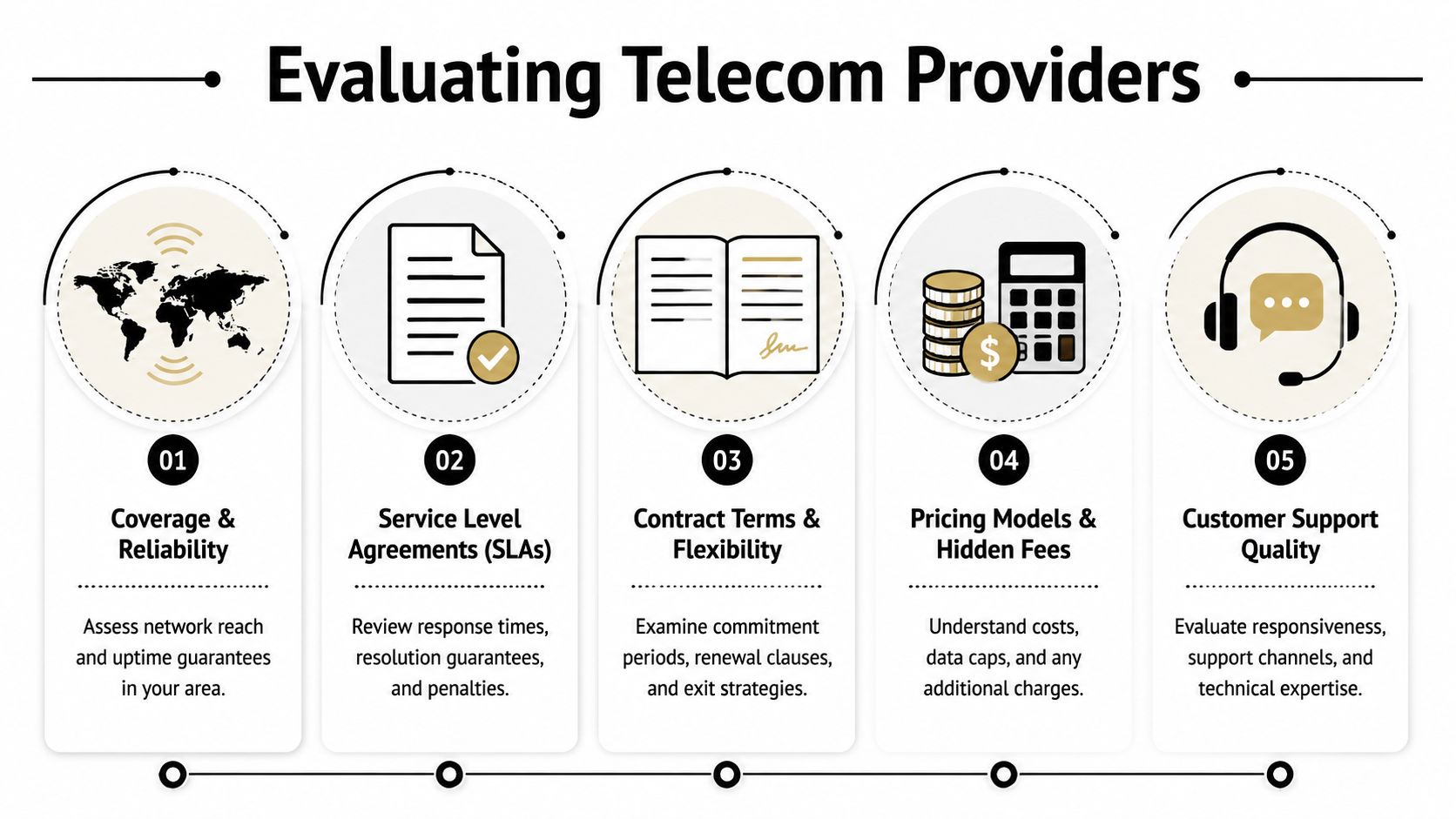
Good proposals often look similar at a glance. The differences show up in three places: actual coverage at your address, enforceable service levels, and contract language that controls your flexibility later.
Coverage has to be verified at the suite level
Provider maps are a starting point. They are not proof.
You need to confirm:
- Serviceability at the exact address: not just the building, but your suite or demarcation point.
- Installation path: whether existing conduit, riser access, or internal cabling supports the order.
- Construction risk: whether the quote assumes standard install or possible added work.
- Indoor performance: especially if you’re relying on wireless backup or mobile-first operations.
- Multi-site consistency: one strong site and one weak site creates support headaches and uneven user experience.
I’ve seen businesses approve a quote based on “service available” only to learn later that install timing, building access, or internal infrastructure made the project much harder. That’s why coverage validation should include the provider, your landlord or facilities contact, and your own internal tech lead.
SLAs matter only if they map to business impact
A service level agreement sounds reassuring, but many buyers never translate the SLA into operational consequences. The useful question isn’t “Do you have an SLA?” It’s “Does this SLA protect the way we work?”
A practical benchmark set starts with Network Uptime >99.95% and Mean Time to Resolve (MTTR) <30min. Those KPI examples are highlighted in NetSuite’s discussion of telecom industry project challenges, which also notes that 65% of telecom projects face budget overruns without clear goals, and 25% of businesses report unreliable broadband that impacts operations.
Review SLA language through that lens:
| SLA area | What to look for | What often goes wrong |
|---|---|---|
| Uptime commitment | Clear service definition and measurement method | “Availability” excludes parts of the real user experience |
| Response time | Fast acknowledgment for critical incidents | Quick response but slow real action |
| MTTR | Actual restoration target for severe outages | No meaningful remedy if restoration drags |
| Escalation path | Named support tiers and management contacts | Tickets stall in generic queues |
| Credits and remedies | Real accountability if provider misses targets | Credits are too small to matter operationally |
Don’t let providers hide behind broad language like “best effort support” when your operation depends on immediate response.
A strong telecom project also needs internal KPIs, not just carrier promises. If your phones support customer scheduling, you might track failed calls, queue delays, or outage response workflows. If your warehouse depends on handheld devices, you may care more about dead zones and roaming behavior than advertised speed.
Contract terms can create pain long after install day
Most telecom contract problems don’t show up during procurement. They show up months later, when a business wants to upgrade, move, cancel, or challenge a charge.
Read these areas carefully:
- Term length: longer terms can lower pricing, but they reduce flexibility if your location or headcount changes.
- Auto-renewal language: many contracts renew unless notice is given in a narrow window.
- Escalating fees: taxes, surcharges, support costs, equipment rental, and usage overages can distort the true monthly cost.
- Move clauses: what happens if you relocate within the city or expand into another building?
- Equipment ownership: know whether phones, gateways, or edge devices are leased, rented, or yours to keep.
- Exit conditions: document early termination rules before you sign.
Some owners focus on monthly rate and ignore expense leakage from older services that were never disconnected. That’s exactly why careful review matters before a new install starts, particularly for Atlanta businesses juggling multiple offices, warehouses, or service locations across the greater Atlanta area.
A practical buying move is to request a redlined contract summary in plain English. If the provider won’t explain terms clearly before signature, expect harder conversations after go-live.
Conducting Your On-Site Readiness Check
A provider can sell the right service and still have a rough installation if your site isn’t ready. The handoff between contract signing and installation is where delays, surprise charges, and finger-pointing often begin.
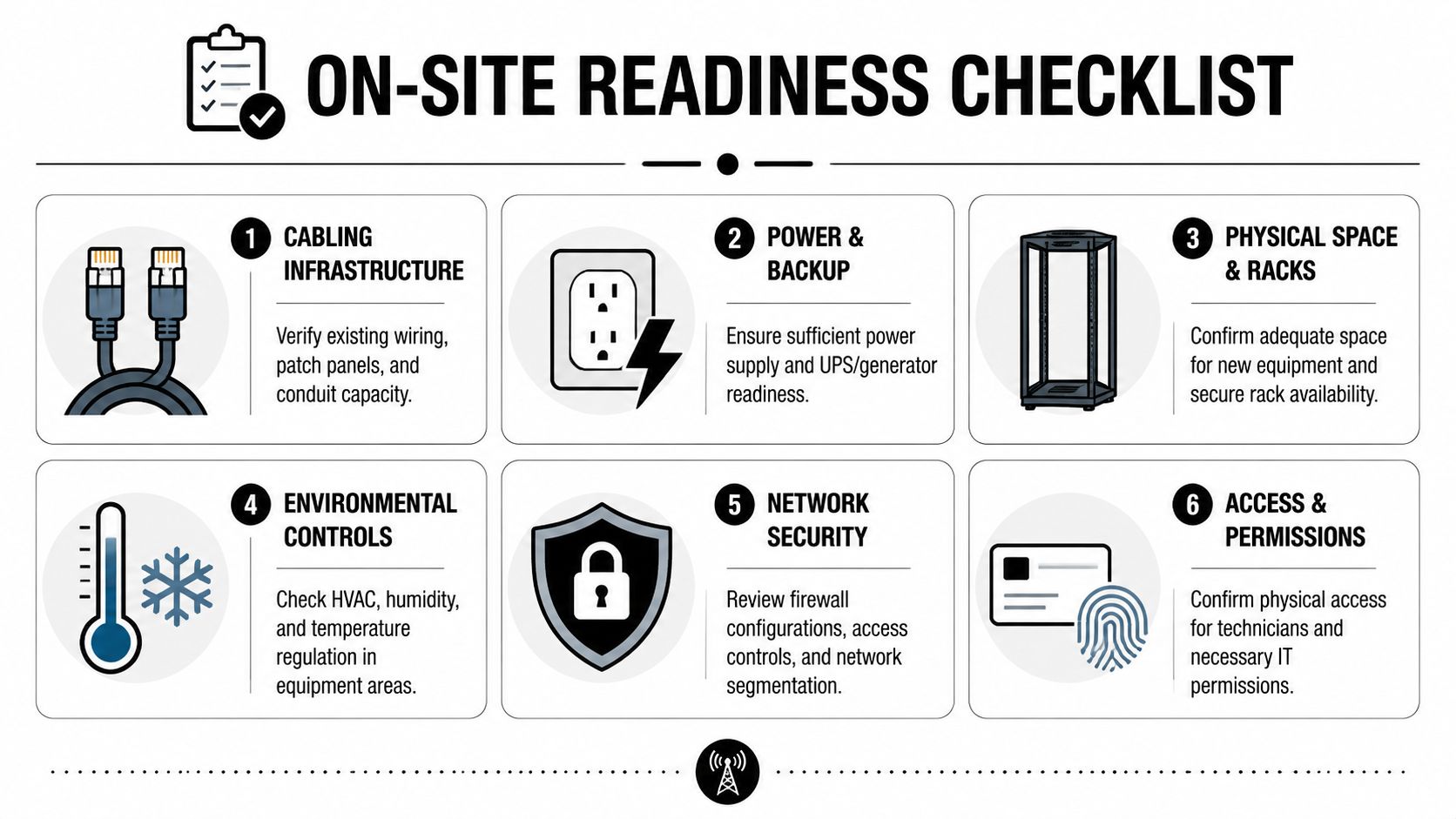
Before a technician arrives, walk the site with facilities, IT, and whoever controls building access. Treat it like a pre-flight inspection, not an administrative detail.
What to inspect inside the building
Start at the point where service enters the building and follow the path to where equipment will live.
Use this checklist:
- Cabling infrastructure: Verify existing ethernet runs, patch panels, labels, and spare capacity. If cabling is undocumented or visibly messy, fix that before cutover.
- Rack and equipment space: Confirm there’s secure rack or wall space for new gear, with enough clearance for installer access.
- Power and backup: Check outlet availability, UPS coverage, and whether critical telecom equipment is on protected power.
- Cooling and environment: Server closets and IDF rooms should have stable airflow and shouldn’t double as storage rooms.
- Access permissions: Make sure building management, suite access, keys, badges, and after-hours approvals are set before install day.
- Security controls: Review firewall placement, VLAN planning, admin access, and who owns final configuration approval.
What to audit before you replace anything
A site walk should be paired with a service inventory review. Businesses often discover active legacy lines, old analog circuits, abandoned numbers, or duplicate services only after the new provider is in motion.
A formal telecom expense audit can identify 15% to 20% in overspending from legacy lines and redundant circuits, and ignoring those pre-installation audits can lead to over $50,000 in annual leakage for a medium-sized business, according to Telco Solutions’ telecom managed services guidance.
That matters for two reasons. First, you don’t want to install new service while paying for old waste. Second, old telecom gear and lines often reveal operational clutter that needs to be cleaned out during the transition.
A clean install starts with a clean inventory. If nobody can say what each line, handset, or circuit is for, delay the cutover until they can.
What readiness looks like in practice
A prepared site doesn’t need to be perfect. It needs to be predictable.
The provider should arrive to a location where the handoff point is known, the equipment destination is ready, key stakeholders are reachable, and legacy services have been identified. If your business is also reorganizing office space, clearing storage, or removing retired electronics at the same time, coordinate those tasks so installers aren’t working around piles of obsolete gear.
That simple discipline reduces change-day confusion more than any polished proposal ever will.
Closing the Loop Responsible Equipment Decommissioning
Most telecom buying guides stop at activation. That’s too early. The final step is decommissioning the old equipment correctly.
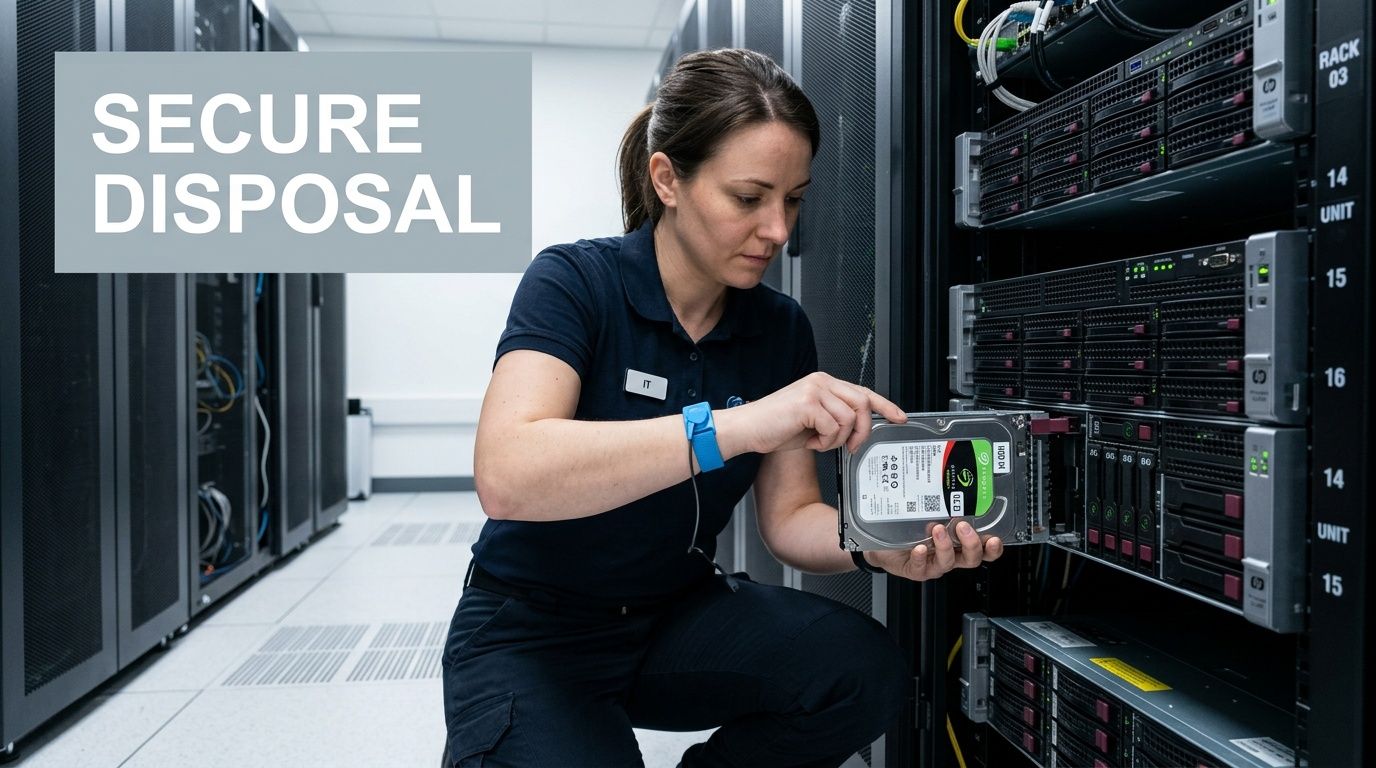
Old desk phones, routers, firewalls, switches, wireless gear, and mobile devices often contain more business information than people realize. Call histories, saved credentials, configuration data, contact records, and network details can persist long after a device is unplugged. Leaving that equipment in a back room isn’t harmless. Throwing it into the dumpster is worse.
Security has to come before disposal
Responsible decommissioning starts with chain of custody. Decide who collects devices, who verifies they’re retired, and who signs off before anything leaves the property.
At minimum, businesses should:
- Inventory the retired assets: model, serial, user or location, and retirement date.
- Separate storage media and sensitive devices: especially anything with internal memory or removable storage.
- Wipe or reset equipment according to vendor guidance: don’t assume unplugging is enough.
- Document handoff and removal: particularly if your business handles customer, tenant, healthcare, financial, or operationally sensitive information.
- Coordinate with IT and operations together: the person removing clutter shouldn’t be making data decisions alone.
The cheapest disposal option becomes expensive fast if it creates a security incident or audit problem.
Sustainability now belongs in the telecom conversation
Most local telecom content often falls short. Providers talk about speed, bundles, and coverage. They rarely talk about what happens to the equipment they replace.
That gap matters because 68% of sustainability directors now prioritize low-carbon telecom providers, yet most telecom content still ignores eco-friendly practices such as certified e-waste recycling for old hardware, based on the Gartner data provided in the brief.
For offices, warehouses, property managers, and multi-site operators, decommissioning is no longer just a facilities task. It’s part of compliance posture, ESG reporting, and vendor accountability. If your company tracks recycling, landfill diversion, or responsible disposal, telecom refreshes should feed into that process instead of bypassing it.
Why removal and recycling should be planned together
A telecom upgrade creates physical waste fast. Phones stack up. Power bricks disappear into drawers. Old racks, printers, cables, monitors, and mixed electronics get left behind because nobody owns the cleanup. That’s how storage rooms become compliance and safety problems.
A better operating model is to treat removal as part of the project closeout. That means:
| Closeout task | Why it matters |
|---|---|
| Secure asset collection | Prevents loss, theft, and undocumented disposal |
| Device segregation | Keeps reusable, recyclable, and sensitive items apart |
| Data-aware handling | Reduces the chance of exposing business information |
| Recycling coordination | Supports diversion goals and cleaner reporting |
| Space recovery | Returns closets, offices, and staging areas to usable condition |
For Atlanta businesses, this is where a junk removal partner with actual recycling capability matters. A standard haul-away service may clear the room, but it may not support responsible electronics handling or sustainability documentation. A partner tied to real downstream recycling processes can make the telecom refresh cleaner operationally and easier to explain internally.
That’s especially relevant for offices, warehouses, and property managers who want one vendor to remove outdated telecom gear and route recyclable electronics into a more responsible stream instead of the landfill. When that capability is bundled into the cleanup process, the business gets a stronger finish: cleared space, less disposal risk, and a better story for facilities, procurement, and sustainability teams.
If your telecom upgrade has left you with old phones, networking hardware, e-waste, or mixed office equipment to remove, Fulton Junk Removal offers Atlanta-area businesses a practical closeout option. The team handles commercial cleanouts with an eco-conscious approach, and through their background and mission, you can see how the Beyond Surplus connection supports responsible recycling for electronics, metals, and reusable materials. That makes it easier to clear space, avoid landfill-heavy disposal, and keep sustainability reporting aligned with the work you’ve already invested in your telecom upgrade.
