
Transform Business: Enterprise Telecom Solutions Atlanta
A lot of Atlanta office upgrades stall in the same place. The carrier is selected, the cabling plan is approved, the cloud migration is moving, and then someone opens the telecom closet and realizes the room is still packed with retired switches, abandoned patch panels, analog lines nobody can identify, and a rack that should’ve been removed during the last renovation.
That’s where enterprise telecom decisions stop being abstract. New circuits, SD-WAN, UCaaS, and managed connectivity all sound clean on paper. In the field, they compete with power limits, cooling gaps, blocked pathways, disposal questions, and the simple fact that old infrastructure takes up real space.
For Atlanta teams planning a major refresh, the smartest approach is to treat digital modernization and physical turnover as one project. That matters whether you're running a multi-suite office, a warehouse operation, or a distributed service business with dispatch, logistics, and compliance needs across the metro.
The Modern Atlanta Enterprise Challenge
An Atlanta facilities manager usually sees the problem before procurement does. The server room is crowded. The office footprint has changed. Hybrid work has reduced desk count, but network demands have gone up. Teams still need voice reliability, strong Wi-Fi, cloud access, and cleaner remote coordination across locations.

The urgency is real. The enterprise telecom services market was valued at USD 848.2 billion globally in 2022 and is projected to reach USD 1.2 trillion by 2032, driven by 5G infrastructure and IoT growth, according to enterprise telecom market analysis from GM Insights. For Atlanta operators, that translates into a practical message. Telecom is no longer a back-office utility. It’s operating infrastructure.
What the upgrade usually looks like on the ground
A typical refresh includes some mix of:
- Carrier changes: replacing old internet circuits or consolidating vendors
- Voice modernization: moving from aging phone systems to cloud-based calling
- Network redesign: adding SD-WAN, better segmentation, or stronger guest and internal wireless separation
- Physical cleanup: removing retired handsets, patching abandoned runs, clearing closets, and reclaiming rack space
The teams that handle this well don't split technology planning from building realities. They align IT, facilities, and operations from day one. That’s especially important for organizations spread across Fulton Junk Removal service areas in metro Atlanta, where timing, access, and coordination across sites can complicate even a straightforward rollout.
Practical rule: If your deployment plan starts with bandwidth and ends with "we’ll deal with the old gear later," your project is already carrying unnecessary risk.
Where projects usually go sideways
Three issues show up repeatedly:
| Problem | What it causes |
|---|---|
| Old equipment stays in place too long | Installers lose space, airflow, and cable access |
| Nobody owns decommissioning | Hardware lingers, inventory gets messy, and deadlines drift |
| Telecom buying happens without site review | New services arrive before the room is ready to support them |
That’s why enterprise telecom solutions Atlanta teams choose have to be evaluated as part network strategy, part facilities project.
Decoding Enterprise Telecom Solutions
Most buying mistakes happen because stakeholders use the same words for different things. A provider says "managed network." Finance hears one invoice. Facilities hears fewer headaches. IT hears routing, failover, voice quality, and security controls. Those are not the same thing.
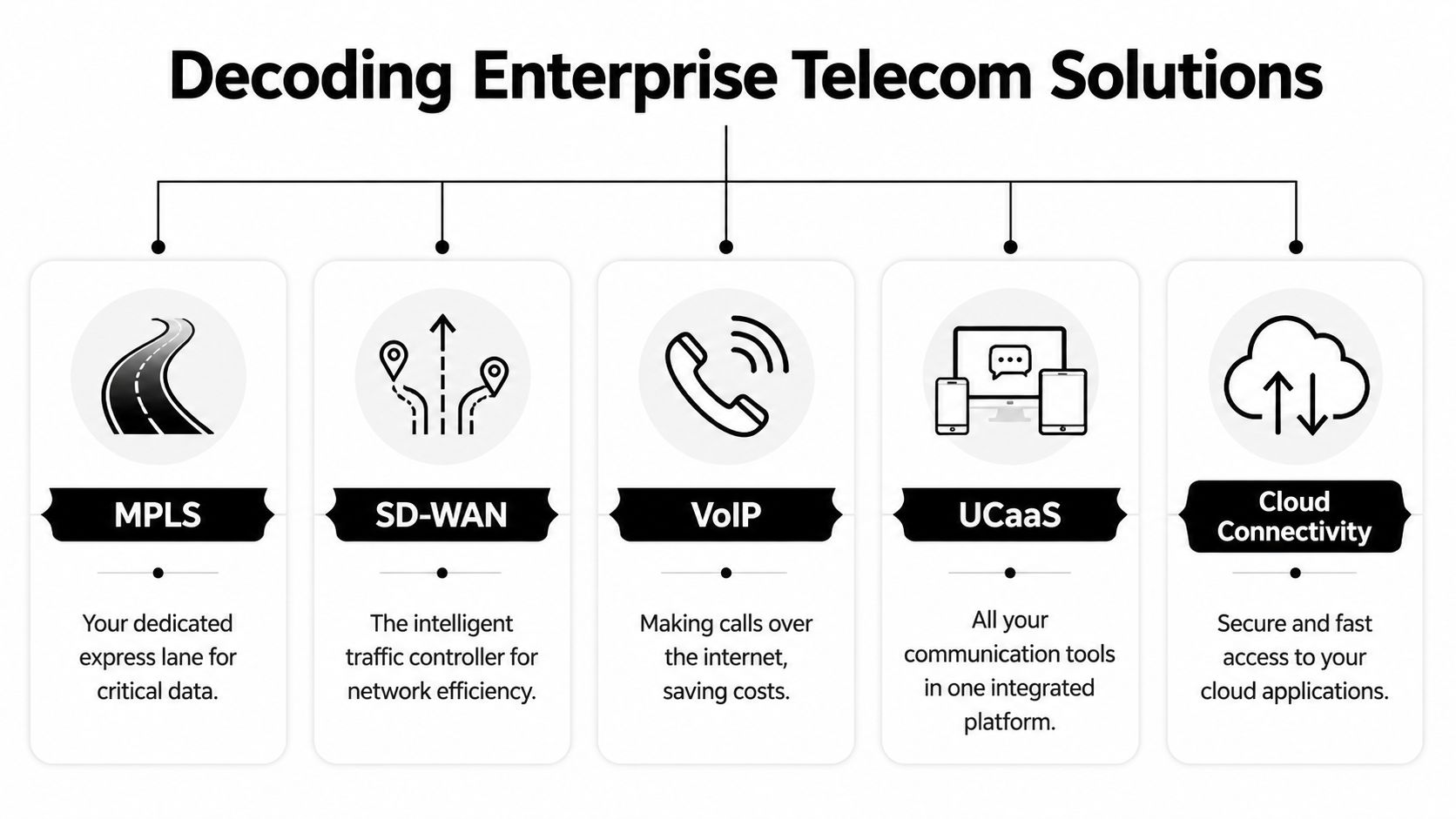
MPLS and SD-WAN are not interchangeable
MPLS is the private highway model. It’s controlled, predictable, and often useful for traffic that can’t tolerate sloppy routing behavior. If your business has critical voice traffic, site-to-site application dependencies, or strict segmentation requirements, MPLS still has a place.
SD-WAN is the smart traffic controller. It evaluates available paths and pushes important applications over the best route instead of treating all traffic the same way. According to Spectrum Enterprise information on managed SD-WAN in Atlanta, managed SD-WAN can deliver a 40 to 60 percent reduction in WAN costs compared with traditional MPLS, while using application-aware routing to target metrics such as jitter below 30ms and packet loss under 0.1%.
That cost story matters, but the operational story matters more. SD-WAN works well when a company needs flexibility across broadband, dedicated links, and changing site conditions. It does not automatically replace disciplined network design.
SD-WAN is a strong fit when application priority changes during the day. It’s a weak fit when teams expect "smart routing" to fix poor circuits, poor cabling, or poor internal ownership.
The other three categories buyers should separate clearly
VoIP
VoIP is internet-based calling. It replaces legacy phone systems and can simplify moves, adds, and changes. It’s attractive when an office is reducing physical handsets or supporting more mobile users.
UCaaS
UCaaS bundles calling, messaging, meetings, and collaboration into one platform. For procurement and operations teams, that can reduce platform sprawl. For end users, it means fewer disconnected communication tools. Buyers comparing platform options often benefit from broader context like this guide to DialNexa enterprise voice solutions, especially when voice quality, call flows, and administrative control all matter at once.
Cloud connectivity
This is the path between your sites, your users, and your cloud applications. It matters most when business systems have moved off local servers but performance still depends on reliable access. If the network path is unstable, users blame the application. The application usually isn’t the problem.
A practical way to match solution to use case
- Use MPLS selectively when predictability is worth the premium.
- Use SD-WAN when you need path intelligence, mixed access types, and better control over application traffic.
- Use VoIP when you’re retiring aging telephony and want cleaner administration.
- Use UCaaS when communication tools are scattered across too many platforms.
- Use stronger cloud connectivity when business systems are fine but user experience isn’t.
The best enterprise telecom solutions Atlanta businesses deploy aren't the most complex. They’re the ones matched to actual workflows, building conditions, and support capacity.
Why Modern Connectivity is an Atlanta Competitive Edge
Atlanta businesses don't compete on connectivity in theory. They compete on response time, service continuity, customer communication, and how fast teams can move information between locations without adding friction.

One local advantage is proximity to serious infrastructure. Atlanta facilities such as the tw telecom site at 2 Ravinia Dr. connect into a 100% fiber-optic SONET ring with sub-10ms intra-Atlanta latency, according to this overview of the tw telecom Atlanta data center. For businesses that rely on real-time logistics, compliance systems, or customer-facing platforms, that kind of regional performance isn't a luxury. It changes how confidently teams can centralize applications and still keep local operations moving.
What that means in practice
A modern Atlanta organization might have:
- a main office in the city
- a warehouse or staging site elsewhere in the metro
- remote staff working from home
- vendors and customers expecting immediate updates
If the network design is solid, those locations behave like one operating environment. If the design is weak, every handoff creates delay.
Teams serving customers across Atlanta and nearby commercial corridors especially benefit from tighter local connectivity because voice, dispatch, scheduling, and documentation all depend on consistent access. Fast infrastructure supports better operations, but only when the internal environment is ready to use it.
Why this is a business decision, not just an IT line item
Connectivity shapes three things leaders care about:
| Business priority | Telecom impact |
|---|---|
| Service reliability | Better routing and carrier design reduce avoidable disruption |
| Staff productivity | Cleaner access to cloud systems reduces workarounds |
| Scalability | New sites and changing layouts become easier to support |
A weak network doesn’t fail only in the server room. It fails at the service desk, in the warehouse, in the conference room, and during customer calls.
That’s why enterprise telecom solutions Atlanta companies invest in should be treated as a strategic advantage. The network affects how quickly the business can adapt.
Your Telecom Procurement and Selection Checklist
Most telecom contracts look manageable until the second year, the first outage, or the first site change. Procurement teams need more than pricing sheets. They need a selection process that tests fit under real operating conditions.
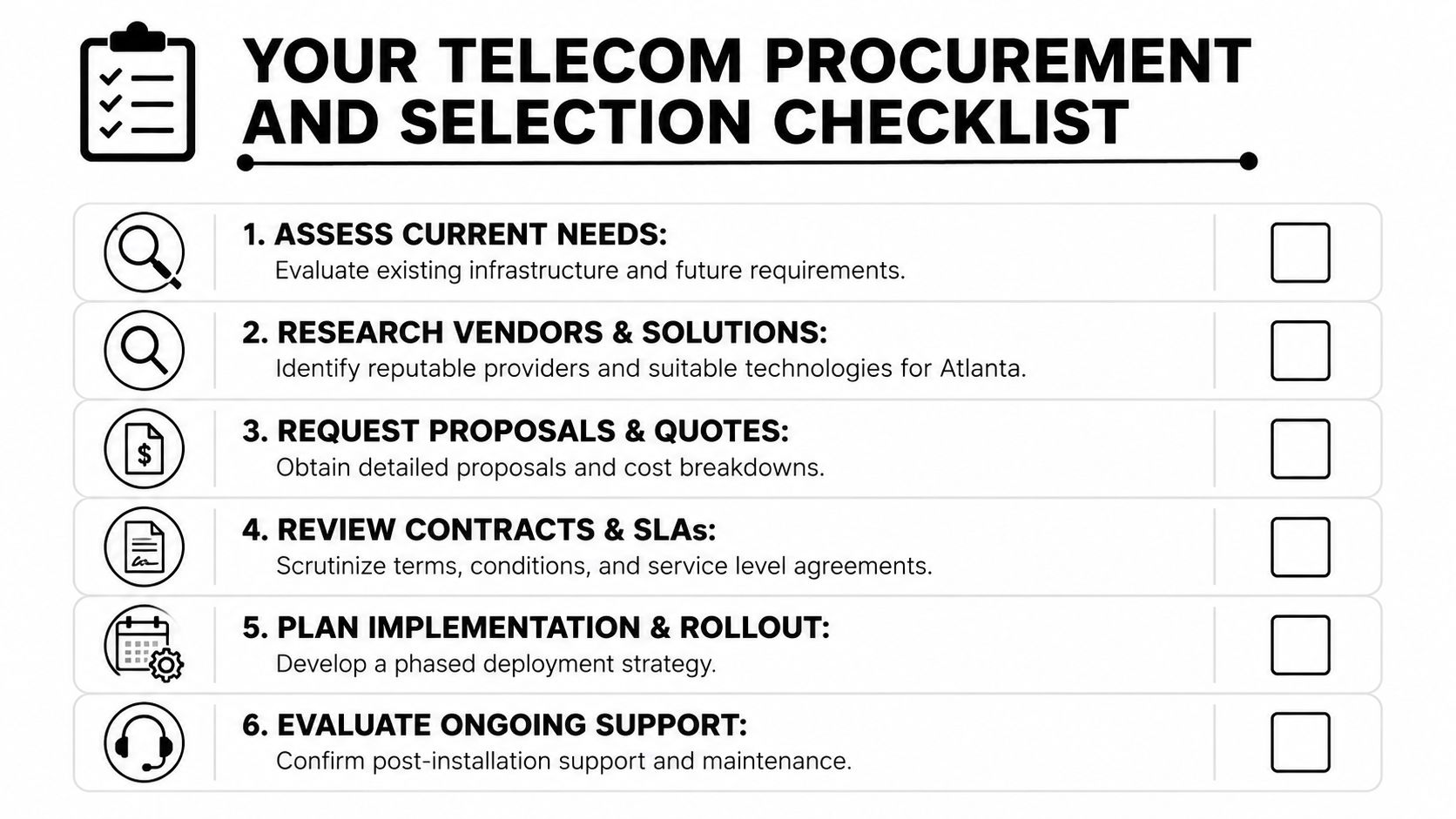
Between Q1 2020 and Q2 2024, the enterprise telecom sector saw $56 billion in M&A activity, according to Jahani & Associates analysis of enterprise telecom transactions and valuations. That’s a useful reminder that provider stability matters. You’re not just buying service features. You’re buying into a vendor’s long-term operating model.
Questions to ask before you shortlist anyone
What business process are we supporting?
Start with workflows, not product labels. Voice, branch connectivity, cloud access, warehouse systems, guest Wi-Fi, and camera traffic don’t all need the same treatment.What happens if we add, shrink, or move sites?
A contract that looks efficient in one building can become expensive and rigid during consolidation or relocation.Who owns support after install?
Ask whether the provider manages the circuit only, the edge device only, or the user-impacting issue end to end.
What to review inside the proposal
Service scope
Look for precise language. "Managed" can mean monitoring only, or it can mean active configuration, change management, escalation handling, and policy support.
SLA language
Read this slowly. If the SLA credits are tiny and the escalation path is vague, the paper protection won’t help much when an outage hits.
Site requirements
Some vendors bury critical assumptions in implementation notes. Check for power, rack units, demarc extension responsibilities, building access, and any dependency on your in-house cabling team.
Buyer note: If a proposal doesn't describe the handoff between provider work and your building work, expect confusion during deployment.
A working checklist for vendor comparison
| Procurement question | Why it matters |
|---|---|
| Can the service scale across changing locations? | Atlanta footprints change fast |
| Are support boundaries written clearly? | Hidden gaps create finger-pointing |
| Is the contract flexible on adds and moves? | Office changes rarely wait for term end |
| Are implementation dependencies documented? | Physical readiness drives go-live success |
| Is the provider financially stable? | Market consolidation can affect continuity |
A good telecom partner should make your environment easier to operate, not just easier to buy.
Preparing Your Site for a Seamless Deployment
A new telecom deployment rarely fails because the ordered service was wrong on paper. It fails because the room, pathway, or handoff wasn't ready when the installer showed up.
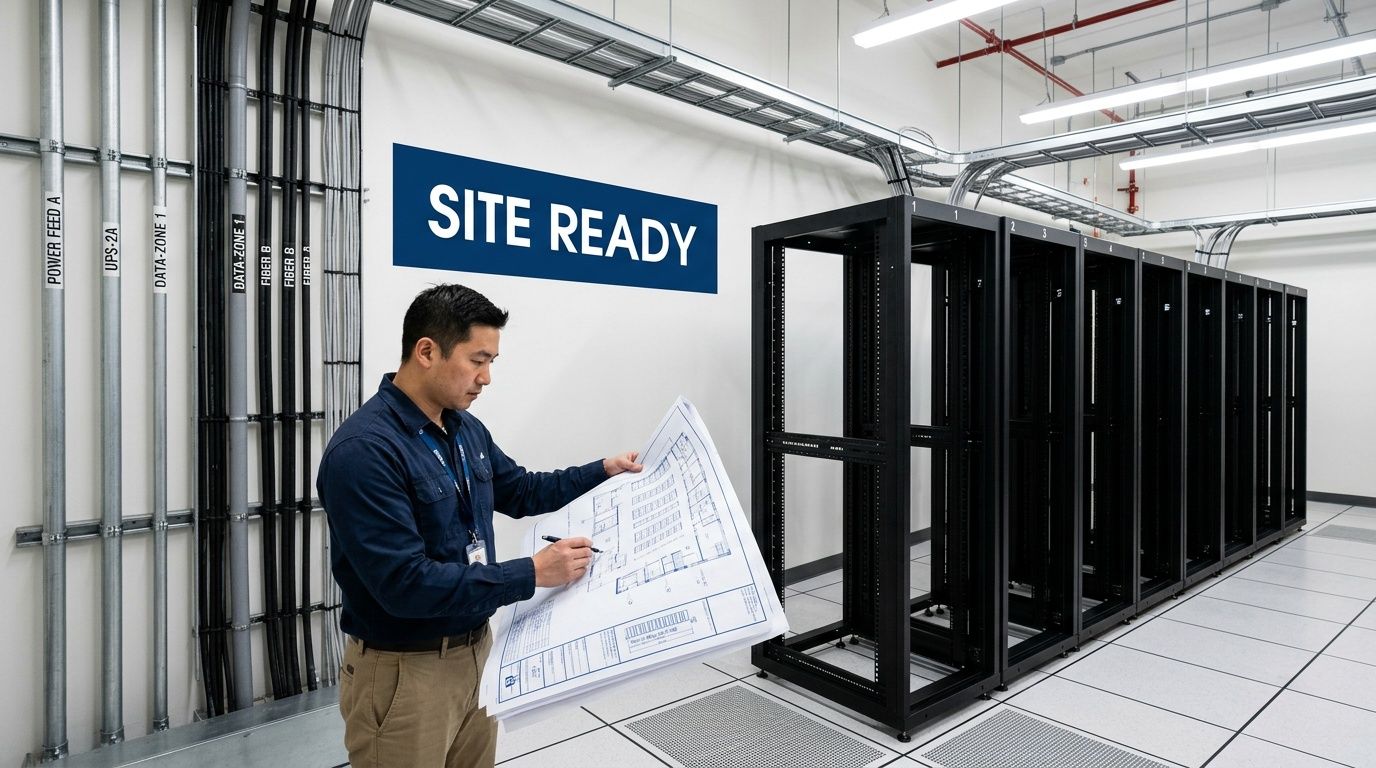
Facilities teams should walk the site before the first install date is set. That means opening telecom closets, checking wall space, confirming power availability, identifying abandoned gear, and tracing how new cabling will move through the building. If you need local support on pathway planning or structured cabling questions, a reference like Home AV Pros on low voltage wiring contractors can help frame what to ask before field work begins.
Four physical checks that save time later
- Power first: Confirm clean, available power where the provider equipment will land. Don't assume an open outlet means the circuit is appropriate for added load.
- Rack and wall space: Measure what’s free, what’s usable, and what only looks available because dead equipment hasn't been removed yet.
- Cooling and airflow: A cluttered room with weak airflow turns "temporary" equipment placement into a reliability problem.
- Cable path access: Check risers, ceilings, sleeves, conduit, and locked rooms before the install team arrives.
What experienced teams do differently
They assign ownership early. One person from facilities, one from IT, and one from operations should know exactly what has to be cleared, retained, labeled, and removed.
They also create a decision list before touching anything:
| Site question | Action |
|---|---|
| Which equipment is still in production? | Label and protect it |
| What gear is abandoned but still powered? | Verify, then schedule shutdown |
| Which cabling must stay for interim service? | Tag it clearly |
| What can leave immediately? | Remove it before install day |
Use the provider kickoff to surface these issues. Don’t wait for the tech to point at a full rack and ask where the new edge device should go.
For teams coordinating access, turnover windows, or multi-room cleanup, it also helps to line up building logistics early through a direct commercial cleanout coordination contact.
The cleanest telecom deployment isn’t the one with the best diagram. It’s the one where the room is ready before the first box arrives.
The Final Step Decommissioning and Sustainable Disposal
Retiring old telecom infrastructure is where many otherwise competent projects lose control. The circuit is cut over, the phones work, the new firewall is mounted, and then the old hardware sits in place because nobody wants to decide what leaves, what gets recycled, and what needs documented handling.
That delay creates multiple problems at once. It clutters valuable space. It confuses asset tracking. It makes future troubleshooting harder because dead equipment still looks active. It also creates risk when storage media, network appliances, batteries, monitors, and mixed electronic waste are left in closets or loading areas without a defined process.
Why decommissioning belongs in the project plan
Business guidance often separates telecom audits from physical cleanouts, even though they should happen together. As noted by CS Atlanta telecom solutions guidance, businesses can cut telecom spending by 20 to 30 percent through audits, but many miss additional savings because they don't synchronize those reviews with office consolidations and junk removal.
That point matters more than it sounds. If a company audits services but leaves old hardware, wiring remnants, unused handsets, and retired infrastructure in place, the site still carries operating drag. Space stays blocked. Legacy confusion remains. The building does not become simpler.
What should be included in a real decommissioning plan
Asset separation
Separate active devices, reusable equipment, recyclable materials, and true waste streams before move-out or install crews overlap. Mixed piles slow every downstream decision.
Data-sensitive handling
Any device that stores data should be identified before removal. Teams should decide internally what requires special handling, chain of custody, or documented destruction.
Sustainability reporting
Organizations with internal ESG, EHS, or facilities reporting goals should collect documentation at the time of removal, not weeks later after memory and chain-of-handoff have already faded.
Field lesson: The best time to decide how old telecom gear leaves the building is before the new equipment is scheduled, not after the cutover.
Where integrated cleanout support helps
This is where coordinated removal matters. Businesses doing office upgrades, warehouse resets, or facility consolidations often need one workflow for old desks, shelving, cables, e-waste, telecom hardware, and recyclable materials. Splitting those streams across too many vendors adds delay and weakens accountability.
A service model that combines haul-away with recycling support is often easier to manage because facilities and operations teams can clear rooms faster while maintaining cleaner documentation for sustainability and compliance purposes. For organizations handling broader office or warehouse transitions, that’s why it helps to review available commercial cleanout and removal services at the same time as the telecom deployment schedule.
A modern telecom upgrade isn't finished when traffic moves to the new network. It's finished when the old environment is safely, clearly, and responsibly out of the building.
Conclusion A Holistic Approach to Atlanta Telecom
The strongest enterprise telecom solutions Atlanta businesses adopt are the ones planned across the full lifecycle. That means selecting the right network model, buying with clear support expectations, preparing the physical site properly, and finishing the job with disciplined decommissioning.
IT can't treat facilities as an afterthought. Facilities can't assume telecom is only an IT issue. Operations can't wait until cutover week to sort out access, storage, or disposal. When those groups coordinate early, upgrades move faster and create fewer surprises.
That holistic approach matters even more in Atlanta, where growing companies often juggle office reconfiguration, distributed teams, warehouse needs, and tighter sustainability expectations at the same time. The network has to work. The room has to be ready. The retired gear has to leave in a responsible way.
A good telecom project improves service. A well-run telecom project also improves space, clarity, and long-term operability.
Frequently Asked Questions
| Question | Answer |
|---|---|
| How do I know whether this is a network upgrade or a facilities project? | It’s usually both. If new telecom services require rack space, power, cable path changes, or removal of old equipment, facilities needs to be involved from the start. |
| Should we remove old telecom gear before the new service is live? | Remove only what has been verified as retired. Active devices, interim circuits, and anything still supporting production should stay labeled and protected until cutover is complete. |
| What’s the most common site-readiness mistake? | Teams often underestimate how much abandoned equipment and unused cabling interfere with install work. The room may look functional, but installers need usable access, not just theoretical space. |
| Is SD-WAN always the best choice for multi-site companies? | No. It’s often a strong option, but only when it matches your applications, carrier mix, and support model. Some environments still benefit from more controlled connectivity for specific traffic types. |
| Who should own telecom decommissioning internally? | One owner should coordinate the process, but IT, facilities, operations, and compliance usually all have a role. Shared accountability works best when one person controls the schedule and approval chain. |
| Why connect telecom planning with cleanouts? | Because the upgrade affects both digital service and physical space. When those are planned separately, rooms stay cluttered, vendors trip over each other, and project closeout drags out longer than it should. |
| Where can I find more operational guidance on turnover, cleanouts, and related planning? | A practical place to continue is the Fulton Junk Removal blog, which covers cleanup and project-readiness topics relevant to office, warehouse, and property transitions. |
If you're planning a network refresh, office tech upgrade, warehouse reset, or full facility cleanout, Fulton Junk Removal can help clear the physical side of the project so your team can focus on deployment. Their commercial junk removal approach, paired with Beyond Surplus recycling support, helps Atlanta businesses remove retired equipment, reclaim usable space, and handle disposal with sustainability in mind.
