
Your Guide to a Fridge Recycle Program in Atlanta
Got an old fridge taking up space in your garage or office breakroom? Before you just haul it to the curb, it's important to understand what a fridge recycle program really is. It’s not just about junk removal; it’s a specialized service that safely decommissions and breaks down old refrigerators and freezers. The goal is to make sure hazardous materials are handled correctly and valuable stuff like metal and plastic gets a second life, keeping it all out of our landfills.
What Is a Fridge Recycle Program and Why Is It Essential
Think of a fridge recycle program as a detailed, responsible retirement plan for your appliance. Instead of ending up in a landfill where it can leak harmful chemicals for years, every unit is carefully dismantled piece by piece. It's a lot like how a car is stripped for valuable parts before the frame gets crushed and recycled.
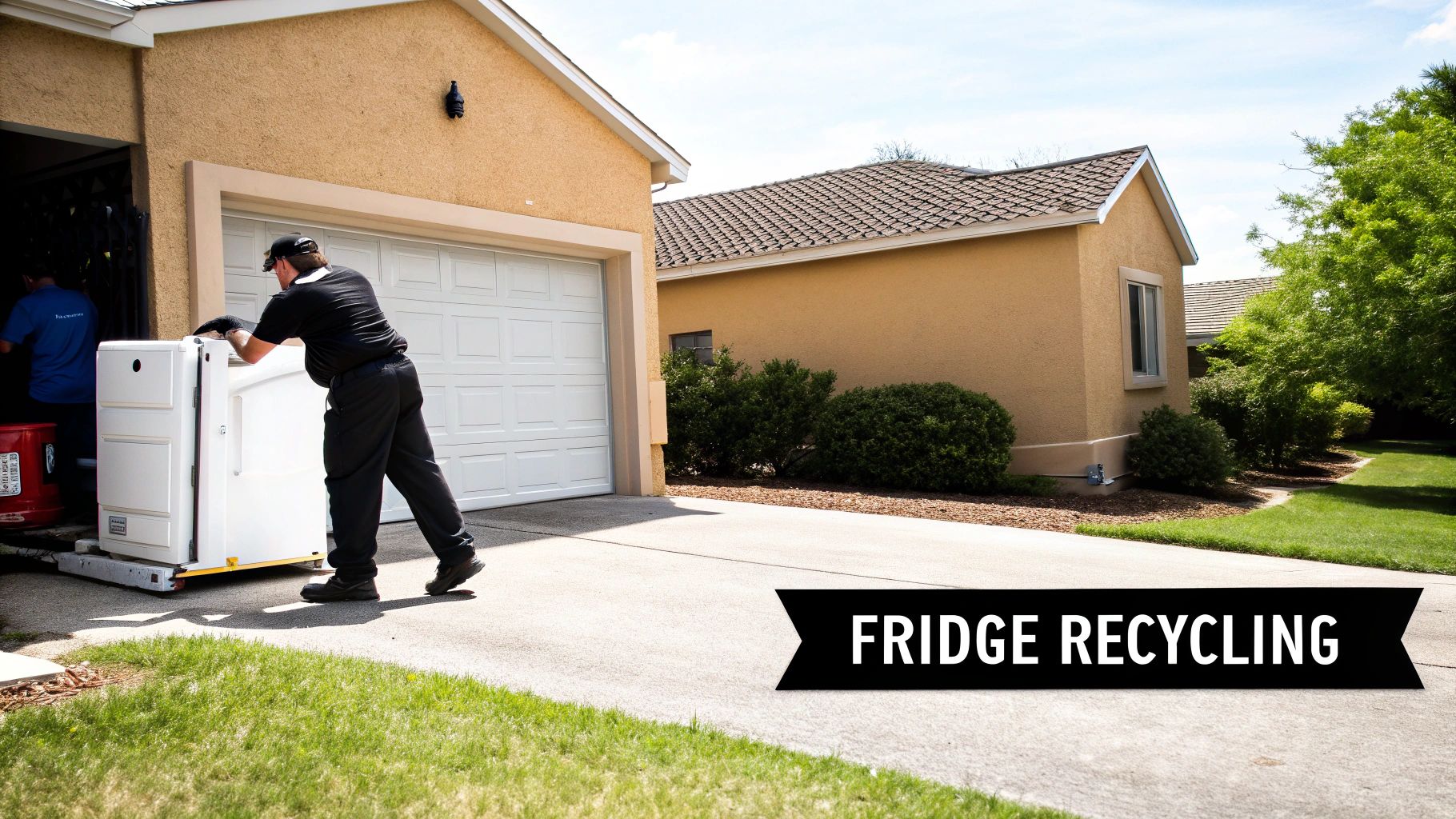
This careful process is non-negotiable because refrigerators are packed with substances that are seriously bad for the environment. We're talking about everything from old-school, ozone-depleting refrigerants to bulky foam insulation that will never biodegrade. These materials require an expert touch to isolate the harmful components while recovering the good ones.
The table below breaks down exactly what's hiding inside that old fridge and why it can't just be tossed out with the regular trash.
Key Environmental Hazards in Unrecycled Refrigerators
| Component | Hazard Type | Environmental Impact if Landfilled |
|---|---|---|
| Refrigerant | Chemical (CFCs/HFCs) | These are potent greenhouse gases. A single fridge can release coolant with the global warming potential of driving a car for thousands of miles. |
| Foam Insulation | Chemical (Blowing Agents) | The foam is made with chemicals that, like refrigerants, can deplete the ozone layer and contribute significantly to climate change. |
| Metals | Physical & Resource Waste | Steel, aluminum, and copper are highly recyclable. Landfilling them wastes finite resources and the energy needed to mine new materials. |
| Oils & Lubricants | Chemical Contaminant | The compressor contains oils that can contaminate soil and groundwater if they leak out in a landfill. |
| Mercury Switches | Toxic Heavy Metal | Found in older models, mercury is a neurotoxin that poses a severe risk to wildlife and human health if it enters the ecosystem. |
As you can see, what seems like a simple appliance is actually a complex collection of materials that demand professional handling to protect our local Atlanta environment.
The Growing Need for Responsible Recycling
The mountain of old appliances is growing faster than ever. Products don't last as long as they used to, and people are upgrading more frequently, leading to a massive increase in appliance and electronics waste. Just ignoring the problem isn't an option anymore.
The global market for waste home appliance recycling is projected to expand from $18.8 billion in 2024 to $38.3 billion by 2034. Refrigerators are a primary driver of this growth, as responsible end-of-life handling becomes a regulatory and environmental necessity worldwide.
This trend shows a major shift in thinking. Environmentally conscious homeowners and businesses are finally moving away from the "out of sight, out of mind" landfill mentality. We're embracing a circular economy where old products become the raw materials for tomorrow's goods.
A Smarter Solution for Atlanta Businesses
For anyone managing an office, warehouse, or apartment complex in the Atlanta area, dealing with appliance disposal regulations can be a real headache. This is where a professional service isn't just a convenience—it's a necessity. Fulton Junk Removal offers a straightforward solution that handles the entire process for you.
We work hand-in-hand with our partner, Beyond Surplus, a circular, eco-friendly solution that goes beyond traditional junk hauling. This partnership guarantees that every single part of your old refrigerator is processed the right way. While most junk removal companies take everything to the landfill, we divert items to Beyond Surplus to minimize waste and maximize reuse.
- Compliance: We make sure your appliance disposal is fully compliant with all local, state, and federal environmental laws, making compliance and sustainability reporting easier.
- Sustainability: Your old fridge stays out of the landfill, helping you meet corporate sustainability goals and demonstrate environmental responsibility.
- Convenience: We are your single point of contact for bundled junk removal and certified recycling.
We turn a complicated logistical problem into a simple, responsible decision that benefits your business and our community.
The Hidden Dangers Lurking in Your Old Fridge
An old fridge sitting in a garage or basement might look harmless, but it's basically a chemical time bomb. The real reason you can’t just drag it to the curb is what’s sealed inside. These potent, invisible substances are precisely why a professional fridge recycle program isn't just a good idea—it's an environmental and legal necessity.
The biggest offenders are the refrigerants used for cooling. Older units often contain chemicals like chlorofluorocarbons (CFCs) or hydrofluorocarbons (HFCs), which are incredibly powerful greenhouse gases. Think of them as a "super-blanket" for the planet. When released, they trap heat in the atmosphere far more effectively than carbon dioxide, directly fueling climate change. If you want to get into the technicals, this is a great resource for understanding the different types of refrigerants like R600a and R134a.
Beyond the Coolant
But the trouble doesn't end with the cooling lines. The thick foam insulation packed into the fridge walls contains its own set of harmful blowing agents. When an appliance is crushed at a landfill, these gases escape, contributing to both ozone depletion and global warming.
And that's not all. Many older models have mercury in their switches and contaminated oils inside the compressor. If that fridge ends up in a dump, those toxins can easily leak out, poisoning the soil and seeping into local water sources for years to come.
A Treasure Trove of Recoverable Resources
While the risks are serious, an old refrigerator is also a goldmine of valuable materials just waiting to be reclaimed. It's not just a piece of hazardous waste; it's a bundle of resources that can be put right back into the circular economy. For property managers and sustainability directors focused on resource recovery, this is a huge win.
A single refrigerator typically contains a surprising amount of valuable stuff:
- Steel: The frame, body, and doors are mostly steel, which is infinitely recyclable.
- Copper: You'll find valuable copper in the compressor motor and wiring.
- Aluminum: Freezer components and tubing contain aluminum, another highly sought-after recyclable metal.
- Plastics and Glass: All those shelves, drawers, and liners can be broken down and turned into new products.
By opting for a certified fridge recycle program, you’re guaranteeing these materials get a second life instead of being buried forever. The global fridge recycling market is already valued at $2.5 billion and growing, all thanks to greater environmental awareness. In fact, recycling just one fridge prevents an estimated 566 pounds of CO2 emissions from entering the atmosphere. That’s a real, measurable impact.
This smart approach turns a potential environmental liability into a positive action, satisfying both regulatory demands and modern sustainability goals. For more tips on getting rid of old stuff the right way, check out our https://fultonjunkremoval.com/blog/.
The Journey of a Recycled Refrigerator
Ever wonder what actually happens to your old fridge after it leaves your curb? It's not a one-way trip to the dump. Instead, it begins a fascinating journey of careful disassembly and transformation, entering a circular system designed to capture every last bit of value.
For businesses and homeowners looking for appliance removal in Atlanta, understanding this process shows why picking a certified fridge recycle program is so important. Through our partnership with Beyond Surplus, we ensure every step is handled the right way—safely and sustainably.
The real work starts the moment that old refrigerator arrives at the processing facility. It isn't just crushed and forgotten; it's meticulously decommissioned. The very first step is also the most critical: safely extracting all the hazardous materials.
Decontamination and Component Separation
Before anything else, specialized technicians get to work draining all the harmful substances. This includes refrigerants, compressor oils, and any mercury-containing switches often found in older models. It’s a painstaking, highly regulated process designed to keep these potent chemicals from ever touching our atmosphere or soil.
Once it's decontaminated, the appliance is ready for the main event. The process flow diagram below breaks down how the primary materials—refrigerants, foam, and metals—are methodically separated and routed for processing.
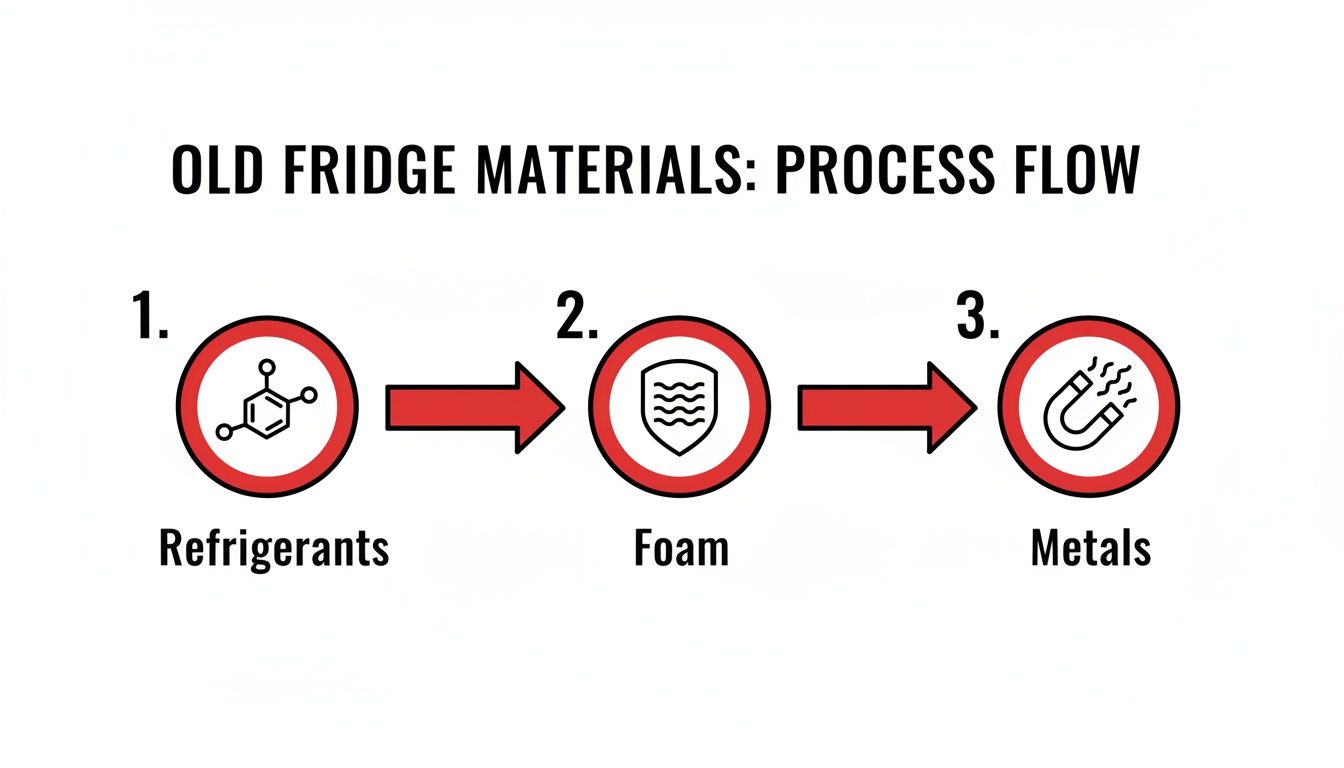
This visual journey makes it clear that recycling isn't a single action. It’s a multi-stage operation where every single component has a specific path, making sure nothing goes to waste.
Shredding and Material Sorting
With the hazardous materials safely removed, the clean fridge shell is fed into a massive industrial shredder. In just minutes, that bulky unit is torn into small, fist-sized pieces. This jumbled mix of materials then travels down a conveyor belt where some pretty smart sorting technology takes over.
Powerful magnets are the first to act, pulling out all the ferrous metals like steel. Steel makes up more than 75% of a typical refrigerator's weight, and the best part is it can be melted down and repurposed almost infinitely.
Next, eddy current separators create a special magnetic field that literally repels non-ferrous metals like aluminum and copper, pushing them into their own collection bins. Finally, a combination of infrared sensors and high-powered air jets sorts the different types of plastics.
What’s left is a collection of clean, separated raw materials, ready to be sold and manufactured into brand-new products. The cycle is complete. This entire process ensures that up to 95% of an old appliance is repurposed, keeping it out of our local landfills for good.
Choosing the Right Disposal Path for Your Business

For property managers, sustainability directors, and office managers in Atlanta, getting rid of old appliances is so much more than a logistical headache. It’s a puzzle of compliance, efficiency, and corporate responsibility.
A big office cleanout or a multi-unit apartment turnover can quickly spiral into a coordination nightmare. You might find yourself juggling a junk hauler for the old furniture, a separate e-waste recycler for the computers, and yet another vendor just for scrap metal.
This piecemeal approach isn't just inefficient; it's risky. Every new vendor adds another layer of paperwork, another potential compliance gap, and another drain on your time. This is where an integrated service isn't just a convenience—it's a massive strategic advantage. It turns a chaotic disposal process into a single, accountable action.
The Power of an Integrated Partnership
Fulton Junk Removal offers a completely different way of thinking. Through our unique partnership with Beyond Surplus, we provide a single, unified solution that covers junk hauling and certified recycling under one roof. Imagine making just one call to handle everything—from worn-out office desks and cubicles to an entire fleet of outdated refrigerators and IT equipment.
Our model was built from the ground up to serve the specific needs of commercial clients like offices, warehouses, and property managers. Fulton handles the junk removal, and Beyond Surplus ensures responsible recycling of all electronics, metals, and other materials. All your electronic waste and recyclable materials are directly processed by Beyond Surplus, a proven leader in eco-friendly, circular solutions.
This integrated system ensures that your items are actually diverted from landfills, maximizing their potential for reuse and responsible recycling. It’s a strategic partnership designed to make your sustainability reporting and compliance validation a whole lot simpler.
There’s a reason the market for responsible disposal is growing so fast. North America currently accounts for over 34.2% of the global home appliance recycling market, a sector valued at a staggering $21.26 billion. Refrigerators are a top priority within that market, thanks to their high replacement rates and the absolute necessity of managing their hazardous refrigerants.
For any IT director or facilities manager, these numbers highlight how critical it is to choose a certified fridge recycle program. It's not just about getting rid of something; it's about doing it right.
Streamlining Compliance and Reporting
One of the biggest wins for our business clients is the simplified documentation. After the job is done, we provide certified diversion reports. These documents are gold for your sustainability audits, giving you clear, verifiable proof that your company’s waste was managed responsibly and in line with all regulations.
When upgrading, it's always smart for businesses to explore all their options. You might even find value in selling or acquiring pre-owned equipment. For instance, some restaurant managers find that navigating the used prep table refrigerator market can be a cost-effective move.
Below is a quick comparison showing how our integrated approach stacks up against the more traditional, fragmented options.
Comparing Disposal Methods for Commercial Properties
| Feature | Fulton Junk Removal (with Beyond Surplus) | Traditional Junk Hauler | Municipal Pickup |
|---|---|---|---|
| Service Scope | One call for junk, appliances, e-waste, and scrap metal. | Typically handles general junk only; may charge extra for appliances. | Limited to specific items; often excludes commercial properties or bulk pickups. |
| Compliance | Certified diversion reports and data destruction certificates. | Minimal to no compliance documentation. | No specialized reporting for business needs. |
| Environmental Impact | Zero landfill commitment for all recyclable materials. | Most items go directly to landfill; recycling is an afterthought. | Varies by municipality; limited recycling capabilities. |
| Efficiency | Single point of contact and one invoice for all services. | Requires coordinating multiple vendors for different waste streams. | Rigid schedules and strict item limitations. |
| Liability | Reduces risk with a secure chain of custody for all assets. | Potential for improper disposal and data security risks. | Responsibility falls on the business to ensure compliance. |
This table makes it clear: a consolidated service isn't just easier—it provides the accountability and documentation that modern businesses require.
Ultimately, this isn't just about removing old appliances. It’s about choosing a partner who can reinforce your company’s commitment to corporate social responsibility while saving you time and headaches.
Ready to simplify your commercial junk removal and recycling in Atlanta? Contact Fulton Junk Removal today to discuss a bundled solution that works for you.
How to Prepare Your Fridge for Recycling Pickup
Getting that old fridge out of your way for good is a great feeling, but a little prep work makes the whole process faster and safer for everyone. When you follow a few simple steps, our crew can get in and out quickly, letting you get back to your day without any fuss.
First things first: completely empty the refrigerator and freezer of all food and drinks. This is the most important step, as it prevents messy spills and potential hygiene issues while the appliance is on the move. Once it’s empty, a quick wipe-down of the inside is always a big help.
Next, you’ll need to unplug the unit at least 24 to 48 hours before we’re scheduled to arrive. This gives it plenty of time to fully defrost, stopping water from leaking onto your floors or creating a slippery hazard for our removal team. We recommend placing a few old towels inside and on the floor around the fridge to soak up any leftover moisture.
Securing the Unit for Safe Transport
Once it's defrosted, the last thing to do is secure the doors. Just wrap some strong packing tape or a rope around the whole unit to keep the refrigerator and freezer doors shut tight. It’s a simple move that prevents them from swinging open and causing damage to your walls, doorways, or our crew.
After that, your old appliance is officially ready for its final trip to a certified recycling facility.
The Simplicity of Professional Scheduling
Now, how do you actually get it picked up? The DIY route often sounds easy at first, but it gets complicated fast. You have to find a certified recycler that even accepts appliances, figure out how to haul a heavy, awkward unit without hurting yourself or your property, and find a truck big enough to transport it.
This is exactly where a professional fridge recycle program changes the game. Instead of juggling all those pieces, you just make one phone call.
A professional service takes care of all the heavy lifting, transportation headaches, and logistical guesswork. You won't have to research local rules or find certified facilities—the service handles every single detail, from scheduling the pickup to ensuring final, responsible disposal.
For Atlanta-area residents and businesses, the process with Fulton Junk Removal couldn't be easier. We handle everything. Our team will schedule a convenient pickup time, do all the heavy lifting, and make sure your old fridge is transported directly to our recycling partner, Beyond Surplus. We turn a complex chore into a simple, stress-free experience.
Your Fridge Recycling Questions Answered
We get it—navigating the world of appliance disposal can feel a little confusing. To clear things up, we've put together some straight, practical answers to the most common questions we hear about our fridge recycle program. Our goal is to give you the confidence you need to make a smart, eco-friendly choice.
Do I Need to Clean My Fridge Before You Pick It Up?
Yes, for safety and hygiene, please make sure the refrigerator is completely empty of food and any other items before our team shows up. A quick wipe-down on the inside is always appreciated, but it's not a deal-breaker.
What's most important is that the unit is unplugged and fully defrosted, ideally 24-48 hours in advance. This one step is critical for preventing a messy water leak while we're moving it. From there, our professional crew will handle all the heavy lifting and hauling.
What Is a Diversion Report and Why Does My Business Need It?
A diversion report is a certified document proving that your waste was properly recycled or repurposed instead of just being dumped in a landfill. Think of it as an official receipt for your environmental responsibility.
For businesses tracking sustainability goals, preparing for environmental audits, or simply validating their Corporate Social Responsibility (CSR) efforts, this report is absolutely essential. It provides the hard data needed to show compliance and prove you're managing waste the right way.
Through our exclusive partnership with Beyond Surplus, Fulton Junk Removal provides these reports to give your business total peace of mind and concrete proof of your commitment to the planet.
Can You Take Other Junk with My Old Fridge?
Absolutely. This is one of the biggest perks of working with Fulton Junk Removal. We can bundle your fridge pickup with other junk removal services, meaning we haul away your old appliances, e-waste, office furniture, and general clutter all in one efficient visit.
This bundled approach saves offices, warehouses, and property managers the headache of calling multiple companies. Instead of trying to coordinate a junk hauler, an e-waste recycler, and a scrap metal collector, you just make one call to us. All electronic waste and recyclable materials are directly processed by our partner, Beyond Surplus, ensuring nothing that can be reused ever goes to waste. It’s a huge part of what makes our company a true circular solution.
How Much Does It Cost to Recycle a Fridge in Atlanta?
We designed our pricing to be straightforward and transparent, with zero hidden fees. The final cost just depends on a couple of factors, like the size of the refrigerator and where it's located on your property (a basement removal is different from a garage pickup, for example).
We always provide a free, no-obligation estimate before we start any work, so you know the exact cost upfront. That price is all-inclusive, covering all the labor for removal, transportation to the recycling facility, and all certified recycling fees. With Fulton, what we quote is what you pay.
Choosing the right partner is crucial for making sure your junk is handled conveniently and responsibly. To see exactly how we make eco-friendly disposal easy for our Atlanta-area clients, you can read about our commitment to eco-friendly junk removal and learn more about our company's mission and our unique partnership with Beyond Surplus.
Ready to reclaim your space and get rid of your old appliances the right way? Fulton Junk Removal offers a seamless, eco-conscious solution for both homeowners and commercial clients. Get your free, no-obligation estimate today and let us handle the heavy lifting.
