
Expert Junk Removal to IT Equipment Disposal in Atlanta
A lot of Atlanta cleanouts start the same way. Facilities has a deadline, IT has a stack of retired laptops and network gear, and operations just wants the floor cleared so the next tenant, employee group, or project can move in.
That's where companies make an expensive mistake. They treat everything in the room as junk.
Old desks, shelving, and broken fixtures usually belong in a standard hauling workflow. Retired computers, servers, hard drives, switches, and multifunction devices don't. Those assets carry different risks, different handling requirements, and different downstream obligations. If you mix them into one generic load-out, you lose visibility over where data-bearing devices went, how they were processed, and whether anything was recycled or just dumped into a broad disposal stream.
The practical issue behind junk removal to IT equipment disposal in Atlanta is simple. One part of the job is about volume and labor. The other is about custody, documentation, data destruction, and material recovery. Commercial clients need both, but they shouldn't buy them as if they're the same service.
Atlanta Business Cleanouts More Than Just Junk Hauling
Walk into a typical office or warehouse cleanout and you'll usually find a mixed stream. There may be cubicles, chairs, wire shelving, packing waste, old signage, and general debris. In the same room, there's often a pallet of monitors, a rack with decommissioned servers, and a box full of hard drives nobody wants to claim.
That mix is exactly why business cleanouts need more than a truck and labor. A team can remove everything quickly and still handle the job badly if it doesn't separate ordinary junk from data-bearing equipment at the point of pickup.
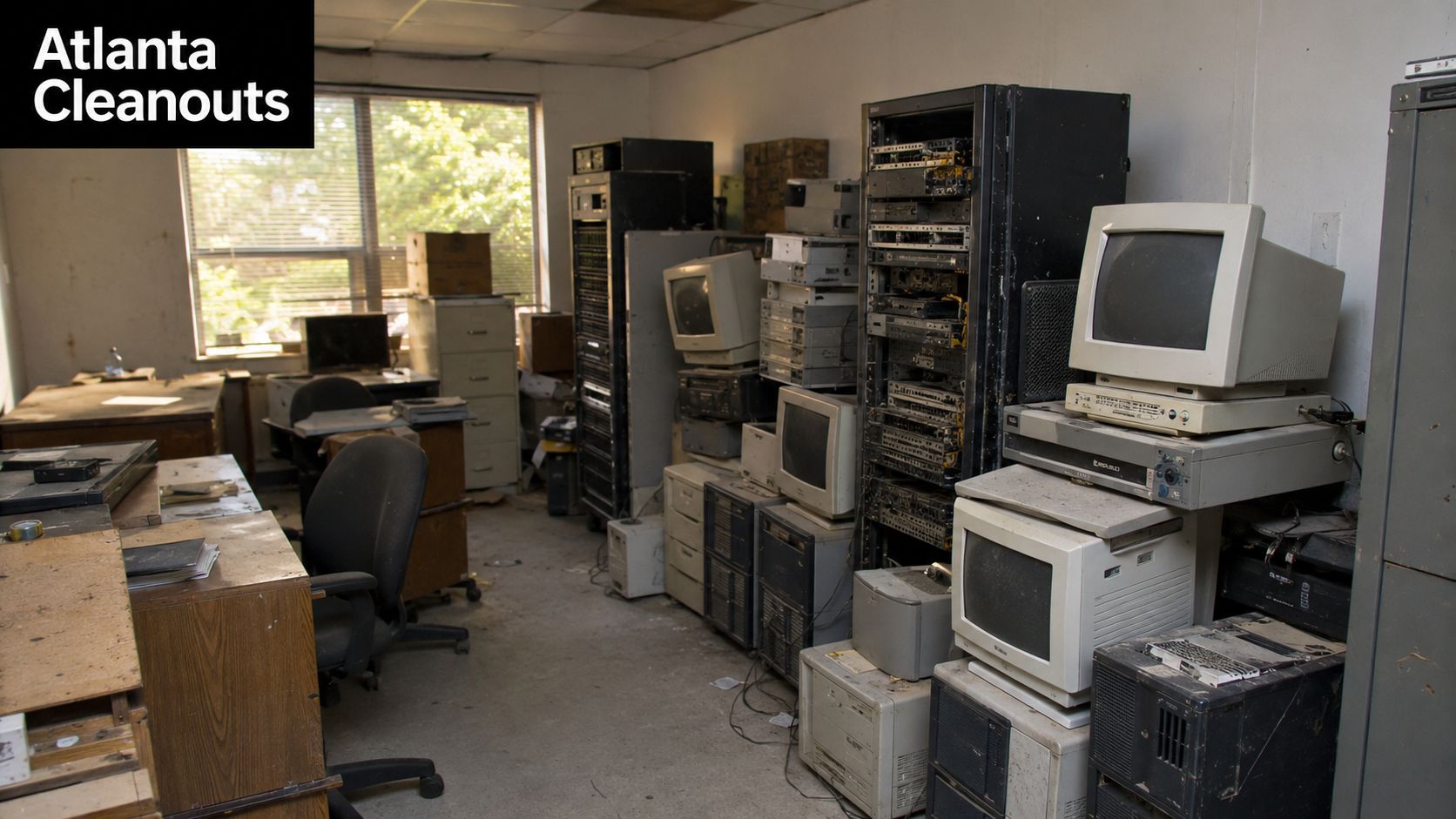
The scale of the problem isn't theoretical. The world generated about 62 million metric tons of e-waste in 2022, and only 22.3% was formally collected and recycled. That total is projected to reach 82 million metric tons by 2030, according to the Global E-waste Monitor summary cited here. For Atlanta businesses with regular moves, refresh cycles, and tenant turnover, that means electronics disposal is no longer a side task. It's part of routine operations.
What belongs in a hauling stream and what doesn't
A mixed commercial cleanout usually breaks into two categories:
- General material includes furniture, non-sensitive fixtures, packaging waste, non-electronic scrap, and ordinary bulky items.
- Controlled material includes computers, laptops, servers, storage devices, copiers, phones, access control hardware, and networking equipment.
Treating both categories the same causes problems fast. The hauling crew may clear the space, but the customer is left without proof of destruction, reuse, or recycling for the items that mattered most.
Practical rule: If a device stored data, connected to a network, or contains regulated components, don't let it leave your site under the same assumptions as office junk.
This distinction matters in adjacent trades too. Anyone coordinating renovations or move-outs already knows that specialty waste streams need their own plan. The same logic applies when teams evaluate resources like this guide to construction debris removal, where separation and destination affect cost and compliance.
Why Atlanta teams need a combined plan
Property managers and office admins usually aren't trying to cut corners. They're trying to simplify a messy project. The problem is that simplicity on the front end often creates risk on the back end.
A better approach is to scope the cleanout in two lanes from the start. One lane covers physical removal and site clearing. The other covers electronics handling, data-bearing assets, and documentation. Businesses looking at bundled removal options can start with Fulton's service overview to understand how those job types are separated in practice.
Junk Removal and ITAD Two Different Problems Two Solutions
A warehouse manager in Atlanta can clear a floor in one afternoon and still end the day with a bigger problem than the clutter. Old desks, broken shelving, and pallet wrap are one job. Retired laptops, phones, firewalls, and server gear are another. If both leave on the same truck under the same paperwork, the business loses control over where sensitive equipment went and how it was processed.
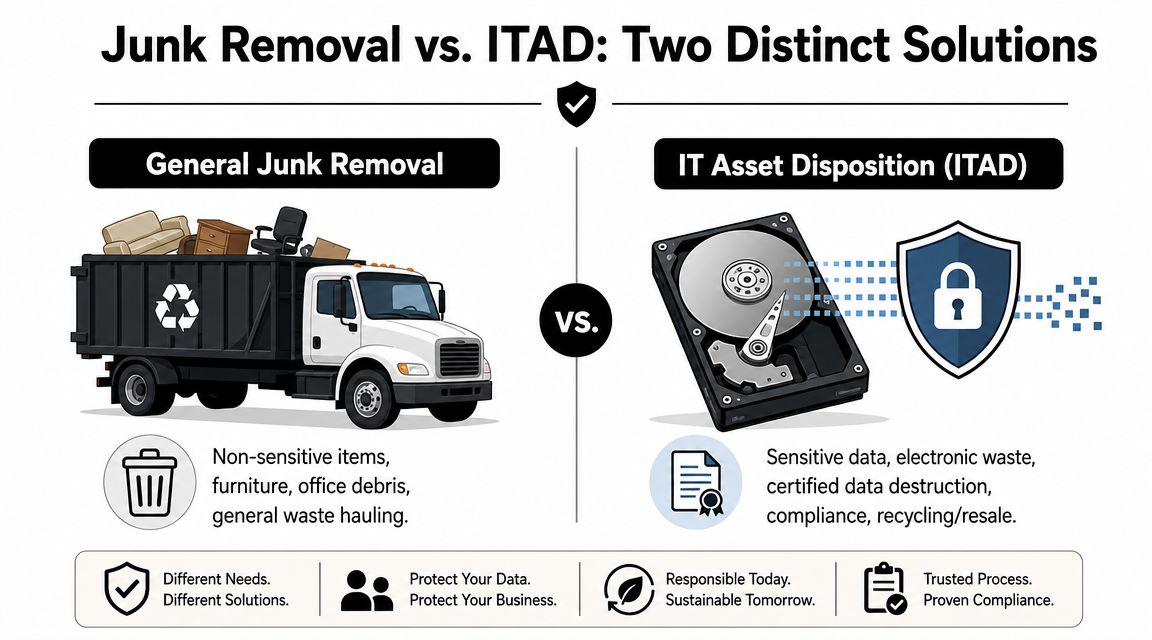
Standard junk removal and IT asset disposition, or ITAD, serve different purposes. Junk removal is built for site clearing. ITAD is built for controlled handling of retired technology, with documented outcomes such as data destruction, refurbishment, parts recovery, or certified recycling.
The shortest useful definition
Standard junk removal is a logistics service. The job is labor, loading, transport, and getting unwanted material out of the space.
ITAD is an asset control process. The job is to identify electronics, separate data-bearing devices, manage approved downstream vendors, and produce records that stand up to an internal review or customer question.
Crews in the field expose the difference quickly. A hauling team usually scopes volume, access, and disposal weight. An ITAD team asks what devices are present, whether any hold data, what tracking is required, and which items may still have reuse value.
Junk Removal vs. IT Equipment Disposal at a Glance
| Aspect | Standard Junk Removal | Specialized IT Equipment Disposal (ITAD) |
|---|---|---|
| Primary goal | Clear space and remove unwanted material | Manage retired technology securely and document final disposition |
| Typical items | Furniture, non-sensitive office contents, debris, fixtures | Computers, servers, hard drives, SSDs, switches, phones, monitors, network gear |
| Data security | Usually not a core service function | Central requirement for any data-bearing asset |
| Handling method | Load, haul, sort, discard or divert where possible | Inventory, segregate, secure transport, sanitize or destroy, document |
| Main risk if mishandled | Disposal inefficiency or landfill overuse | Data exposure, chain-of-custody gaps, failed audit trail |
| End destination | Landfill, donation, recycling, mixed sorting facility | Certified recycling, refurbishment, material recovery, documented destruction |
| Value recovery potential | Usually limited to resale or donation of bulky goods | Reuse, parts recovery, commodity recovery, and formal IT disposition workflows |
Why cost works differently
The pricing model follows the work. General hauling is usually priced around labor, truck space, access conditions, and disposal fees. IT equipment disposal adds time for sorting, inventory control, secure handling, downstream processing, and documentation.
That creates a real trade-off for businesses. A single hauler may look simpler at scheduling stage, but the low-friction option often shifts risk to the customer after pickup. Separate vendors can cover both scopes, yet handoffs between them create gaps in timing, custody, and reporting. An integrated service model solves that problem by clearing the facility and isolating technology streams under one coordinated plan.
That operating split is part of Fulton Junk Removal's company background and service approach. For Atlanta businesses, the practical question is not who can remove everything fastest. It is who can remove general junk, route electronics correctly, and leave a record of what happened to the assets that carried compliance and security risk.
Why Data Security Dictates Your Disposal Choice
If a business device ever stored customer records, employee data, financial information, credentials, internal files, or system configurations, disposal stops being a housekeeping issue. It becomes a control issue.
That's why standard junk hauling is the wrong fit for business electronics. The risk isn't that a crew removes the equipment. The risk is that nobody can prove what happened after pickup.
What secure handling actually looks like
Best-practice ITAD providers maintain a documented chain of custody from pickup through final disposition. That usually includes inventory by serial number or asset tag, secure transport, and records that show where each data-bearing device went at every handoff. The Atlanta-focused guidance on documented chain of custody and secure transport captures that standard clearly.
In practice, this is what organizations should expect:
- Asset identification before or during pickup so devices aren't treated as anonymous scrap
- Segregated handling for hard drives, SSDs, servers, laptops, firewalls, and network gear
- Secure transport controls rather than open, mixed hauling conditions
- Auditable records that support internal review, customer requirements, or regulator questions
Without that chain, “secure recycling” is just a marketing phrase.
What happens to drives after pickup
This is one of the most important questions buyers fail to ask. Storage media can be wiped, physically destroyed, or routed into a process based on device type and customer policy. Networking equipment may also contain storage or configuration data that deserves the same treatment as a workstation drive.
What matters is not which term a vendor uses first. What matters is whether the vendor can explain:
- Who handles the devices
- Whether media is wiped, shredded, or otherwise sanitized
- What proof the customer receives
- How exceptions are documented
A pickup isn't secure because the truck left the building. It's secure when the organization can show custody, method, and final outcome for each sensitive device.
Compliance is built on records, not promises
Organizations in healthcare, finance, legal services, education, property management, and enterprise operations often have internal retention and disposal rules that are stricter than the casual market assumes. Even when the governing rule set varies by business, the operational lesson stays the same. You need evidence.
A disposal partner should be able to support your internal policy, not ask you to ignore it for convenience. If your process requires serial-level inventory, proof of destruction, or documented recycling, generic haul-away won't meet the mark.
Teams comparing procedures and vendor questions can use the articles on the Fulton Junk Removal blog as a starting point, but the true measure is simple: ask to see what records you'll receive after the job is done.
How Fulton Junk Removal Bridges the Gap in Atlanta
Businesses often create unnecessary friction by splitting one cleanout across separate vendors. One company removes furniture and debris. Another picks up electronics later. A third may handle downstream recycling. That sounds organized on paper, but in the field it creates missed pickups, duplicate site coordination, and blurry accountability.
An integrated model works better when the job includes both general material and retired technology.
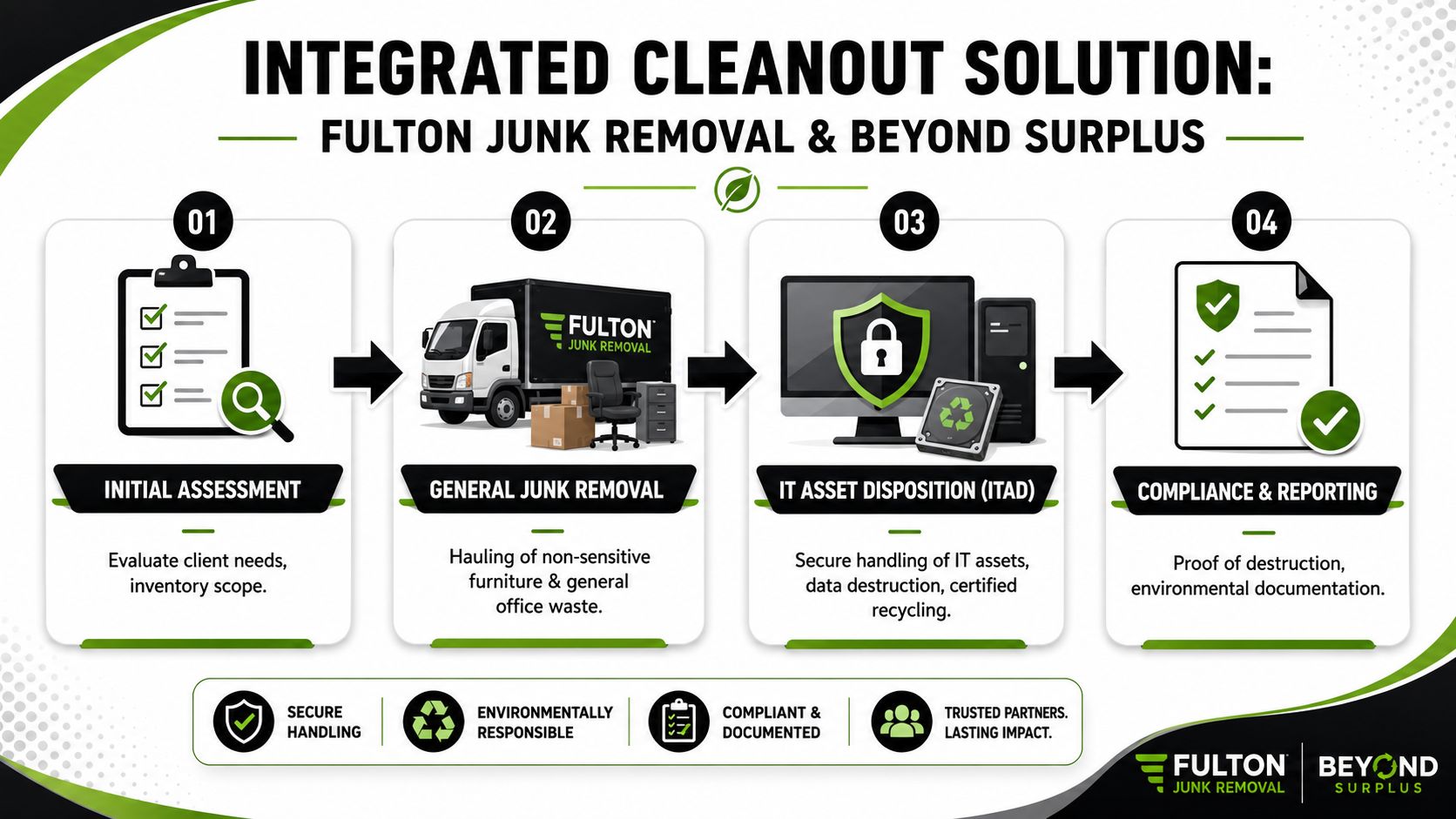
One site visit, two handling paths
The practical advantage is straightforward. The crew assesses the site, separates non-sensitive material from electronics, and routes each category into the right stream. Furniture, fixtures, and ordinary debris go through a hauling workflow. Computers, monitors, servers, and related equipment move into a controlled electronics and recycling workflow.
That integrated approach is where Fulton Junk Removal fits for Atlanta-area commercial projects. As part of the Beyond Surplus family, it can support bundled haul-away and electronics recycling workflows so offices, warehouses, and property managers don't have to coordinate unrelated vendors for one mixed cleanout.
Where separate services usually break down
The failure points are rarely dramatic. They're procedural.
- Scheduling gaps happen when the junk crew clears the room before IT has tagged devices for special handling.
- Custody gaps appear when electronics sit in staging areas waiting for a second vendor.
- Reporting gaps show up later, when the customer has one invoice for hauling and no usable documentation for assets that contained data.
- Responsibility gaps emerge when each provider assumes the other is handling recycling, destruction records, or final disposition details.
An integrated workflow reduces those handoff problems because the project is scoped with both outcomes in mind from the start.
Separate vendors can work. They just require tighter customer oversight. Most facility and operations teams would rather manage one coordinated cleanout than referee three disconnected scopes.
Why this matters for Atlanta properties
Atlanta projects often involve high-rise access, loading dock scheduling, freight elevator windows, and occupied spaces that can't tolerate repeated vendor visits. That makes clean execution more important than theoretical service menus.
If the work includes office furniture, warehouse contents, and retired IT, the cleanest process is usually a single operational plan with clear item separation, secure transport for electronics, and one reporting trail the customer can use. Businesses planning service in the city can review Atlanta-area cleanout coverage to confirm whether a local provider supports that kind of mixed project.
Preparing for Your Office or Warehouse Cleanout
Most cleanouts go wrong before the truck arrives. Devices aren't tagged, nobody knows what must be retained, and building access details get sorted out at the last minute. Good preparation doesn't eliminate every issue, but it prevents the predictable ones.
The biggest planning mistake is assuming bulk IT removal works like dropping a few items at a recycling center. It doesn't. For business pickups, logistics like scheduling, access constraints, and asset tracking directly affect cost and execution, as noted in this Atlanta bulk IT removal guidance.
The prep checklist that saves time
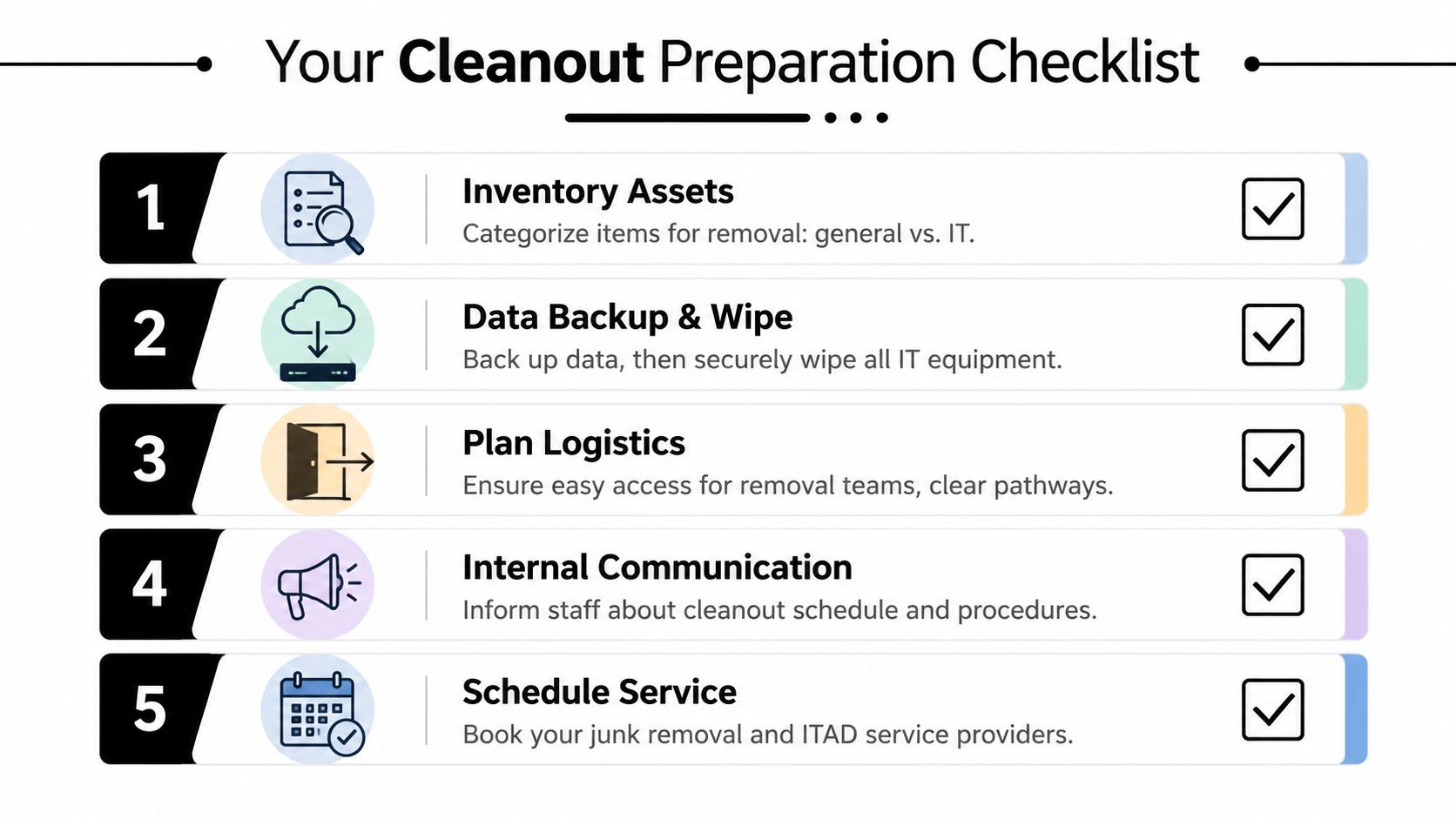
Use a simple internal checklist before requesting quotes.
Build two inventories
List ordinary material separately from IT assets. Don't leave servers, desktops, printers, access panels, and loose drives buried inside a general junk estimate.Flag every data-bearing device
Laptops are obvious. Network appliances, copiers, point-of-sale hardware, and some multifunction systems are easier to miss.Check your internal disposition policy
Confirm whether your company requires wiping, physical destruction, serial-level reporting, or manager signoff before release.Map site access before pickup day
Note loading dock rules, elevator reservations, parking limits, packing requirements, and whether the crew needs COI paperwork or after-hours entry.Ask vendors what records you'll receive
A serious provider should answer clearly when you ask about chain of custody, proof of destruction, and recycling documentation.
Questions worth asking before approval
A vendor conversation gets much better when you stop asking only about price and ask about process.
- “How do you separate general junk from IT assets on site?”
- “What happens to hard drives and SSDs after pickup?”
- “Will you provide auditable documentation?”
- “How do you handle buildings without a dock or with limited elevator time?”
Those questions expose the difference between a hauling quote and a real disposal plan.
Borrow discipline from other property workflows
Facilities teams already use repeatable checklists for turnover work, cleaning, and maintenance because they reduce surprises. The same discipline helps with cleanouts. For a useful example of how strong property workflows are structured, this overview from WipesBlog.com's property maintenance guide shows the value of documenting tasks before crews arrive.
If your cleanout is coming up soon, the fastest way to avoid confusion is to gather the asset list, site constraints, and disposal requirements before scheduling through the Fulton contact page.
Your Partner for Compliant Disposal in Atlanta
At 6 p.m., a tenant move-out turns into two jobs at once. The old desks, pallets, and broken fixtures need to leave the building fast. The laptops in a storage closet, the retired switches in the IT room, and the drives inside decommissioned servers need documented handling that can stand up to an audit.
That split is where Atlanta cleanouts go wrong. General hauling clears space. IT asset disposition protects data, documents custody, and routes equipment through the right downstream process. A business that treats both streams the same usually creates its own risk.
The problem is not complexity for its own sake. The problem is mixing low-risk material with high-risk material under one vague scope of work. A chair has no privacy exposure. A laptop with a failed screen still may hold customer records, employee data, saved credentials, or regulated information.
Why integrated disposal works better than split vendors
Using one hauler for junk and a second company for electronics can work. It also creates extra handoffs, separate schedules, and more room for confusion about who touched what and when. I have seen projects stall because the junk crew loaded small electronics with scrap, while the IT vendor assumed all tagged devices were still on site.
An integrated model solves a practical operations problem. The crew can separate material streams during the cleanout, remove general debris, isolate data-bearing assets, and document the chain of custody without forcing the client to coordinate two different field teams. That reduces custody gaps and makes sustainability reporting easier because the removal record and the electronics disposition record come from the same job.
What a compliant partner should be able to explain
A qualified provider should be able to explain the process in plain language.
They should tell you how assets are identified on site, how data-bearing devices are kept separate from general junk, how transport is controlled, what happens to drives and whole units after pickup, and what records you will receive afterward. If those answers are vague, the scope is vague.
Short promises are not enough. “We recycle electronics” does not explain whether equipment is remarketed, dismantled, or sent through downstream vendors. “We handle hard drives” does not explain destruction, serialization, or whether you receive proof tied to your pickup.
Choose the provider that can describe the chain of custody, the processing path, and the final documentation before the truck arrives.
For Atlanta offices, warehouses, property managers, and operations teams, Fulton Junk Removal fills the gap between standard haul-away and controlled IT equipment disposal. The value is not convenience alone. It is having one coordinated plan for site access, labor, security-sensitive assets, and documented downstream handling from pickup through final processing.
If your cleanout includes both bulky waste and retired electronics, contact Fulton Junk Removal for an estimate built around access constraints, data-bearing devices, and compliance requirements from the start.
