
Can Junk Removal Handle IT Disposal in Atlanta?
Yes, some junk removal companies can handle IT disposal in Atlanta, but only when they use a dedicated process to separate electronics and move them into certified recycling channels. Simple haul-away is not the same as compliant disposal, especially when hard drives, laptops, servers, printers, and other data-bearing devices are mixed into a cleanout.
This question frequently prompts a more important underlying query. If a crew clears out my office or warehouse, what happens after the truck leaves?
That gap matters. In the Atlanta market, junk removal often includes e-waste handling, yet electronics remain one of the fastest-growing waste streams worldwide. The world generated 62 million metric tons of e-waste in 2022, and only 22.3% was formally collected and recycled, according to the Global E-waste Monitor as cited by Atlanta junk removal guidance on e-waste disposal. For a business, that turns IT disposal into more than a space problem. It becomes a data-security problem, a downstream handling problem, and an environmental decision.
The Real Question Behind Your IT Disposal Needs
Businesses usually don't struggle with recognizing old equipment. They struggle with deciding whether it can be treated like ordinary junk.
A stack of monitors in a vacant suite looks like clutter. A closet full of retired laptops looks like surplus. A pallet of printers after an office relocation looks like debris. But once those items include storage media, batteries, or regulated electronic components, the standard junk-removal mindset stops being enough.
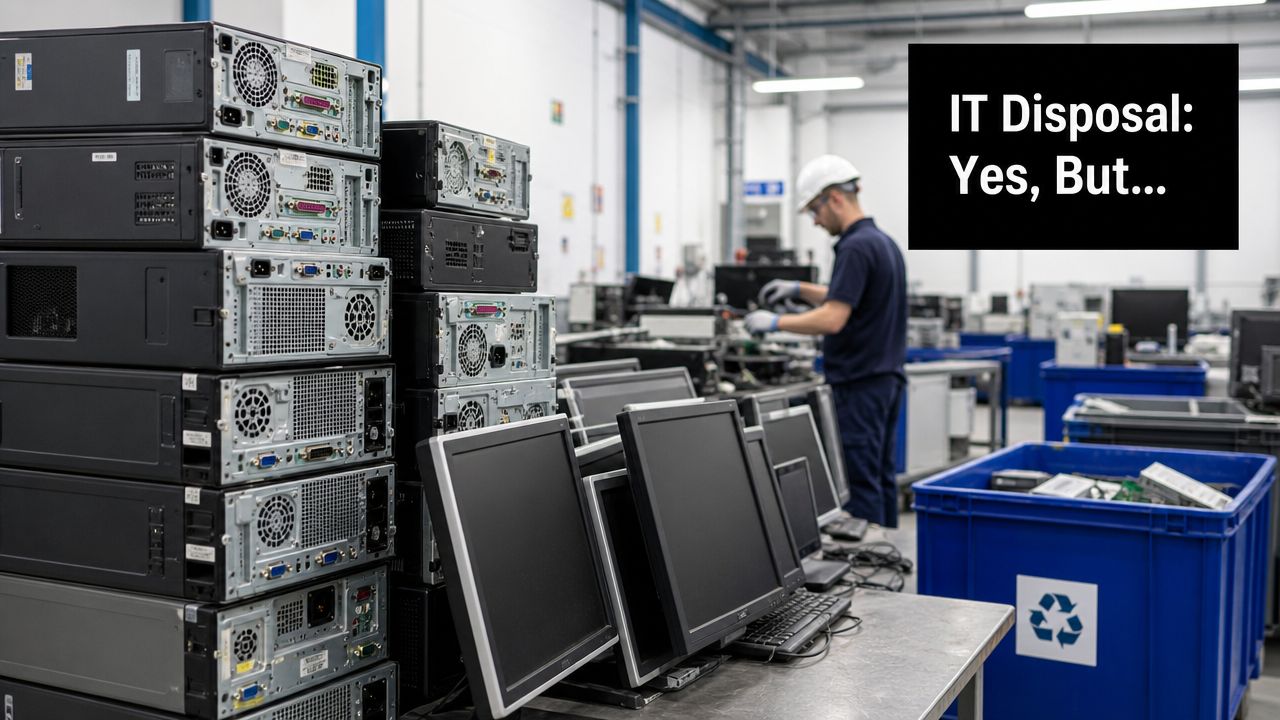
Why the question is bigger than pickup
The issue isn't whether someone can physically remove the equipment. Almost any hauling company can do that. The issue is whether the provider can identify electronics in a mixed load, keep them out of the general waste stream, and route them correctly.
That matters in Atlanta because office moves, construction turnover, warehouse cleanouts, and commercial tenant exits often create mixed pickups. Furniture, cubicles, shelving, packaging, scrap metal, computers, monitors, networking gear, and peripherals all leave the site at the same time. If the crew treats everything as bulk junk, the electronics can disappear into a disposal path that gives the customer no real control over where they end up.
Practical rule: If a vendor's process ends with “we haul it away,” you still don't know how your IT assets were handled.
For companies operating across Atlanta service areas for commercial junk removal, the better question is this: can the hauling process connect directly to responsible electronics recycling and documented handling?
What responsible disposal actually means
Responsible disposal starts before loading. Someone has to recognize which devices need separate handling. Someone has to keep data-bearing equipment from being treated like broken furniture. Someone has to decide whether equipment is going to reuse, recycling, or destruction.
That distinction is where conventional junk removal often breaks down. Speed is useful. Space reclamation is useful. A fast truck and a strong crew solve the front end of the problem. They don't automatically solve the back end.
Here's what works in practice:
- Sort electronics from general debris: Computers, monitors, printers, drives, cables, and accessories shouldn't stay buried in mixed trash.
- Use a recycler with a defined downstream process: The customer should know the electronics are being routed for recovery, not just transferred.
- Document handling where needed: Businesses often need proof for internal records, sustainability reporting, or audit support.
What doesn't work is assuming every company advertising e-waste pickup is providing secure disposition. Some are only providing transportation.
Junk Hauling vs Secure IT Asset Disposition
There are two services that buyers often collapse into one category. They are not the same.
Junk hauling is a logistics service. It focuses on clearing space, removing unwanted material, loading trucks, and getting material off-site quickly.
Secure IT asset disposition is a control process. It focuses on identifying devices, separating electronics, managing data risk, and routing assets into certified recycling or destruction workflows.
Atlanta businesses need to understand the difference because electronics can't directly be mixed with regular trash. Responsible handling usually starts with inventorying devices, removing batteries and accessories, and wiping data before transfer, as described in guidance on how to handle disposal of IT equipment.
The side-by-side difference
| Feature | Standard Junk Hauler | Fulton Junk Removal (with Beyond Surplus) |
|---|---|---|
| Primary goal | Clear space fast | Clear space and route electronics for responsible processing |
| Electronics in mixed loads | May be treated as part of general cleanout | Separated from general debris for dedicated handling |
| Data-bearing devices | Often outside normal scope | Coordinated into secure downstream recycling workflows |
| Batteries and accessories | May be overlooked in bulk loads | Identified and removed as part of electronics handling |
| Chain of custody | Usually limited to pickup | Built around documented transfer to recycler |
| End result | Haul-away | Haul-away plus compliant disposition path |
What property teams usually miss
Facilities teams often hire for convenience. That's understandable. One vendor, one truck, one invoice, and the suite is empty.
But convenience only works when the underlying process is designed correctly. If an office manager schedules a cleanout through a general hauler, the vendor may be perfect for desks, broken shelving, flooring scraps, and miscellaneous debris. The same vendor may have no practical process for laptops, drives, copiers, access-control hardware, or retired network equipment.
A better model combines the physical pickup with an electronics-specific disposition path. That's why businesses looking at commercial cleanout and hauling services should ask not only what gets removed, but who handles the IT equipment after pickup.
Hauling answers, “Can you take this away?” IT disposition answers, “Can you prove what happened to it next?”
A simple test
If the vendor can't clearly answer these questions, they're probably offering hauling, not true IT disposal:
- Where do the electronics go after pickup?
- How are data-bearing devices separated from general junk?
- What documentation can be provided after processing?
Those answers matter more than the truck size or how fast a crew can empty a room.
Data Security and Compliance A Top Priority
The biggest failure point in IT disposal isn't slow pickup. It's incomplete data sanitization.
For business equipment, the higher-risk scenario is simple. A device leaves your office, but the data doesn't. Guidance used in the Atlanta market emphasizes NIST 800-88-style purge-or-destroy practices, serial-number-level tracking, and a destruction certificate that records method, date, location, and custody transfer, as outlined in Atlanta guidance on electronic recycling and secure destruction.
Why pickup alone doesn't solve the real risk
A monitor with no storage is one thing. A laptop, server, copier hard drive, firewall appliance, or desktop tower is another.
When companies hand over IT assets without a defined sanitization process, they create blind spots for legal, compliance, and security teams. That's why disposal decisions should fit into broader GRC frameworks and compliance, not sit off to the side as an after-hours facilities task.
The practical controls are straightforward:
- Track devices at the asset level: Model-level descriptions help, but serial-level tracking is stronger when you need a record.
- Choose purge or destroy intentionally: Some assets may be sanitized for reuse, while others should go straight to destruction.
- Require documented transfer: Custody matters from pickup through final processing.
- Keep certificates on file: The certificate is what turns a vendor claim into an auditable record.
What an audit-ready workflow looks like
A credible workflow doesn't rely on verbal assurances. It produces evidence.
That evidence usually includes intake records, asset identification, sanitization or destruction method, processing date, and confirmation of custody transfer. Without that record trail, the customer is trusting process language instead of receiving proof.
Secure IT disposal is a risk-control function. If you can't document the path of the device, you can't verify the outcome.
Businesses that want examples, disposal guidance, and practical cleanup planning can also review operational notes on the Fulton blog. The useful question isn't whether a vendor says they recycle. It's whether they can support your IT, legal, and sustainability teams with records that hold up after the job is done.
How Fulton's Integrated Process Works
The cleanest approach is an integrated one. The hauling team and the recycling team don't operate as disconnected vendors. They operate as one coordinated process.
That's the main difference between an ordinary cleanout and a controlled IT disposal project. One removes material. The other removes material and assigns the right downstream path to each category.
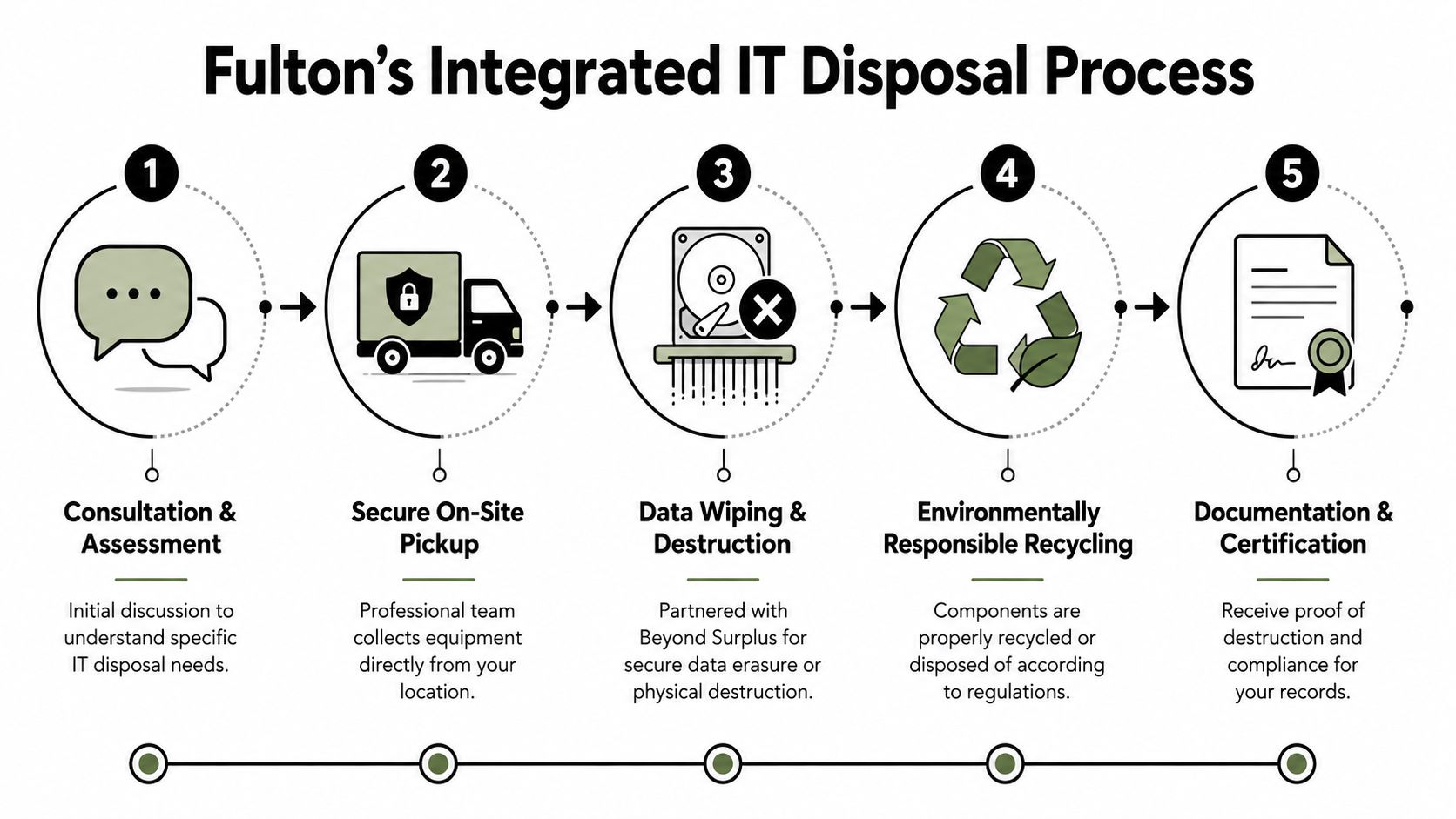
The bundled model in practice
For Atlanta offices, warehouses, and property managers, the practical value is simplicity. A single job can include furniture, bulk debris, scrap, and retired electronics, but the electronics don't disappear into the same handling stream as the rest of the load.
In this model, Fulton Junk Removal handles the physical cleanout while electronics and recyclable materials are processed through Beyond Surplus. That gives the customer one coordinated path instead of trying to manage a hauler, a recycler, and a separate data-destruction vendor independently.
What the process looks like on the ground
Initial assessment
The job starts by determining what items are on site. That sounds basic, but it matters. A pile of “old office stuff” may include monitors, docking stations, desktop towers, printers, UPS units, and miscellaneous drives mixed in with furniture and general clutter.On-site separation
The crew doesn't treat every item the same. Electronics are separated from general junk so they can move into the correct downstream stream. That protects the customer from the common failure where devices are loaded as if they were just more debris.Secure transfer for electronics processing
Once identified, the IT assets move into a recycler-led workflow rather than remaining part of a generic haul-away load. That's where secure handling becomes more than pickup.Data sanitization or destruction coordination
Depending on the asset type and customer requirements, devices can be routed for data wiping or physical destruction. The key is that the process is intentional, not assumed.Recycling and documentation
After processing, the customer can receive documentation that supports internal records and reporting. That's especially useful for offices, procurement teams, property managers, and sustainability staff.
Why this model works better than a patchwork approach
A disjointed process creates handoff risk. One vendor removes the assets. Another vendor receives them later. A third party may handle destruction. By the end, no single provider owns the whole chain.
The integrated model reduces that confusion. The pickup and recycling relationship is built in from the start, which makes chain of custody easier to manage and easier to explain internally.
When disposal is planned as one workflow instead of three separate jobs, companies usually get fewer surprises and cleaner records.
Businesses wanting company background and service scope can review how Fulton operates within its broader cleanout and recycling model. The important point is operational, not marketing-related. When hauling and certified electronics processing work together, the customer spends less time coordinating vendors and less time wondering what happened after pickup.
Key Questions to Ask Your Disposal Vendor
If you're comparing vendors, skip the broad question, “Do you handle electronics?” It's too easy to answer with yes.
Ask narrower questions that force the provider to explain its actual process. That's how you separate a general hauler from a company that can support secure IT disposition.
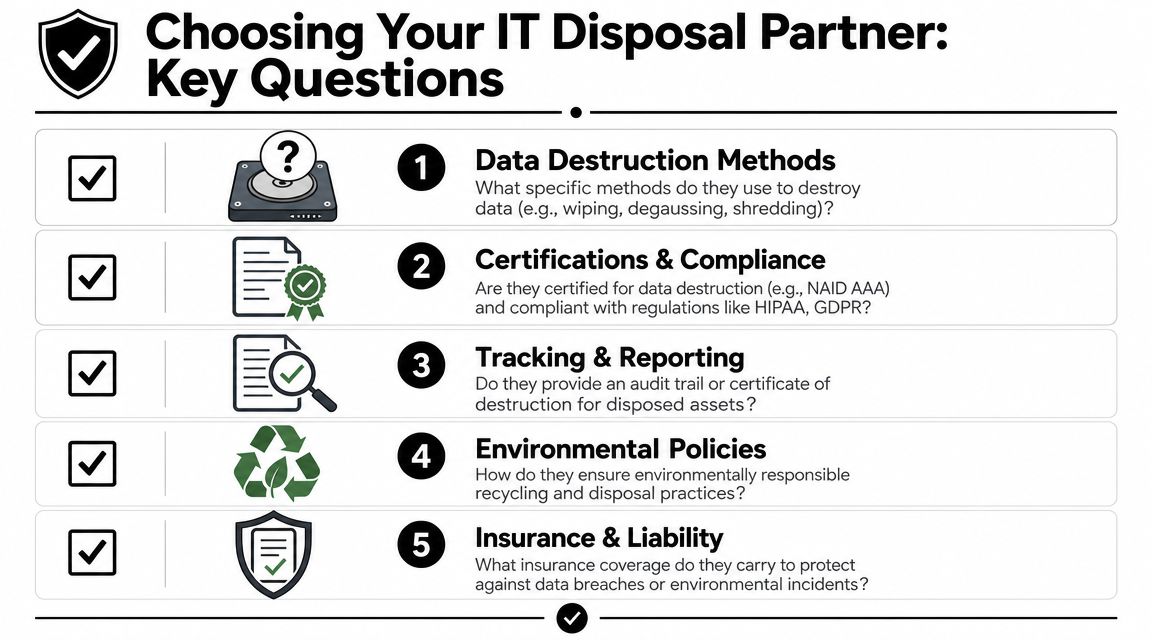
The vendor scorecard
- What happens to data-bearing devices after pickup? Ask whether laptops, servers, hard drives, copiers, and networking equipment are tracked separately from general junk.
- How do you handle sanitization or destruction? The vendor should explain whether assets are wiped, destroyed, or routed by device type and client requirement.
- Can you document chain of custody? If the answer is vague, the process probably is too.
- Do you provide recycling or destruction records? A business customer often needs more than an invoice.
- Who is the downstream recycler? If they can't name the process or the partner, that's a warning sign.
Questions that reveal maturity fast
Some questions tell you more than others.
Ask who removes batteries and accessories. Ask how mixed loads are sorted. Ask whether they can support internal sustainability reporting. Ask what happens if a pallet includes both scrap electronics and reusable equipment. Mature vendors answer these without hesitation because they've built the workflow already.
If your procurement or operations team needs a stronger framework for evaluating service providers, this third-party due diligence guide is a useful reference point. IT disposal vendors should be evaluated with the same discipline you'd apply to any outside partner handling sensitive business risk.
Don't buy “recycling” as a slogan. Buy a process you can question, document, and defend.
Schedule Your Compliant Cleanout in Atlanta
For commercial cleanouts, the decision usually comes down to one thing. Are you hiring a truck, or are you hiring a process?
The economics of the space show why this matters. One industry source estimates the U.S. waste industry at $75 billion annually and junk removal at about $10 billion, and it also states that proper junk removal and recycling can reduce waste by 40% when sorting is done correctly, according to industry junk removal statistics and recycling analysis. For Atlanta businesses, that supports a practical conclusion. Cleanouts are not just housekeeping. They're operational events where the right sorting and downstream handling can materially change the outcome.
When to use an integrated model
An integrated disposal model makes the most sense when your site has any of the following:
- Office move-outs: Workstations, monitors, printers, and accessories are mixed with furniture and general junk.
- Warehouse or facility cleanouts: Old terminals, scanners, networking gear, and scrap materials leave at the same time.
- Property turnover projects: Abandoned electronics show up alongside fixtures, bulk trash, and tenant debris.
- Refresh cycles: Equipment needs to leave quickly, but not casually.
In those scenarios, speed still matters. So does documentation. So does keeping electronics out of the wrong disposal stream.
What to do next
Start with a site-level review of what you need removed. Separate obvious data-bearing assets from ordinary junk. Then ask whether your vendor can support secure handling, downstream recycling, and documentation in one coordinated workflow.
If you need pickup for mixed commercial loads in Atlanta, including electronics that require a responsible disposition path, use the Fulton contact page for a cleanout request. A scoped pickup with the right downstream process is simpler to manage than trying to fix a bad disposal decision after the fact.
If your office, warehouse, or property needs a cleanout that includes old electronics, Fulton Junk Removal can coordinate haul-away with responsible recycling through Beyond Surplus so the job is handled as disposal, not just removal.
