
Junk Removal vs. IT Asset Disposal for Atlanta Offices
An Atlanta office cleanout rarely shows up as a neat category. It's usually a mix. A row of broken chairs. Old desks from the last reconfiguration. Bankers boxes nobody has opened in years. Then, in the corner, retired laptops, docking stations, printers, phones, and maybe a small stack of hard drives that nobody wants to touch without approval.
That's where teams make the wrong call. They treat the whole job like a hauling problem when part of it is really a security and compliance problem. If the goal is only to clear floor space, a general junk crew can be the right tool. If any of those assets store data, connect to your network, or fall into electronics handling rules, the decision changes fast.
For Atlanta offices, junk removal vs IT asset disposal isn't a minor purchasing detail. It affects project speed, chain of custody, audit readiness, internal workload, and how much risk leaves the building with the load.
Your Atlanta Office Cleanout Dilemma
A common situation looks like this. Your team is downsizing one suite, refreshing equipment on another floor, or preparing for a move. Facilities wants the space cleared this week. IT wants nothing data-bearing to leave without control. Finance wants a simple vendor process. Sustainability wants to avoid a landfill-heavy outcome if there's a better path.
All of them are right.
The trouble is that mixed-asset office cleanouts don't fit cleanly into one service category. Furniture, whiteboards, shelving, packaging, and non-sensitive clutter belong in one workflow. Laptops, servers, network gear, printers, storage media, batteries, and electronics belong in another. If you force everything into a single “just haul it away” job, you save coordination at the start and often create a bigger problem later.
That's especially true for businesses operating across Atlanta commercial service areas, where office managers often need fast scheduling but can't afford sloppy disposition practices.
Why this decision gets messy
Most offices don't retire assets one category at a time. They clear space in batches. A tenant improvement project produces old furniture and cable piles. A hardware refresh leaves behind monitors and desktops. A lease exit turns storage closets into a last-minute disposal project.
Practical rule: If the item only takes up space, think hauling. If the item also carries data, battery risk, or compliance exposure, think controlled disposition.
What usually goes wrong
Teams tend to make one of two mistakes:
- Overusing junk removal: They send electronics out with everything else because it's faster to schedule one truck.
- Overengineering the whole cleanout: They route ordinary office junk through a process meant for sensitive IT assets, which adds friction where it isn't needed.
The right answer is usually a split workflow. Not because the vendors want it that way, but because the risk profile of the assets is different.
The Core Distinction Speed vs Security
The cleanest way to separate these services is simple. Junk removal is a logistics service. IT asset disposal is a control process.
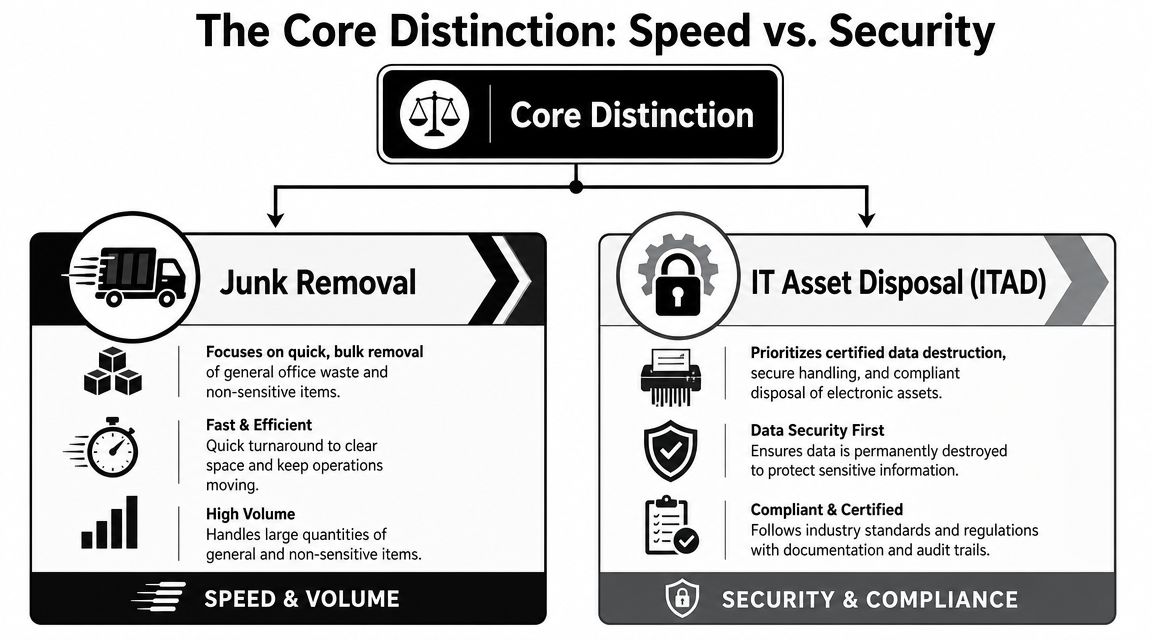
A junk crew is built to remove bulk items fast, clear usable space, and keep labor coordination light. ITAD is built to manage what happens to retired electronics from pickup through processing, with attention to data destruction, handling, and reporting.
What junk removal is optimized to do
In Atlanta, same-day and next-day junk pickup is widely marketed, and one local provider advertises service starting at $55 for a single bulky item. That's useful context because it shows what the category is designed for: quick turnaround and rapid space recovery, not device-level governance. The same source contrasts that speed with ITAD workflows that include secure collection, hardware review, and data destruction before disposition. See the Atlanta market example from LoadUp's local junk removal page.
That difference matters in the field. If you need old cubicles, packaging, and broken furniture gone by tomorrow, speed is the value.
What IT asset disposal is optimized to do
ITAD developed around a different operational need. Modern offices retire far more electronics than they used to, and those assets don't just need pickup. They need decommissioning, dismantling, downstream handling, and records that stand up when someone asks what happened to a given device.
General junk removal solves a space problem. ITAD solves a risk problem.
That's why the two services shouldn't be treated as interchangeable. One can restore your office footprint quickly. The other can document that a data-bearing device was handled through a controlled path.
For teams comparing workflows and disposal categories, Fulton's commercial cleanup articles and project guidance are useful as an operational starting point. But the key distinction doesn't change. If the asset has no data and no special handling concern, hauling speed usually wins. If the asset needs tracking, sanitization, or auditable disposition, security wins.
Comparing Key Decision Factors for Your Office
Before you schedule a pickup, compare the job on four axes: cost structure, compliance exposure, environmental handling, and timeline control.
| Factor | Junk Removal | IT Asset Disposal (ITAD) |
|---|---|---|
| Cost structure | Usually priced by load size, item type, and access conditions | Usually scoped around decommissioning, data sanitization, electronics handling, and reporting |
| Primary objective | Clear space fast | Retire electronics with documented control |
| Best fit | Furniture, fixtures, boxes, mixed office debris, non-sensitive bulk items | Computers, servers, storage media, printers, networking gear, batteries, and other electronics |
| Main operational risk | Paying for more truck volume than expected | Mishandling data-bearing or regulated assets if the process is weak |
| Documentation expectation | Basic service and removal confirmation | Asset tracking, disposition records, and proof of proper handling |
| Sustainability path | Varies by provider | Usually tied more closely to controlled recycling and downstream electronics processing |
Cost works differently
In Atlanta, traditional junk removal is typically priced by truck volume. Local 2025 examples show $75 to $125 for a minimum load, $150 to $200 for a quarter load, $250 to $300 for a half truckload, and $450 to $600 for a full truckload. That structure works well when your project is mostly desks, chairs, boxes, and mixed debris. See the local pricing breakdown from BHH Junk Removal's Atlanta cost guide.
ITAD doesn't work that way. The price isn't just about how much space the load takes up. It reflects labor and control steps such as secure decommissioning, data sanitization, dismantling, recycling, and reporting.
If you mix the categories carelessly, the invoice may look simpler, but the process usually isn't.
Compliance is the real dividing line
A desk is just a bulky object. A retired laptop is not. The moment an item can hold user data, network settings, stored documents, print history, credentials, or embedded storage, disposal moves into a different class of responsibility.
Environmental handling isn't identical
Traditional junk hauling and formal electronics disposition may both use the language of recycling, but the actual standard isn't the same. With ordinary junk, the provider's sorting discipline and landfill diversion practices matter. With electronics, downstream handling and documented disposition matter more.
If a vendor can remove electronics but can't clearly explain how those devices are tracked and processed, you're still missing the part that protects the business.
Timelines should match the asset type
Fast isn't always better. It's better for non-sensitive items. It's not automatically better for data-bearing ones.
For mixed office projects, teams should ask two questions:
- What must leave quickly to restore workspace? Furniture, packaging, broken fixtures, and general clutter usually fall here.
- What must leave under controls? Laptops, servers, drives, phones, printers, and network hardware belong here.
That's the practical frame for junk removal vs IT asset disposal for Atlanta offices. You're not choosing one universal vendor category. You're matching each asset class to the right process.
When to Use Junk Removal for Your Office
Use standard junk removal when the job is about bulk, speed, and reclaimed space, not device-level custody.
Industry comparisons place full-service junk removal windows at 2 to 4 hours, with small jobs starting around $150 and standard commercial cleanouts commonly falling in the $150 to $1,000 range. Those jobs are generally priced around volume, item type, and accessibility, which is why they work well for general office cleanouts. The comparison appears in this junk removal service overview.
Good candidates for standard removal
These categories usually belong in the hauling lane:
- Office furniture: Desks, task chairs, conference tables, bookcases, and empty filing cabinets.
- Fixtures and layout leftovers: Cubicle panels, whiteboards, shelving, and breakroom furniture.
- General cleanout debris: Cardboard, packaging, old office supplies, and non-sensitive storage room clutter.
- Warehouse or back-of-house items: Pallet debris, non-electronic shelving, unused fixtures, and damaged non-hazardous materials.
- Move-out leftovers: Items abandoned after a reconfiguration, lease exit, or department consolidation.
A simple filter that works
Ask three quick questions before assigning an item to junk removal:
- Does it store data?
- Does it contain regulated electronic components or batteries?
- Would anyone in IT, legal, compliance, or security want proof of what happened to it?
If the answer is no across the board, junk removal is usually appropriate.
For common cleanout categories and project types, Fulton's commercial junk removal services give a good picture of where standard haul-away fits operationally.
What not to force into this lane
Don't let “it's just old equipment” become the test. Plenty of office devices look harmless and still carry real exposure. A printer in a copy room, a switch from an IDF closet, or an old executive laptop shouldn't be treated like a broken side table just because both fit on the same truck.
When to Mandate IT Asset Disposal
Some equipment should never leave your office through a general junk workflow unless it has first been routed through a proper IT asset disposal process.
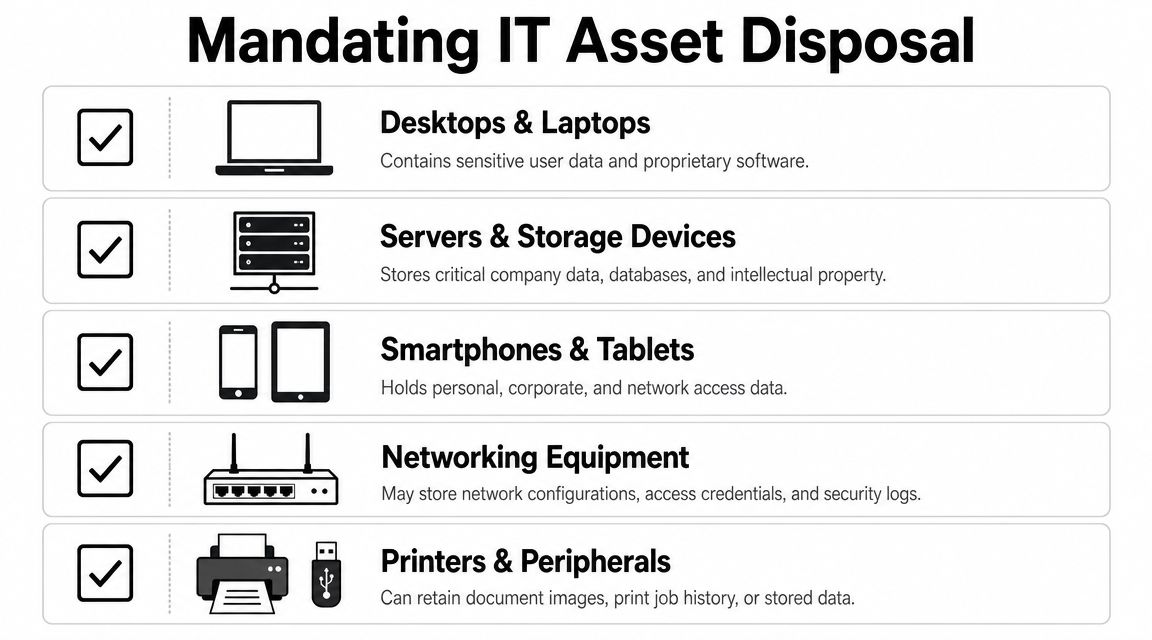
The risk isn't theoretical. The gap most office managers struggle with is the difference between a truck removing electronics and a provider giving you a controlled process with asset tracking, data destruction, and audit-ready reporting. That gap is described clearly in this Atlanta IT asset disposition overview.
Assets that belong in ITAD
These categories should trigger an ITAD workflow:
- Desktops and laptops: Even devices that seem wiped may still require documented disposition.
- Servers and loose storage: Drives, SSDs, backup units, and server hardware need controlled handling.
- Phones and tablets: Mobile devices can hold both business data and access credentials.
- Networking hardware: Routers, switches, firewalls, and related gear may retain configuration and security information.
- Printers and multifunction devices: Many businesses overlook these, even though they can retain stored data or job history.
- Mixed e-waste with batteries or hazardous components: These need more than simple haul-away.
Why office managers should insist on this
The right standard isn't “someone took it.” The right standard is “we can show what happened to it.”
That means asking for a process that includes:
- Asset identification: What was collected.
- Secure transfer: Who took custody and how the items were segregated.
- Data destruction handling: How storage-bearing devices were sanitized or destroyed.
- Disposition reporting: What record you retain afterward.
A secure cleanout isn't defined by how fast the truck arrives. It's defined by whether your organization can defend the disposition later.
Where mixed projects get risky
The failure point is usually convenience. Someone says, “Let's just load the monitors, laptops, old docking stations, and chairs together and get this over with.” That may feel efficient, but it erases the distinction that matters most. Once data-bearing assets are blended into a general junk stream, the chain of responsibility gets weak fast.
For regulated, audited, or security-conscious environments, that's not optional work. It's a policy issue.
The Fulton Advantage A Unified Solution for Atlanta Offices
The hardest office cleanouts aren't pure junk jobs or pure ITAD jobs. They're hybrid projects. That's where coordination usually breaks down.
A standard junk vendor can move fast on desks, shelving, and debris. A specialized electronics disposition provider can manage secure downstream handling. The practical challenge is sequencing both without making your office team manage two disconnected projects.
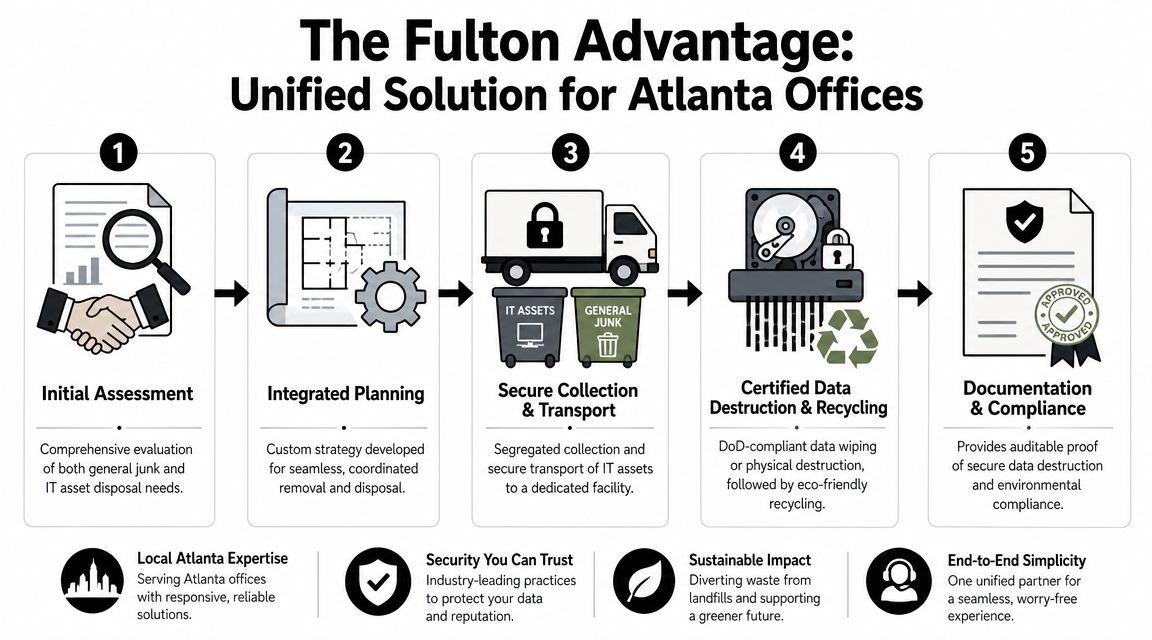
What a mixed-asset workflow should look like
For Atlanta offices, the better model is straightforward:
- Assess the load by category. Separate furniture and debris from electronics and data-bearing equipment before pickup starts.
- Stage the job around risk. Non-sensitive bulk items can move through a fast hauling path. Electronics should stay segregated.
- Send each category down the right stream. General junk goes to haul-away and material recovery. Electronics go to controlled recycling and data-handling processes.
- Close the loop with records. The office manager shouldn't have to reconstruct what happened after the fact.
That approach solves the underserved problem in mixed office clearouts: not whether one truck can take everything, but which items should move together and which should not. Public junk-removal pricing guidance often shows wide cost variation, but it doesn't answer the deeper operational question of how to sequence desks, chairs, monitors, batteries, and old IT gear without increasing compliance risk. That gap is reflected in this cost and mixed-load discussion.
Why the Fulton and Beyond Surplus model fits this problem
Fulton Junk Removal is relevant as a practical option. Through the Beyond Surplus partnership, the company can support a bundled workflow in which general junk removal and responsible electronics recycling are coordinated in one project rather than treated as unrelated tasks. That matters for offices, warehouses, and property managers because the same cleanout often includes both categories.
The operational advantage isn't marketing language. It's reduced handoff friction.
What works better than two separate vendor tracks
A unified model helps when your team needs to:
- Clear space quickly without sending sensitive electronics into a generic junk stream.
- Support landfill diversion goals by routing recyclable materials and electronics into more responsible channels.
- Simplify reporting for facilities, procurement, and sustainability teams.
- Reduce internal coordination on move-outs, reconfigurations, and refresh cycles.
For background on the company structure and its link to Beyond Surplus, see the Fulton Junk Removal company overview.
Your Vendor Evaluation and Decision Checklist
Most office managers don't need more vendor promises. They need better questions.

For electronics and regulated materials, the technical differentiator is compliance and documentation. Disposal services for electronics require careful handling, adherence to laws and environmental standards, and often documentation of proper disposal for audit support. That's the clearest dividing line between ordinary junk hauling and a governed ITAD process. The distinction is summarized in this explanation of junk hauling versus regulated disposal handling.
Questions for a junk removal vendor
If a vendor is handling your non-sensitive office debris, ask:
- Where do the materials go after pickup? You want a clear explanation, not a vague “we recycle what we can.”
- How do you separate recyclable items from landfill-bound materials? This matters if your business tracks sustainability outcomes.
- What happens if your crew finds electronics during the cleanout? Good vendors should have a defined escalation path.
- How do you price mixed office loads? You want to understand whether volume, item type, labor, or access is driving the quote.
Questions for an ITAD or electronics disposition provider
For data-bearing or regulated equipment, ask harder questions:
- What does your chain of custody look like from pickup through final disposition?
- Can you provide asset-level reporting or itemized disposition records?
- How is data destruction handled for drives, servers, laptops, and embedded-storage devices?
- What proof do we receive after processing? If the answer is vague, assume the process is vague too.
- How do you handle batteries, e-waste, and downstream recycling?
Questions for hybrid office projects
Mixed cleanouts need one more layer of scrutiny:
- Who decides which assets are junk and which must go through ITAD?
- Will your crew segregate electronics on-site?
- Can one project manager coordinate both streams without losing tracking clarity?
- What documentation can you provide for the electronics side and what reporting can you provide for the recycling side?
The right vendor conversation doesn't start with “How fast can you haul it?” It starts with “Which assets create risk, and how will you prove they were handled correctly?”
If you're lining up a mixed office cleanout and want to compare approaches directly, use Fulton Junk Removal's contact page as one place to start the conversation.
If your Atlanta office cleanout includes both bulky junk and retired electronics, treat it like two workflows inside one project. That's the practical way to protect speed, budget, and compliance at the same time. Fulton Junk Removal helps simplify that process by pairing commercial junk removal with the Beyond Surplus recycling network, so offices can clear space efficiently while routing electronics and recyclable materials through a more responsible path.
