
Sustainable Telecom Recycling Los Angeles Guide 2026
A lot of Los Angeles telecom cleanouts start the same way. A facilities manager opens a back room and finds years of accumulated switches, desk phones, rack gear, UPS units, patch panels, handsets, monitors, cords, and mystery boxes from old moves. IT wants the room back. Operations wants the project done fast. Legal cares about data. Sustainability wants proof that the load didn't just get dumped.
That pile looks like a hauling problem. It usually isn't. It's an asset control problem, a data security problem, and a documentation problem packed into one job.
The scale behind that pressure is real. The UN Global E-waste Monitor 2024 reports that 62 million tonnes of e-waste were generated worldwide in 2022, and only 22.3% was documented as properly collected and recycled. The same report says e-waste is rising by about 2.6 million tonnes per year and is projected to reach 82 million tonnes by 2030. For Los Angeles businesses, that's why telecom disposition has shifted away from simple haul-away and toward reuse-first sorting, chain of custody, and documented downstream handling.
Most companies don't need another generic recycling checklist. They need a working playbook that holds up during an office decommission, a warehouse reduction, a lease turnover, or a network refresh.
Your Playbook for LA Telecom Recycling
If you're staring at a telecom closet that hasn't been cleaned out since three phone systems ago, the first move isn't ordering a truck. It's getting control of the material before anything leaves the site.
That means separating what has data, what has batteries, what may still have reuse value, and what's scrap. Once those streams get mixed on rolling carts or into gaylords, the project gets slower, riskier, and harder to document. Teams often learn that too late.
Los Angeles businesses also operate in a market where disposal decisions get scrutiny from more than one direction. IT wants proof of destruction. Facilities wants speed. Sustainability wants diversion and reuse. Procurement wants a vendor process that doesn't create cleanup work later. Those goals don't conflict, but they do require planning.
A solid telecom recycling plan does five things well:
- Starts with inventory: You need a list of what's leaving, especially data-bearing and battery-containing equipment.
- Separates materials early: Phones, servers, UPS units, batteries, cabling, and general office debris should not move as one mixed stream.
- Protects chain of custody: Every handoff should be clear from pickup through final disposition.
- Tests for reuse before scrap: Functional gear shouldn't go straight to destruction if secure reuse is viable.
- Produces records worth keeping: Manifests, destruction certificates, and final disposition reports matter long after pickup day.
Practical rule: If a vendor talks mostly about truck capacity and almost nothing about serialized reporting, they're describing junk removal, not telecom asset disposition.
If you're planning a live project and need to scope pickup requirements before the site gets busier, start with a direct project conversation through Fulton Junk Removal contact options.
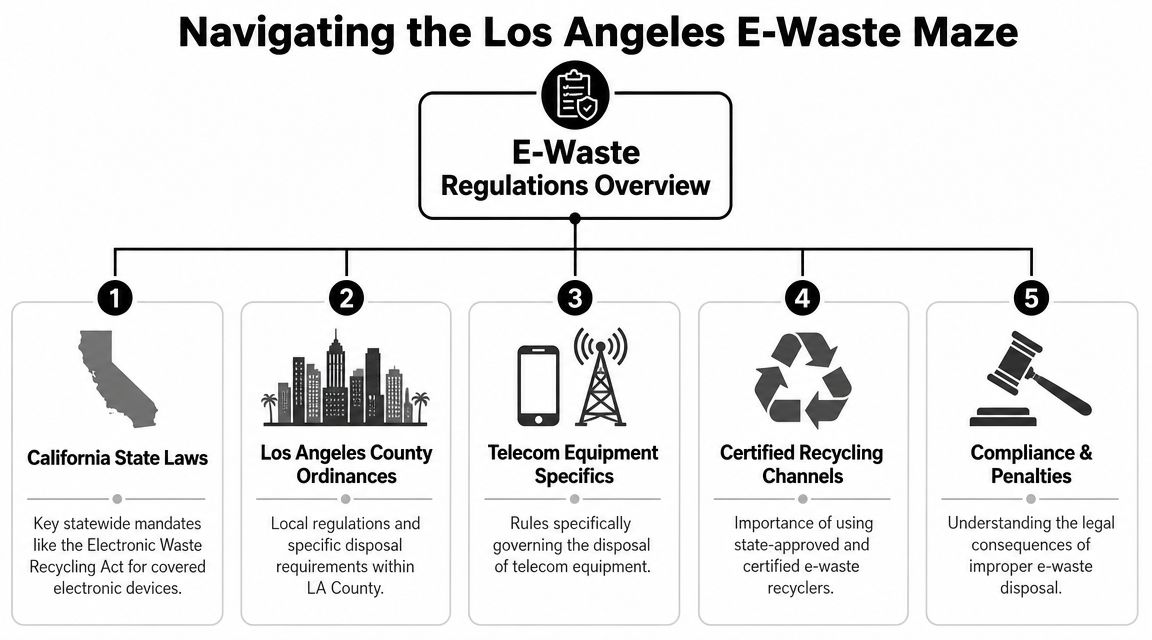
Navigating the Los Angeles E-Waste Maze
Los Angeles businesses don't operate in a loose disposal environment. They work inside a layered compliance setting where state infrastructure, local policy, and practical handling standards all affect how telecom gear should move off-site.
The public-policy backdrop matters. Los Angeles County sustainability resources for cities show that local governments maintain toolkits, guidance documents, model ordinances, and partnership resources. In practice, that creates an environment where documented final disposition isn't a nice extra. It's part of doing the job responsibly.
Why a generic hauler creates risk
A standard junk crew is built to clear space. Telecom recycling requires more than clearing space.
Commercial telecom loads often include:
- Data-bearing hardware: Servers, storage devices, network appliances, VoIP systems, and managed print devices
- Battery-containing equipment: UPS units, laptops, handsets, backup units, and battery modules
- Potentially reusable assets: Late-model switches, racks, phones, and peripherals that still have second-life value
- Mixed support material: Cabling, metal, plastics, mounts, and packaging
When those categories get loaded together without control, several problems show up fast. Batteries may be buried in loose scrap. Data-bearing units may lose traceability. Reusable equipment may get damaged. Audit records become harder to defend.
The three layers that matter on the ground
Most managers don't need a legal lecture. They need to know which layer affects the work order in front of them.
| Layer | What it means operationally | What to ask your vendor |
|---|---|---|
| State framework | California has long-running electronics management infrastructure | Can you document final disposition for commercial telecom loads? |
| County and city context | Local governments support sustainability through guidance and policy tools | How do you support reporting for sustainability and compliance? |
| Site-level handling | Your internal staging, segregation, and pickup process determine whether records stay clean | How do you maintain chain of custody from our dock to final processing? |
That last layer is where projects usually succeed or fail. Regulations matter, but bad staging causes most headaches.
Mixed pallets are the quiet source of a lot of downstream trouble. They hide batteries, blur ownership, and break the paper trail.
What documented final disposition actually looks like
A compliant-looking pickup isn't the same as a documented one. For telecom equipment, useful documentation usually includes:
- Asset manifests: What left the facility
- Destruction records: What data-bearing media was sanitized or destroyed
- Final disposition reporting: What was reused, recycled, or otherwise processed
- Pickup traceability: Dates, handlers, and movement records tied to the load
If a provider can't explain those records in plain language, the job probably isn't being managed at the standard LA commercial clients need.
For broader cleanup planning and related commercial removal topics, the Fulton Junk Removal blog is a useful reference point.
Beyond Deletion Data Security and Asset Disposition
Most telecom recycling conversations start with sustainability. In the field, the primary priority is usually data.
Old routers, firewalls, desk phones, servers, SSDs, laptops, and multifunction devices don't stop being sensitive because they're obsolete. A closet full of retired equipment can still hold call logs, saved credentials, user directories, configuration files, network maps, cached documents, and storage media that no one remembered was still inside the chassis.

Deletion is not disposition
Deleting files, resetting devices, or having a tech “clear out” a few machines isn't a disposition process. It's a partial prep step at best.
A real process ties each data-bearing asset to a defined outcome. That outcome is usually one of two paths:
- Sanitize for reuse
- Destroy because reuse isn't appropriate
The mistake I see most often is organizations deciding on the method too late. They stage everything together, call for removal, and only then start asking which devices have storage. By that point, they're already reacting.
Match the method to the asset
Not every device should be handled the same way. A practical review looks at the media type, the condition of the asset, and whether reuse is part of the organization's policy.
Here's the operating logic many experienced teams use:
- Functional equipment with reuse potential: Use a formal sanitization method so the asset can be tested, graded, and moved into reuse if policy allows.
- Damaged or failed data-bearing equipment: Use physical destruction where the organization requires no possibility of recovery.
- High-sensitivity environments: Use the stricter path by default, especially when internal policy or sector requirements leave little room for judgment calls.
The important part isn't sounding technical. It's being able to prove which method was used on which device.
What good records look like
For data-bearing telecom gear, the most valuable document after pickup is usually the destruction or sanitization record tied to specific devices. That's what closes the loop when audit, legal, or procurement asks what happened to the equipment.
A strong record set typically includes:
- Serialized device tracking: So a hard drive, phone, server, or appliance isn't just part of a bulk count
- Method notation: Whether the device was sanitized for reuse or physically destroyed
- Chain-of-custody detail: Who handled it, when, and where it moved
- Final disposition status: Reuse, component recovery, or recycling
If the paperwork only says “electronics recycled,” it doesn't answer the questions that matter after a commercial telecom cleanout.
Reuse belongs inside the security conversation
A lot of teams assume security and reuse are opposites. They aren't. Reuse works when sanitization is rigorous and documented.
That matters because a shred-first mindset can destroy value unnecessarily. In many telecom projects, some portion of the load still has operational or component value. Secure asset disposition means evaluating that gear before it's reduced to scrap.
This is also where broader zero-waste thinking becomes useful. myhalo's approach to e-waste frames the issue around extending product life and reducing unnecessary disposal. The practical lesson for telecom environments is simple. Reuse only works when chain of custody and sanitization controls are built in from the start.
What doesn't work in real projects
Certain habits create avoidable risk every time:
- Open-box staging: Drives, phones, and network gear tossed loosely into cartons without labels
- Late identification: Discovering after pickup that a pallet included storage media or confidential devices
- All-or-nothing destruction assumptions: Shredding everything because no one built a triage process
- No owner on site: Pickup crews arrive, but no one can confirm what is approved to leave
When a telecom cleanout goes well, it feels boring. Gear is identified, packed by category, signed over correctly, and tied to documentation that makes sense months later. That's what you want.
The Logistics Playbook An Integrated Approach
Large telecom cleanouts rarely involve telecom equipment alone. They also involve dead monitors, furniture, wire carts, empty packaging, scrap metal, broken fixtures, and the general clutter that accumulates around infrastructure over time. That's why isolated recycling plans often break down on active sites. Too many vendors, too many handoffs, too many chances to mix the wrong materials together.
The better model is integrated. One coordinated project plan handles general cleanout and specialized telecom recycling as separate streams under one schedule.
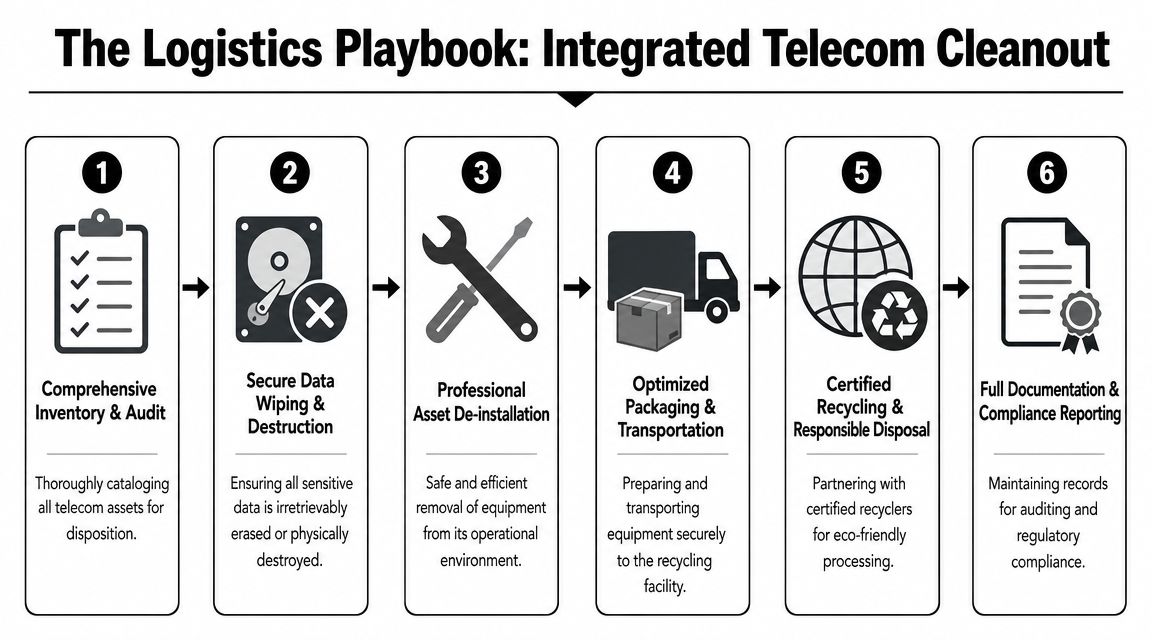
A useful field benchmark appears in this guidance on sustainable telecom recycling in Los Angeles. It notes that practical workflows start with asset inventory and segregation before removal, and that experienced operators typically rely on four controls: pre-pickup inventory, material segregation, functional testing for reuse, and documented downstream processing. It also flags common failure points such as mixing commercial assets into residential channels and failing to tag batteries early.
Step one is staging, not lifting
Before anyone starts rolling equipment out, establish zones.
One area should hold data-bearing equipment. Another should hold battery-containing items such as UPS units, handsets, and laptops. Another should hold reusable telecom hardware pending testing or grading. Then create a separate zone for general junk and non-sensitive debris.
That sounds basic. It saves projects.
A crew can move faster when each stream already has a destination. More important, documentation stays cleaner because your vendor isn't trying to reconstruct the load after it reaches a warehouse.
Integrated service reduces handoff problems
A bundled service model offers an edge. If one team handles junk removal while a separate electronics vendor handles telecom assets, the site manager has to coordinate access, sequence, load separation, and reporting across two operating systems. That can work. It often creates friction.
An integrated model combines the cleanout side with specialized recycling coordination so the project runs from one plan instead of two. For offices, warehouses, and property managers, that usually means:
- One site walkthrough
- One pickup schedule
- One set of staging instructions
- One communication chain for exceptions
- One reporting package instead of split paperwork
That doesn't eliminate complexity. It keeps the complexity from landing on your internal team.
The cleanest workflow on commercial sites
The jobs that run smoothly usually follow this sequence:
Survey the site
Walk telecom rooms, storage areas, offices, IDF and MDF spaces, warehouse corners, and any off-book storage spots. The hidden closet is often where the risky material sits.
Build a pickup map
Decide what leaves first, what needs secure custody, what requires battery segregation, and which materials need different crews or equipment.
Tag exceptions early
Leased equipment, disputed ownership, and anything still under internal review should be marked before pickup day.
Separate at the source
Don't create a mixed central pile and sort later. Sort where the item sits.
Load by category
Data-bearing hardware, batteries, reusable assets, metal, and general junk should each have distinct loading treatment.
Close with documentation
The job is finished when reports match what left the building.
Field note: If the schedule is tight, shorten walking distances, not control steps. Teams get into trouble when they skip segregation to save a few minutes on the dock.
Packaging and labeling that actually help
You don't need fancy packaging to improve control. You do need consistency.
| Material type | Best on-site practice | Why it works |
|---|---|---|
| Servers and network gear | Keep units intact where possible and label by room or rack source | Preserves traceability and supports testing |
| Hard drives and loose media | Place in clearly identified secure containers | Prevents loss and simplifies destruction records |
| Batteries and UPS components | Isolate and label immediately | Reduces fire risk and handling confusion |
| General office junk | Keep completely separate from telecom streams | Prevents contamination of audit-sensitive loads |
For companies handling broad office or warehouse cleanouts alongside telecom assets, the Fulton Junk Removal services page shows the kind of bundled service structure that makes this model practical. This advantage is operational. Fewer vendors mean fewer transfer points, fewer misunderstandings, and less cleanup after the “cleanup.”
What integrated projects still need from the client
Bundling simplifies logistics. It doesn't replace internal decisions.
Your team still needs to define:
- Who can approve asset release
- Which equipment is owned versus leased
- What gets destroyed versus evaluated for reuse
- Which departments need copies of final documentation
When those questions are unresolved, even a good vendor will end up waiting on direction. On the best projects, operations, IT, and facilities settle those points before the truck arrives.
How to Choose Your Los Angeles Recycling Partner
Most vendors sound responsible in a proposal. The differences show up when you ask for process detail.
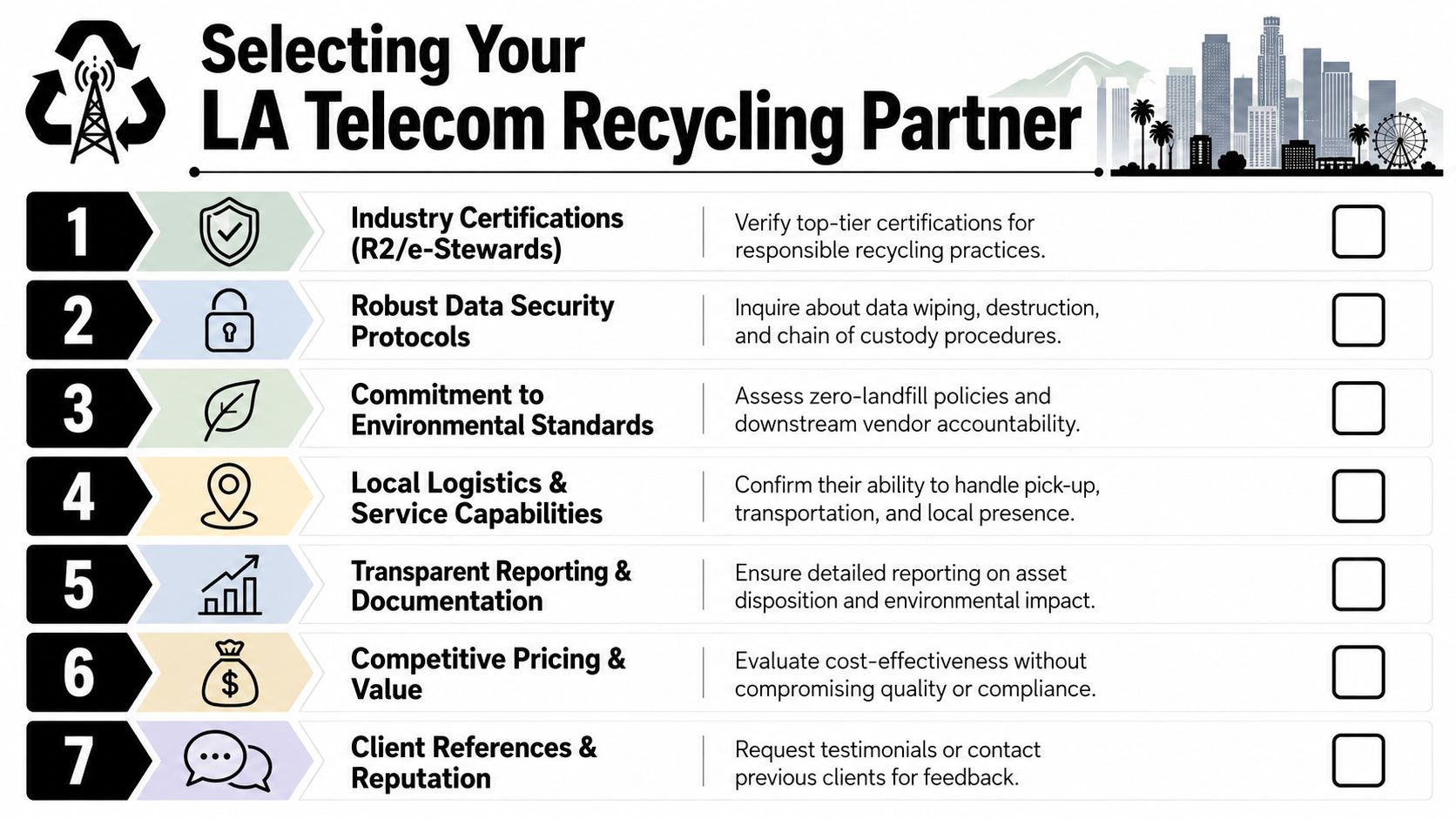
A qualified telecom recycling partner should be able to explain chain of custody, downstream handling, data destruction, battery management, and reporting without vague language. If the answers stay broad, that's usually because the process is broad too.
Start with the records, not the truck
A lot of buyers start by comparing hauling capacity, arrival windows, and price. Those matter. They shouldn't be first.
For sustainable telecom recycling in Los Angeles, the better first question is: What records will I have after the load leaves?
Ask to see examples of:
- Asset manifests
- Certificates tied to data destruction or sanitization
- Final disposition reporting
- Any downstream documentation they're willing to share or summarize
If they can't produce sample documentation, they probably can't produce reliable documentation on your job.
A practical vendor scorecard
Use a simple decision framework during bidding.
| Evaluation area | Strong answer | Weak answer |
|---|---|---|
| Chain of custody | Clear handoff process with traceable records | “We handle everything securely” |
| Data security | Defined sanitization and destruction options | “We can wipe drives if needed” |
| Battery handling | Separate packaging, labeling, and transport controls | Batteries treated as part of mixed electronics |
| Downstream transparency | Explains where reuse, recycling, and destruction occur | Avoids detail after pickup |
| Reporting quality | Can describe what your final packet includes | Focuses only on removal completion |
That scorecard helps cut through polished sales language.
Questions worth asking in the walkthrough
A site walkthrough tells you more than a proposal. Ask direct questions and let the vendor talk through exceptions.
Useful questions include:
- How do you separate data-bearing equipment from general e-waste at pickup?
- What happens if your crew finds batteries inside a mixed telecom load?
- How do you identify assets for reuse versus scrap?
- What does your final disposition reporting look like for a multi-stream commercial job?
- Who is responsible for documenting the handoff on site?
- How do you handle assets that shouldn't be released yet?
A serious operator won't be annoyed by those questions. They'll expect them.
Low price gets expensive when your team has to chase missing records, explain mixed loads, or answer for a battery issue that should have been caught at pickup.
Red flags buyers should take seriously
Some warning signs are easy to miss because they sound convenient.
Watch for vendors who:
- Promise simple one-price removal for everything without asking what's data-bearing or battery-containing
- Push speed over separation and suggest sorting later
- Avoid discussing downstream partners or final processing
- Treat sustainability as a slogan but can't describe reporting
- Use residential recycling language for a commercial telecom project
For operations teams, facilities managers, and property managers vetting provider background, the Fulton Junk Removal company overview is the kind of page that should help answer basic service-structure questions before you get into job-specific scoping.
The partner you want is operationally boring
That's a compliment.
You want a company that arrives with a plan, labels material correctly, separates sensitive streams without drama, and sends paperwork that matches what happened on site. Telecom disposition shouldn't feel improvisational. If it does, the project is already off track.
Maximizing Value Through Reporting and Reuse
A telecom recycling project becomes more valuable when the reporting is good enough to support decisions after the pickup. That's where many companies leave value on the table. They finish the cleanout, get the room back, and never turn the disposition data into anything useful for procurement, sustainability, or future decommissions.
The strongest benchmark for value recovery is reuse-first handling. This industry guidance on telecom equipment recycling and sustainable disposal methods recommends extending equipment life through maintenance and evaluating units for refurbishment at end-of-life. It also notes a practical benchmark that operations teams should take seriously: assets tracked from purchase to disposal are far more likely to be managed properly than assets that become anonymous surplus.
Reuse starts long before retirement
Organizations often treat end-of-life as a final event. In practice, the outcome is shaped much earlier.
If procurement never records asset ownership cleanly, if IT never updates deployment records, and if facilities gets involved only when a room is overflowing, the project enters the disposition phase with blind spots. Those blind spots kill reuse value because no one is confident about model, age, condition, or release approval.
That's why asset tracking deserves more attention than it usually gets. The mechanics may differ by organization, but the discipline is universal. For teams refining internal controls, these Australian asset tracking best practices offer a useful outside perspective on tagging, lifecycle visibility, and audit readiness.
The reports that matter after pickup
A useful reporting package should help at least three internal groups: IT, sustainability, and finance or procurement.
Here's what each usually wants:
- IT wants proof: What data-bearing equipment was processed, and what happened to it
- Sustainability wants disposition detail: Which material streams were reused, recycled, or otherwise handled
- Procurement or finance wants lifecycle insight: Which assets still held value, and which categories regularly age out with no recovery path
If your reporting only confirms that material was removed, you've paid for logistics but missed the management value.
What to ask for in final reporting
A better final packet often includes a mix of operational and compliance records:
| Reporting item | Why it matters |
|---|---|
| Asset-level listing | Confirms what actually left the facility |
| Destruction or sanitization documentation | Supports data governance and audit review |
| Disposition summary | Shows what was reused, recycled, or scrapped |
| Exception log | Captures unresolved items, nonconforming materials, or items held back |
| Project narrative | Useful for internal sustainability summaries and post-project review |
That last item is underrated. A short written summary helps internal stakeholders understand what happened without reading every line item.
Good reporting turns a cleanout from a one-time expense into a baseline for better procurement and retirement policy.
How organizations lose value
The biggest losses usually come from process, not market conditions.
Common examples:
- Premature scrapping: Functional assets are treated as waste because no one tested them
- Poor inventory history: Teams can't establish whether equipment is worth evaluating
- No policy link between procurement and disposal: New purchases happen with no thought to eventual recovery
- Weak closeout reporting: Future projects start from scratch because nothing usable was documented
Reuse doesn't mean keeping everything alive forever. It means giving equipment a fair, controlled evaluation before destroying value.
Build the next project into this one
Every decommission should improve the next one. If you handle sustainable telecom recycling in Los Angeles regularly across offices, warehouses, clinics, campuses, or mixed-use properties, use the closeout to tighten policy.
That usually means updating:
- Procurement standards for asset tagging
- Internal ownership records
- Battery identification procedures
- Release approvals for leased versus owned gear
- Required vendor reporting language
The organizations that do this well stop treating telecom recycling as an occasional cleanup event. They run it as part of asset management. That's where compliance gets easier and value recovery gets more consistent.
Frequently Asked Questions About Telecom Recycling
What should we do with telecom equipment that contains lithium-ion batteries
Separate it early and label it clearly. That includes handsets, laptops, UPS units, and any equipment with embedded or attached battery systems.
Samsung's responsible recycling guidance notes a rise in fires at recycling facilities linked to improperly handled batteries. For commercial telecom loads, the practical takeaway is simple: battery-containing devices should not ride buried inside mixed e-waste or general junk. They need their own handling stream and a vendor that understands hazardous-material risk.
Can we mix telecom gear with general office junk if it's all leaving the same floor
You can physically do it. You shouldn't.
Mixed loads create three avoidable problems. They reduce visibility into which items were data-bearing, they make battery identification harder, and they complicate final reporting. Even on a tight office move, separate telecom equipment from furniture, fixtures, and general debris before pickup starts.
What if we don't know which devices still contain storage media
Assume uncertainty means risk until someone verifies otherwise.
In older offices, it's common to find storage hiding in places people forget about. VoIP systems, appliances, multifunction devices, legacy servers, and network hardware may still contain drives or memory worth treating carefully. When in doubt, stage those items with the data-bearing stream until IT or your disposition partner confirms the right handling path.
Should we shred everything to be safe
Not automatically. The safer approach is to identify which assets require destruction and which can go through controlled sanitization and reuse evaluation.
A shred-first mindset feels simple, but it can wipe out reusable value without improving outcomes where secure sanitization is acceptable under your policy. The decision should come from a documented standard, not from pickup-day guesswork.
How should leased telecom equipment be handled
Keep leased assets out of the normal disposition stream until ownership and return requirements are confirmed.
A surprising amount of confusion in office decommissions comes from equipment that was installed years ago under carrier, copier, or infrastructure agreements that no one remembers clearly. Tag those assets during inventory and route them for review before release. Don't let a cleanout crew make that call at the dock.
What happens to low-value plastics and metals after processing
That depends on the downstream path, which is why vendor transparency matters. Some materials are suitable for recovery and recycling. Others may have limited recovery value.
The important point for commercial clients is documentation. You want a provider that can explain, at least at a practical level, how material categories are handled after pickup rather than treating everything as one generic recycling outcome.
Can a property manager coordinate this, or does IT have to own the whole job
A property manager can coordinate logistics, access, elevators, loading zones, and general cleanout sequencing. IT still needs to approve decisions involving data-bearing assets, release authority, and destruction standards.
The strongest projects split responsibilities clearly. Facilities or property management runs the site. IT governs the data. Procurement or operations reviews ownership and reporting needs.
For businesses coordinating pickups across different locations, the Fulton Junk Removal service areas page can help confirm geographic coverage before scheduling.
If you need a single partner to simplify commercial cleanouts and responsible electronics handling, Fulton Junk Removal offers a practical bundled model. Fulton handles the haul-away side, while Beyond Surplus supports responsible recycling and reuse workflows that make documentation, compliance, and sustainability reporting easier for offices, warehouses, and property managers.
