
Foreclosure Cleanout Services: Atlanta Guide 2026
Accessing the property, you push the door open and get the answer in about five seconds. The property isn't ready for a listing, a contractor walk-through, or a lender inspection. There's furniture left behind, loose trash in corners, old food in the kitchen, maybe a garage packed wall to wall, and no clean line between what's worthless, what might need to be held, and what could create a disposal problem later.
That first look is where many bad decisions start. Someone wants it emptied fast, so a crew gets called in to “take everything.” In foreclosure work, that approach creates risk. The property has to be cleared, documented, and handled in a way that protects the asset owner, the broker, and whoever signs off on the final condition.
Professional foreclosure cleanout services exist for that reason. They became a major operational niche during the foreclosure wave after the 2008 housing crisis, and one widely cited snapshot noted that 185,580 properties faced foreclosure in a single reporting period, showing the scale lenders, agents, and preservation vendors had to manage, as described in this overview of foreclosure cleanout history and scope.
The First Look Inside a Foreclosed Property
The first entry into a foreclosed home usually tells you two things at once. The visible mess is only part of the problem, and the clock is already running. Every day a property sits in uncertain condition, someone is carrying vacancy risk, scheduling pressure, and market-prep delays.
What the property is really telling you
A foreclosed property rarely presents as a simple junk job. One room may contain abandoned furniture and bagged trash. Another may have appliances, water-damaged materials, paperwork, or personal effects mixed together. Outside, there may be bulk debris, dumped items, or overgrowth that affects access and curb appeal.
That matters because the cleanout is the first operational reset. Before repairs, paint, flooring, photos, or listing prep, someone has to create a clear, safe, documented starting point.
Practical rule: The first objective isn't “make it empty.” It's “make it controllable.”
Property managers and asset teams often feel pressure to move straight to speed. Speed matters, but unstructured speed costs more later. If a crew damages salvageable items, misses regulated waste, or removes property without documentation, the job gets slower and more expensive after the truck leaves.
Why this work became its own discipline
Foreclosure cleanouts grew into a defined part of REO and property preservation workflows because lenders and brokers needed more than labor. They needed a repeatable process that reduced vacancy risk, prepared homes for resale or rental, and limited liability after default.
In practice, that means cleanout work usually includes more than hauling. Industry guidance describes it as clearing abandoned homes of furniture, appliances, debris, and sometimes minor repairs so the property can be resold or rented. That's why experienced operators treat the first visit as the beginning of asset recovery, not just the removal of junk.
A good cleanout restores order. A bad one just moves disorder from the house to the back end of your project.
Defining the Scope of a Foreclosure Cleanout
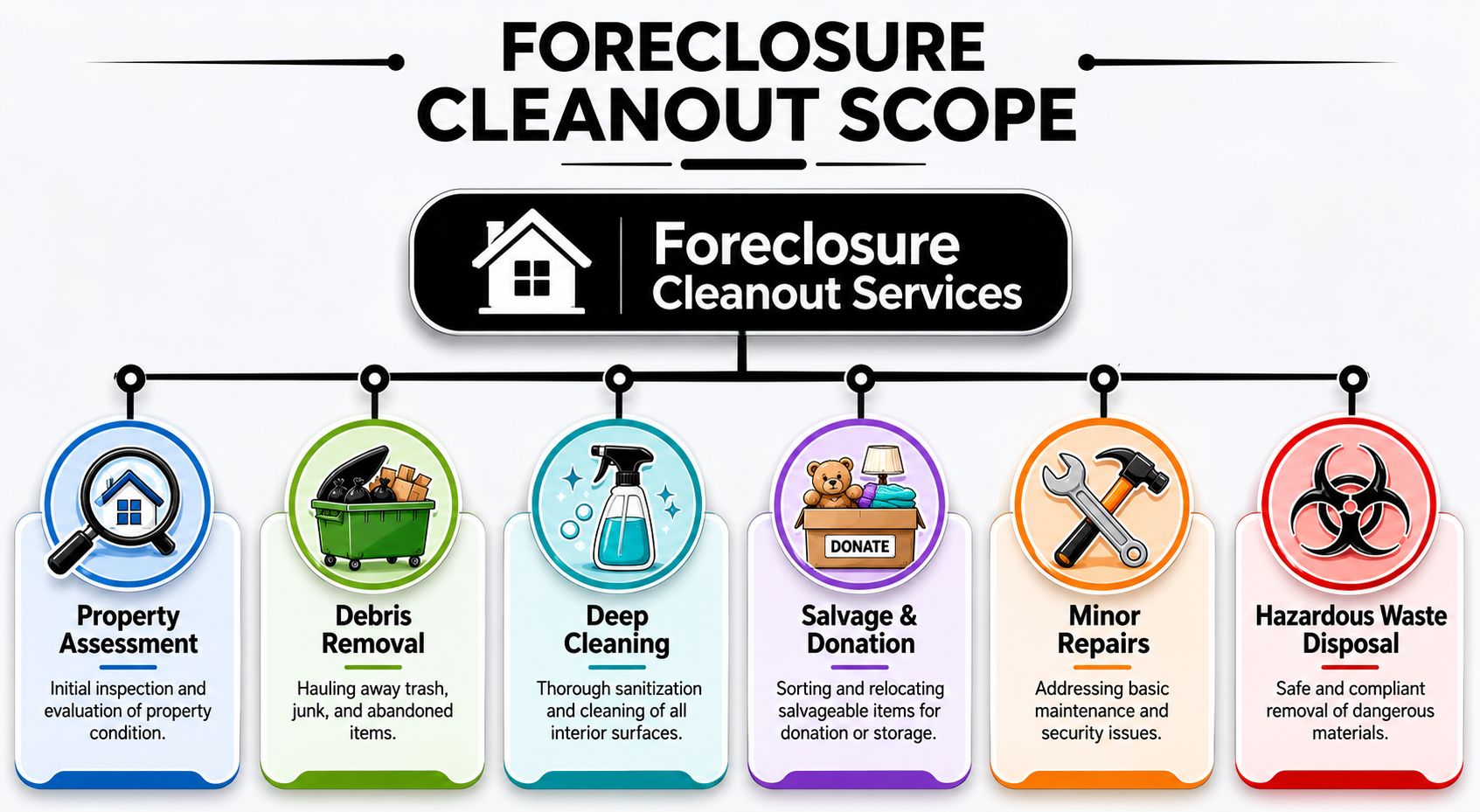
Think of a foreclosure cleanout as hitting the property's reset button. The goal isn't just to clear floor space. The goal is to return the site to a condition where inspection, repair, marketing, or tenant-ready work can happen without confusion.
What falls inside the scope
A true foreclosure cleanout usually covers both interior and exterior recovery work. That can include:
- Whole-house contents removal of furniture, mattresses, boxed items, loose trash, and abandoned household goods
- Appliance and bulky item handling where weight, stairs, or tight access change labor needs
- Yard and outbuilding clearing for sheds, garages, porches, and perimeter debris
- Sorting decisions for items that are obvious trash versus items that may need to be held, documented, donated, or recycled
- Post-removal reset work such as sweeping out, basic wipe-downs, and preparing the property for the next trade
If the property is heavily packed, some owners choose a different exit path altogether. In those situations, it can help to review options for how to sell your hoarder property as-is before investing in a full market-prep cleanout.
Why this is different from standard junk pickup
The biggest mistake clients make is assuming foreclosure cleanout services are just a larger version of curbside hauling. They aren't. Industry guidance notes that the work often requires documented room-by-room clearance, segregation of salvageable items, and safety protocols for unknown materials, with crews planning for mixed waste streams that can include furniture, electronics, trash, and damaged building materials in one pass, as explained in this guide to foreclosure cleanout complexity.
That changes everything on the ground.
A standard junk pickup might load obvious discard items and leave. A foreclosure cleanout crew has to think in zones, sequence, and liability. Which room gets photographed first. Which pile contains electronics. Which items may hide sharps, mold, or liquids. Whether the garage should be loaded before the upstairs because truck cube and weight need to stay balanced. Whether a final sweep is enough, or if the property needs a deeper turnover package before handoff.
If the waste stream is mixed, the job isn't just removal. It's sorting, routing, and documenting.
The reset only works if the process is systematic
Professional teams usually work from a repeatable checklist because abandoned properties are unpredictable. The right scope starts with assessment, then moves through removal, separation, disposal routing, and closeout verification. That's why property managers often look for vendors that can handle broader site conditions instead of one-off pickups. A full-service example is a contractor with documented property cleanout and hauling capabilities rather than a crew that only offers generic junk loading.
What doesn't work is improvising from room to room without a plan. That leads to missed items, double handling, and arguments later about what was removed, what was recycled, and what should never have gone on the truck in the first place.
Navigating Legal and Possession Considerations
The legal side of a foreclosure cleanout starts before the first item is touched. Access has to be authorized. Possession has to be clear. The party ordering the work needs to know whether the contents are abandoned debris, potentially recoverable personal property, or a mix of both.

Possession first, removal second
A lot of disputes happen because someone confuses physical vacancy with legal clearance. An empty driveway and disconnected utilities don't automatically answer who has the right to remove contents. Brokers, servicers, landlords, and investors all need the same discipline here. Verify authority before dispatch.
In Georgia, some owners and occupants may still be looking at alternatives before the foreclosure process fully closes out. If that applies to the file, practical legal context on how to stop foreclosure in Georgia can help decision-makers understand where the property stands before authorizing cleanout work.
Chattel versus abandoned junk
How items are handled in a property cleanout often separates experienced operators from random labor crews. Not everything left inside a property should be treated the same. Loose trash, spoiled food, broken particleboard furniture, and contaminated soft goods may be straightforward. Personal records, family photos, valuables, or boxed belongings are a different category operationally, even when the owner believes the house has been abandoned.
The safest process is simple:
- Document the condition before work begins with photos and room notes.
- Identify categories of contents rather than treating all material as bulk trash.
- Pause when there's uncertainty about personal property or regulated items.
- Create a record of what left the site and where it went.
That record protects everyone. It also keeps the cleanout from becoming the weak point in an otherwise well-managed foreclosure file.
Insurance, permits, and the vendor standard that matters
Foreclosure cleanout work carries overlapping risks. Crews lift heavy debris, enter unstable spaces, transport loads on public roads, and make disposal decisions that can trigger problems if the wrong material goes to the wrong facility. Because of that, reputable operators carry the same core controls expected in regulated hauling work.
One industry guide notes that brokers and banks often require at least $1 million in general liability coverage before hiring a foreclosure cleaner, along with proper local permits and related coverage because the work can involve injury exposure, unknown materials, and disposal violations. The requirement is outlined in this resource on starting and insuring a foreclosure cleaning business.
The cheapest crew is expensive if they can't prove coverage, can't show permits, or can't explain their disposal chain.
What doesn't work is relying on verbal assurances. Ask for certificates. Ask who pulls permits if needed. Ask what happens when the crew finds sharps, chemicals, or mold-affected debris halfway through the job. If the answer is vague, the risk transfers back to you.
Understanding Cleanout Timelines and Pricing Factors
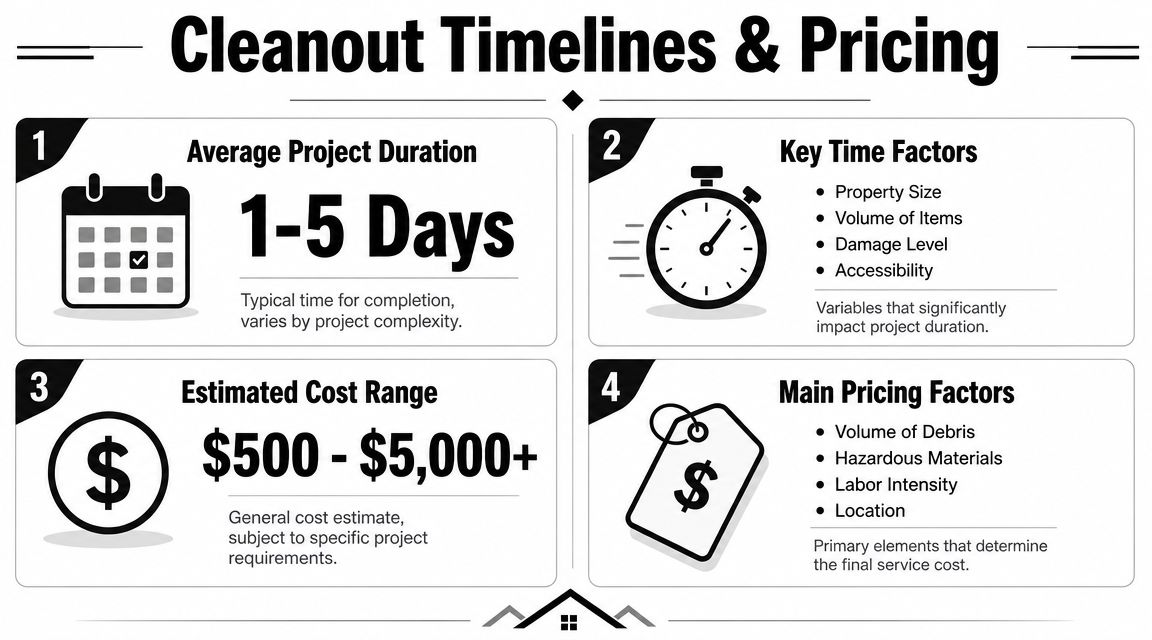
The question clients usually ask first is price. The more useful question is what drives the price. Foreclosure cleanout services vary because the labor isn't determined by square footage alone. The variables are density, access, material type, and how much sorting the property requires before the first truck is full.
What usually drives cost
Published pricing guidance places a basic cleanout for a small home between $300 and $1,000, while larger properties or heavy-debris jobs can run $1,000 to $2,500 or more, and complex estates or commercial properties can exceed $5,000, depending heavily on size and debris density, according to this overview of foreclosure cleanout pricing.
Those ranges make sense in the field because cleanout costs are rarely about one thing. They usually come from a stack of conditions:
- Volume and density: Packed rooms cost more than light scatter, even in the same footprint.
- Material mix: Furniture, electronics, damaged drywall, and bagged trash don't load or route the same way.
- Access challenges: Upper floors, long carry distances, locked rooms, and limited truck placement all slow production.
- Special handling: Appliances, mattresses, paint, chemicals, and other regulated or awkward items change disposal plans.
- Closeout expectations: A broom-swept finish is different from a turnover-ready reset.
What affects the schedule
Timelines work the same way. Two homes with similar square footage can move very differently depending on congestion inside the structure and whether crews can sort in place or need staging space outside.
A fast cleanout usually has three traits. Clear legal access, open truck access, and a decision-maker who has already defined what stays and what goes. Delays often come from locked areas, uncertain ownership of contents, or discovering materials that need a separate handling path.
A practical way to estimate schedule is to think in phases rather than one total number:
| Phase | What happens | What slows it down |
|---|---|---|
| Assessment | Walk-through, scope check, quote confirmation | Unknown hazards, unclear item categories |
| Removal | Loading, hauling, room clearing | Stairs, dense contents, mixed debris |
| Disposal routing | Recycling, donation, landfill, specialty drop-off | Electronics, appliances, hazardous leftovers |
| Closeout | Final sweep, photos, documentation | Missed rooms, client change orders |
A reliable quote doesn't come from guessing how many truckloads there are. It comes from identifying what kind of truckloads they are.
For clients, the best move is to ask for scope-based pricing, not just a headline number. If the estimate doesn't explain labor assumptions, disposal categories, and finish level, it's harder to compare bids and easier for costs to shift later.
The Eco-Friendly Advantage Waste Diversion and Donation
Most foreclosure cleanout vendors still work from a blunt model. Load everything. Dump everything. Send the invoice. That may clear the property, but it doesn't solve the full disposal problem, especially for commercial owners, lenders, and property managers who need a record of what happened after the truck left.
Why landfill-first is an outdated approach
A foreclosure cleanout often includes materials that shouldn't be handled as one undifferentiated waste pile. Electronics, metals, appliances, reusable goods, and potentially regulated items all benefit from separate routing. When a vendor treats every property as landfill-bound, the client loses visibility and often loses useful documentation.
That matters more now because commercial real estate and lending teams increasingly need auditable waste diversion data. The U.S. EPA's sustainable materials management framework encourages tracking materials kept out of landfills, and many procurement teams ask vendors for diversion percentages, recycling receipts, and disposal documentation to support ESG goals, as discussed in this article on waste diversion reporting for foreclosure cleanouts.
What a documented diversion model looks like
An eco-conscious cleanout process does three things differently:
- Separates recyclable streams early so electronics, metals, and other recoverable materials don't get buried under mixed trash
- Builds documentation into operations instead of trying to reconstruct disposal history after the fact
- Matches the disposal path to the material so the property owner has a cleaner compliance record
For offices, warehouses, mixed-use sites, and portfolio properties, this is more than image management. It affects procurement reviews, internal reporting, and how easily a facilities or sustainability team can close the file.
One practical option in Atlanta is a bundled model where hauling and downstream recycling are coordinated together. Through Beyond Surplus, Fulton Junk Removal can pair cleanout work with responsible processing for electronics, metals, and other recyclable materials, which is useful when a client wants one operational chain instead of separate vendors. Clients comparing service models can review broader examples of responsible removal and recycling topics on the company's junk removal blog.
Where this matters most in foreclosure work
Donation and reuse sound simple in theory. In practice, they only work when crews sort carefully and the chain of custody stays organized. The same goes for electronics. A pile of monitors, routers, printers, and loose cables isn't just “junk” if the client later needs to explain where those items went.
That's why the long-term choice is often the more disciplined one, even if it isn't the fastest-looking quote on day one. A landfill-only vendor may seem simpler. But if the property contains recoverable materials, e-waste, or items a procurement team wants documented, the cheaper invoice can create more internal work later.
Good disposal practice isn't separate from asset recovery. It's part of asset recovery.
For property managers, lenders, and commercial operators, the hidden value is clarity. You know what was removed. You know what was recycled. You know what was donated or diverted. And if someone asks for proof later, you aren't chasing it through phone calls and memory.
The Foreclosure Cleanout Project A Step-by-Step Guide
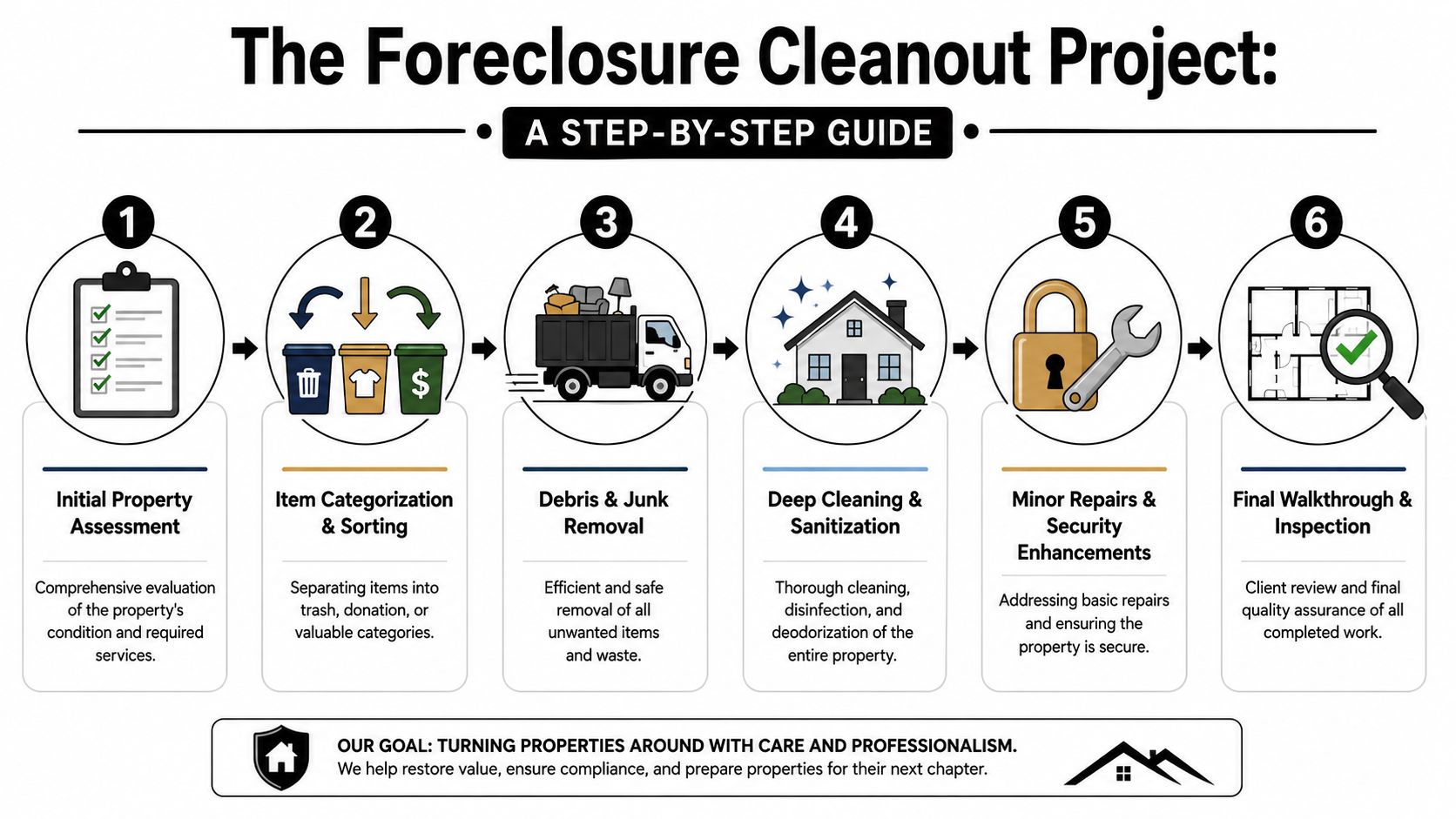
A well-run cleanout follows a sequence. The client should know what happens before the crew arrives, what happens on site, and what gets delivered at closeout. When the process is clear, approvals move faster and fewer surprises show up in the middle of the job.
Before the crew arrives
The cleanest projects start with a short prep checklist from the owner, servicer, broker, or property manager:
- Confirm access authority: Make sure lockbox codes, keys, gate access, and authorization are settled before dispatch.
- Flag known problem materials: Mention paint, chemicals, electronics, appliances, mold-affected items, or sharps if you know they're present.
- Define hold items: If anything must remain on site or be set aside for review, identify it in writing.
- Set finish expectations: Decide whether you want haul-away only, broom sweep, or a fuller turnover reset.
- Name one decision-maker: Mid-job questions need one person who can answer quickly.
Clients who want a simple entry point can start with a local provider that explains its scheduling and cleanout workflow clearly, such as the service overview on the Fulton Junk Removal home page.
Step one through step three on site
The first step is assessment. A supervisor or estimator walks the property, confirms scope, notes access limits, and identifies anything that changes labor or disposal routing.
The second step is categorization. During this phase, a professional crew saves time later. Instead of ripping through the home randomly, they separate obvious trash from recyclables, salvageable contents, bulky items, and materials that require special handling.
The third step is removal. Good teams work in a sequence that reduces rehandling. Upper floors may be stripped first. Exterior staging may be used if the truck can't be kept close. Dense rooms are usually broken into manageable zones so the crew doesn't waste motion.
Step four through closeout
After the bulk material is out, the project shifts from hauling to reset. Depending on the scope, that may include sweeping, light cleaning, odor reduction measures, or preparing the site for the next vendor.
A typical closeout sequence looks like this:
- Bulk debris is gone and rooms are visually cleared.
- Recyclable or reusable material is routed through the right downstream channel.
- The crew performs a final sweep and checks closets, cabinets, crawl areas, and exterior edges.
- Photos and documentation are delivered so the client has a clear before-and-after record.
The best final walkthrough is boring. No surprises, no debate about missing rooms, no uncertainty about what happened to the contents.
What clients should expect from communication
Foreclosure work gets messy when updates are inconsistent. A reliable contractor doesn't disappear for six hours and then send an invoice. They flag problems as they find them. They document changes in scope. They explain when a material needs separate handling.
That communication matters most when the property falls outside the original estimate. Hidden shed contents, illegal dumping behind the home, mixed electronics in an office conversion, or biohazard concerns all require decisions. A crew that documents those conditions in real time gives the client options. A crew that improvises without approval gives the client exposure.
This is the full lifecycle in practical terms. Authority is confirmed. The property is assessed. Contents are sorted. Materials are removed and routed. The site is reset. Documentation closes the loop.
How to Choose the Right Contractor in Atlanta
Atlanta adds its own operating realities to foreclosure work. Tight urban access, traffic delays, mixed residential and commercial zoning patterns, and disposal rules all affect how smoothly a cleanout runs. The right contractor doesn't just own trucks. They know how to scope uncertain properties, communicate clearly, and close a file without creating a second problem.
What to ask before you hire anyone
A good vendor interview should be short and direct. If the company is experienced, the answers come back fast and with specifics. If the company is winging it, the vagueness shows up immediately.
Here's a practical screening table to use.
| Question to Ask | Green Flag Answer (What you want to hear) | Red Flag Warning (What to avoid) |
|---|---|---|
| Are you insured for foreclosure cleanout work? | They can provide proof of liability coverage and explain what their policy covers. | “We've never needed that” or “We can send something later.” |
| How do you handle personal property versus trash? | They describe documentation, categorization, and a pause process for uncertain items. | “We just take everything unless someone stops us.” |
| What happens if you find electronics, paint, or other special materials? | They explain separate handling and disposal routing. | “It all goes in the same load.” |
| How do you quote jobs with unknown contents? | They explain scope assumptions, change-order triggers, and finish levels. | A flat number with no detail behind it. |
| What documentation do I receive after the job? | Before-and-after photos, disposal records when applicable, and a clear completion summary. | “We usually don't do paperwork unless asked.” |
| Can you support commercial or portfolio needs? | They understand repeat work, reporting, and communication with property managers or asset teams. | They only speak in terms of one-time residential pickups. |
What matters locally
In Atlanta, access planning matters more than many clients expect. A contractor may need to think through parking, loading distance, gate codes, elevator coordination, or neighborhood restrictions before the first item gets moved. That isn't glamorous, but it affects labor hours and schedule reliability.
It also helps to choose a vendor that can explain its operating model and disposal philosophy clearly. If you're comparing local options, the company background on Fulton Junk Removal shows the kind of information worth looking for: service area, project types, and how the company approaches responsible removal.
The biggest red flag is a bid that sounds simple because it leaves out the hard parts. In foreclosure work, the hard parts are the job.
Reclaim Your Property with Confidence
Foreclosure cleanout services sit at the intersection of labor, liability, and disposal discipline. The property has to be emptied, but it also has to be documented, handled legally, and routed responsibly once materials leave the site. That's where many cheap bids fall apart.
For Atlanta-area owners, brokers, and property managers, the safer path is to use a contractor that understands the full lifecycle, from access and categorization through removal, diversion, and closeout documentation. If you need a scope review or estimate, start with Fulton Junk Removal's contact page.
If you're dealing with a foreclosed home, office, rental unit, or mixed-use property in the Atlanta area, Fulton Junk Removal can help you move from first walk-through to documented cleanout without turning the job into a landfill-only rush. Reach out for a free, no-obligation estimate and get a practical scope for removal, recycling, and next-step property readiness.
