
A Guide to Used Tire Recycling for Atlanta Businesses
Used tire recycling is all about giving old, end-of-life tires a new purpose instead of letting them rot in a landfill. It’s a smart, sustainable practice that takes what would otherwise be a massive waste problem and turns it into useful materials for manufacturing, construction, and even energy.
The Hidden Costs of Discarded Tires
For any business in Atlanta, from warehouses to auto shops, old tires are just part of the landscape. But letting them pile up is more than just an eyesore—it’s a major operational and financial risk hiding in plain sight. Those stacks of end-of-life tires create serious environmental and health hazards that can come back to bite your business, affecting both your reputation and your bottom line.
Just hauling old tires to the dump isn't an option. In fact, it’s illegal here in Georgia. Whole tires are a nightmare for landfills because they don’t compact, taking up a ridiculous amount of space. Worse, they can trap methane gas, which can pop up and tear through the protective liners designed to keep contaminants out of our soil and water.
But the most immediate threat? Those stockpiled tires are a huge public safety concern.
Beyond the Landfill: The Real Risks
Abandoned tire piles are notorious for creating two specific, dangerous problems that property managers and business owners need to be aware of:
- Pest Infestations: A tire’s curved shape is the perfect collector for stagnant rainwater. This turns each tire into a five-star hotel for mosquitoes, which can carry diseases like West Nile and Zika viruses. That’s a direct health risk for your employees, customers, and the surrounding community.
- Fire Hazards: Tire fires are a catastrophe. They are incredibly difficult to put out and release thick, black smoke loaded with toxic pollutants like lead, arsenic, and mercury. These fires can smolder for days or even weeks, causing severe air and soil contamination that could lead to expensive, mandated environmental cleanups.
For a commercial property, an unmanaged pile of tires isn't just clutter—it's a compliance time bomb. Partnering with a professional service transforms this liability into a documented act of corporate responsibility, ensuring every tire is handled according to state regulations.
Turning a Problem into an Opportunity
Fortunately, this challenge presents a clear opportunity for businesses to get smarter and more sustainable. The global used tire recycling industry has made incredible strides. It’s estimated that over 1.8 billion tires are recycled annually worldwide, which is a huge portion of the roughly 2.5 billion new tires produced each year.
That means a whopping 70–85% of end-of-life tires are now successfully diverted from landfills. This growth is a testament to the power of the circular economy, turning potential liabilities into valuable resources.
When you choose professional used tire recycling, you aren't just solving a problem; you're plugging into a circular, eco-friendly solution. Fulton Junk Removal works hand-in-hand with our partner, Beyond Surplus, to divert items from landfills and ensure they’re repurposed or recycled. We turn a compliance headache into a badge of environmental stewardship, providing you with all the documentation needed for your sustainability reports and paving the way for a cleaner, more efficient operation. You can explore more sustainable waste management tips on our blog.
How Old Tires Are Transformed into New Resources
Ever wondered what actually happens to an old tire after a service like Fulton Junk Removal hauls it away? It’s not just a trip to the dump. The journey from a discarded tire to a valuable new product is a surprisingly precise, multi-stage process.
Think of it less like throwing something away and more like disassembling a complex Lego model to reuse every single brick. Modern used tire recycling isn't just about disposal; it's a sophisticated manufacturing operation that turns potential waste into the building blocks for all sorts of innovative materials.
The entire process kicks off the moment our trucks leave your commercial property. Once we’ve collected the tires, we transport them to a specialized processing facility, like the ones operated by Beyond Surplus. This is where the real transformation begins.
The Initial Breakdown Process
The first stop in any effective recycling stream is sorting. At the facility, tires are inspected and sorted by type—passenger car, heavy-duty truck, or off-road—to make sure they’re fed into the right machinery. Any stray debris is removed to prevent contamination and equipment damage down the line.
Next, the tires hit the primary shredding phase. This is where the heavy lifting happens. Massive industrial shredders with immense torque grab whole tires and tear them into rough strips or chips, usually around two to six inches in size. This initial breakdown is crucial, as it turns bulky, awkward tires into something manageable for the next steps.
This is where responsible disposal becomes so critical. Leaving old tires piled up on your property creates a chain of escalating risks that can come back to bite you.
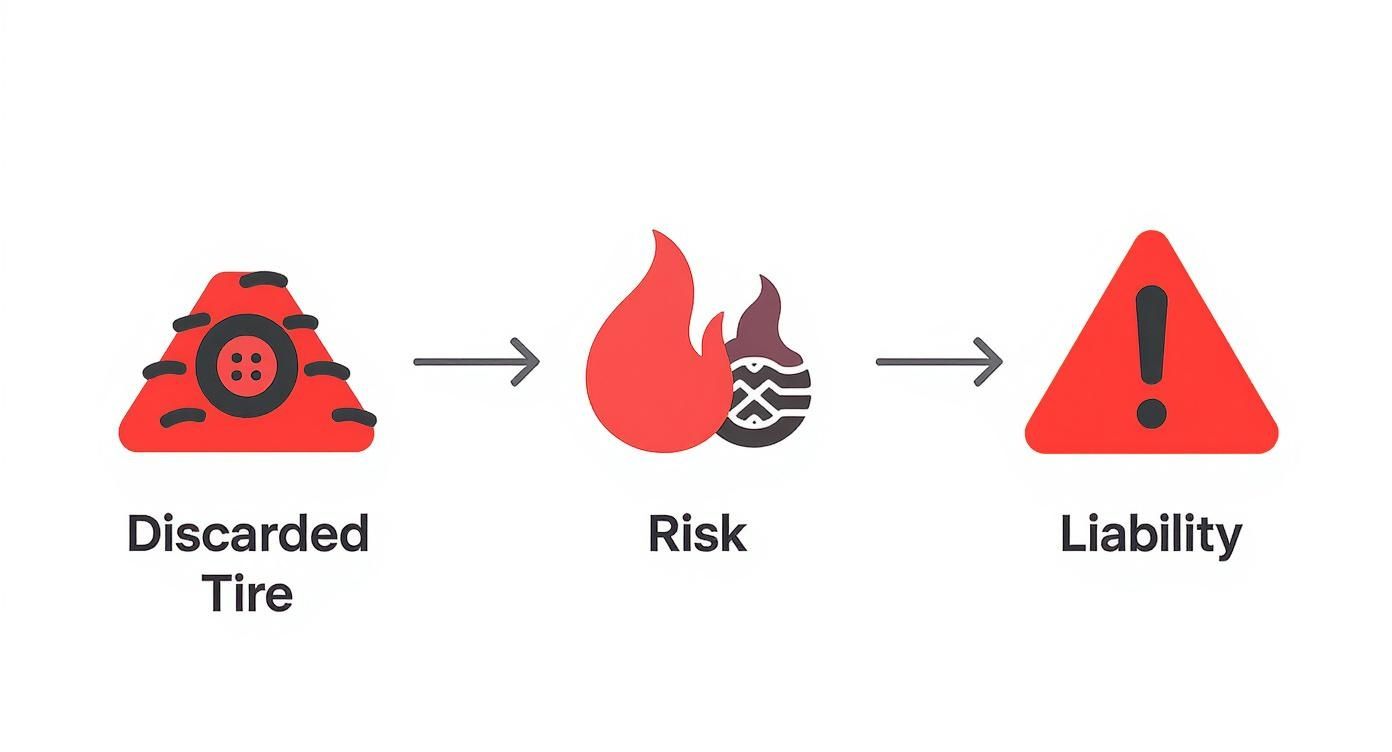
As you can see, what starts as a simple pile of tires quickly becomes an environmental hazard, a safety issue, and ultimately, a significant legal and financial liability for your business.
Separating The Core Components
A modern tire isn’t just a solid piece of rubber. It’s a complex composite material made of rubber, high-tensile steel, and textile fiber. To unlock the true value of a used tire, each of these components has to be carefully separated.
After the first round of shredding, the large chips move on. Powerful magnets are used to pull out the steel belts and beads embedded within the rubber. This recovered steel is a valuable commodity on its own and gets sent to steel mills to be melted down and repurposed.
At the same time, a combination of screening systems and powerful air classifiers work to separate the lightweight nylon or polyester fiber from the heavier rubber pieces.
The goal of this separation is purity. The cleaner the final streams of rubber, steel, and fiber, the higher their value and the wider their range of applications in the circular economy. This meticulous process ensures minimal waste and maximum resource recovery.
Once the steel and fiber have been stripped away, the rubber chips head for secondary shredding or granulation. This equipment refines the rubber into smaller, more uniform granules known as crumb rubber. The size of these granules can be precisely controlled, depending on what they’ll be used for next.
Common Pathways For Recycled Tire Materials
The output from this detailed process isn't waste; it's a collection of raw materials ready for a new life. Each component—rubber, steel, and fiber—has its own market and applications.
This table breaks down where the different parts of a recycled tire typically end up.
| Recycled Material | Common Applications | Environmental Benefit |
|---|---|---|
| Crumb Rubber | Playground surfaces, athletic tracks, rubberized asphalt, landscaping mulch, molded goods. | Reduces need for virgin rubber and creates safer, durable surfaces. |
| Steel Wire | Melted down for new steel production (rebar, new tires), used in concrete reinforcement. | Conserves natural resources and saves energy in steel manufacturing. |
| Textile Fiber | Carpet underlay, insulation, filler material in construction, tire-derived fuel (TDF). | Diverts material from landfills and provides alternative fuel sources. |
As you can see, every part of the tire is put to good use, ensuring that what was once a liability becomes a valuable asset for other industries.
A Growing Market For Recycled Rubber
This intricate process isn’t just good for the environment; it’s a major economic driver. The global tire recycling market has seen steady financial growth, thanks to both the rising volume of scrap tires and the expanding list of applications for recycled materials.
Recently, the global tire recycling market was valued at approximately $13.92 billion, with projections showing it could reach $19.24 billion by 2033. The Asia-Pacific region has emerged as the largest market, accounting for about 39% of the global share. You can dig into the full tire recycling market research from Precedence Research to see the trends for yourself.
This growth proves that the materials extracted through recycling are in high demand. From raw chips to refined crumb rubber, these outputs are no longer waste—they’re valuable commodities ready for their second life.
Exploring the Second Life of a Recycled Tire
Once a tire gets broken down into its basic parts—rubber, steel, and fiber—its story is far from over. This is where the real magic of used tire recycling happens. Instead of sitting in a landfill forever, these materials get a new lease on life as a huge range of valuable products that Atlanta businesses see and use every day.
This whole process is a perfect example of the circular economy in action. The raw materials pulled from old tires become the building blocks for new, durable, and often innovative products. For our commercial clients, like property managers and warehouse operators, seeing these end uses helps connect the dots between getting rid of old tires responsibly and creating a tangible, positive impact.
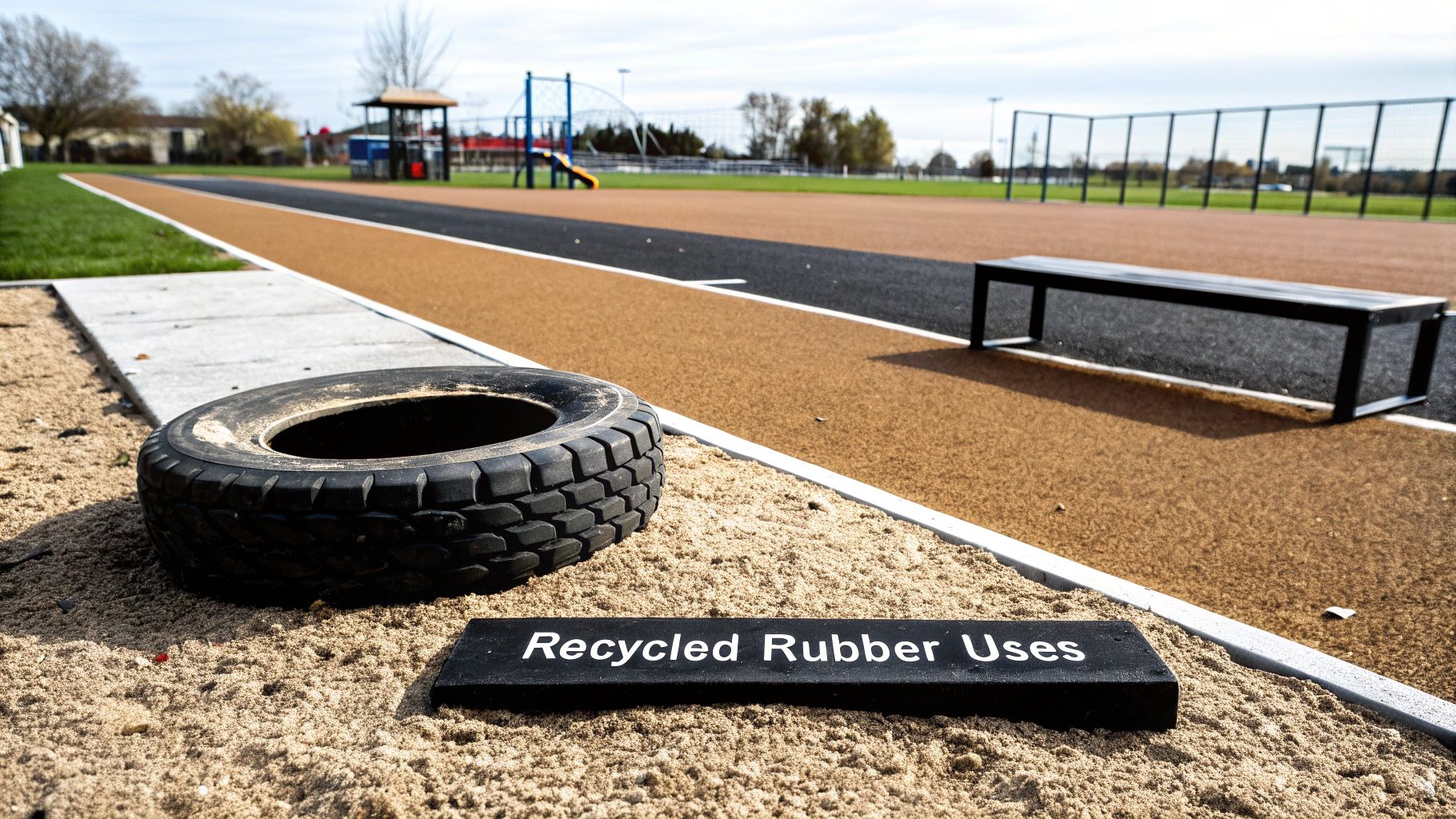
Crumb Rubber: The Workhorse of Recycled Materials
The most versatile thing to come out of a recycled tire is crumb rubber. It's a fine, granular material made after the steel and fiber have been stripped away and the rubber is ground down into tiny, uniform pieces. Think of it as the raw ingredient for a whole new batch of products.
You've definitely seen the results of this process all over our communities. Crumb rubber is a key ingredient in many modern surfaces where safety and durability are a top priority.
Some of its most common uses include:
- Playground Surfaces: That soft, bouncy ground covering at local parks and schools? It’s often made from crumb rubber, giving kids a much safer place to land.
- Athletic Tracks: The tough, all-weather surfaces on running tracks are frequently made with recycled rubber, which gives athletes great traction and absorbs shock.
- Rubberized Asphalt: When mixed into asphalt, crumb rubber helps create a road surface that’s quieter, tougher, and lasts longer—perfect for busy commercial parking lots and local streets.
For a business, this means the old tires from a company fleet or a property cleanout could literally end up paving the parking lot they drive on every day. It's a direct, visible example of the circular economy working right here in Atlanta.
Tire-Derived Fuel: Powering Local Industry
Not every piece of a recycled tire ends up as a solid product. A huge portion is used to create Tire-Derived Fuel (TDF). TDF is basically shredded tire chips, usually about one to two inches in size, that serve as a potent alternative energy source for heavy industrial facilities.
Places like cement kilns, pulp and paper mills, and electric utilities need a massive amount of energy to run. TDF is a fantastic substitute for fossil fuels like coal because it actually has a higher heating value—meaning it packs more energy punch for its weight.
Using TDF gives us a double environmental win: it keeps millions of tires out of landfills while cutting down our reliance on brand-new fossil fuels. That makes it a critical part of making our industries more sustainable.
When a warehouse or logistics company recycles its old truck tires, they're not just getting rid of waste. They're contributing a high-energy fuel that helps power other essential industries and lowers our collective carbon footprint in the process.
Civil Engineering and Retreading Applications
Beyond fine granules and fuel, larger chunks of shredded tires have important jobs to do, especially in civil engineering. These bigger shreds, sometimes called Tire-Derived Aggregate (TDA), are used as a lightweight but incredibly stable fill material.
Projects that use TDA include:
- Road Embankments: TDA is much lighter than regular soil or gravel, which reduces the pressure on the ground underneath a new road.
- Landfill Construction: It’s used to build drainage layers and protective barriers in modern, engineered landfills.
- Retaining Walls: Its light weight makes it a great backfill material for holding up retaining walls.
Finally, for any business with a commercial fleet, one of the most direct and cost-effective forms of reuse is retreading. The process is simple: a tire's casing is checked to make sure it's still structurally sound. If it passes, a brand-new layer of tread is applied. This extends the tire's life for a fraction of what a new one would cost, cutting down on both waste and expenses.
For every Atlanta business, from a small office to a massive warehouse, the decision to recycle used tires properly sends ripples through our local economy. Through our partnership with Beyond Surplus, Fulton Junk Removal makes sure these materials don't just vanish—they get a second chance as valuable, functional products that build safer playgrounds, pave stronger roads, and help power our community.
Navigating Georgia’s Tire Disposal Regulations
For any property manager, warehouse operator, or business owner in the Atlanta area, dealing with old tires isn't just a cleanup task—it's a serious compliance issue. Getting it wrong can bring fines, penalties, and a black mark on your company’s reputation. Georgia has very specific rules designed to prevent the environmental damage that scrap tires can cause, making professional handling a must.
These regulations aren't just bureaucratic red tape; they're safeguards for our communities and your business. The state’s Scrap Tire Management Program was built to make sure every single end-of-life tire is tracked, processed, and recycled the right way. This is where having a knowledgeable partner turns a potential headache into a smooth, seamless part of your operations.
Understanding Georgia’s Core Tire Rules
The single most important rule every business needs to know is this: whole tires are strictly banned from Georgia landfills. This one regulation is the cornerstone of the state's entire approach to tire recycling. It forces everyone to find a responsible recycling path instead of just tossing them in a dumpster.
To make this stick, Georgia uses a manifest system. Think of it as a chain-of-custody document that follows your scrap tires from the moment they leave your property until they arrive at a certified processing facility.
This manifest is your proof of compliance. It shows you handed your tires over to a legitimate carrier who is taking them to a state-approved recycler. Without it, your business could be held liable if those tires are found dumped illegally down the road.
At Fulton Junk Removal, we manage this entire paper trail for you, working hand-in-hand with our circular solutions partner, Beyond Surplus. We provide all the necessary documentation to ensure your business meets every state requirement, giving you total peace of mind and simplifying your sustainability reporting.
Why Compliance Is a Business Advantage
Following Georgia's tire rules does more than just keep you out of hot water. It shows you're a responsible community partner, which is a big win with today’s environmentally conscious customers and stakeholders. For any business managing large properties or vehicle fleets, having a documented process for used tire recycling is a key part of modern corporate responsibility.
Partnering with a service that truly understands the local landscape is vital. As a dedicated provider for the greater metropolitan area, we have deep expertise in the specific regulations that affect businesses right here in our community. You can learn more about our commitment to responsible junk removal for Atlanta businesses and see how we integrate these practices across all our services.
For commercial fleets, staying compliant often means looking beyond state lines, too. A solid understanding of federal DOT tire regulations is critical for comprehensive compliance, especially when managing commercial vehicles.
Fulton Junk Removal and Beyond Surplus are your compliance partners. We don’t just haul away tires—we ensure they enter a verified, eco-friendly recycling stream. We provide the diversion reports and certificates of recycling you need to make your sustainability reporting simple and accurate, turning a regulatory burden into a clear win for your business.
The Fulton Junk Removal and Beyond Surplus Advantage
Picking a partner for junk removal is about more than just hauling stuff away. For businesses in Atlanta today, it’s about knowing that what you get rid of is handled the right way. This is where Fulton Junk Removal brings something to the table that most traditional haulers simply can't—a truly integrated, eco-friendly service built on our unique partnership with Beyond Surplus.
We handle the heavy lifting and logistics of getting old tires and other junk off your commercial property. Meanwhile, Beyond Surplus makes sure every single recyclable item is processed correctly and responsibly. This turns a simple cleanout into a documented act of corporate responsibility.
Think about a common headache for a property manager: a tenant moves out, leaving a mess of old furniture, ancient electronics, and a pile of illegally dumped tires. Calling a standard hauler might clear the space, but where does it all actually end up? With us, you never have to wonder.
A Seamless, Bundled Solution
Our bundled junk removal and recycling pickup service gives you a single point of contact for even the most complicated cleanouts. Forget juggling separate companies for hauling and recycling. You just make one call, and we manage the entire chain of events, from pickup to final processing.
This integrated approach is a game-changer for busy property managers, warehouse operators, and office administrators:
- Simplified Invoicing: You get one straightforward, consolidated invoice for everything, cutting down on administrative busywork.
- Streamlined Logistics: We coordinate the whole job, so you aren't stuck managing multiple vendors and conflicting timelines.
- Guaranteed Compliance: Our partnership ensures that all your materials—from tires to e-waste—are handled exactly according to Georgia’s regulations.
We turn a logistical nightmare into a simple, sustainable win. It’s a huge part of our mission, which you can learn more about by exploring the values driving Fulton Junk Removal.
Beyond Hauling to True Recycling
The real difference is what happens after our truck pulls away. Most junk removal companies are on a one-way trip to the landfill, but we actively divert waste by routing it through Beyond Surplus. All your electronic waste, scrap metal, and other recyclable materials go directly to them for processing, ensuring very little goes to waste.
This commitment to the circular economy is what makes our used tire recycling service stand out. We don't just pick up tires; we guarantee they enter a verified recycling stream that transforms them back into valuable raw materials.
Our partnership with Beyond Surplus creates a closed-loop system. We handle the heavy lifting and logistics, while they provide the certified recycling and detailed reporting your business needs to hit its sustainability targets.
This powerful combination makes environmental compliance and sustainability reporting easier than you'd think. We provide the comprehensive diversion reports and Certificates of Recycling that modern businesses need for their Environmental, Social, and Governance (ESG) initiatives. These documents give you transparent, verifiable proof that your company is making a real difference.
Fulton Junk Removal Vs Traditional Haulers
The contrast in our approach really hits home when you put our service model side-by-side with a standard junk hauler. It's not just about removing junk; it's about adding value.
| Feature | Traditional Junk Removal | Fulton Junk Removal & Beyond Surplus |
|---|---|---|
| Disposal Method | Primarily landfill-focused. | Recycling-first approach; diverts items from landfills. |
| Service Scope | Hauling only; recycling is often an afterthought or not offered. | Integrated junk removal and certified recycling services. |
| Documentation | Basic receipt for removal services. | Provides detailed diversion reports and Certificates of Recycling. |
| Compliance | Responsibility often ends at the curb. | Ensures full compliance with state and local regulations. |
| Business Value | Simply removes clutter. | Supports ESG goals and enhances corporate responsibility. |
For offices, warehouses, and property managers in Atlanta, the choice is clear. Fulton Junk Removal doesn’t just clean up your space—we give you a strategic advantage, helping you operate more sustainably and meet the growing demand for corporate environmental responsibility.
How to Prepare for a Commercial Tire Pickup
Getting your used tires picked up shouldn't be another logistical headache for your business. We've designed our process to be simple and straightforward, and a little prep work on your end makes things go even faster. When our crew can get in and out with minimal disruption, you get back to your day sooner. Our goal is to take all the guesswork out of it, so you can schedule with confidence.
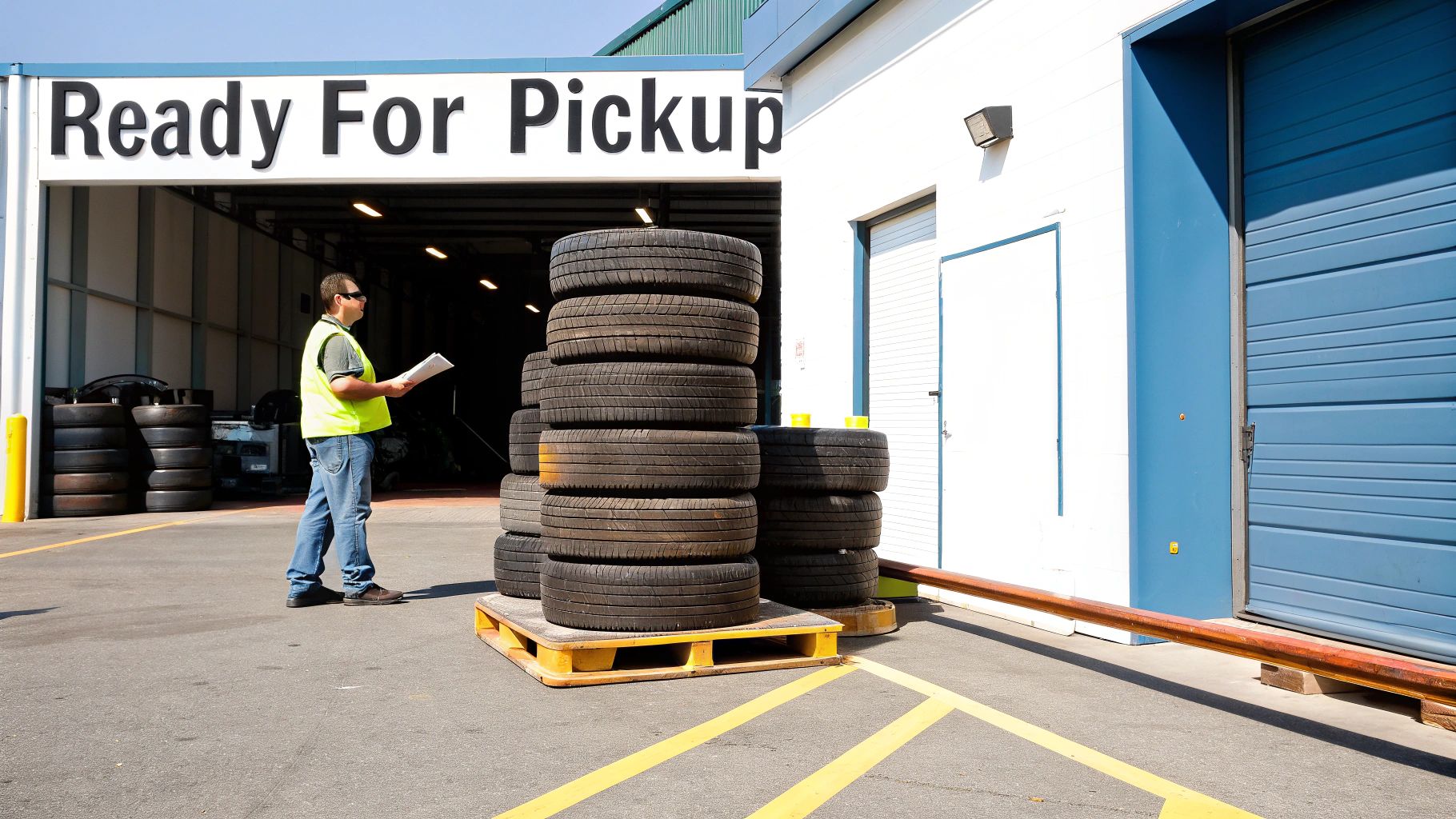
Honestly, the single biggest thing you can do is make sure the tires are easy to get to. If they’re tucked away in a hard-to-reach spot, stuck behind a locked gate, or blocked by equipment, just give us a heads-up. Clearing a path for our team is a huge time-saver once we're on-site.
And while we’re happy to sort through a mixed junk pile to get to the tires, having them all gathered in one spot is a game-changer. Think of a central pile in your parking lot, near a loading dock, or in a designated corner of your warehouse—that’s perfect.
Streamlining the Pickup Process
Having a rough count of the tires is also incredibly helpful. No need to be exact down to the last one, but a ballpark estimate—say, "around 100 passenger tires" or "about 30 large truck tires"—helps us dispatch the right size truck and crew. This means we can clear everything in a single visit, which saves everyone time and money.
Follow these quick tips for a seamless pickup:
- Clear the Area: Make sure the path to the tires and the space around them is free of vehicles, pallets, or other junk.
- Provide Access Details: If we need a gate code or have to check in with security, let us know when you book the appointment.
- Separate If Possible: This isn't a requirement, but if you have a mix of passenger and commercial tires, separating them can speed up the loading process.
The smoother the pickup, the more cost-effective the service. A few minutes of prep on your end can translate directly into a faster, more efficient cleanout, which is especially valuable for large-scale projects at warehouses or managed properties.
Understanding Pricing and Bundled Services
We believe in straightforward, upfront pricing. The cost for a used tire recycling pickup is typically based on the volume—how many tires you have. As you'd expect, larger volumes often come with more cost-effective pricing, making it affordable for businesses with a steady stream of used tires.
This is where our integrated service model really shines. Fulton Junk Removal can bundle your tire pickup with general junk removal, creating serious cost efficiencies for bigger projects. If you're managing an office cleanout, warehouse decommissioning, or property turnover that involves tires plus e-waste, old furniture, and other junk, we handle it all. One truck, one crew, one invoice.
This bundled approach just makes life easier. Instead of juggling multiple vendors, you have a single point of contact for the entire job. To see how this could work for your project, check out our commercial services and let us put together a custom, cost-effective plan for you.
Your Questions About Used Tire Recycling, Answered
Got questions about getting rid of old tires in Atlanta? You're not alone. Navigating the rules and logistics can feel like a headache, but we're here to make it straightforward. Here are the clear, simple answers to the questions we hear most from local businesses.
Whether you're a property manager dealing with illegally dumped tires or a warehouse operator cycling through your fleet's supply, this is what you need to know.
What Kinds Of Tires Do You Take?
We handle the common tires that pile up at most Atlanta businesses. Our crews are equipped to remove a wide range of types you’d typically encounter.
We routinely pick up:
- Passenger Car and Light Truck Tires: The everyday tires from cars, SUVs, and pickup trucks.
- Commercial Truck Tires: The heavy-duty tires that keep semi-trucks, box trucks, and other large commercial fleets on the road.
Dealing with something bigger or more specialized? If you have oversized tires from heavy construction equipment (often called OTR or Off-the-Road tires), just give us a call. We can put together a custom plan to handle those specific needs.
Is There A Limit On How Many Tires You Can Pick Up?
Nope. Our service is built to handle jobs of any scale. We have the trucks and manpower to manage everything from a small pile of ten tires behind an auto shop to a massive cleanup involving hundreds left on a commercial property.
This scalability is why we're the go-to partner for property managers clearing out large sites, warehouses managing fleet turnover, and businesses tackling major cleanout projects. No matter the volume, we get it done right.
How Do I Prove My Tires Were Recycled For My Company's Records?
This is probably the most important question for any business serious about compliance and sustainability. We've got you covered. Through our exclusive partnership with Beyond Surplus, we provide official documentation that verifies every tire was handled responsibly.
You will receive Certificates of Recycling and detailed diversion reports. These documents show the total weight and volume of materials recycled, giving you the transparent, verifiable proof you need for internal compliance, ESG goals, and sustainability reporting.
This paperwork offers total peace of mind, proving your company's commitment to doing the right thing. If you have specific reporting needs or want to discuss a large-scale project, feel free to get in touch with our team.
Ready to clear out old tires and other commercial junk the responsible way? Fulton Junk Removal offers a seamless, eco-friendly solution. We handle the pickup, and our partner Beyond Surplus ensures every tire is recycled, providing you with the documentation you need. Get your free estimate today and reclaim your space with confidence.
