
Warehouse Space Optimization: A Guide to Peak Efficiency
When your warehouse starts to feel cramped, the first instinct might be to look for a bigger, more expensive space. But what if the answer isn't more square footage, but smarter use of the space you already have? That's the core of warehouse space optimization—a strategic process for turning every inch of your facility into a high-performing asset.
It’s about more than just tidying up. This is a complete operational overhaul aimed at improving your storage capacity, making workflows smoother, and cutting down on those pesky operational costs.
Your Blueprint for a High-Performance Warehouse
Before you even think about moving a single pallet rack, you need a solid game plan. A well-thought-out optimization project can transform a chaotic, inefficient warehouse into a streamlined logistics powerhouse that’s ready for future growth.
The journey starts with a hard look at your current layout. We're talking about hunting down the bottlenecks, dead zones, and underused areas that are quietly costing you money. Once you know where the problems are, it’s time for a strategic cleanout. This means getting rid of obsolete inventory, broken-down equipment, and any other debris that’s eating up valuable real estate. Only then can you move on to the exciting part: redesigning your layout and storage systems to finally take advantage of vertical space and intelligent product placement.
The Strategic Phases of Optimization
This isn't a random process. It follows a logical flow from analysis to action, ensuring every step builds on the last. Getting these phases right is the key to creating lasting improvements.
Here’s a simple visual of the four pillars of this process: auditing your current state, cleaning out the clutter, redesigning for efficiency, and implementing the new systems and workflows.
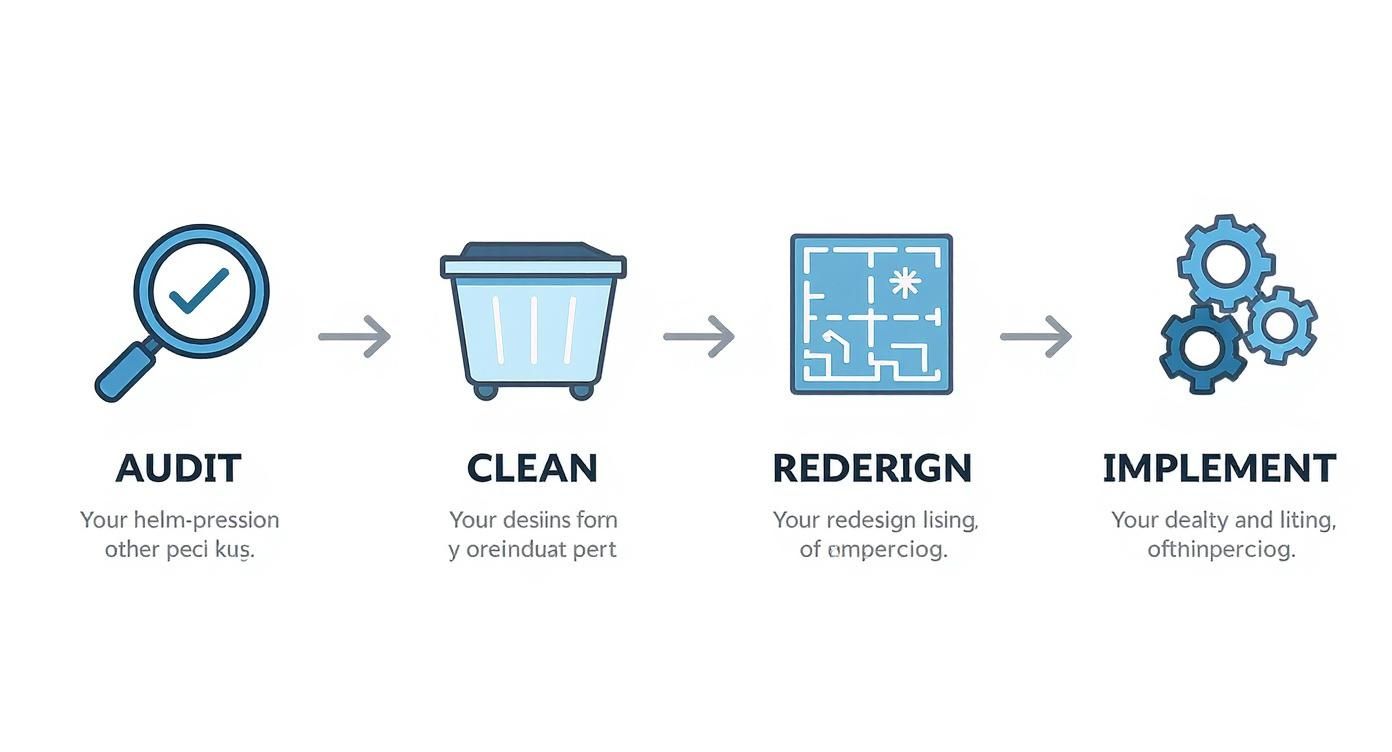
Each of these steps is crucial for building a solid foundation. Skipping one is like trying to build a house on shaky ground—it just won’t hold up.
To give you a clearer picture of how these elements work together, here’s a breakdown of the core pillars we’ll be covering.
| Pillar | Objective | Key Actions |
|---|---|---|
| Audit & Assess | Identify inefficiencies and opportunities. | Conduct a space utilization analysis, map current workflows, and collect performance data. |
| Clean & Clear | Reclaim valuable space. | Remove obsolete inventory, dispose of old equipment, and clear out debris responsibly. |
| Redesign & Reconfigure | Maximize storage and flow. | Implement vertical storage, optimize the layout for picking paths, and create flexible zones. |
| Implement & Sustain | Lock in efficiency gains. | Adopt new inventory controls, train the team on new workflows, and set up a maintenance plan. |
By focusing on these four areas, you're not just cleaning house; you're building a more resilient, profitable, and efficient operation from the ground up.
Clearing the Path for Progress
The cleanout phase is one of the most physically demanding but critically important parts of the project, especially for large warehouses, cluttered offices, and properties managed by third parties. It's so much more than just junk removal; it’s your first real step toward a more sustainable and efficient future.
You can't optimize a space that’s choked with obsolete inventory, broken machinery, or years of accumulated debris. A clean slate isn't just nice to have—it's non-negotiable.
This is where finding the right partner makes all the difference. While most junk removal companies take everything to the landfill, Fulton Junk Removal operates under Beyond Surplus, a circular, eco-friendly solution that goes beyond traditional junk hauling.
Our team works hand-in-hand with Beyond Surplus to recycle electronics, metals, and other materials responsibly, diverting them from landfills to be repurposed or recycled. This integrated approach not only appeals to environmentally conscious businesses but also makes compliance and sustainability reporting easier for offices, warehouses, and property managers. To learn more about Fulton Junk Removal's eco-friendly mission, you’ll see how we simplify responsible disposal.
With the number of warehouses worldwide expected to hit 180,000, the pressure to be efficient has never been greater. It's no surprise that nearly 90% of modern facilities are adopting Warehouse Management Systems (WMS) to stay competitive. But even the best software can’t fix a physically disorganized space. It all starts with a clean, well-organized floor.
Starting with a Strategic Audit and Eco-Conscious Cleanout
Every great warehouse optimization project starts with two things: a brutally honest assessment and a serious cleanout. This isn't just about tidying up a messy corner. It's the groundwork—a deliberate, data-backed first step that dictates the success of everything that follows. You can't build a hyper-efficient system on a foundation of clutter and old habits.
First, you have to get the lay of the land with a comprehensive audit. I'm not talking about a quick walk-through. This is a deep dive into how your space is actually being used, not how you think it's being used. Start by mapping out your entire facility—every rack, every pallet position, every picking path.
This simple act of creating a physical map will immediately highlight the obvious problems. You'll see the "dead zones" collecting dust, the congested aisles causing constant bottlenecks, and the awkward layouts that force your team to take the long way around.
Let Data Drive the Cleanout
Once you have your map, it's time to bring in the data. Your Warehouse Management System (WMS) or inventory software is an absolute goldmine here. By overlaying inventory data onto your physical map, you can pinpoint exactly what needs to go.
This approach takes all the guesswork out of the equation. It gives you cold, hard justification for every item you tag for removal, making the entire process strategic instead of emotional.
Look for these red flags in your data:
- Inventory Turnover: Find your slow-moving and completely obsolete stock. Anything that hasn't moved in 12+ months is just expensive, space-hogging decoration.
- SKU Velocity: Run an ABC analysis. Your 'C' and 'D' list items—the slowest of the slow—are prime candidates for consolidation or outright removal.
- Damage Reports: Where are products consistently getting damaged? This often points to poor storage conditions or inefficient handling routes that a cleanout can fix.
- Equipment Logs: Dust off the maintenance records for your machinery and racking. That old forklift that's always breaking down or those bent pallet racks aren't just obstacles; they're serious safety hazards.
When you ground your cleanout in solid data, you’re not just tidying up—you're building a clear business case for reclaiming valuable space.
A strategic audit transforms a daunting cleanout into a targeted, justifiable business decision. It ensures you're removing what's truly holding you back, not just what looks messy.
Partner Up for a Smart, Sustainable Removal
You've identified what needs to go—from outdated racking and broken equipment to pallets of products you'll never sell. Now what? The removal itself is the next big hurdle, and for modern warehouses, it's also a chance to double down on corporate sustainability goals.
The old way was easy: call a hauler and send it all to the landfill. But that’s not just environmentally irresponsible; it’s a massive missed opportunity. The smart move is to partner with a removal service that gets the bigger picture of recycling and repurposing.
Fulton Junk Removal, working hand-in-hand with our parent company Beyond Surplus, operates differently. While most junk removal companies take everything to the landfill, we recycle through Beyond Surplus to minimize waste and maximize reuse. We can even offer bundled junk removal + recycling pickup, where all electronic waste and recyclable materials are directly processed for a seamless, eco-friendly solution.
Our process ensures that items like scrap metal, old electronics, and other recyclable materials are properly sorted and processed. This responsible approach helps your business hit its sustainability targets and can make environmental compliance reporting a whole lot easier. To see what we can haul away for you, check out the full range of our commercial junk removal services.
By choosing an eco-conscious partner, you turn a simple cleanout into a statement about your company's values. You're not just creating space; you're actively participating in a circular economy. This first step clears the physical and operational clutter, paving the way for a truly efficient redesign that benefits your bottom line and the planet.
Redesigning Your Layout for Modern Demands
Now that you have a clean slate, you can finally rethink your warehouse layout—not just for today’s needs but for future growth. The goal here is to design a space where every movement is logical, every path is clear, and every square foot is pulling its weight. This is where you transform a simple storage building into a high-performance logistics hub, slashing travel time and boosting overall efficiency.
First things first: let your sales data be your guide. Your fastest-moving products, often called 'A' products in an ABC analysis, are the lifeblood of your operation. It just makes sense to place these items in the most accessible, premium locations—typically right near your shipping and packing stations.
This strategy, known as slotting optimization, is one of the most impactful changes you can make. It directly cuts down on the time pickers spend walking, which can eat up more than 50% of their total shift time.
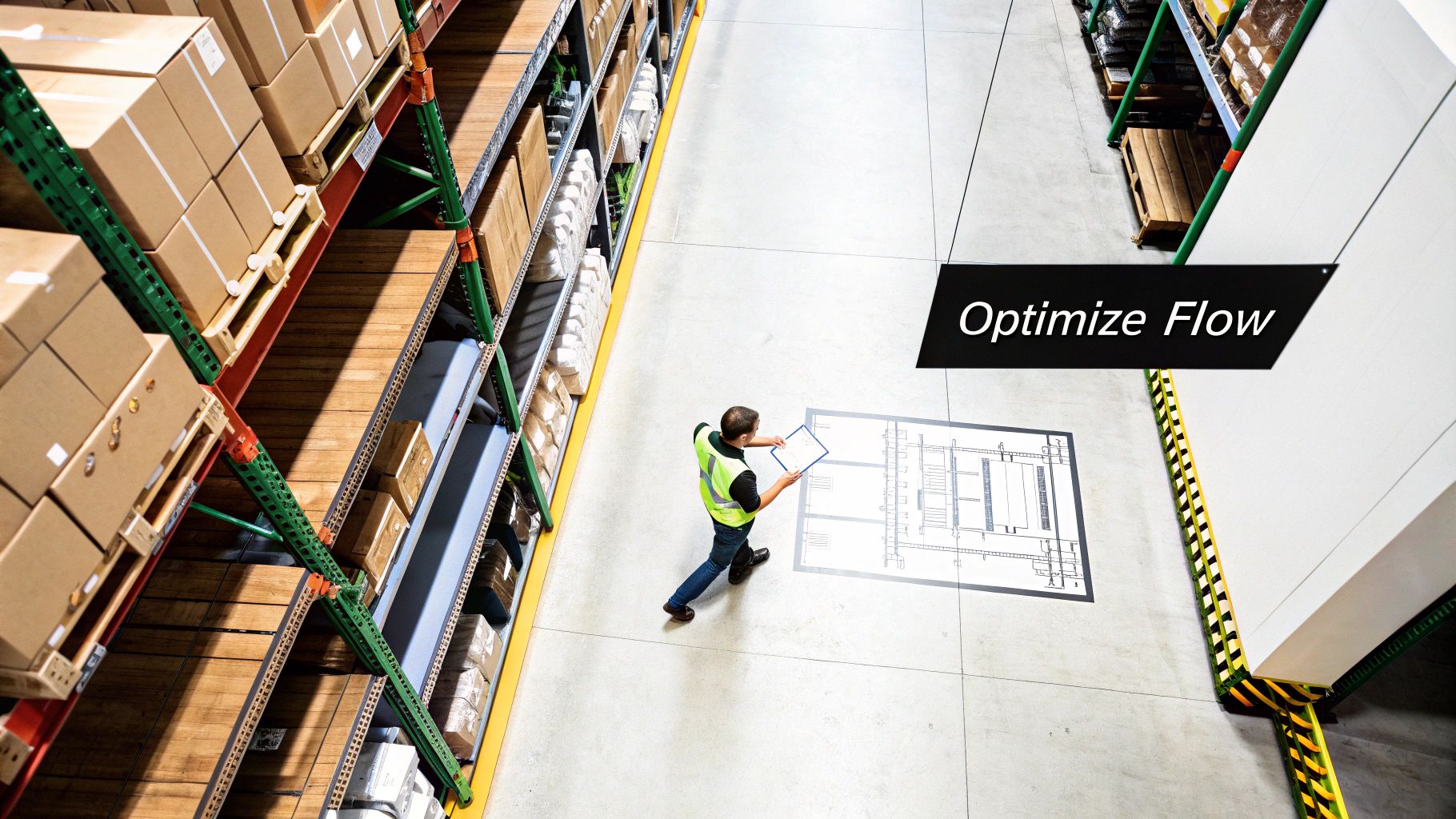
It’s a simple principle, really. You ensure your team isn't trekking to the back of the warehouse for items that fly off the shelves. When you align your physical layout with your product velocity, you create a natural, efficient rhythm for your entire fulfillment process.
Maximizing Your Cubic Footage
Most managers get stuck thinking in square feet, but the real opportunity for optimization lies in cubic feet. That empty space between the top of your racking and the ceiling? That’s often the most underutilized asset in your entire facility. It’s time to start looking up.
Investing in taller pallet racking is the most straightforward way to capitalize on this vertical space. In many cases, you can double your storage capacity without expanding your building's footprint.
Other powerful vertical solutions include:
- Mezzanines: These elevated platforms create an entire second floor for storage, picking operations, or even office space. They can effectively double the usable area in that section of your warehouse.
- Vertical Lift Modules (VLMs): For small parts and high-value inventory, VLMs offer incredibly dense automated storage. They bring items directly to the operator, maximizing space while improving picking accuracy and ergonomics.
Thinking vertically also means considering how every component of your facility works together. This can include innovative door solutions; for instance, a side mounted garage door opener can eliminate the overhead tracks of traditional openers, freeing up valuable vertical clearance right where you need it most—near the dock doors.
Reclaiming Floor Space by Rethinking Aisles
After looking up, turn your attention to the space between your racks. Aisle width is a huge factor in layout design. Wide aisles are necessary for standard counterbalance forklifts, but they consume a massive amount of floor space that could otherwise be used for revenue-generating storage.
Making the switch to narrow-aisle (NA) or very-narrow-aisle (VNA) equipment, like turret trucks or articulating forklifts, can dramatically shrink your aisle width requirements. This lets you fit more rows of racking into the same square footage. While it means an initial investment in new equipment, the return in gained storage capacity can be substantial, often delaying or even eliminating the need for a costly facility expansion.
For a deeper dive into optimizing warehouse processes and making the most of your space, you can explore additional strategies on the Fulton Junk Removal blog.
The final step in your redesign is mapping a clear, linear workflow for every major process, from receiving to shipping. The goal is a one-way street, not a tangled web of crossroads.
Create designated pathways that guide materials and people seamlessly from one stage to the next. This logical flow prevents congestion, eliminates dangerous cross-traffic, and minimizes costly backtracking. A well-designed workflow ensures that every step adds value and moves the product closer to its final destination—efficiently and safely.
Implementing Smart Inventory and Workflow Systems
A killer layout is only half the battle. Once you've cleaned, cleared, and redesigned your warehouse, it's time to implement the technology that actually brings it all to life. This is where a Warehouse Management System (WMS) becomes the central nervous system of your entire operation.
Think of a WMS as the operational brain directing every piece of inventory and every staff member with precision. It gives you real-time, granular visibility into every single item, from the moment it hits the receiving dock to the second it ships out. This digital oversight is what turns a static floor plan into a dynamic, responsive asset.
The Power of Real-Time Inventory Visibility
The main job of a modern WMS is to kill guesswork. Period. Instead of team members wandering the aisles searching for a specific SKU, the system directs them to the exact bin location for both putaway and picking. This simple function has a massive impact, slashing search time—one of the biggest drains on labor productivity—and dramatically reducing picking errors.
But a WMS unlocks even more advanced strategies that are impossible to manage on a clipboard.
- Dynamic Slotting: The system can automatically reassign product locations based on changing demand, seasonality, or velocity. This ensures your fastest-moving items are always in the most optimal, easy-to-reach spots.
- Cycle Counting: It allows you to perform continuous, small-scale inventory checks instead of shutting down the entire operation for a disruptive wall-to-wall physical count. The result? Better accuracy all year long.
This level of control ensures your inventory is always in the right place at the right time, maximizing the efficiency of your new layout. The global push for this is clear; the Warehouse Management System (WMS) market is forecasted to reach nearly USD 5.98 billion by 2030, growing at a CAGR of 13.59%. This growth is fueled by the integration of AI and IoT sensors that provide real-time insights, empowering managers to minimize idle storage and maximize every square foot. You can learn more about these WMS market trends and see how they are shaping modern logistics.
Integrating Workflows for a Seamless Operation
A solid WMS doesn't just track inventory; it orchestrates workflows. It integrates with your other hardware and software to create a unified operational ecosystem. For instance, it can connect with handheld scanners, voice-picking headsets, and even sophisticated automation like Autonomous Mobile Robots (AMRs).
When a WMS is properly integrated, it can direct AMRs to shuttle goods from receiving to their designated storage spot or from picking zones to packing stations. This frees up your team from tedious, non-value-added travel time, letting them focus on more complex tasks like quality control, packing, and handling exceptions.
Implementing a WMS is the single most important step you can take to lock in the gains from your physical redesign. Without it, even the most brilliant layout will eventually degrade into chaos due to human error and shifting inventory demands.
Beyond the Basics: Advanced Techniques
Once your WMS is up and running, you can start exploring more sophisticated strategies to dial in your space and workflows even further. To truly hit peak performance, you need to understand the different levers you can pull. Explore these 10 Inventory Optimization Techniques to see how concepts like Just-In-Time (JIT) inventory, safety stock analysis, and demand forecasting can be powered by your WMS data. These methods help you fine-tune stock levels to prevent overstocking—a primary cause of wasted space.
These smart systems are crucial for maintaining long-term efficiency. But sometimes, the process of setting one up reveals hidden pockets of clutter or inefficiently stored materials missed during the initial cleanout. For property managers and warehouse operators who need one last, thorough clearing before going live with a new system, partnering with a professional service is a game-changer. For a fast and reliable final sweep, Fulton Junk Removal provides commercial cleanout services that can work around your operational schedule, ensuring you have a truly clean slate for your new, smarter warehouse.
Bringing in Automation for Maximum Space Efficiency
Once you’ve dialed in your layout and have a solid inventory system in place, it’s time to look at the next big win: automation. The idea of a fully robotic warehouse can seem intimidating, but you don't need to go from zero to one hundred overnight. Making smart, targeted investments in automation can completely transform your most congested areas into models of high-speed efficiency.
Think about what an Automated Storage and Retrieval System (AS/RS) could do. These systems are game-changers, using cranes, shuttles, and lifts to manage inventory in ultra-high-density racking. They can operate in aisles far narrower than any forklift and reach heights that are simply impossible for human operators. An AS/RS essentially unlocks the entire vertical cube of your building, maximizing your storage capacity in a way manual methods never could.
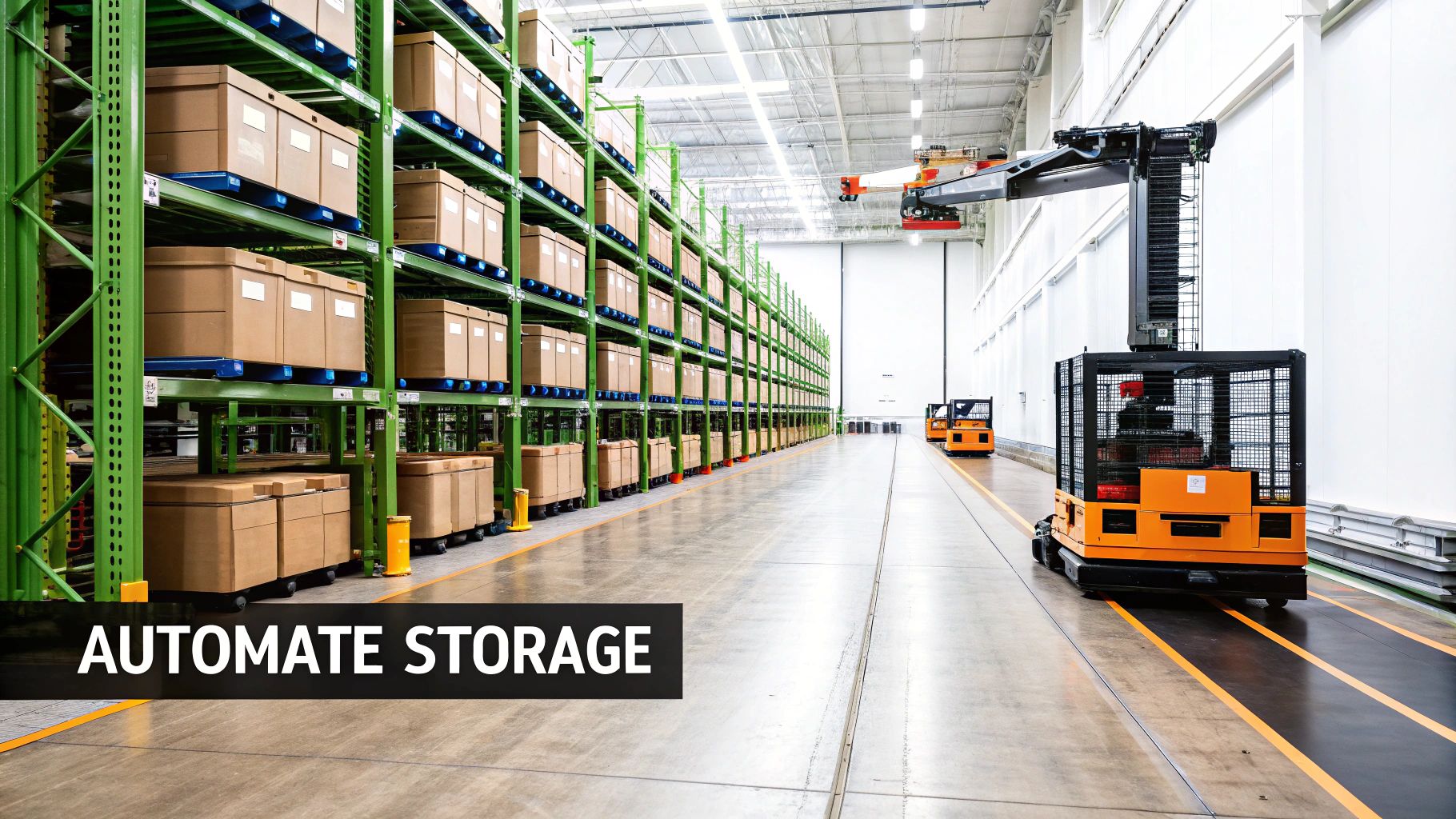
This kind of strategic automation directly tackles your biggest space problems. It condenses your storage footprint, freeing up that precious floor space for other critical activities like packing, kitting, or shipping.
Making Automation Work for You
Automation isn't an all-or-nothing deal. The real secret is finding the right tool for your specific problem. You can start small with high-impact solutions and scale up as you grow.
For example, Autonomous Mobile Robots (AMRs) are a fantastic, flexible starting point. These smart little robots navigate your warehouse on their own, moving pallets, carts, or bins exactly where they need to go. By handing over this task to AMRs, you shrink the need for wide, open lanes dedicated to forklift and pallet jack traffic. This lets you tighten up your layout and reclaim that floor space for something more productive.
Even simpler upgrades can make a world of difference:
- Smart Conveyor Systems: These can automatically shuttle goods between different zones—like from receiving to putaway—slashing the foot traffic and bottlenecks that clog up your aisles.
- Automated Sortation Tech: This technology can rapidly sort packages for outbound shipping, drastically reducing the space and manpower needed for manual sorting and staging.
The goal isn't just to add robots for the sake of it. It's about strategically using technology to save space, improve accuracy, and crank up your throughput. Find your biggest headache and start right there.
The Real-World Impact of Automated Systems
The benefits here aren't just on paper; they show up in real, measurable improvements. We've seen companies that embrace automation report stunning efficiency gains that directly translate to better space utilization. They can suddenly handle way more volume without having to knock down a single wall.
For instance, facilities that have successfully integrated these systems have seen a 50% drop in facility congestion during their busiest seasons and a 30% boost in units processed per hour. By using smart systems to optimize slotting and batching, some have even achieved an 81.8% decrease in aisle visits. You can discover more about the impact of warehouse automation and see how these numbers play out. It’s clear: automation creates a smoother, faster, and more spacious warehouse.
Prepping Your Space for Automation
Before you can roll out the robots, your facility has to be ready for them. Automation thrives in a clean, organized, and predictable environment. Any lingering clutter, old equipment, or random obstacles have got to go.
A final, top-to-bottom cleanout is often the first critical step in any successful automation project. This is especially true if you're a property manager overseeing a major upgrade or an operator planning a phased rollout. You need your floors clear and your layout set up exactly as planned—it's non-negotiable.
If you’re facing a mountain of old racking, retired machinery, or other industrial junk, bringing in a professional crew is the smart move. You can easily contact Fulton Junk Removal to schedule a cleanout that fits right into your project timeline. Starting with a truly clean slate ensures your new automated systems can operate safely and hit the ground running from day one.
Common Questions on Warehouse Optimization
When warehouse managers, business owners, and property managers start looking at optimizing their space, a few key questions always come up. Here are the straightforward answers we share based on years of experience.
What's the Single Most Important First Step?
Without a doubt, the best place to start is with a data-driven audit followed by a serious cleanout. You simply can't optimize a space that’s bogged down by obsolete inventory, broken equipment, or inefficient racking. It’s like trying to redesign a kitchen before you've taken out the trash.
First, dig into your inventory data. Pinpoint the dead stock and slow-movers that are hogging your most valuable real estate. Once you’ve identified what needs to go, a commercial service like Fulton Junk Removal can take it from there. We handle the entire removal process, from old machinery to pallets of unsellable products. Creating that clean slate is the essential groundwork for any successful layout redesign.
How Can I Get More Storage Capacity Without Expanding?
Look up. The key is to think vertically. Most warehouses have a massive amount of unused overhead space, and tapping into it is the fastest way to boost capacity without a costly expansion project.
Here are a few powerful strategies to maximize your cubic footage:
- Go Taller with Racking: The most direct approach. Investing in taller pallet racking systems lets you use the full height of your facility.
- Install a Mezzanine: This basically creates a second floor within your existing footprint. It's perfect for light storage, picking operations, or even adding some small offices.
- Bring in Vertical Lift Modules (VLMs): For dense storage of small parts or high-value items, VLMs are incredible. They bring the items right to the operator, saving a ton of space and improving ergonomics.
- Re-evaluate Aisle Widths: Can you go narrower? Switching to narrow-aisle (VNA) forklifts allows you to squeeze in more rows of racking without needing more square footage.
Is a Warehouse Management System Really Necessary?
If you want to achieve and maintain a high level of optimization, then yes, absolutely. A Warehouse Management System (WMS) is the brain of the operation. It gives you the real-time data and logic needed to manage inventory placement, ensure proper stock rotation (like FIFO), and create the most efficient picking paths for your team.
Without a WMS, even the most brilliant layout will slowly drift back into chaos. Human error, shifting inventory needs, and seasonal demand swings can quickly undo all your hard work.
A great layout is the hardware, but the WMS is the software that makes it run. One can't hit its full potential without the other. It’s the system that locks in your gains for the long haul.
How Should I Handle All the Debris from a Big Reconfiguration?
When you start tearing out old racking, machinery, and other infrastructure, you need a partner who gets both junk removal and responsible disposal. This is a common hurdle for offices, warehouses, and property managers taking on these kinds of projects.
Instead of just hauling everything to a landfill, Fulton Junk Removal works directly with our parent company, Beyond Surplus, to make sure everything is handled responsibly. We focus on diverting materials like metals and electronics from landfills, ensuring they get repurposed or recycled correctly. This approach not only gets your space clear but also makes sustainability compliance and reporting a whole lot easier for your business.
How Do I Actually Measure the ROI of an Optimization Project?
To see the real return on investment (ROI), you have to track key performance indicators (KPIs) before and after the project. This data gives you the hard numbers to prove the financial impact.
We recommend focusing on these core metrics:
- Increased Storage Capacity: Calculate the new total cubic feet of usable storage you’ve gained.
- Improved Labor Productivity: Track the change in units picked or orders fulfilled per hour, per employee.
- Reduced Order Fulfillment Time: Measure the average time from when an order is received to when it ships. How much faster is your process now?
- Cost Avoidance: This is often the biggest win. Tally up the money you didn't have to spend on leasing or building a new facility.
By putting numbers to these improvements, you can clearly show the financial and operational benefits of your investment in warehouse space optimization.
Ready to reclaim your warehouse floor and pave the way for a more efficient layout? Fulton Junk Removal provides fast, reliable, and eco-conscious commercial cleanout services for warehouses, offices, and property managers. We work with our partner, Beyond Surplus, to ensure your old equipment, e-waste, and other materials are recycled responsibly.
Get a free, no-obligation estimate today and see how we can help you create a clean slate for your optimization project. Visit us at https://fultonjunkremoval.com.
