
Managed Telecom Services Near Me: A Local Buyer’s Guide
A lot of searches for managed telecom services near me start after a rough week.
A warehouse supervisor can't reach drivers because calls keep dropping between the office phone system and mobile devices. A property manager has three sites, two internet vendors, one aging phone contract, and no clear answer on who owns the problem when tenant calls fail. An operations lead adds another location and discovers that every site has a different setup, different invoice, and different support number.
That's when telecom stops being “IT stuff” and becomes an operations problem. If crews can't coordinate, trucks sit. If site managers can't send photos, confirm arrivals, or update work orders in real time, delays spread through the day like a missed pickup on a tight route.
The right managed telecom partner doesn't just sell lines and handsets. They reduce noise, simplify accountability, and keep communication moving across offices, warehouses, mobile teams, and vendors.
Are Communication Headaches Slowing Your Business Down
A common pattern shows up in physical operations. The phones work fine until dispatch gets busy. Internet performance looks acceptable until multiple sites upload files at once. Mobile apps behave until crews move between buildings, parking lots, and job sites. Then the cracks appear.
A facilities team may think they have separate problems. Choppy voice calls, slow cloud access, missed messages, and finger-pointing between internet and phone providers. In reality, they often have one problem. Nobody is managing communications as a single operating system.

When small failures become expensive
Think about a day with field crews. A dispatcher calls a technician. The call clips. The technician texts back. The message arrives late. A customer update doesn't hit the system. The next stop gets pushed. By lunch, nobody trusts the tools, so people start using personal phones, side chats, and workarounds.
That's not a telecom issue in the narrow sense. It's a coordination issue. Teams dealing with addressing workplace communication friction usually find that process and technology are tangled together.
Poor communication infrastructure acts like a jammed loading dock. The work is still there, but everything backs up around one blocked point.
This is one reason managed telecom keeps expanding. The global telecom managed services market was valued at USD 20.67 billion in 2022 and is projected to reach USD 55.29 billion by 2030, with a 13.4% CAGR. North America held over 35.0% of revenue in 2022, reflecting how many businesses are using these services to streamline operations, according to Grand View Research's telecom managed services analysis.
What local buyers are usually asking
When someone searches for managed telecom services near them, they're rarely asking for a product catalog. They're asking practical questions like these:
- Who can own the whole mess: internet circuits, phones, mobile connectivity, support tickets, and vendor coordination.
- Who can support multiple sites: without building a different workaround at every location.
- Who answers during live disruption: not after the crew is already idle.
- Who can scale cleanly: when a business adds locations, vehicles, devices, or temporary project space.
A good provider turns telecom from a patchwork into a managed utility. One point of contact. One service model. Fewer moving parts.
Understanding Managed Telecom Services
Managed telecom services are outsourced management of the systems your business relies on to communicate and stay connected. That usually includes internet access, voice systems, network performance, carrier coordination, support, and often security and mobile device oversight.
The simplest way to think about it is this. You can run your own cleanup project with rented trucks, separate disposal vendors, and your own sorting crew. Or you can hire one partner to handle pickup, routing, recycling, documentation, and problem resolution. Telecom works the same way.
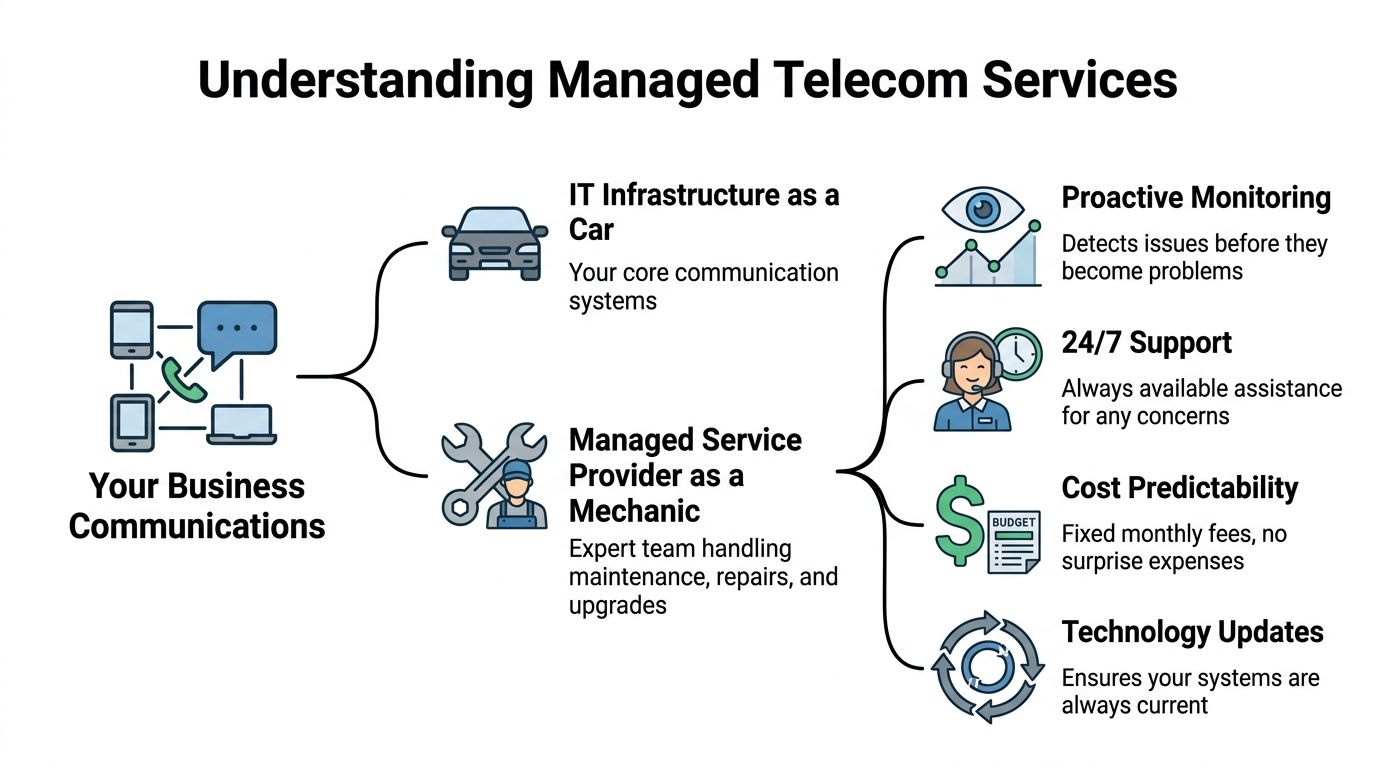
One provider, one chain of custody
Businesses often buy telecom in pieces. One carrier for internet. Another for voice. Someone else for wireless. A local IT company handles tickets. A consultant steps in when a contract renews. That setup can work for a while, but it breaks down under pressure because responsibility is fragmented.
A managed telecom provider pulls those pieces under one operating model. They don't just resell service. They monitor, coordinate, troubleshoot, escalate, and help plan upgrades.
That matters because most businesses don't fail on the design diagram. They fail in the handoff between vendors.
What this looks like in practice
A managed telecom arrangement usually includes a few core responsibilities:
- Carrier management: The provider works with internet and voice carriers so your team doesn't spend half a day opening duplicate tickets.
- Service oversight: They watch circuit health, call quality, and recurring issues before users flood the help desk.
- Change management: Moves, adds, and site changes go through a repeatable process instead of ad hoc emails.
- Support accountability: Users know who to call, and leadership knows who owns resolution.
Practical rule: If you still have to coordinate three vendors yourself during an outage, you probably don't have managed telecom. You have outsourced fragments.
What managed doesn't mean
Managed telecom doesn't mean you give up control. It means you stop carrying the maintenance burden in-house.
It also doesn't mean every provider does the same thing. Some focus on carrier brokerage and billing. Others go deeper into SD-WAN, UCaaS, mobile fleet support, and circuit lifecycle management. That's why buyers need to read proposals carefully. “Managed” can mean full operational ownership, or it can mean a very light support layer over basic services.
The better analogy is a fleet mechanic, not a parts store. You don't hire them because you want more invoices. You hire them because the vehicles need to stay on the road.
Whats Included in a Managed Telecom Plan
A solid managed telecom plan should match how the business operates. For a warehouse, that may mean stable connectivity between offices, handheld devices, and cloud systems. For a property management group, it may mean dependable calling, quick site turnups, and clear escalation when a building loses service. For commercial field teams, it usually means voice, mobile app reliability, and support that understands moving crews.

Core services that do the heavy lifting
Most plans revolve around a handful of components.
| Service area | What it does | Why operators care |
|---|---|---|
| UCaaS | Combines calling, voicemail, messaging, and collaboration tools | Staff can communicate across office and field without juggling disconnected systems |
| Internet and circuit management | Procures and manages connectivity across sites | Reduces the hassle of dealing with multiple carriers and renewals |
| SD-WAN | Routes traffic intelligently across available connections | Helps voice and business apps stay usable when one path degrades |
| Security services | Adds monitoring, policy control, and protection around communications | Lowers risk from weak points spread across sites and devices |
| Mobile device management | Oversees company phones and tablets | Useful when teams depend on issued devices for work orders, dispatch, and photos |
| Monitoring and support | Tracks service health and handles incidents | Problems get addressed before every user reports them separately |
Why SD-WAN gets so much attention
For multi-site businesses, SD-WAN is often the difference between “the internet is technically up” and “the business can operate.”
Managed services using SD-WAN can deliver up to 30x faster convergence with failover under 50ms compared with traditional routing that can take 30 to 120 seconds. They can also reduce packet loss by 70% and cut WAN costs by 40% to 60%, according to this SD-WAN overview from Alamo Telecom.
Those numbers matter because voice and mobile workflows are sensitive to delay and packet loss. A field app doesn't need perfection. It needs consistency. Dispatch calls, digital signatures, image uploads, and route updates all depend on the network recovering fast when conditions change.
A good way to explain SD-WAN to nontechnical managers is this. It works like a smart traffic controller for your data. If one lane clogs up, it reroutes the important vehicles first.
Features buyers often overlook
A proposal can look impressive and still miss operational basics. Ask whether the plan includes things like:
- Moves and changes support: New users, new sites, and device changes should follow a documented process.
- Escalation management: Someone should own carrier follow-up when the root cause sits outside your building.
- Performance reporting: Leadership needs more than “ticket closed.” They need enough visibility to spot recurring issues.
- Site standardization: A provider should help make Site A and Site B look more alike, not less.
What works and what doesn't
What works is matching service scope to operating reality. A business with one office and no field staff doesn't need the same design as a company with warehouses, gate systems, roaming supervisors, and mobile crews.
What doesn't work is buying features because they sound advanced. Plenty of teams pay for collaboration tools nobody adopts, or they leave mobile devices unmanaged even though the workforce depends on them every day. The practical test is simple. If a service doesn't improve communication, resilience, or accountability, it's probably decoration.
Key Benefits for Operations and Facility Managers
The biggest benefit of managed telecom isn't technical elegance. It's operational control.
Operations and facility leaders already manage enough moving parts. Vendors, contractors, schedules, occupancy changes, access issues, and compliance tasks. Telecom becomes painful when it adds hidden labor. Staff chase outages, compare bills, reopen tickets, and try to translate technical answers into business impact.
Predictability beats firefighting
A good managed arrangement shifts telecom from surprise project work into a predictable service model. That matters for smaller and midsize businesses that need enterprise-grade support without building a large internal telecom function.
The SME segment is projected to post the highest CAGR of 13.5% in 2024, and the broader market is projected to grow from USD 28.38 billion in 2025 to USD 66.34 billion by 2032, according to Fortune Business Insights on telecom managed services. That growth tracks with what many operators already know firsthand. They need to cut IT complexity without losing service reliability.
Benefits that show up on the ground
Here's where managed telecom usually pays off:
- Fewer vendor loops: One provider coordinates carriers, equipment issues, and service changes.
- Cleaner budgeting: Monthly service costs are easier to plan than surprise troubleshooting projects and emergency replacements.
- Faster scaling: New sites, temporary spaces, and added users can be turned up through a known process.
- Better uptime discipline: Problems are watched continuously instead of waiting for end users to complain.
A facilities manager may not care what transport method carries a voice session. They care that the leasing office can answer calls during a move-in surge. A warehouse manager cares that handhelds and office systems stay in sync. Managed telecom aligns support around those outcomes.
The single point of contact matters more than most buyers expect
The strongest operational advantage is often the least flashy. One accountable contact changes the speed of decision-making.
Without that, every outage becomes a scavenger hunt. Internet carrier says the phone system is fine. Phone vendor says the local network is unstable. Internal IT says the issue is upstream. Meanwhile, site staff keep improvising.
When communication tools fail, teams don't stop working. They switch to manual workarounds. That's exactly why telecom problems can hide for months while productivity quietly erodes.
Managed telecom won't remove every outage or every service dependency. What it does is shorten the chain between issue and action. For operations teams, that's usually the difference between a contained disruption and a whole day lost to confusion.
What to Look for in Service Level Agreements
The proposal may sound polished. The service level agreement, or SLA, tells you whether the provider is willing to stand behind it.
Buyers should slow down. Many contracts look broad and reassuring until an outage happens. Then you learn that “support” means email only, “coverage” excludes a key circuit type, or response time starts only after the provider confirms the issue their way.
Read the migration language carefully
If your business still has legacy circuits or older voice infrastructure, migration terms deserve close attention. The handoff from older connectivity to newer fiber or ethernet service is where many avoidable outages happen.
According to Managed Telecom Services on circuit migration, expert-led circuit migrations can reduce downtime to less than 4 hours through hitless cutover techniques. The same source notes that poorly managed migrations can cause 20% to 30% call drops in VoIP handoffs, while successful execution supports 99.999% availability. It also notes that revenue loss for SMBs can average $5,000 per minute during outages.
That doesn't mean every business faces the same loss profile. It does mean migration quality isn't a side issue. It's contract-level risk.
Clauses worth reviewing before you sign
Use this checklist when reviewing the SLA:
- Response time definition: Does the clock start when you submit the ticket, or when the provider accepts that the issue qualifies?
- Resolution targets: Response is not resolution. Look for realistic commitments on both.
- Escalation path: Named escalation tiers beat vague “best effort” language.
- Maintenance windows: Planned downtime should be disclosed clearly, especially for sites with after-hours operations.
- Third-party carrier responsibility: If the provider uses underlying carriers, the SLA should say who owns updates and coordination.
A simple way to compare proposals
| Contract area | Strong sign | Weak sign |
|---|---|---|
| Support coverage | Clear hours, channels, and severity levels | Generic “24/7 support” with no definitions |
| Migration planning | Documented cutover process and rollback plan | Assumes the change will be routine |
| Uptime commitment | Specific service scope tied to named services | Broad promise with exclusions buried later |
| Reporting | Regular service reviews and incident summaries | Ticket portal only |
Don't judge an SLA by the marketing page. Judge it by what happens during a circuit cutover, a voice quality complaint, or a multi-site outage.
Pricing red flags to watch
Pricing problems usually show up in the gaps between line items. A low monthly rate can hide one-time setup fees, change-order charges, or expensive add-ons for support levels you assumed were included.
Ask for pricing in the form your business uses. Per-user can work well for office-heavy teams. Per-site can make more sense for distributed operations. Neither is automatically better. The key is whether the billing model matches how labor, devices, and locations change over time.
A Checklist for Vetting Local Telecom Providers
Local matters more than many buyers think. Not because every provider needs a truck in your parking lot, but because your business environment is specific. Building types, carrier options, suburban service gaps, construction timelines, and support expectations vary by region.
That's especially true outside the densest urban core, where a polished website may hide thin operational coverage.
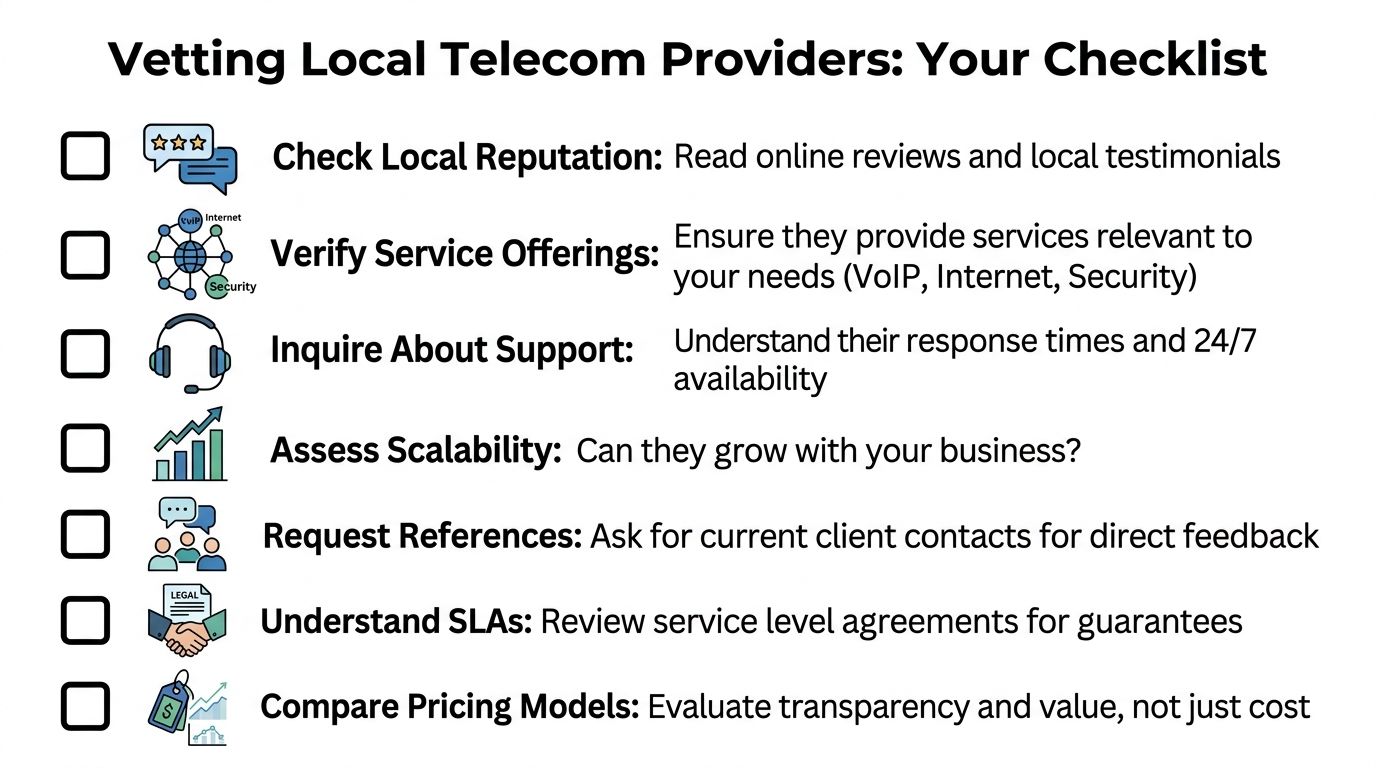
Why local vetting matters
A 2025 Gartner report notes that 62% of SMBs in the U.S. Southeast struggle with telecom service silos. It also notes that businesses in rural-adjacent suburbs can see 18% higher latency for integrated IoT, pushing 40% of operations managers toward DIY solutions that increase downtime by 15%, as cited on Clutch's Georgia MSP page.
That combination is familiar. Businesses near a major metro still get treated like edge cases. They're close enough to be sold enterprise expectations, but not always close enough to receive disciplined implementation.
A practical vetting process
Use a staged approach instead of relying on one demo call.
Map your operating reality first
List your sites, mobile users, critical apps, current carriers, renewal dates, and recurring pain points. Include practical details like after-hours staffing, gate systems, and temporary project locations.Search locally, then narrow hard
When you search for managed telecom services near me, ignore generic promises. Look for evidence of multi-site support, field-team experience, and carrier coordination.Ask support questions early
If you need a frame for comparing support models, this IT support guide is useful because it clarifies the difference between basic ticket handling and broader service management.Request industry-adjacent references
You don't need a provider who serves your exact niche. You do need one that understands dispatch, facilities workflows, warehousing, or distributed operations.
Questions worth asking in the first serious meeting
- How do you handle multi-vendor issues: Who owns carrier escalation when the root cause is unclear?
- What happens when we open a new site: Ask for the actual process, not the sales version.
- How do you support mobile-heavy teams: Voice quality and device management matter more when work happens outside the office.
- How do you standardize locations: A mature provider should reduce variation over time.
- What reporting do we get: You want operational visibility, not just invoice access.
Signs you've found the right fit
The best local providers usually do three things well. They ask sharp questions about your workflows. They admit trade-offs instead of pretending every option is perfect. And they talk about service transitions, not just product bundles.
If the conversation stays focused on speeds, seats, and hardware, keep digging. Good telecom partners ask how your sites operate when things get messy.
A local buyer's guide really comes down to this. You're not hiring a line provider. You're hiring an operating partner that can keep communication reliable when your business is moving fast.
Taking Control of Your Business Communications
Managed telecom works best when you treat it like operational infrastructure, not just another utility bill. The right provider reduces vendor sprawl, supports field teams, stabilizes multi-site communication, and gives leadership one accountable path for service issues.
That matters even more as communication decisions start touching compliance and sustainability work. According to Bandwidth Team's writeup on managed IT and telecom service gaps, telecom networks contribute 2% to 3% of U.S. business emissions, yet only 12% of Southeast MSPs offer analytics that support sustainability reporting. For facilities managers and EHS leaders, that creates a real gap when communication systems need to align with reporting and certification goals.
A strong telecom partner doesn't just keep calls connected. They help the business document, standardize, and improve how communication infrastructure is used across sites. That's a different level of value.
If you're evaluating managed telecom services near me, the smart move is simple. Buy for accountability, operational fit, and service depth. The technology matters, but the handoffs matter more.
If your team is also dealing with office cleanouts, warehouse turnover, site prep, or responsible recycling, Fulton Junk Removal can help simplify the physical side of operations. They support Atlanta-area businesses with fast cleanouts, transparent service, and environmentally responsible disposal through Beyond Surplus, which makes recycling and diversion reporting easier for offices, warehouses, and property managers.
