
How to Dispose of Construction Waste Responsibly
Every construction or renovation project, big or small, leaves behind a trail of debris. We’re talking about massive piles of concrete, twisted metal, and splintered wood. A smart disposal plan isn't just an afterthought—it's about sorting materials on-site, isolating hazardous waste, prioritizing recycling, and partnering with a professional service that gets it done right. This guide is for businesses and property managers ready to adopt a smarter approach to waste management.
Your Guide to Smart Construction Waste Disposal
Let's be honest: the real challenge isn’t just clearing the site. It’s handling all that debris legally, sustainably, and without blowing your budget. Moving away from the old ‘haul-it-all-to-the-landfill’ mindset to a more circular model doesn’t just help the environment; it builds your company’s reputation and can even improve your bottom line. Think of waste disposal as a critical part of your project's success, not just the final cleanup.
The scale of this issue is staggering. According to the Environmental Protection Agency (EPA), construction and demolition projects generated nearly 145 million tons of landfill debris in 2018 alone. Even more shocking, some estimates suggest that as much as 30% of building materials delivered to a typical job site end up as waste. That's a huge inefficiency.
Shifting to a Circular Model
For offices, warehouses, and property management firms, the old way of dealing with debris just doesn't cut it anymore. A modern strategy focuses on diverting as much material as possible from local landfills. This isn't just about being green; it's about being smart.
A forward-thinking model involves:
- Recycling and Repurposing: While most junk removal companies take everything to the landfill, we recycle through Beyond Surplus to minimize waste and maximize reuse. Fulton Junk Removal works hand-in-hand with Beyond Surplus to recycle electronics, metals, and other materials responsibly, ensuring they’re repurposed or recycled.
- Improving Compliance: Proper disposal and recycling make compliance and sustainability reporting easier. Fulton handles junk removal, and Beyond Surplus ensures responsible recycling, providing clear documentation to help you meet standards and boost your company’s green credentials.
- Bundled Services: An integrated approach combines general junk removal with certified recycling. Fulton can offer bundled junk removal + recycling pickup, where all electronic waste and recyclable materials are directly processed by Beyond Surplus, dramatically simplifying logistics for your team.
Adopting a circular approach to construction waste transforms a logistical headache into a competitive advantage. It demonstrates a clear commitment to corporate responsibility, which appeals to environmentally conscious homeowners and businesses.
Ultimately, how you handle waste is a key performance indicator for a well-run project. It reflects your company’s efficiency, its dedication to sustainability, and its ability to manage complex logistics. For those looking to dive deeper, our blog offers further guidance on responsible junk removal practices. By rethinking how we handle debris, we can turn a project's biggest byproduct into a valuable asset.
Setting Up Your Site for Efficient Sorting
Smart waste management starts long before a single piece of debris is hauled away. In fact, how you organize your worksite from day one is your biggest tool for cost-effective, compliant disposal. It’s what turns a potential headache into a streamlined process.
This isn't just theory—it’s about creating a practical system for sorting materials right as they’re generated, whether you're on a commercial job or a home renovation. A little forethought here prevents costly fines, keeps workers safe, and makes the final cleanup incredibly smooth.
This simple flow chart breaks down the core of any good on-site waste plan.
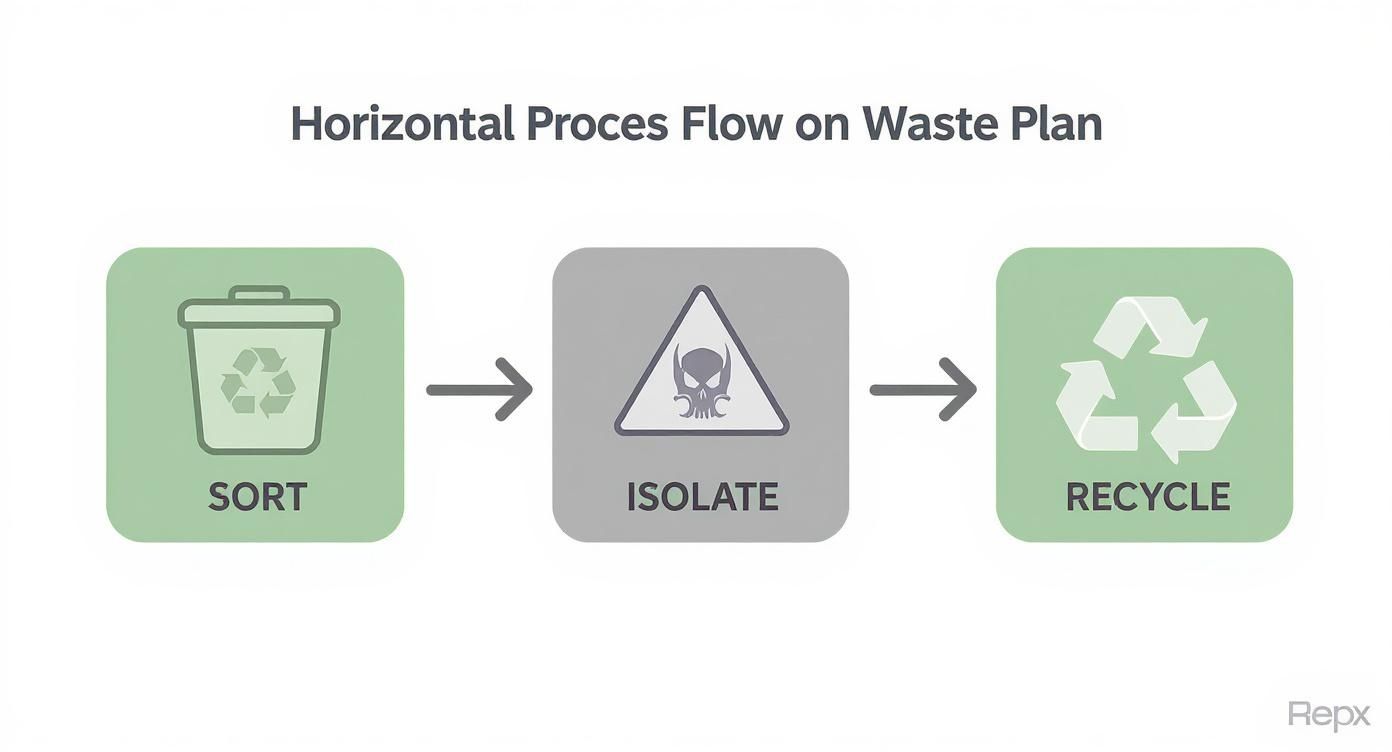
From sorting to isolating the bad stuff and recycling the good, this is the backbone of doing it right.
Designate Clear Sorting Zones
This is the most critical move you can make. Set up distinct, clearly marked areas for the common types of debris you’ll be creating. Tossing everything into one big pile is the fastest way to guarantee it all ends up in a landfill, often at a premium price.
By separating materials as they come off the structure, you immediately unlock their recycling potential.
For a typical renovation, you’ll likely have piles for:
- Clean Wood: Untreated lumber, offcuts, and pallets can be turned into mulch or biomass fuel.
- Scrap Metal: Think steel studs, copper pipes, and aluminum siding. These materials have real recycling value.
- Concrete & Masonry: Broken concrete, bricks, and blocks get crushed and reused as aggregate in new projects.
- Drywall (Gypsum): As long as it stays clean and dry, drywall can be recycled into new wallboard or even used as a soil amendment.
Set up labeled bins or just create designated, sectioned-off piles. This simple act of organization pays for itself by slashing landfill fees and feeding into a circular economy. And when you're planning a site where heavy machinery will be moving these materials, always follow strict forklift safety guidelines to protect your crew.
Identify and Isolate Hazardous Materials
Not all debris is created equal. Some materials are downright dangerous to the environment and people’s health, and they demand special handling. Your on-site plan absolutely must include a clear protocol for spotting and safely setting these items aside.
Never mix hazardous waste with your general construction debris. The penalties are severe, it contaminates recyclable materials, and it creates dangerous conditions for anyone handling the waste down the line. Isolate these items immediately and call in certified experts.
Common hazardous materials you’ll run into on job sites include:
- Asbestos-Containing Materials (ACMs): Still found in older insulation, flooring, and siding. This is a job for certified professionals only.
- Lead-Based Paint: Anything coated with lead paint has to be managed according to EPA rules to prevent toxic dust exposure.
- Chemicals and Solvents: Leftover paints, adhesives, sealants, and cleaners must go to designated hazardous waste facilities.
- Electronics (E-waste): Old thermostats, light fixtures, and office gear contain heavy metals and are banned from landfills.
For businesses and property managers, navigating these rules is non-negotiable. Partnering with a service that gets it is key. Fulton Junk Removal offers specialized commercial junk removal services that cover the proper handling of these complex waste streams. Through our partnership with Beyond Surplus, we also ensure e-waste and other recyclables are processed responsibly, simplifying your compliance and sustainability goals from the get-go.
Finding Sustainable Alternatives to the Landfill
These days, responsible construction waste disposal means looking way beyond the nearest dump. For contractors, property managers, and businesses, the real goal is to divert as much debris as possible from our landfills. It’s not just about being green—it's a smart business move that can save you money and build a better brand.
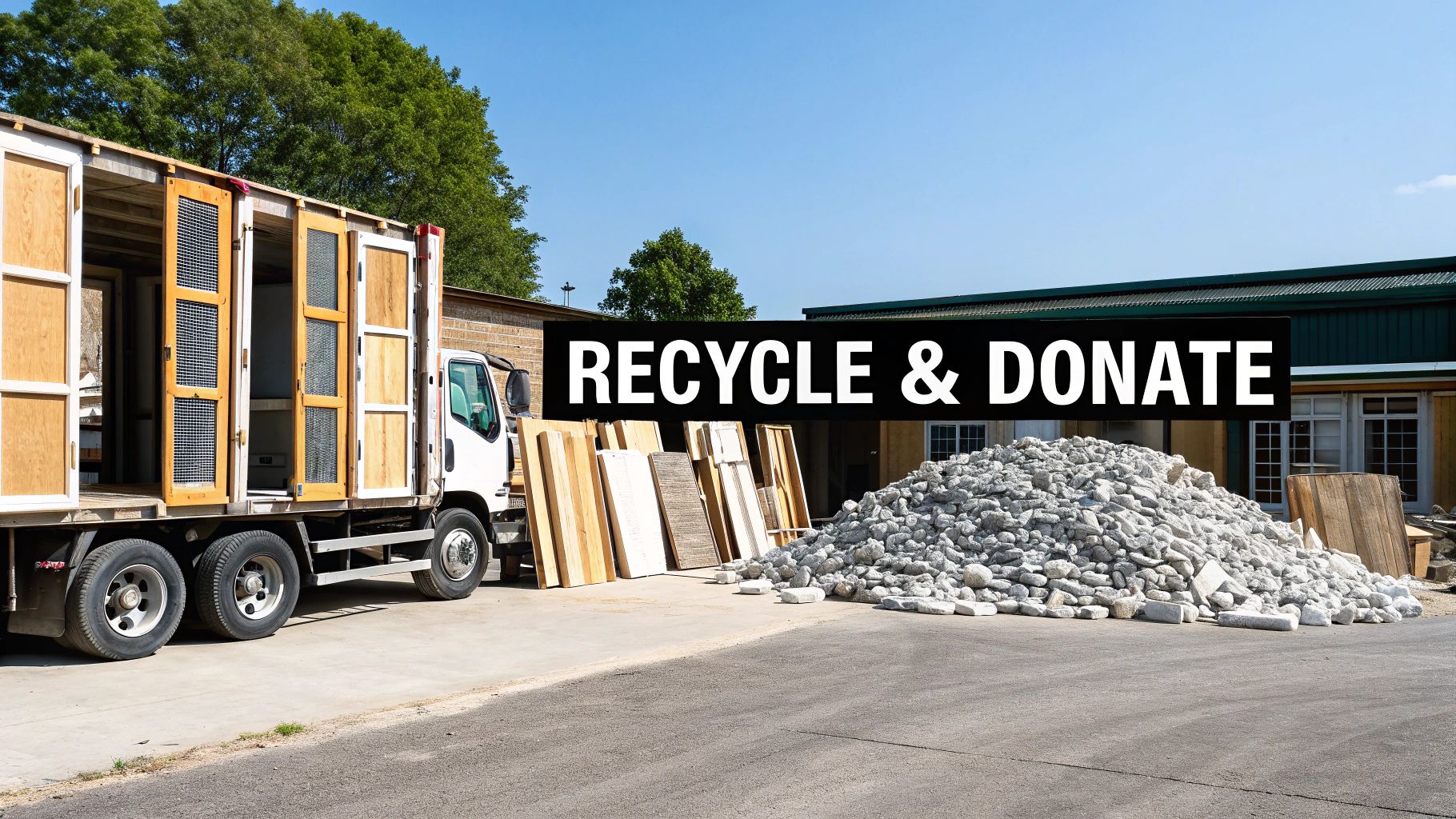
The modern playbook for waste management is all about the circular economy. Instead of the old "take, make, waste" model, we focus on keeping materials in use for as long as we can. This means turning potential trash into a valuable resource through smart recycling and donation.
Partnering with C&D Recycling Centers
Your first and best alternative to the landfill is a specialized Construction and Demolition (C&D) recycling facility. These places are built to handle the heavy, bulky materials that come off a job site, turning them back into raw materials for new projects.
It's amazing how much can actually be recycled. Many people don't realize the potential:
- Crushed Concrete and Asphalt: These get processed into aggregate for new roadbeds, foundations, and other construction projects.
- Clean Wood: Untreated lumber and old pallets can be chipped for mulch, compost, or even biomass fuel.
- Scrap Metals: Steel, aluminum, and copper are highly valuable and can be recycled over and over without losing quality.
When you're checking out a local recycling center, be sure to ask about what they accept, their sorting rules, and tipping fees. You’ll often find that bringing them pre-sorted materials will seriously lower your disposal costs. Some facilities might even pay you for valuable scrap metal, flipping a disposal expense into a small revenue stream.
The Power of Donation and Salvage
Not everything pulled out of a renovation is junk. So many items are perfectly usable and can find a second life through donation, which helps out the community while keeping good stuff out of the landfill. This is the circular economy in action.
Before you just toss these items, think about donating them to local organizations:
- Fixtures and Appliances: Sinks, toilets, light fixtures, and working appliances are gold to places like Habitat for Humanity ReStore.
- Doors and Windows: If they're still intact, doors and windows can be salvaged and reused in other building projects.
- Cabinets: Kitchen and bathroom cabinetry in decent shape is a hot item for anyone doing a budget-friendly renovation.
A simple but super effective tip: keep a running list of local donation centers and what they accept. It's a total win-win—you cut down your disposal volume, support a local cause, and you can often get a tax deduction for your contribution.
Tracking Diversion for Sustainability Reporting
For offices, warehouses, and property management firms, just saying you’re eco-friendly doesn't cut it anymore. You have to prove it. This is where waste diversion tracking comes in.
Your diversion rate is the percentage of waste that you successfully recycled or repurposed instead of sending to the landfill. It’s a key metric for any business that's serious about its environmental impact.
The construction industry generates a staggering amount of waste globally—over two billion tonnes a year. But there’s good news: about 93% of construction waste is already recovered or reused, and steel recycling rates are at an incredible 98%. Tracking how your own project contributes to this is vital for sustainability reporting. You can learn more from this eye-opening report on construction waste facts from BusinessWaste.co.uk.
This is where having a professional partner changes the game. While most junk removal companies take everything to the landfill, a service like Fulton Junk Removal operates differently. We work hand-in-hand with Beyond Surplus, our parent company, to recycle electronics, metals, and other materials responsibly.
This unique setup allows us to offer bundled junk removal + recycling pickup, where all electronic waste and recyclable materials are directly processed by Beyond Surplus. To see how our integrated approach can make your life easier, you can explore the Fulton Junk Removal and Beyond Surplus mission. We provide the detailed diversion reports you need to make compliance and sustainability reporting easier.
Choosing The Right Waste Management Partner
For most commercial operations, the cleanup after a construction or renovation project is a huge logistical headache. It eats up valuable time, ties up your staff, and if you get it wrong, you could be facing compliance fines and surprise costs. This is where a strategic waste management partner isn't just another vendor—they become an extension of your team.
The right partner does more than just haul junk away. They help you turn a messy waste stream into a managed asset. Choosing a service with a circular, eco-friendly model gives you a real competitive advantage, moving you beyond the old-school "take it to the dump" mindset. Instead, you focus on maximizing the value of your debris through recycling and repurposing—a powerful shift that aligns your business needs with modern corporate responsibility.

Beyond Hauling: The Value of an Integrated Model
Let’s be honest, nobody wants to coordinate with separate haulers, recyclers, and hazardous waste specialists. An integrated waste management model gives you a single, streamlined solution for a complex problem. This is a game-changer for property managers, office administrators, and warehouse operators who are already juggling a dozen other responsibilities.
That’s the exact philosophy behind the partnership between Fulton Junk Removal and our parent company, Beyond Surplus. Fulton handles the hands-on junk removal—the cleanouts, the heavy lifting, and the logistics. Behind the scenes, Beyond Surplus, a certified materials recycler, makes sure everything is processed responsibly.
This unique setup means we can offer bundled junk removal and recycling pickups. Imagine clearing out an office after a renovation. Instead of one dumpster for drywall and another complicated plan for old electronics, we handle it all in one go.
A true waste management partner simplifies your operations. Fulton handles junk removal, and Beyond Surplus ensures responsible recycling, making compliance and sustainability reporting easier with a single point of contact.
Why a Circular Solution Matters for Your Business
For our commercial clients, the benefits of this circular model go way beyond just earning environmental brownie points. It has real, tangible impacts on your efficiency, brand reputation, and bottom line. A partner committed to diverting waste from landfills helps you meet sustainability targets, which is becoming more and more important for attracting tenants, satisfying investors, and building a positive public image.
Here are the core advantages we see every day:
- Simplified Compliance: Let's face it, navigating local and federal disposal regulations can feel like a full-time job. A knowledgeable partner keeps you compliant, especially with tricky items like e-waste that are often banned from landfills.
- Effortless Sustainability Reporting: You can't just say you're green; you have to prove it. An eco-friendly partner like Fulton Junk Removal provides detailed diversion reports, showing you exactly how much of your waste was recycled or repurposed. This documentation is invaluable for ESG (Environmental, Social, and Governance) reports.
- Enhanced Brand Reputation: Showing a real commitment to responsible disposal resonates with today's environmentally conscious consumers and business partners. It proves you're a forward-thinking organization that takes its corporate responsibilities seriously.
- Operational Efficiency: One call, one invoice, and one point of contact. This saves a massive amount of administrative time and frees up your team to focus on their actual jobs instead of wrestling with waste logistics.
Ready to see how an integrated model can benefit your next project? Contact our team at Fulton Junk Removal for a free estimate and a disposal plan built around your needs.
Fulton Junk Removal vs Traditional Landfill Services
To really see the difference, it helps to compare the standard approach with our circular model. For offices, warehouses, and property managers, the choice you make directly impacts your operational workflow and sustainability goals.
The table below breaks it down.
| Feature | Traditional Junk Hauler | Fulton Junk Removal (with Beyond Surplus) |
|---|---|---|
| Primary Goal | Haul debris to the nearest landfill as quickly as possible. | Divert the maximum amount of waste from landfills through recycling and repurposing. |
| Material Handling | Mixes all debris together, making recycling nearly impossible. | Sorts materials to isolate recyclables (metals, e-waste, wood) for proper processing. |
| Service Scope | Basic hauling. Often requires separate vendors for e-waste or hazmat. | Bundled junk removal and certified recycling, providing a single-source solution. |
| Compliance & Reporting | Provides a basic invoice. No detailed tracking of what happens to your waste. | Offers detailed diversion reports for easy compliance and sustainability tracking. |
| Environmental Impact | High landfill contribution, minimal resource recovery. | Significantly reduces landfill waste and supports a circular economy. |
Ultimately, choosing the right partner is about finding a service that aligns with your business goals. If efficiency, compliance, and corporate responsibility are priorities, then a circular, eco-friendly solution is the only logical choice. It turns a necessary expense into a smart investment in your company's future.
Navigating Disposal Costs and Compliance
Let’s be honest—a successful renovation project lives and dies by its budget. And one line item you absolutely can't afford to overlook is waste disposal. Getting a handle on what drives these costs, from dumpster rentals and landfill fees to the price of a full-service junk removal crew, is non-negotiable.
But money is only half the story. The other, equally critical part is compliance. You have to play by the rules. Getting both your budget and your legal ducks in a row protects your bottom line, sure, but it also protects your reputation. Skimp on either, and you're setting yourself up for surprise costs and legal headaches nobody wants to deal with.
Breaking Down Disposal Costs
First things first, you need to estimate how much debris you're actually creating. A small office cleanout is a completely different beast than a full-scale demolition, and the costs will reflect that. Your budget will be shaped by things like landfill tipping fees (what the dump charges you per ton) and the daily or weekly rates for roll-off dumpsters.
Full-service removal companies often simplify this by pricing based on how much space your junk takes up in their truck. It's often a more predictable and straightforward way to budget. For businesses in our area needing a reliable team, you can see the different areas Fulton Junk Removal serves to find a local solution.
Here are the main things that will move the needle on your disposal bill:
- Volume of Debris: This is the big one. The more stuff you have, the more it's going to cost. Simple as that.
- Type of Materials: Heavy materials like concrete, dirt, and shingles can drive up costs because of their weight. And if you've got hazardous materials, expect to pay a premium for the specialized handling they require.
- Labor and Time: Going the DIY route saves you money on labor, but it costs you and your team valuable time. A professional service rolls the labor for loading and hauling right into the price.
The Critical Role of Compliance and Documentation
For any commercial operation, knowing how to legally get rid of construction waste isn't just a good idea—it's the law. The sheer amount of debris being generated is staggering. A report from Transparency Market Research projected that construction waste will hit 2.2 billion tons a year by 2025. That explosion in volume has put a spotlight on the environmental and safety issues, leading to much stricter regulations.
So, how do you prove you're doing things by the book? Paperwork. This isn’t just bureaucratic red tape; it's your proof of compliance if you ever get audited and a cornerstone of your company's sustainability efforts.
Key documents you'll need to keep on hand include:
- Waste Transfer Notes: These are legally required in many areas. They track the waste from your site to its final destination, showing exactly what was hauled, who hauled it, and where it went.
- Recycling Certificates: Any reputable recycling facility will provide these. They certify that specific materials—like metal, cardboard, or concrete—were properly processed and kept out of the landfill.
- Diversion Reports: A professional, eco-conscious junk removal service should provide these reports. They break down the percentage of your waste that was successfully recycled or repurposed, giving you hard data on your project's environmental impact.
For property managers and businesses with ESG (Environmental, Social, and Governance) goals, those diversion reports are gold. They provide the concrete data you need to back up your sustainability claims and show a real commitment to reducing your environmental footprint.
This is where hiring a professional partner really pays off. They handle the maze of regulations for you and deliver all the necessary documentation, making audits and reporting a breeze. To keep your whole operation running smoothly, it's always smart to consult an essential construction site safety checklist, which should always include protocols for waste management.
By keeping a close eye on both your costs and your compliance, you can ensure your project is not only successful but also responsible and audit-proof from start to finish.
Common Questions About Construction Waste
Even the most organized project hits a snag or two, and when it comes to construction waste, questions are bound to pop up. For the property managers, contractors, and business owners we work with, getting the right answers quickly is what keeps a job moving and on-budget. Here are a few of the most common questions we get from our commercial clients.
What Is the Most Cost-Effective Way to Dispose of Small Amounts of Waste?
For a minor office touch-up or a small-scale renovation, it’s tempting to think you’ll save money by having your own team haul the debris away. You’ve got the truck, so why not?
But when you really crunch the numbers—factoring in labor hours, fuel costs, and the time your skilled crew spends driving to a C&D facility instead of working on-site—that "cheaper" option suddenly looks a lot more expensive. For most businesses, the time and focus you get back by hiring a professional service delivers a much better return. Let a dedicated team handle the lifting and logistics so your people can stick to what they do best.
Can I Mix All My Debris in One Dumpster?
Sure, you can toss everything into one big container. But it's almost always the least sustainable and most expensive choice you can make. A dumpster filled with mixed debris is pretty much guaranteed a one-way ticket to the landfill, since sorting it after the fact is a logistical nightmare.
Crucial Tip: Never, ever mix hazardous materials like chemicals, old electronics, or asbestos-containing materials with your general debris. It’s a fast track to hefty fines and regulatory trouble. Sorting on-site is the key to responsible recycling and keeping your disposal costs in check.
How Does an Eco-Friendly Service Benefit My Business Reputation?
Let’s be honest: in today’s market, clients, tenants, and investors care about sustainability. Partnering with a visibly eco-friendly service like Fulton Junk Removal isn't just about doing the right thing—it’s a smart business move. It shows everyone that your company is serious about its corporate social responsibility.
Choosing a partner that actively diverts waste from the landfill helps you by:
- Enhancing Your Brand Image: It positions your business as a modern, responsible leader in the community.
- Providing Real Data: You get clear documentation and diversion reports that are perfect for your ESG reporting or marketing campaigns.
- Setting You Apart: It gives you a competitive edge over others who are still stuck in the old "haul-it-to-the-dump" mindset.
Suddenly, a routine task like waste disposal becomes a powerful statement about your company’s values.
What Documentation Should My Disposal Service Provide for Compliance?
A simple invoice just doesn’t cut it anymore. A reputable commercial waste partner should provide detailed paperwork that protects your business and proves you’re handling waste correctly.
Look for a service that gives you:
- Waste Transfer Notes: Think of these as a chain-of-custody document for your debris. They track everything from your site to its final destination, detailing what was collected and where it went. This is critical for compliance.
- Diversion Reports: This is what separates a basic hauler from a true sustainability partner. These reports break down exactly what percentage of your waste was recycled or repurposed, giving you the hard data you need for internal audits and sustainability goals.
This level of transparency is standard practice for us at Fulton Junk Removal. Thanks to our partnership with Beyond Surplus, we ensure all recyclables, especially metals and electronics, are processed responsibly. We deliver the clear, actionable reports that make compliance a breeze for offices, warehouses, and property managers.
Ready to simplify your construction waste disposal with a partner who gets sustainability and compliance? The team at Fulton Junk Removal offers a bundled solution that handles everything from junk removal to certified recycling, complete with the detailed reporting your business needs. Get your free estimate today and discover a smarter way to manage debris.
